CNN
—
India’s second nuclear-capable ballistic missile submarine joined its naval fleet late last month, a move the government says strengthens its nuclear deterrent as New Delhi casts a wary eye at both China and Pakistan.
But India is still playing catch-up, at least compared with China, as the People’s Liberation Army grows its fleet – as well as its land and air capabilities – amid simmering tensions along their shared border.
The nuclear-powered sub, INS Arighaat – “Destroyer of the Enemy” in Sanskrit – will “help in establishing strategic balance” in the region, Indian Defense Minister Rajnath Singh said at an August 29 commissioning ceremony at Visakhapatnam naval base, the headquarters of India’s Eastern Naval Command on the Bay of Bengal coast.
That balance currently tilts in favor of China, with the world’s largest navy by numbers, including six operational Jin-class nuclear-powered ballistic submarines that outclass India’s two – Arighaat and its predecessor in the same class, INS Arihant – in firepower.
The Chinese subs can carry a dozen ballistic missiles with ranges of at least 8,000 kilometers (4,970 miles) and have the ability to carry multiple nuclear warheads, according to the Missile Defense Advocacy Alliance, a non-profit organization promoting the development and deployment of missile defense for the United States and its allies.
Both 366 feet long with a 6,000-ton displacement, according to an analysis by the open-source intelligence agency Janes, Arighaat and Arihant carry K-15 Sagarika ballistic missiles that can be launched from four vertical launch tubes. But the range of the nuclear-tipped K-15 is thought to be only around 750 kilometers (466 miles), limiting the targets that can be struck from the Indian Ocean.
“The INS Arihant-class can barely reach Chinese targets along the eastern Sino-Indian border from the coastal waters of northern Bay of Bengal, which is dangerously shallow for a submarine,” said analyst Carl Schuster, a former director of operations at the US Pacific Command’s Joint Intelligence Center.
The de facto border between India and China, known as the Line of Actual Control, has been a longtime flashpoint between the two. Troops most recently clashed there in 2022 and in 2020, when hand-to-hand fighting between the two sides resulted in the deaths of at least 20 Indian and four Chinese soldiers in Aksai Chin.
The Indian government has been tight-lipped about the capabilities of the Arighaat, saying only “technological advancements undertaken indigenously on this submarine make it significantly more advanced than its predecessor,” which was commissioned eight years ago.
India has not even released pictures of Arighaat since its August 29 commissioning.
Naval analysts say India is clearly on course to develop a subsea nuclear deterrent that, while it may not be as big as China’s, will pack enough second-strike wallop to deter Beijing from taking hostile action against it.
India has newer, bigger subs with longer-range missiles in the works. Those missiles could have ranges up to 6,000 kilometers (3,728 miles), according to analysts, enabling strikes anywhere in China.
“Although India’s sea-based nuclear deterrent remains in relative infancy, the country clearly has an ambition to field a sophisticated naval nuclear force with ballistic missile submarines at its core,” said Matt Korda, associate director for the Nuclear Information Project at the Federation of American Scientists.
“These submarines are a key piece of India’s broader efforts to establish a secure second-strike nuclear force, thus allowing India to hold both Pakistani and Chinese targets at risk, particularly with its eventual third and fourth submarines (which will have more missile tubes and longer-range missiles),” Korda said in an email to CNN.
India’s next ballistic missile subs could be years away, however, if history is any predictor of the future. Arighaat was launched almost seven years ago, and if that timeline from launch to commissioning applies to the next Indian ballistic missile sub, it won’t join the service until 2030.
Still, a second ballistic missile sub does do something for India’s naval and military psyche, said Tom Shugart, an adjunct senior fellow at the Center for a New American Security and a former US Navy submarine commander.
“It is a marker of being a great power,” Shugart said, pointing out that the five members of the United Nations Security Council – the United States, Russia, China, the United Kingdom and France – all have nuclear-capable ballistic missile submarines, or SSBNs.
The smallest of those SSBN fleets, those of Britain and France, have four boats each, a number Shugart sees as the minimum for keeping one at sea at all times.
Nuclear-powered submarines are complex machines. When things break and need repairing, or just when regular maintenance is needed, the work can take a month or more.
For instance, the US Navy’s Ohio-class SSBNs spend on average 77 days at sea followed by 35 days in port for maintenance, according to the US Navy’s Pacific Fleet.
Refits and overhauls take up to 27 months for a nuclear reactor refueling, according to US Navy documents.
“By having more than one, there’s a better chance India will be able to have one of them at sea in a survivable status,” Shugart said.
“But to keep one at sea at all times is probably going to take more boats” than the current two, he said.
Before its commissioning, the Arighaat was drawing attention in China, with state-run newspaper Global Times quoting unnamed Chinese experts as saying India should not “use it to flex muscles.”
“Nuclear weapons should be used in safeguarding peace and stability, not muscle flexing or nuclear blackmailing,” the Global Times report said.
Other analysts have said New Delhi is just responding to increased pressure from Beijing, which now has the largest navy in the world in terms of sheer number of vessels.
“China’s extensive naval buildup and the regular deployment of fully armed nuclear deterrence patrols by Type 094 submarines (the Jin class) are perceived as a threat by other countries in the region, including India,” said Kandlikar Venkatesh, analyst at the GlobalData analytics company.
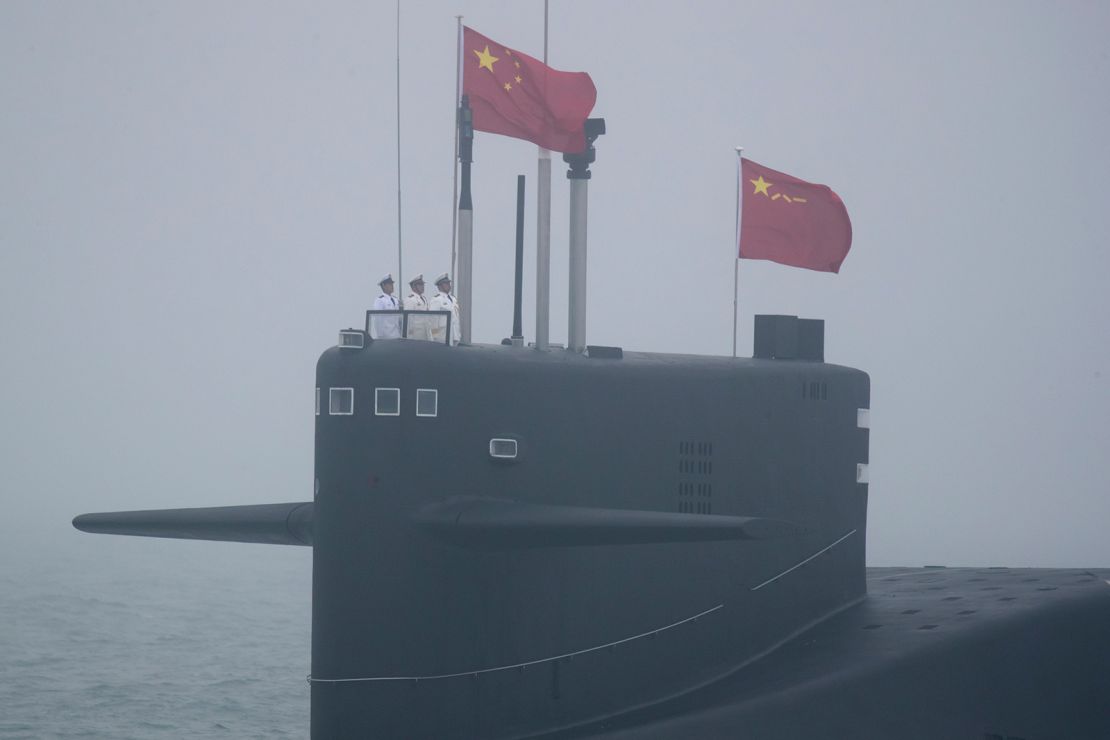
“The deployment of Arihant-class submarines will provide India some degree of parity with its Chinese counterparts,” he said, adding that more submarine investment is coming, $31.6 billion over the next decade.
Bigger subs and longer-range missiles are reportedly under development, which could eventually see India field nuclear-tipped weapons with a range of 12,000 kilometers (almost 7,500 miles), Venkatesh said.
It’s not just China that India is looking at with its sub development, according to Abhijit Singh, a senior fellow at the Observer Research Foundation in Mumbai.
“The real impetus for India’s expansion of its second-strike capability is, in fact, the significant growth of the Pakistani and Chinese navies in the Indian Ocean,” Singh wrote in an op-ed for the Hindustan Times, adding that Islamabad is in the process of acquiring eight Chinese-designed Type 039B attack submarines as it modernizes its fleet.
“Pakistan continues to narrow the sea-power differential with India,” Singh wrote.
India and Pakistan have long been at odds in the disputed and heavily militarized region of Kashmir, which both countries claim in its entirety. A de facto border called the Line of Control divides it between New Delhi and Islamabad. The dispute has led to three wars between the two nations.
China remains one of Pakistan’s most important international backers and a major investor in the country.
Korda, the Federation of American Scientists expert, says it’s not the subs themselves that give him cause for worry, but the multiple-warhead missiles they carry.
That technology – known as Multiple Independently targetable Reentry Vehicles (MIRV) – also applies to land-based missiles and can be destabilizing, Korda argues.
“India, Pakistan, and China are all developing missiles that can carry multiple warheads,” he says.
India announced to great fanfare in April that it had joined the MIRV club, which includes the US, UK, France, Russia and China, with a successful test of the domestically developed Agni-V intercontinental ballistic missile.
Pakistan has also claimed to have MIRV technology, but experts say the claim is unverified.
Adversaries need to assume such claims are true, lest they be caught unprepared in the event of actual conflict.
“These systems are ideal first-strike weapons, but they are also the first weapons that would likely be targeted in an opposing first strike,” Korda says.
“As a result, their deployment across the region will likely kick the collective arms race into a higher gear, as countries seek to build missile defenses and conventional strike options that can counter them.”