Look, I need to make it clear that I never intended to become the kind of person so attached to their phone that I’d end up walking into a tree. Or a lamp post. Or a bollard. But it’s pointless to deny the truth.
Admittedly, it was dark (and I was drunk) when the tree thing happened. It’s little consolation. The fact remains that I strolled right into a whacking great trunk while glued to my screen; I’ve still got the scars to prove it. The bollard one was even more humiliating – I ended up hitting it vulva-first in broad daylight while pawing furiously at WhatsApp. As for the lamp post… well, the less said about that, the better.
Accidents aside, I’ve become increasingly anxious about the steady creep of phone addiction over the past 18 months. I often find myself scrolling without remembering when or why I started, suddenly “coming to” out of a fugue-like state with a fuzzy, cotton-wool head. A cosy night in watching a film is inevitably marred by my fractured attention span – I’ll spend half of it transfixed by the smaller screen clutched in my hand instead.
I’m not alone. Average mobile phone use over the past decade has leapt from one hour and 17 minutes a day to three hours and 21 minutes, according to research from the Institute of Practitioners in Advertising (IPA); the daily average for looking at all types of screen (mobiles, laptops, tablets, games consoles and TV) is now almost 7.5 hours.
It wouldn’t be such a big deal if we were happy about this state of affairs, but most of us categorically are not. Increased screen time has gone hand in hand with rising global depression rates over the past 20 years, while research has shown a correlation between problematic smartphone use and anxiety, depression, stress and decreased wellbeing.
A survey by youth charity OnSide conducted last year found that, of the quarter of 11- to 18-year-olds who spent the majority of their free time outside school online, more than half (52 per cent) wanted to break their addiction and reduce their screen time. The majority just didn’t know how.
Meanwhile, the popularity of so-called “dumb phones”, officially known as feature phones – stripped-back devices that you can use for texting and calling but not much else, like the old Nokia “brick” phones I cut my teenage teeth on back in the Noughties – has soared. According to consultancy CCS Insight, UK sales of these devices rose from 400,000 in 2023 to 450,000 last year, reports Reuters, while sales in western Europe climbed by 4 per cent the same year, totalling 215 million units.

Having tried to use one myself for a week, I found that they’re simply not practical for most adults. The modern world requires smartphones at every turn, from essential authenticator apps to enable secure home working to the storing of digital train tickets and rail cards. I found myself forced to keep “cheating” by using my smartphone, which seemed to somewhat defeat the purpose.
This time around, I decided to trial a whole host of hacks in a quest to slash my existing mobile usage – some employing tech, some deferring to analogue alternatives – to see whether I could develop healthier habits and free myself from spiralling addiction. Here’s what worked (and what didn’t).
Measure your addiction
Measurement is key to reduction. Think about it: how can you possibly cut down on your screen time if you don’t know what it was to begin with? The first and most obvious step, therefore, is to check where you’re currently at before tracking your progress.
It’s easier than you might think – the location might be labelled differently depending on the model and make of smartphone, but there will be a section that allows access to some of your usage data. On my Samsung phone, for example, this information lives in “Settings” under “Digital wellbeing and parental controls”. It includes a weekly report about my average screentime and breakdowns of my most-used apps. At my first check, I averaged 2h 40m a day – less than the UK average, but far more than I’d thought possible, considering I already spend eight hours a day at a screen when working.
You can also set yourself a daily target here. I put mine at 1h 30m, which turned out to be wildly optimistic – but shoot for the moon, land among the stars and all that.
Impose limits
In the same digital wellbeing area, you may be able to set yourself time limits for specific apps. Once the allotted time is up, you can’t use that app any more unless you manually add extra minutes. I decided to set restrictions for WhatsApp and Instagram, the two that commandeer the majority of my time.

Of course, the trouble is that it’s incredibly easy to add more time – a matter of a few taps – something I repeatedly ended up doing for WhatsApp because otherwise you can’t receive new messages. (The notion of simply not receiving them until the next day proved too stressful for someone used to being permanently contactable.) But I do find the timer element somewhat helpful in that it puts the kibosh on my incessant Insta scrolling – and even when I do add time on WhatsApp, I’m aware it’s technically “borrowed”. I try to be more efficient with my correspondence, getting in and out like a ninja.
Keep notifications at bay
I’ve had my phone permanently set to silent mode – it doesn’t even vibrate – for the past five years to ensure I’m not constantly distracted by the “ding!” of endless messages and notifications. The only tangible downside is when you misplace your device and realise it can’t be located by simply calling it.
I also started flipping my phone face-down, obscuring the screen, when out for dinner with friends – a symbol that I was present and spending intentional time with them, with no wish to put the whims of the digital world ahead of the real one. (A better practice might have been to put it away altogether – but baby steps.)
This week, I tried implementing the screen-down technique elsewhere, particularly when working, to stop my eye from being drawn to the screen every time a new notification popped up. Although it works well enough when socialising, the temptation when alone is to just keep turning my phone over every five minutes with the justification that “I might have missed something”. For a true addict, this method sadly doesn’t touch the sides.
Buy a (non-smart) watch
This might sound laughably simple, but I’m convinced that, overall, it’s had the biggest impact. Previously, I would constantly turn to my phone to find out the time. Every time I did, I got sucked in. There would be a new email to read, a new DM to respond to, a new voicenote to listen to. Next thing you know, 20 minutes had been lost – and I still didn’t know what flipping time it was. This problematic smartphone habit was all but eradicated overnight for the price of a pre-loved Casio (£20 on Vinted, absolute bargain).

And speaking of analogue timekeeping, employing an actual alarm clock instead of relying on your phone is a cheap and easy way of ensuring that staring at social media in horror as you contemplate the twisted, broken state of the world isn’tthe very first thing you do upon waking.
Make it black and white
The bright and jazzy colours on your phone screen are no accident; they’re very much there by design, optimised to set your brain’s pleasure centres alight.
One of the most effective remedies, therefore, is to rob your screen of its seductive technicolour and swap rainbow for greyscale. One 2023 study found that this simple technique reduced participants’ daily screen time by 20 minutes at a stroke.
The effect is instantaneous and arresting – like stepping from Oz into Kansas
The process is not always particularly intuitive and will be different depending on the device’s precise make and model – google your specific phone to find out how to implement it. On my Samsung, for example, I went to Settings, Accessibility, Visibility Enhancements, Colour Correction, then selected Greyscale and toggled it to “On”.
The effect is instantaneous and arresting – like stepping from Oz into Kansas – and your phone immediately feels at least half as enticing, conjuring up drizzly Sunday afternoons spent watching black and white telly at an elderly relative’s house (I may be showing my age here).
As it’s slightly annoying to have to go through this multi-step journey in reverse every time you want to look at a photo, for example – and then far too tempting not to switch back to greyscale – another top tip is to create a shortcut so that you can easily switch between the two modes at the touch of a button. This might sound unnecessarily lazy, but my main finding from all of this is that we are lazy. The easier you can make it not to use your phone, the better.
Leave it elsewhere
Clearly, the most surefire way to use your phone less is to be without it more: you can hardly use it if it’s not there.
In fact, research has shown that the proximity of a device has a huge impact, not just on our usage but on our ability to perform other tasks. One study ran experiments in which participants had to complete cognitive tests. They were split into three groups: one had to leave their phones in their bags in another room; one could hang onto them but had to keep them out of sight; and the third were told to have them visible on the desk without succumbing to using or checking them. The group whose phones were in another room outperformed everyone else, while those who could see their phones fared far worse. The study authors concluded that “the mere presence of these devices reduces available cognitive capacity”.
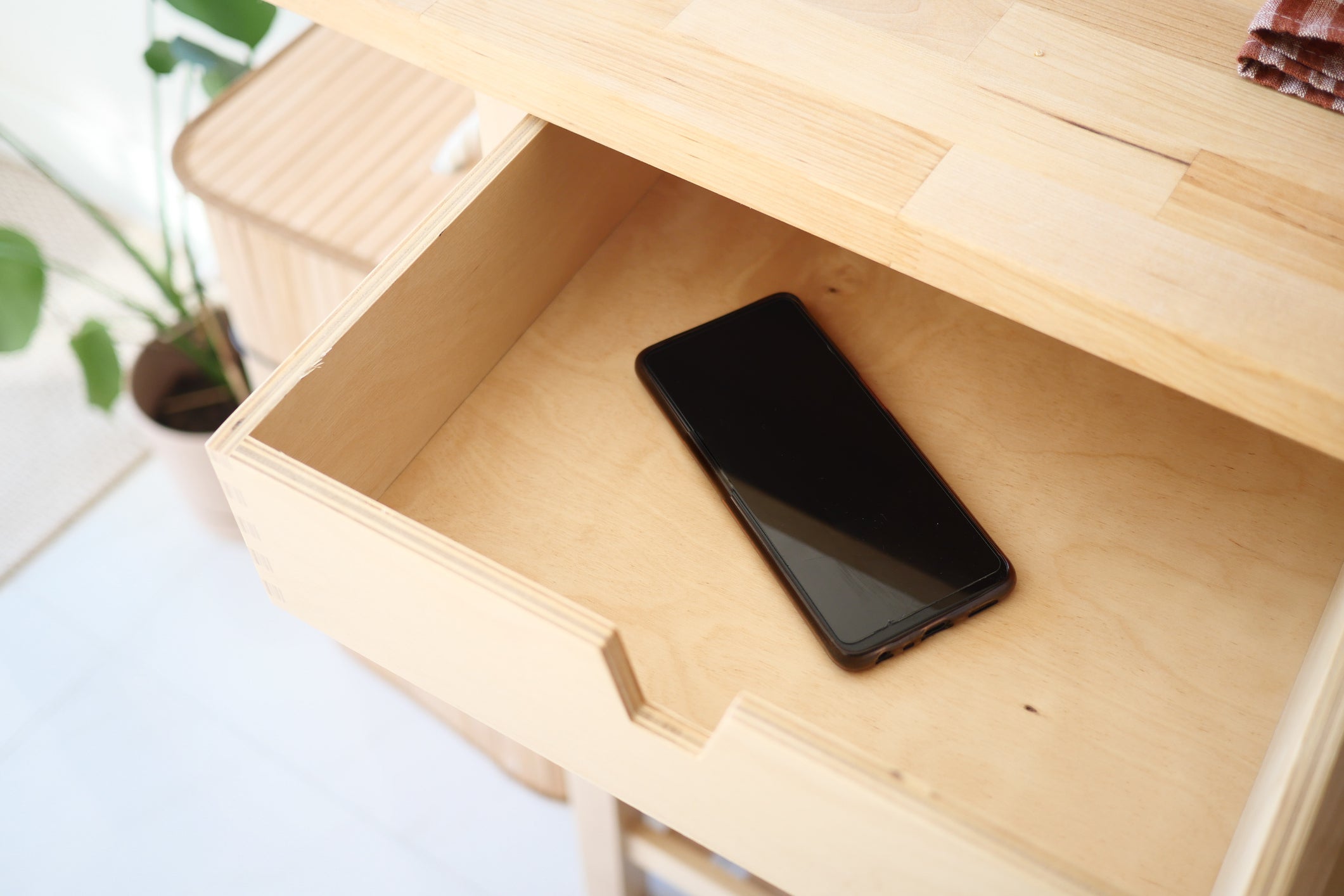
Leaving my phone in another room for a set period of time – for a couple of hours, for example, while I actually watched a film instead of falling prey to the weird, unfulfilling split-screen business – made me feel more relaxed and able to concentrate. Out of sight, out of mind, is the literal name of the game.
The next step is to sometimes leave my device at home when I go out, especially if it’s a low-key excursion like nipping to the shops. But the fear that I might suddenly need my phone in an emergency – or, conversely, that someone else might have an emergency and need me – is still alarmingly deep-rooted.
‘Boringify’ your phone
It may sound counterintuitive to suggest downloading more apps to help you spend less time on your phone – but this one’s a winner, I promise. There is a whole range of “minimalist launchers” whose sole purpose is to make your phone’s interface more boring. I go for a free one called Olauncher: it instantly swaps out all my jaunty app icons for a joyless list of their names. It’s incredible how much less tempting TikTok, Hinge and the like are when displayed as stark text; even the font, a charmless sans serif number, is something of a turn-off.
The results
After combining these techniques for a week, I find that my average screentime has dropped by 22 minutes a day to 2h 18m. More gratifyingly, on three days I manage to get it down to under 1h 50m, with my lowest recorded daily use at 1h 40m – 10 minutes off my target. The previous week, my heaviest use day saw me spend a truly horrifying five hours attached to my device; this week, my max has been 3h 15m, mostly the consequence of watching Netflix while stuck at the station awaiting a chronically delayed train.
Now that I’ve started, the competitive part of me feels driven to continue paring back my screen time until I hit the absolute minimum necessary to live in the modern world. In the meantime, every second of my attention I manage to claw back from my phone – and every bollard I manage to avoid walking into along the way – feels like its own small but glorious victory.