By Grace Huang, President, Cox Automotive Inventory Solutions
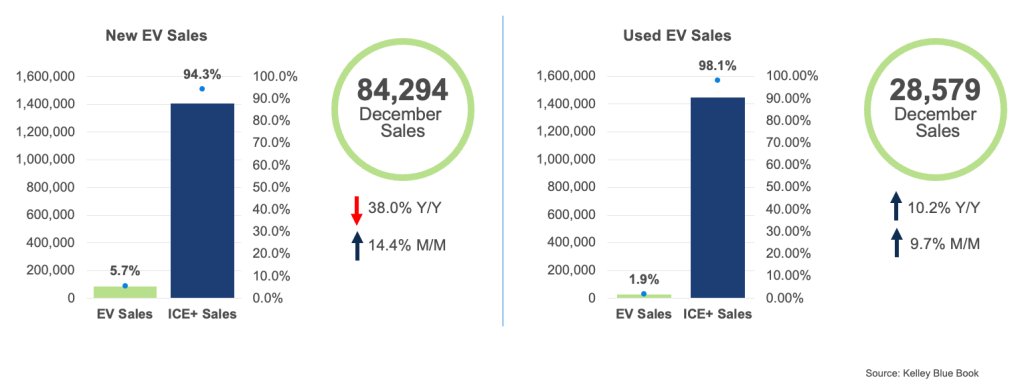
If you read recent media headlines, you may think the EV market is slipping into decline. Stories about softening demand, disappearing government-backed incentives and price volatility have fueled the perception that electric vehicles are losing momentum. If you read recent media headlines, you may think the EV market is slipping into decline. Stories about softening demand, disappearing government-backed incentives and price volatility have fueled the perception that electric vehicles are losing momentum. But as our team showcased during the Manheim Used Vehicle Value Index call in early January, inside the wholesale ecosystem, and especially throughout the Manheim marketplace, the story looks very different.
What may look like cooling for new vehicle sales is actually a reset for the used market, setting the stage for the largest wave of used EVs the industry has ever experienced. The real EV shift hasn’t peaked. It’s just beginning. And Manheim is already prepared for what comes next.
A Coming Supply Surge
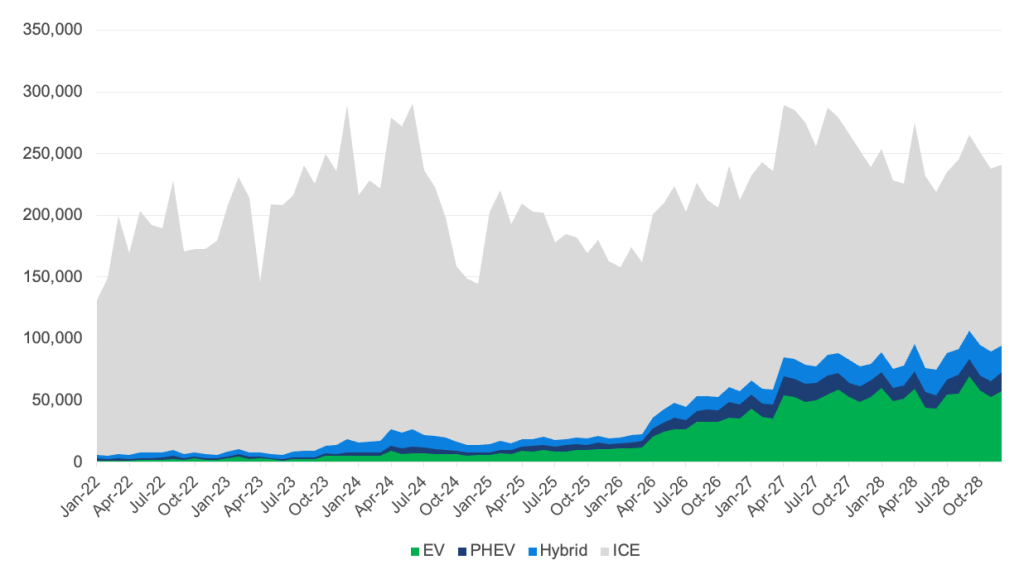
The data signals are unmistakable. EVs accounted for roughly 5% of lease maturities in 2025, but that number is expected to more than double in 2026 (12%) and could reach around 23% by 2028. Every one of those off-lease vehicles feeds directly into the used and wholesale markets, and because EV leasing surged while incentives were rich, a wave of returns will ripple through wholesale channels for years.
Even today, before this upswing begins in full, wholesale EV volume at Manheim grew 47% year over year in Q4 2025.
Estimated Lease Maturities Distribution
A Decade of Preparation
Absorbing this kind of supply shift isn’t something a marketplace can improvise; it requires years of foundational investment. That’s why Manheim has been building for this moment for more than a decade.
- ~800 EV chargers across Manheim locations keep units safely charged and staged at scale.
- 45 Manheim locations earned EV Certification in 2025, the first standardized EV readiness program in the industry.
- ~550 technicians trained on EV-specific curriculum, ensuring safety, consistency and expert handling.
This readiness is also informed by real-world experience. Manheim has already seen what EV‑heavy operations look like in the UK, where Manheim operates 11 locations, and in Southern California, where EVs routinely make up 15-20% of on‑ground inventory. Those early experiences revealed exactly what EV‑first operations demand: new handling protocols, expanded charging capacity and a fundamentally different workflow. The best practices established in those markets are now being deployed across our entire Manheim footprint, including dedicating EV‑only areas at select sites.
Battery Transparency Will Define the Used EV Market
Battery health information will arguably become the most important currency in the used EV ecosystem, and this is another area where Manheim invested early. Buyers and sellers consistently identify battery uncertainty as the No. 1 barrier to adopting EVs on the secondary market. To close that confidence gap, Manheim has delivered more than 70,000 VIN-specific battery health scores that provide details drawn directly from the vehicles’ own systems. Instead of relying on age and mileage assumptions, wholesale buyers and sellers now have access to precise battery condition data that informs valuation, reconditioning decisions and long-term risk. As depreciation patterns stabilize and the EV index finds its footing, this level of clarity becomes indispensable.
Prepared for the Market That’s Coming
So, while the headlines may focus on cooling, the wholesale market tells a different story. The next phase of EV growth will be defined by the companies prepared to process, evaluate, price and move EVs at scale. Manheim is ready for that future and the surge ahead won’t catch us by surprise. It’s exactly what we’ve been preparing for.