The Dragon’s Total Eclipse: How China Seized 70% of the EV Market and the Desperate, Last-Minute Moves Left for Detroit to Avoid Permanent Irrelevance

Follow us today…

Facebook icon
 

X icon
 

Telegram icon
 

Reddit icon

The global automotive landscape has reached its “Rubicon” moment. For decades, the industry operated under the assumption that Western engineering and Japanese efficiency would forever dictate the terms of global mobility. That era officially ended this week. The International Energy Agency (IEA) released its definitive 2026 report, confirming a statistic that has sent shockwaves through boardrooms from Dearborn to Wolfsburg: China now produces 70% of all electric vehicles sold globally.

This is no longer a “emerging trend” or a “competitive threat.” It is a fundamental restructuring of the world’s largest manufacturing sector. The IEA data shows that the Chinese industrial machine has transitioned from a fast-follower to a global hegemon, leaving Western legacy automakers in a defensive crouch, shielded only by thinning layers of protective tariffs and brand nostalgia.

The 70% Reality: More Than Just Subsidies

The IEA’s confirmation that China has reached a 70% share of global EV production is the result of a twenty-year master plan. While the West debated the viability of hydrogen and the longevity of the internal combustion engine, Beijing secured the entire “dirt-to-dashboard” pipeline.
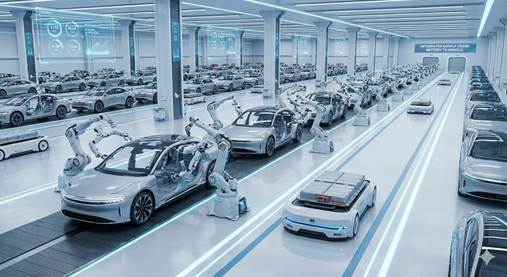
By controlling the refining of 80% of the world’s battery minerals and 60% of battery component manufacturing, China created a cost advantage that is now insurmountable through traditional means. Companies like BYD and Xiaomi are not just benefitting from state support; they are benefiting from an integrated vertical supply chain that allows them to iterate three times faster than Ford or Volkswagen. In early 2026, we are seeing Chinese brands launch new models every 12 to 18 months, while Western “Gen 3” platforms are still mired in four-year development cycles.

What Western Carmakers Must Do to Survive

To prevent being entirely forced out of the market, Western manufacturers cannot rely on the 100% tariffs currently imposed by the U.S. or the steep price floors set by the EU. Protectionism is a bridge, not a destination. To survive the next decade, Detroit and Europe must execute three radical shifts:

1. Abandoning the “Legacy Premium” Strategy For too long, Western makers have treated EVs as luxury items with high price tags to protect their ICE margins. They must now embrace “Cost Radicalization.” This means adopting Lithium Iron Phosphate (LFP) chemistry—a space China currently dominates—and redesigning vehicles for extreme manufacturing simplicity. If they cannot produce a $25,000 EV that is profitable, they will lose the middle class entirely.

2. Software-Defined Everything The current battleground isn’t horsepower; it’s the Software-Defined Vehicle (SDV). Chinese EVs are increasingly viewed as mobile living spaces with seamless digital ecosystems. Western makers are still struggling with buggy infotainment and fractured over-the-air (OTA) update capabilities. They must stop being “car companies that use software” and become “software companies that build cars.”

3. Supply Chain Sovereignity The West must decouple its battery reliance from China. This requires massive investment in solid-state battery technology and domestic mineral processing. Without a non-Chinese supply chain, Western makers are essentially just “white-labeling” Chinese innovation.

Will the West Actually Make These Changes?

The likelihood of a successful Western pivot is, frankly, a coin toss. While companies like Stellantis have begun aggressive cost-cutting measures and BMW is betting heavily on its Neue Klasse architecture, the cultural inertia of legacy auto is a powerful anchor.

Western carmakers are currently caught in a “Death Loop”: they need ICE profits to fund the EV transition, but as EV prices drop due to Chinese volume, the resale value of ICE cars is plummeting, eroding the very capital needed for the shift. Furthermore, the labor costs in the U.S. and Europe, while socially vital, make it nearly impossible to compete on price with a Chinese workforce that is increasingly automated and vertically integrated. We are likely to see a “Great Consolidation,” where only two or three major Western brands survive as high-volume players, while the rest pivot to niche luxury or vanish entirely.
The Timeline: When Does China “Own” the World?

If the IEA’s 70% production figure is the milestone for 2026, the timeline for total market ownership is shorter than most analysts predicted. “Owning” the market doesn’t mean every car is a Chinese brand; it means China dictates the price, the technology standards, and the supply chain for the entire industry.

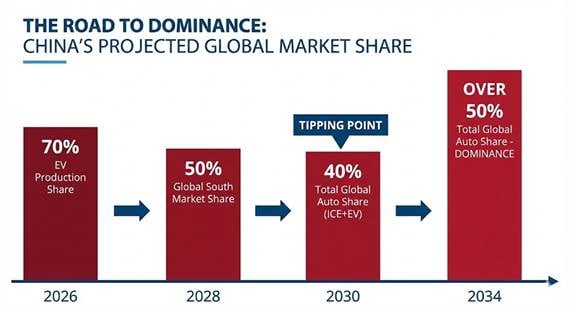
  • 2027-2029: The Global South Pivot. While the U.S. and EU use tariffs to block Chinese cars, China will capture 80% of the market in Southeast Asia, Latin America, and Africa. By 2028, Chinese brands will likely account for 50% of all new car sales in these high-growth regions.
  • 2030: The Tipping Point. By 2030, as global EV adoption is expected to hit 45-50%, China’s manufacturing lead will translate to a 40% share of the total global automotive market (ICE and EV combined).
  • 2034: Total Dominance. Within the next eight years, if Western innovation does not leapfrog current battery tech, China will effectively “own” the world automotive market. At this point, even Western cars will likely be built on Chinese platforms or powered by Chinese “Black Box” software and batteries.

The Ecosystem Gap

The most significant advantage China holds in 2026 isn’t the battery; it’s the ecosystem. As Xiaomi targets 550,000 deliveries this year, they are proving that a smartphone manufacturer can build a better “smart car” than a traditional automaker.
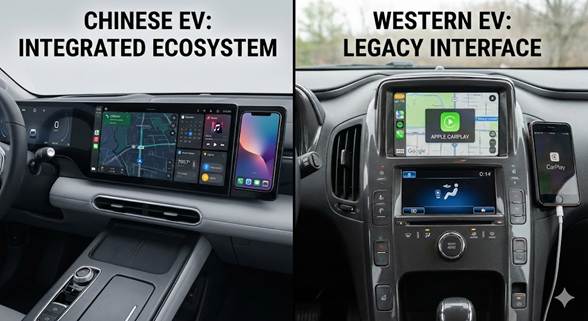
Their vehicles are fully integrated with the user’s home, office, and personal devices. In contrast, Western automakers are still fighting to keep Apple CarPlay and Android Auto as the primary interface because their own software suites are insufficient. This digital gap is the “silent killer” of the Western auto industry. Consumers under 30 prioritize digital integration over “driving dynamics,” a shift that plays directly into China’s hands.

Wrapping Up

The IEA report confirming China’s 70% production share is a final warning for the Western automotive establishment. The era of “business as usual” is dead. To avoid being marginalized, Western carmakers must stop relying on government protection and start out-innovating their Eastern rivals in software, battery chemistry, and manufacturing efficiency. The window for this transition is closing rapidly. If Detroit and Stuttgart cannot bridge the “value gap” by 2030, the global automotive crown will not just be shared with China—it will be permanently surrendered.

Disclosure: Images rendered by Artlist.io

Rob Enderle is a technology analyst at Torque News who covers automotive technology and battery developments. You can learn more about Rob on Wikipedia and follow his articles on ForbesX, and LinkedIn.

Follow us today…

Facebook icon
 

X icon
 

Telegram icon
 

Reddit icon

Source link

Visited 1 times, 1 visit(s) today

Related Article

Nvidia’s trillion-dollar run puts pressure on the bulls

BEIJING, CHINA – MAY 14: Nvidia CEO Jensen Huang (C) gestures as he prepares to depart following a welcome ceremony at the Great Hall of the People on May 14, 2026 in Beijing, China. President Trump is meeting with President Xi Jinping in Beijing to address the Iran conflict, trade imbalances, and the Taiwan situation

Permutations in Europe: What’s still at stake in final weeks of season?

There’s still plenty to play for across Europe as we head into the final matches of the club season. Here are all the title races, Champions League fights, and relegation battles left to be decided in the top leagues this month. This story will be updated until the end of the campaign. 👉 Jump to:EPL

Brewing a Better Half-Gallon Batch

Today I finally ran an experiment I’ve wanted to try for a long time. If you’re a professional barista—or you run a busy café—this may save you some time. Most coffee shops use 1–1.5 gallon batch brewers (Bunn, Curtis, Fetco, etc.). When I opened Short Sleeves Coffee, I intentionally avoided brewing full 1-gallon batches. I

5 Frozen Breakfasts Chefs Say Keep You Full All Morning

Chef-approved frozen breakfasts with more protein and better ingredients. Eating a healthy breakfast every morning is a great way to start the day, but most people don’t have time to cook. Whether you’re rushing out the door in the morning for work, taking the kids to school or both, there’s usually not much time in

CA scales back plan to ban student use of cell phones

By Carolyn Jones, CalMatters This story was originally published by CalMatters. Sign up for their newsletters. Until last month, California was poised to join nearly a dozen other states that ban cell phones in K-12 schools. But under pressure from school boards and administrators, lawmakers scaled back a bill that would have required such a

BulkQuant Launches AI Trading Bot for Crypto, Forex, and Stock Markets

BulkQuant Launches AI Trading Bot for Crypto, Forex, and Stock Markets

London, United Kingdom, May 15, 2026 (GLOBE NEWSWIRE) — BulkQuant has officially launched its AI trading bot platform designed for crypto, forex, and stock market traders seeking a simpler way to automate trading strategies across multiple financial markets. The platform combines AI-powered quantitative analysis, automated trade execution, portfolio monitoring, and adaptive risk management into a

IMF lauds resilient Hong Kong economy but warns of risks linked to Middle East war

IMF lauds resilient Hong Kong economy but warns of risks linked to Middle East war

The International Monetary Fund (IMF) has lauded the resilience of Hong Kong’s economy, noting a sustained recovery despite economic activity having yet to return to pre-Covid levels, while warning of downside risks stemming from escalating geopolitical tensions. It also urged Hong Kong to pursue medium-term financial reforms, including the introduction of a goods and services

Smithsonian Presidents Exhibit Reopens With Low-Key Trump Impeachment Mention

For the past year, the Smithsonian Institution has found itself in the awkward position of telling the nation’s story while being supported in part by a government that wants to narrow how that story is told. In December, the White House threatened to revoke funding to the institution if it did not hand over a

Marvel’s Daredevil Follow-up Is Already Dominating on Streaming

A follow-up to Daredevil: Born Again Season 2 on Disney+ has become a massive streaming success within days of its launch. The Punisher: One Last Kill has quickly climbed to the top of multiple charts, beating out other titles on the platform. The MCU television special follows the gun-toting vigilante, who finds himself targeted by

Is Now a Bad Time to Invest?

The market has been on a roll lately, with the S&P 500 (SNPINDEX: ^GSPC) setting new highs throughout May. If you think you missed your opportunity when the market bottomed in late March, don’t fret. The market hitting new all-time highs is not particularly rare and should not change your investment strategy. And if you

6 bids for Hong Kong land sale signal renewed confidence despite market caution

6 bids for Hong Kong land sale signal renewed confidence despite market caution

The Hong Kong government’s first land sale in the current financial year has drawn six bids, according to the Development Bureau, including those from the city’s largest developers, suggesting a more confident outlook for the residential property market. At the close of tender for Tung Chung Town Lot No 54 at Area 106A on Friday

Each Premier League team reranked: Man City rise; Chelsea, Liverpool collapse

Ryan O’Hanlon Close Ryan O’Hanlon ESPN.com writer Ryan O’Hanlon is a staff writer for ESPN.com. He’s also the author of “Net Gains: Inside the Beautiful Game’s Analytics Revolution.”  and  Bill Connelly Close Bill Connelly ESPN Staff Writer Bill Connelly is a writer for ESPN. He covers college football, soccer and tennis. He has been at

Trump departs China after two-day summit

Trump departs China after two-day summit

IE 11 is not supported. For an optimal experience visit our site on another browser. Trump Wraps China Summit With Xi Jinping: What Are the Results? 05:41 Xi gives Trump rare tour of secret garden at heart of Chinese government 01:04 Now Playing Trump departs China after two-day summit 01:01 UP NEXT Special Report: Trump

Carol Chow was facing a bankruptcy petition by five people over unspecified debts at the time of her death. Photo: Dickson Lee

Embattled Hong Kong developer sued for HK$130 million, days after founder’s death

A Hong Kong property developer has been sued for HK$130 million (US$16.6 million) over allegedly breaching guarantor obligations in two bond subscription agreements, becoming the latest lawsuit to implicate the embattled company and following its founder’s sudden death earlier this week. Lofter Group, known for its urban renewal projects across the city’s core districts, and

Trump’s China visit left chip export issue unresolved

This report is from this week’s The Tech Download newsletter. Like what you see? You can subscribe here. One look at the roster of U.S. execs that cozied up to U.S. President Donald Trump on the 20+ hours flight from Alaska to China on Wednesday and you get a sense of the American delegation’s key focus

Why the Cerebras IPO matters for the AI race with China

Why the Cerebras IPO matters for the AI race with China

Cerebras, an AI chipmaker, saw its shares nearly double on Nasdaq, closing up 70% with a $95B market cap. Cerebras’s powerful chips are key in the US-China AI tech race. Chris Buskirk, co-founder and chief investment officer of 1789 Capital, a key Cerebras investor, says the company’s IPO is geopolitically significant. On Thursday, shares of

Fitbit Air vs Whoop Strap Comparison: Price, Features and AI

The Google Fitbit Air is very much the talk of the fitness tracking town right now, not only because it’s the first new Fitbit device that we’ve had in years, but it’s also one of the first big brands to go head-to-head with the established Whoop Strap (if you don’t count the Polar Loop and

0
Would love your thoughts, please comment.x
()
x