[The content of this article has been produced by our advertising partner.]
AI-enabled solution providers and corporate gathered at Hong Kong Science Park on March 24 to examine real-world use cases of AI as it shifts from experimental pilots into connected, operational systems across multiple sectors.
The “Connected Intelligence: AI & Robotics Across Industries” event featured candid exchanges on workforce preparation, customer engagement and the challenges of scaling AI.
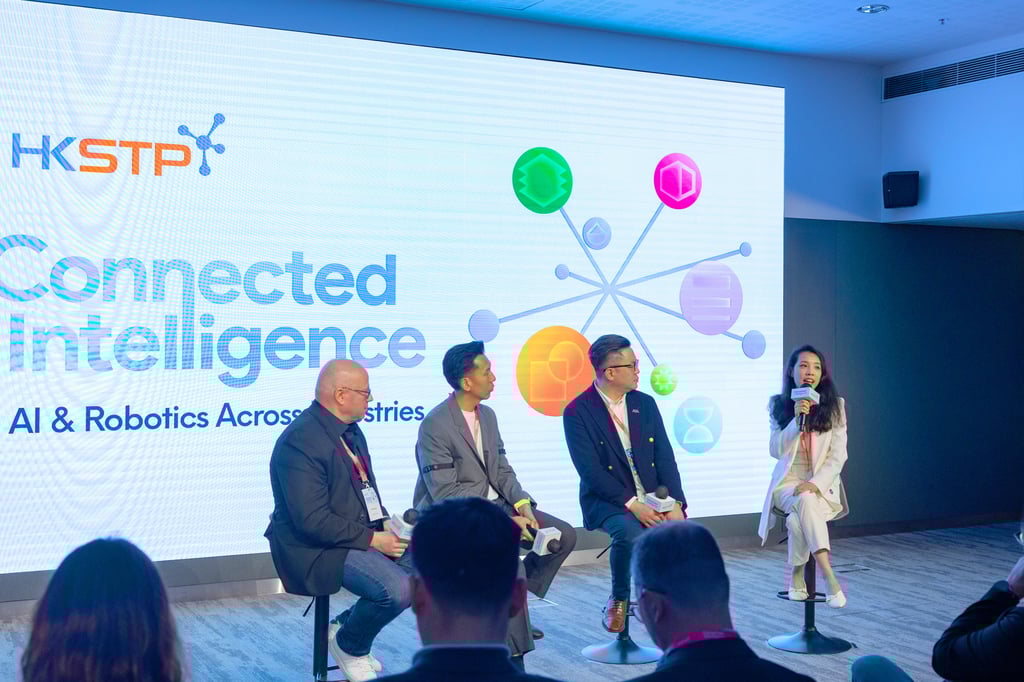
“Last year we delivered more than 77,000 hours of training, that’s equal to 24 hours per employee,” said Janice Sue Wong, Senior Vice President for AI and Innovation Strategy at Nan Fung Group, emphasizing the importance of AI upskill initiatives in the coming year.
Training has shifted towards role-specific applications, such as the use of AI image generation for real estate concept design and marketing. She said: “Colleagues, after walking out of the meeting, can already embrace AI as part of the role.”
Aldric Chau, General Manager of Digital at Cathay, cited several operational examples from the airline’s digital transformation work.
The in-house Customer360 AI model, as one of the examples, supplies frontline teams with passenger history and preferences so that staff can deliver more consistent service whether at the airport, on board, or via contact centres.
Chau also described a trial in which AI analyses weather and flight data to recommend optimal altitudes for pilots, therefore reducing vapour trails that contribute to global warming. The initiative has produced measurable carbon savings with no significant extra fuel cost.
In his remarks, Tim Leung, formerly Group Chief Technology Officer at Vistra and now serves on HKSTP’s Board of Directors, addressed the balance required between machine capability and human oversight.
“While AI excels at processing at scale, identifying patterns and generating options,” he said. “Judgment still firmly resides with humans, especially in high-stakes environments.”
Leung added that humans must still define the problem and the desired outcome, noting that “critical thinking becomes increasingly vital” as AI outputs grow faster yet remains non-deterministic. As such, he advocated for responsible AI to function as a design principle rather than solely as a compliance matter.
Two start-ups, supported by HKSTP, presented tangible solutions during the AI Discovery Corridor.
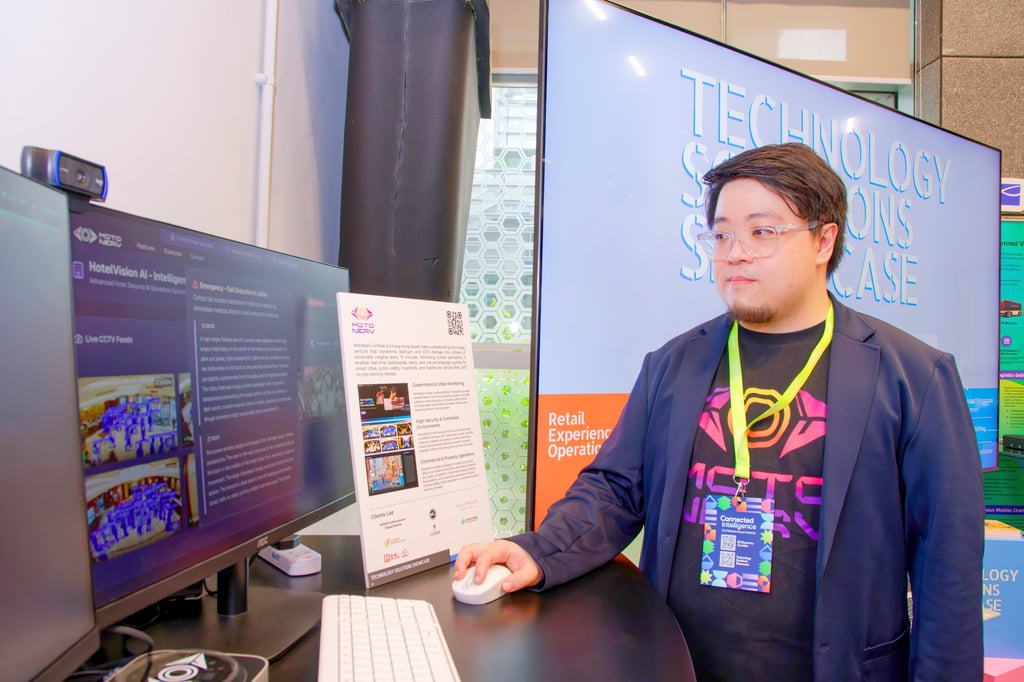
The system converts footage into structured text that users can query naturally. “Every camera is like having a person sitting there watching 24 hours,” he said.
The solution supports real-time alerts and automation, such as dispatching cleaning robots when spills occur, and has gained traction with law enforcement and facility management teams in Hong Kong.
MotoNerv, an HKSTP-incubated start-up co-founded by Forte Fung, specialises in video understanding AI that converts raw CCTV, dashcam, and surveillance footage into structured, searchable text descriptions since 2020.
The system enables natural language queries and real-time automation across security, facility management and smart-city applications.
“HKSTP has played a very important role in helping us build trust with our clients, especially in government. The backing of the Science Park gives our video AI solutions a lot more credibility,” said Fung.
Christina Cheng, Account Director at Omnichat, an AI Social Messaging CRM solution provider, also a graduate of the HKSTP Incubation Programme, detailed the company’s conversational commerce platform on WhatsApp.
The company’s platform delivers a suite of native AI agents that automate the full customer journey across WhatsApp, Facebook, Instagram, LINE and WeChat.
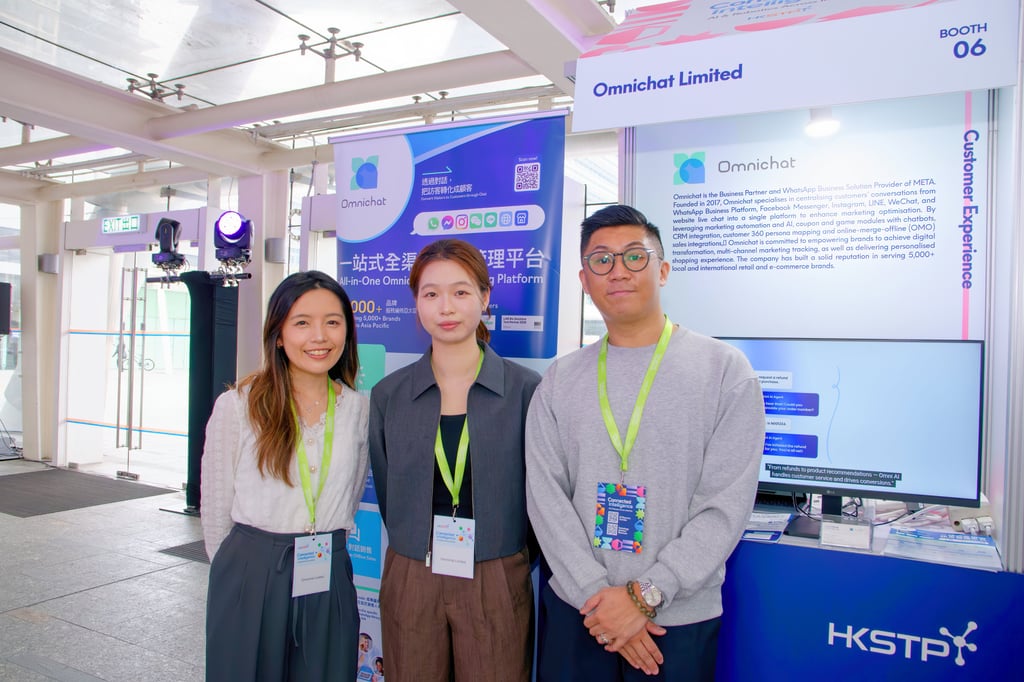
Omnichat, which has raised US$5mn in funding, operates as a Meta Business Partner, LINE Biz-Solutions Tech Partner and AWS Partner, according to the company.