Surging oil prices and a sharp decline in the U.S. stock market have led to an unusual retreat in U.S. Treasury yields! Market participants have offered a dual explanation for this anomaly. On one hand, investors are beginning to question whether the energy crisis will truly prompt the Federal Reserve to raise interest rates against expectations, with elevated yields attracting bargain-hunting buyers. On the other hand, the market focus has swiftly shifted from short-term inflation fears to deep concerns over long-term economic recession and downward growth pressures.
Amid a sustained rise in global crude oil prices due to ongoing geopolitical conflicts and consecutive declines in the U.S. stock market, U.S. Treasury yields unexpectedly retreated from recent highs on Friday, breaking their recent pattern of rising in tandem with oil prices and highlighting a shift in market pricing dynamics.
On Friday, as the ongoing conflict between the United States and Iran continued to escalate, the benchmark $Crude Oil Futures (MAY6) (CLmain.US)$ rose to a multi-year high of $101.24 per barrel, while the Nasdaq Composite Index fell into correction territory. However, the U.S., which is highly sensitive to the Federal Reserve’s monetary policy, $U.S. 2-Year Treasury Notes Yield (US2Y.BD)$ retreated to 3.90%, amid heightened sensitivity to the Federal Reserve’s monetary policy.

 This rare decoupling of asset movements indicates that financial markets may be approaching a critical inflection point. While investors briefly chased high-yield bonds within the year, their core focus is rapidly shifting from short-term inflation fears driven by surging energy prices to deeper concerns about long-term economic stagnation or even recession.
As verbal interventions to curb oil prices gradually lose effectiveness and pressures from U.S. fiscal debt issuance emerge, Wall Street is being forced to reassess the valuation framework for risk assets and the potential downside risks to the macroeconomic outlook amid rising energy costs.
U.S. Treasury Yield Divergence: Growth Concerns Override Inflation Fears
Market trend charts show that asset prices have recently exhibited a typical联动 pattern of ‘high oil prices, low stock markets, and high yields,’ but on Friday, U.S. Treasury yields significantly deviated from this trajectory. The charts clearly reflect that while oil prices continued to rise and U.S. equities were sold off, Treasury yields did not climb as usual but instead saw a notable retreat, completing a clear logical decoupling.

In response to this unusual phenomenon, the market has offered a dual explanation. According to Bloomberg analysis, on one hand, after yields climbed to their highest levels since mid-2025, the elevated yields themselves attracted substantial buying interest, leading investors to question whether an energy crisis would truly prompt the Federal Reserve to raise interest rates against the tide.
On the other hand, the deeper reason lies in the deterioration of expectations regarding economic fundamentals. According to Bloomberg, Ian Lyngen, Head of U.S. Rates Strategy at BMO Capital Markets, stated: ‘The front end of the Treasury yield curve no longer tracks energy prices as an inflation risk but is more focused on downside risks to economic growth and risk assets.’
ZeroHedge also pointed out that investors are shifting from concerns over short-term inflation to fears of long-term economic recession and persistent supply chain disruptions.
Oil Prices Defy Verbal Interventions; Supply Crisis Worsens
The robust performance of the crude oil market has been the core driver of recent asset volatility. Although President Trump briefly extended the pause on attacks, causing a temporary pullback in the oil market, the further escalation of the Middle East conflict into its fifth week ultimately pushed oil prices higher.
According to ZeroHedge analysis, the substantive impact on the oil market is evolving from flow disruptions to inventory depletion. Market liquidity is deteriorating, with investors no longer pricing in the resolution of short-term conflicts but instead factoring in the escalation of tensions and tightening supply. Goldman Sachs traders emphasized the limitations of verbal intervention, pointing out that ‘you cannot verbally intervene with molecules.’
The shock to oil prices has triggered concerns about stagflation. John Briggs, Head of U.S. Rates Strategy at Natixis, noted that as long as the Strait of Hormuz remains closed, investors will be concerned about medium-term inflation and the possibility of central banks repeating aggressive tightening measures akin to those in 2022.
U.S. stocks came under pressure, with the Nasdaq officially entering a correction phase.
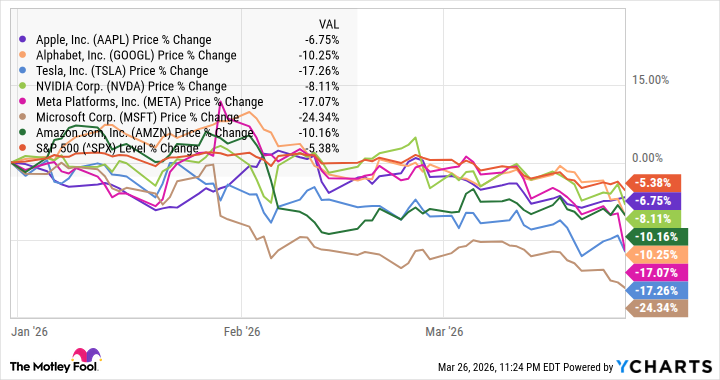
High energy costs and ongoing macroeconomic uncertainty have dealt a heavy blow to risk assets. $Nasdaq Composite Index (.IXIC.US)$ fell more than 3% this week, officially entering a correction zone with a 10% drop from its historical peak, while $S&P 500 Index (.SPX.US)$ recorded its fifth consecutive weekly decline, marking the longest losing streak since May 2022.

Technology stocks became the epicenter of the sell-off. According to Nathaniel Welnhofer, a strategist at Bloomberg Intelligence, the recent pullback in tech stocks reduced the Nasdaq’s forward price-to-earnings ratio premium relative to the S&P 500 to just 4.4%, the lowest level since January 2019, far below the 35.7% premium seen in October last year.
The structure of the options market has also exacerbated stock market fragility. ZeroHedge pointed out that as implied volatility rises, the market is in a negative gamma state, where heightened volatility triggers additional passive hedging selling, amplifying the downward movement of indices.
Bond issuance pressures are emerging, leaving the market facing a dual squeeze.
In addition to downside economic risks, the U.S. Treasury market is also facing real supply-side pressures. According to Bloomberg, Andrew Hollenhorst, an economist at Citi, highlighted that the prospect of increased U.S. government borrowing to cover war costs and refinance debt amid higher interest rates is exerting upward pressure on Treasury yields. This week’s Treasury auctions cleared at yields higher than expected, underscoring the severity of fiscal challenges amid rising interest rates.
Meanwhile, market expectations regarding monetary policy have undergone significant fluctuations. Molly Brooks, a rates strategist at TD Securities, stated, “The market has made a complete U-turn; participants have shifted from asking when the next rate cut will occur to pricing in future rate hikes.”
Against this backdrop, investors are forced to strike a balance between high inflation and weak growth. As summarized by Tony Pasquariello, an analyst at Goldman Sachs, the longer the geopolitical conflict drags on, the more vulnerable the market becomes to genuine growth panic.
Editor/KOKO