A US Trader’s Guide to the Supreme Court’s Looming Tariff Ruling
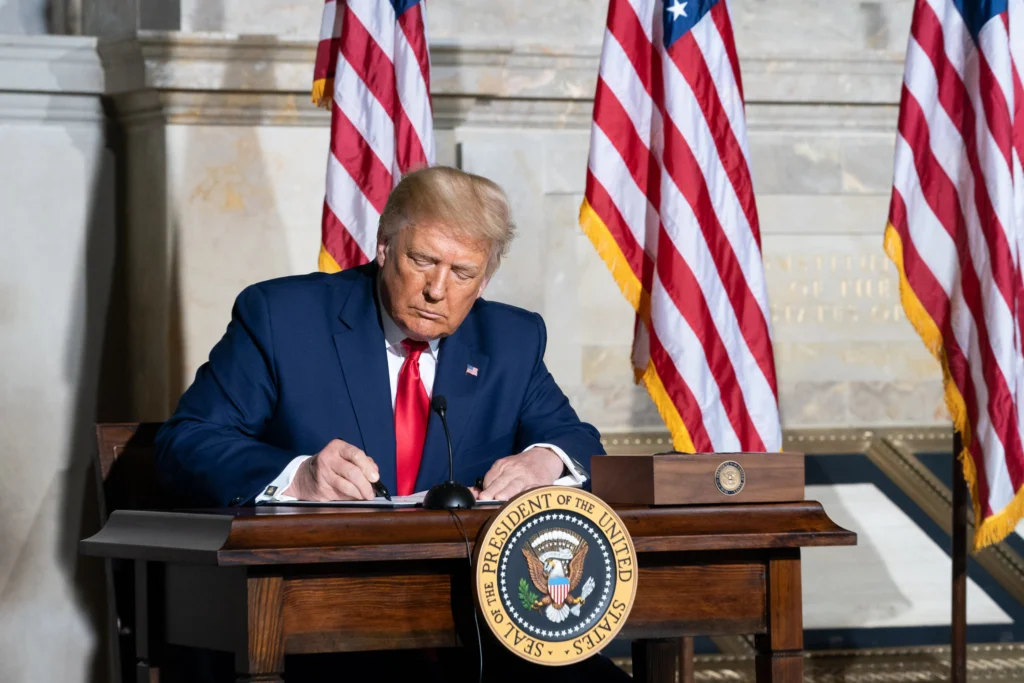
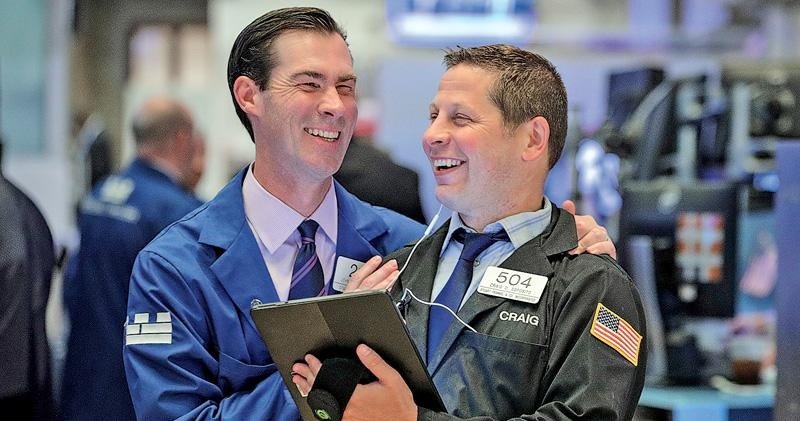
Photographer: Allison Robbert/Bloomberg
(Bloomberg) — An upcoming Supreme Court ruling on the legality of the sweeping tariffs that President Donald Trump rolled out in April, briefly sending shockwaves through markets, looms as one of the next big tests for US stocks and bonds.
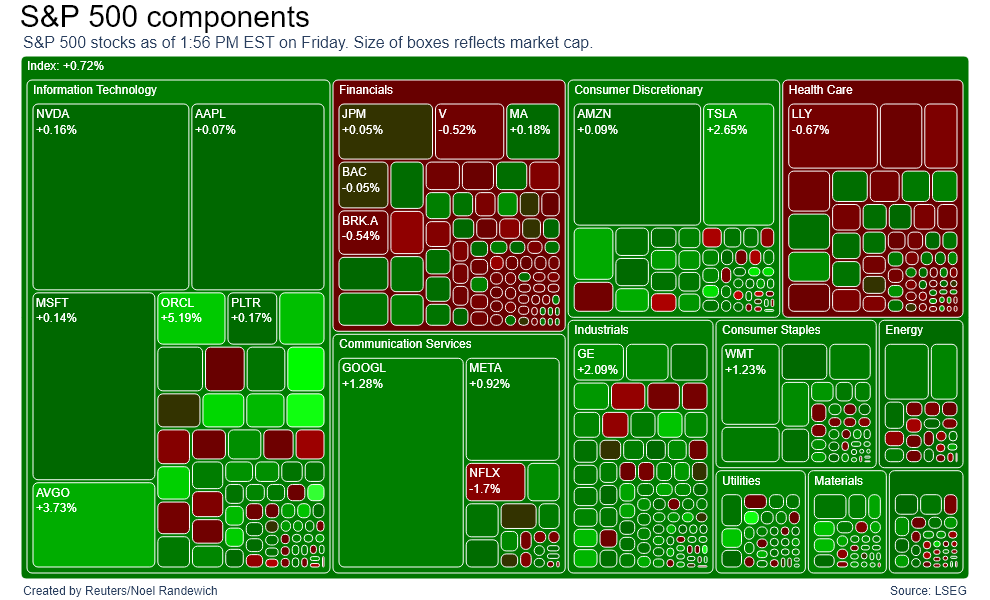
The equity market has extended its rise into the new year, with the S&P 500 Index hovering near a record. The advance, which has left the benchmark about 40% above its April lows, has been fanned by the artificial-intelligence boom and Trump’s decision to dial back some of his most draconian tariffs. Treasury yields have also come down from their mid-2025 peaks as traders bet the Federal Reserve will keep cutting rates while the economy cools.
Most Read from Bloomberg
If the nation’s top court says Trump exceeded his power with the blanket tariffs on countries around the globe, there will still be significant longer-term uncertainty, given that the White House could seek to re-impose similar levies by invoking different legal authority.
But analysts and investors say the immediate market reaction appears somewhat more predictable. A ruling striking down the tariffs would likely give a boost to stocks by promising to improve profit margins and remove a burden on consumers. At the same time, Treasuries may come under pressure as that potential stimulus complicates the outlook for the Fed’s rate-cut path and threatens to worsen the government’s budget deficit.
Wall Street may get an answer as soon as this week. The court has scheduled Friday as an opinion day, indicating that it will be the first chance for a ruling.
Tailwind for Stocks
Overall, a ruling against the tariffs would boost the earnings of companies in the S&P 500, before interest and taxes, by 2.4% in 2026 over last year’s levels, Wells Fargo & Co. Chief Equity Strategist Ohsung Kwon previously estimated. That would likely drive investors to push up prices to reflect higher profits if the Supreme Court rules against Trump. James St. Aubin, chief investment officer at Ocean Park Asset Management, said that would be “a catalyst for a little bit of a rally.”
Some stocks stand to benefit more than others. The tariffs have been particularly painful for businesses that are heavily dependent on imported goods, such as companies that cater to the US consumer. Financial firms like banks are seen likely to benefit from a more confident or flush consumer as well.
On Thursday, the S&P 500 Consumer Staples Index jumped as much as 2.3%, the biggest gain since the rally set off when Trump temporarily paused his tariffs in April. Gains on Thursday were led by Costco Wholesale Corp. and Bunge Global SA.
“On the flip side,” said Haris Khurshid, chief investment officer at Karobaar Capital, “materials, commodities and domestic producers that benefited from protectionism might lag a bit.”
Clothing and toy companies — both heavily dependent on imports from China and other Asian countries targeted with some of the highest tariffs — are seen as clear winners, according to Bloomberg Intelligence. Shares in the sector rallied in November when justices struck a skeptical tone on the tariffs during a hearing.
Nike Inc. and Mattel Inc. are potential standouts to watch. Others include Deckers Outdoor Corp., Under Armour Inc., Crocs Inc., and American Eagle Outfitters Inc., all of which have struggled with tariff-related uncertainty. Home furnishing stocks have been volatile too, including Wayfair Inc., Williams-Sonoma Inc. and RH.
Industrial manufacturing giants Caterpillar Inc. and Deere & Co. are among those set to benefit the most from tariff refunds, according to Kwon. Hedgeye also sees positive implications for transport stocks, expecting a boost if lifted tariffs — in combination with the impacts of Trump’s tax cuts — give the economy a boost early this year. That could benefit United Parcel Service Inc., FedEx Corp. and trucking companies.
Major banks such as JPMorgan Chase & Co. and Goldman Sachs Group Inc. faced volatility last year, alongside private equity giants like Blackstone Inc., amid concerns that Trump’s trade war will slow economic activity. Financial-technology companies such as Affirm Holdings Inc. and Block Inc. are prone to big swings, as are stocks linked to cryptocurrencies.
‘Fiscal Concerns’
Bond traders are bracing for volatility, even if it’s expected to be short-lived. Treasuries gained more than 6% last year, their best performance since 2020, as the market prepared for the Fed to resume its interest-rate cuts. Tariff revenues also took some pressure off the budget deficit, easing the perennial worries about the surging government debt.
A removal of tariffs would likely “rekindle fiscal concerns, presenting a risk of higher long-term yields and steeper curves,” JPMorgan strategists including Jay Barry wrote in a note. But any such impact “should be fairly limited,” because the Trump administration is likely to pursue alternative legal routes to reinstate most of the levies, they added.
Investors would be watching for any word on the timing and scale of refunds that the government might have to pay to importers, according to Morgan Stanley. A team including Martin Tobias and Matthew Hornbach said that would have implications for the size of the government’s Treasury bill sales.
But given that Wall Street traders have been waiting for such a potential verdict — and have likely priced in some of the risk — a bond market selloff would likely prove short lived, according to the Morgan Stanley analysts: “The second order and more lasting reaction is investors ‘buy the fact’ and send yields lower,” they wrote.
–With assistance from Janet Freund, Jordan Fitzgerald and Georgie McKay.
(Updates index move in second paragraph, adds consumer index details in seventh and eighth.)
Nonfarm payrolls rise less-than-expected in December Vistra surges after nuclear power deal with Meta Intel rallies after Trump says he met with CEO Jan 9 (Reuters) – The S&P 500 rallied to a record high close on Friday, lifted by Broadcom and other chipmakers, while a weaker-than-expected jobs report did little to alter expectations of
Investing in attractively valued AI stocks could be a smart move this year. While artificial intelligence (AI) stocks have led the market higher the past few years, that doesn’t mean there still aren’t bargain buys to be found. If you have $5,000 to invest right now, splitting it between three attractively valued AI stocks could
Evidence suggests President Trump’s tariffs will ultimately slow economic growth, a particularly concerning prospect because the S&P 500 currently trades at a valuation last seen during the dot-com crash. The S&P 500 (^GSPC +0.66%) has advanced 15% since President Donald Trump took office, despite his administration upending decades of trade-policy precedent with severe tariffs. However,
US stocks rose on Friday as investors assessed the December jobs report and braced for a possible Supreme Court ruling on President Trump’s “Liberation Day” tariffs. The S&P 500 (^GSPC) gained roughly 0.4%, while the Nasdaq Composite (^IXIC) moved up 0.3%. The Dow Jones Industrial Average (^DJI) was 0.1% higher, with stocks broadly upbeat after
Both chipmakers have serious opportunities to capitalize on the AI infrastructure buildout. It’s going to be a knock-down, drag-out fight to capture segments of the growing hardware market in data centers, artificial intelligence (AI), and cloud computing. Two of the heavyweights competing for market share in the AI chip space are Broadcom (AVGO 3.21%) and Advanced
Tilray had good things to say about its recent quarter — and investors were listening. After logging a 1.6% gain during regular trading hours today, Tilray Brands (TLRY +1.56%) is racing higher in after-hours trading. The company reported second-quarter fiscal 2026 financial results after the bell rang, and investors are riding high on the company’s
Last year’s winners could be this year’s winners. 2025 was another big year for the S&P 500 (^GSPC +0.01%). The broad-market index finished the month up 16.4%, marking the third year of the AI-driven bull market. While that’s a one-year gain that almost any investor will be pleased with, some S&P 500 stocks did much
Investors looking to buy fast-growing AI companies trading at attractive valuations should take a closer look at these two names before they jump higher. Artificial intelligence (AI) has been the driving force behind the stock market’s solid performance over the past three years. That’s not surprising, as the massive investments in AI infrastructure and the
If you’re looking to build wealth through the stock market, consider these three top-notch stocks. Consistently investing in the stock market is one of the best ways to build long-term wealth and secure your financial future. Whether you’re drawn to high-growth opportunities or prefer the steady hand of value investing, one principle stands above all:
This article was written by Follow Rida Morwa is a former investment and commercial Banker, with over 35 years of experience. He has been advising individual and institutional clients on high-yield investment strategies since 1991. Rida Morwa leads the Investing Group High Dividend Opportunities where he teams up with some of Seeking Alpha’s top income
Defense stocks climb as Trump proposes bigger military budget Ford rises after Piper Sandler upgrades rating, raises PT Weekly jobless claims rise less than expected S&P 500 +0.01%, Nasdaq -0.44%, Dow +0.55% Jan 8 (Reuters) – Wall Street ended mixed on Thursday, as Nvidia and other technology stocks dipped, while defense companies advanced after President
As the U.S. stock market navigates a period of volatility with major indices like the S&P 500 and Dow Jones Industrial Average recently hitting all-time highs before pulling back, investors are keenly observing how geopolitical events and economic indicators shape future trends. In this environment, growth companies with high insider ownership can be particularly appealing
Many San Diego experts are taking a cautious view of what the economy holds for 2026, citing tariff concerns and slowed job growth. We asked our Econometer panel of San Diego business leaders and economists to predict what the economy will look like roughly 12 months from now. Forecasts were mixed this year, with some optimistic,
Opendoor stock is falling again. Opendoor Technologies (OPEN +4.82%) stock has been an unanticipated winner over the past few months, with meme stock status fueled by social media and retail investor momentum. It ended 2025 up 264%, but it’s been falling over the past few months. There have been some real results of the renewed