President Donald Trump’s Economy and the AI-Driven Stock Market Are in Trouble, Thanks to a Newly Identified Source of Inflation
The stock market has endured some of its most volatile days in history under President Donald Trump. Nevertheless, the iconic Dow Jones Industrial Average (DJINDICES:^DJI), benchmark S&P 500 (SNPINDEX:^GSPC), and tech-fueled Nasdaq Composite (NASDAQINDEX:^IXIC) have averaged higher returns under Trump than under most other presidents since the late 1890s.
Some of this outperformance can be traced directly to Trump’s policies. The signing of the Tax Cuts and Jobs Act into law in December 2017 slashed the peak marginal corporate income tax rate from 35% to 21%, leading to record share buybacks by S&P 500 companies.
Missed Nvidia in 2009? This Rare Signal Is Flashing Again. In 2009, a “Double Down” signal flashed for a little-known chipmaker called Nvidia. For the first time in years, that same “Total Conviction” signal is flashing for a company 1/100th the size of Nvidia. Continue »
But the bulk of Wall Street’s gains comes courtesy of the artificial intelligence (AI) revolution and the ongoing AI data center build-out. AI is the largest addressable opportunity investors have ever seen, which explains why the Dow, S&P 500, and Nasdaq Composite have blasted to several record highs.
Persistently elevated inflation is a serious problem for President Trump’s economy and Wall Street. Image source: Official White House Photo by Andrea Hanks, courtesy of the National Archives.
Both President Trump’s economy and the AI-driven stock market are in trouble, with persistently elevated inflation to blame. If Fed Chair Kevin Warsh and the Federal Open Market Committee (FOMC) get aggressive with interest rate hikes, it would likely spell the end of a four-year (and counting) bull market.
The issue is that elevated inflation is no longer just a Trumpflation story. The central bank has identified a new source of inflation that’s put FOMC policymakers in quite the pickle.
Trumpflation is becoming entrenched in the broader economy
Keep in mind that when the U.S. economy is growing, a modest level of inflation is expected. It’s a positive thing when strong demand for goods and services gives businesses some degree of pricing power.
But the theme of 2026 has been one of persistently elevated inflation. Whereas the FOMC aims for a “timely return” to the 2% long-term inflation target, Personal Consumption Expenditures (PCE), the Fed’s preferred inflation gauge, reached a three-year high of 4.1% in May and has been moving in the wrong direction, yet again, in recent months.
Trumpflation (i.e., inflation driven by the president’s policies) is certainly to blame for some of this pricing pressure.
Donald Trump’s tariff and trade policy has been one clearly defined source of elevated inflation since the start of his second nonconsecutive term. Following the April 2025 “Liberation Day” tariffs, which the U.S. Supreme Court struck down in February 2026, the Trump administration has imposed sweeping global duties of 10% to 12.5% on more than 80 countries.
According to a recent report from three New York Federal Reserve economists writing for Liberty Street Economics (“How Fast Do Tariffs Pass Through into Consumer Prices?”), Trump’s 2025 tariffs added an estimated 2.9 percentage points to goods price inflation by February 2026. Goods prices would have fallen if not for the president’s tariffs.
The Trump-led Iran war is also pushing up prices. The Strait of Hormuz is a global crude oil choke point, and its closure has resulted in the largest energy supply disruption in modern history. Diesel prices climbed to an all-time high in September.
A slow but steady rise in Core PCE, which removes volatile food and energy costs, also suggests that Iran-war-driven inflation has reached the broader economy. The added transportation and supply chain expenses associated with the Iran war are translating into higher costs for consumers.
The newest source of inflation has put Fed Chair Kevin Warsh and the FOMC in a pickle. Image source: Official Federal Reserve Photo.
The Federal Reserve has identified a new source of inflation, and it’s a big problem
But Trumpflation is no longer the only driver of elevated inflation. Beginning in June and in each subsequent FOMC meeting, Fed Chair Warsh and his colleagues have homed in on a new source of inflation — one that may prove incredibly challenging to combat.
The FOMC’s minutes for the June meeting contained the following statement:
Core goods price inflation had risen relative to a year earlier, which the staff judged as largely reflecting the effects of tariffs and AI-related pricing pressures.
That’s right, folks… the AI infrastructure build-out, Wall Street’s and the U.S. economy’s No. 1 catalyst, is now officially a culprit for elevated inflation.
The Dow Jones Industrial Average, S&P 500, and Nasdaq Composite wouldn’t be where they are today without businesses spending a jaw-dropping amount of capital on AI hardware. A combination of otherworldly demand for data center infrastructure and ongoing supply shortages for graphics processing units and memory is affording AI hardware companies never-before-seen pricing power and record-high margins.
Likewise, the AI revolution is a key economic growth driver. President Trump favors as little regulation as possible to enable this infrastructure build-out.
However, rapidly rising prices for electronic components are adversely affecting consumers and businesses. Any device with a central processing unit, memory, or storage has likely endured a price hike. This means higher costs for smartphones, laptops, and other devices.
If Fed Chair Warsh and his colleagues maintain their focus on price stability and aggressively raise interest rates to do so, they could effectively cut off the stock market’s and economy’s No. 1 catalyst at the knees. Increasing borrowing costs for a partially debt-financed AI build-out would almost certainly slow this expansion, hurting growth projections and calling into question valuations amid the second-priciest stock market in history.
If the Fed does nothing, it could eventually prove just as damaging for Trump’s economy and the AI-driven bull market, with inflation continuing to march higher.
Regardless of the solution, the economy and Wall Street appear likely to pay the price.
Should you buy stock in S&P 500 Index right now?
Before you buy stock in S&P 500 Index, consider this:
The Motley Fool Stock Advisor analyst team just identified what they believe are the 10 best stocks for investors to buy now… and S&P 500 Index wasn’t one of them. The 10 stocks that made the cut could produce monster returns in the coming years.
Consider when Netflix made this list on December 17, 2004… if you invested $1,000 at the time of our recommendation, you’d have $315,271!* Or when Nvidia made this list on April 15, 2005… if you invested $1,000 at the time of our recommendation, you’d have $896,981!*
Now, it’s worth noting Stock Advisor’s total average return is 768% — a market-crushing outperformance compared to 198% for the S&P 500. Don’t miss the latest top 10 list, available with Stock Advisor, and join an investing community built by individual investors for individual investors.
Sean Williams has no position in any of the stocks mentioned. The Motley Fool has no position in any of the stocks mentioned. The Motley Fool has a disclosure policy.
Image source: Getty Images A recent pullback has dragged BAE Systems‘ (LSE: BA.) shares into crash territory. The share price is now down 20.7% from a high earlier this year. But this is a company that has been thriving. The many billions being pumped into defence budgets have sent the order backlog to record levels,
When the European Central Bank shuffles its top seats while inflation holds at 4% and questions swirl around French debt, bond markets do not sit quietly. Pricing of risk can reset fast, and with it the outlook for large Eurozone financials tied to rates and sovereign yields. This article examines how that shockwave affects three
Another 7.5% fall would send the index into a bear market. Which battered giant would I buy first? By Daniel Sparks – Nov 20, 2026 at 10:57PM EST Key Points The Nasdaq Composite ended around 13.5% below its October record on Nov. 19. Alphabet’s revenue growth has picked up in every quarter of 2026, hitting
If you only skimmed Ranpak’s latest update, modest revenue growth and a smaller quarterly loss might look like progress. For Ranpak shareholders, the loss from the start of the year was 51.7%, including dividends. That gap between improving results and a steep hit to capital raises a blunt question. If you had put money to
Amphastar Pharmaceuticals has seen its share price move around in recent years, and the question now is whether the current valuation can be squared with what the business earns. For anyone following the stock, the key issue is how that earnings profile stacks up against the price on the screen today. Over the past 3
Quick Read Nebius closed at $81.31 on Friday, down 16%, its fourth-worst day since October 2024 and 72% below its $286.69 record on June 18. The stock is down 47% in seven trading days since its Nov. 12 earnings report and down 3% for 2026. Michael Burry posted on X Thursday afternoon: “Coreweave, Nebius, NVIDIA,
Traders work on the floor at the New York Stock Exchange (NYSE) in New York City, US, November 18, 2026. REUTERS/Brendan McDermid Brendan McDermid Reuters NEW YORK, Nov 20 (Reuters) – Investors next week will focus on consumer spending, looking for evidence that a broadly solid economy can help calm a US stock market unsettled
Reports of a new investigation drove many investors to sell. By Joe Tenebruso – Nov 20, 2026 at 8:25PM EST Shares of Nvidia (NVDA -14.01%) plunged 14% on Friday following reports that the U.S. Securities and Exchange Commission (SEC) is investigating the tech titan’s accounting practices. Image source: Getty Images. Regulatory probes It’s a challenging
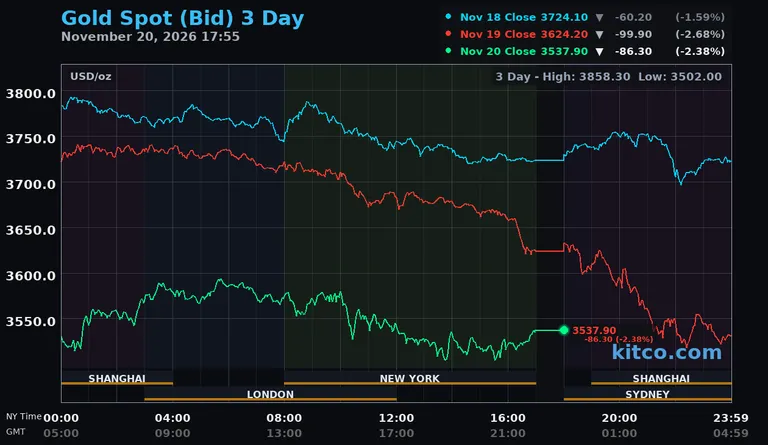
(Kitco NewsWire) – Spot gold and silver prices were sharply lower in late U.S. trading Friday, extending their recent selloff as a historic technology-led equity market decline and expectations for additional Federal Reserve interest rate increases pressured precious metals. Gold approached the psychologically important $3,500 level, trading at its lowest prices since September 2025, while silver suffered
Quick Read Micron (MU) plunged 32% in a month to $605 as doubts grow over how long the AI memory boom can last. UBS warns against companies whose valuations depend on persistent bottlenecks, while Western Digital and Seagate sank similar amounts despite strong revenue growth. Reclaiming $1,000 requires firm memory pricing and strong guidance, with
A Reuters report that the SEC is looking at Nvidia’s accounting sent the stock plunging on Friday. Here’s what’s known and what investors should do. By Jonathan Ponciano – Nov 20, 2026 at 4:07PM EST Key Points Nvidia lost about $500 billion in market value on Friday as Reuters reported the SEC is examining its
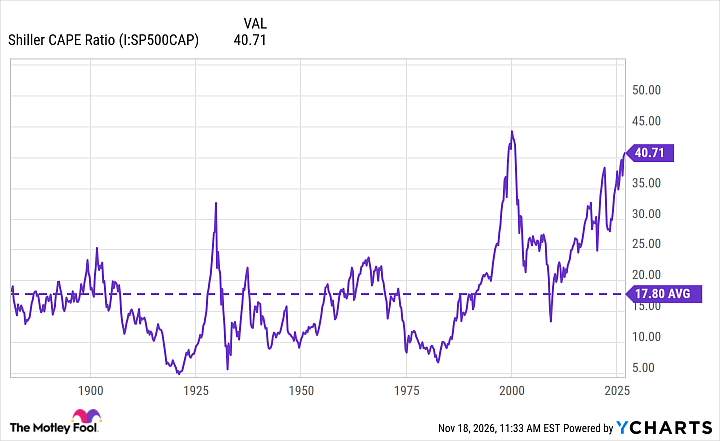
A time-honored valuation metric is flashing a warning, but history suggests the real danger for investors might not be another market crash. By Steven Porrello – Nov 20, 2026 at 2:43PM EST Key Points The Shiller P/E hovers around 40, more than twice its historical average. Five previous periods of similarly high valuations ended with
Wall Street is wrapping up a kind of week it has seen only five other times since World War II. Two of them came in 2008 and 2001. The S&P 500 (^GSPC) is on track to fall every day this week, with at least four drops of 1% or more. That has happened only in
So much for the much-hyped Anthropic (ANT) IPO on Thursday lifting the spirits of tech investors ahead of the holidays. Lost in all the Anthropic IPO coverage yesterday was the fact that, while the stock finished up nicely on its debut day, the tech-heavy Nasdaq Composite (^IXIC) fell 2.2%. The selling pressure in wider tech
Quick Read NVIDIA (NVDA) has plunged 30% in a month after Jensen Huang’s resignation, yet our model targets $199, implying 31% upside and a BUY rating. NVIDIA grew quarterly revenue 103% yet trades at roughly 10 times forward earnings, versus 30 for AMD and 18 for Broadcom (AVGO). Vera Rubin generated nearly $20 billion in
The stock market is having its roughest patch since the early days of the pandemic. Stocks wavered on Friday after tumbling the previous day, with the S&P 500 on track to mark its seventh consecutive day of losses. That would mark its longest losing streak since February 2020, when investors fled the market amid the
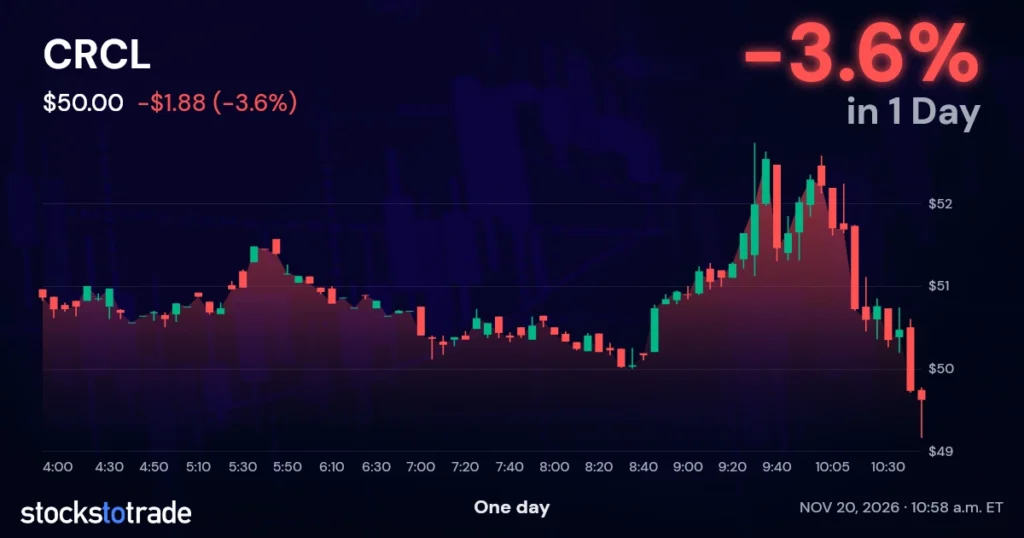
Circle fell 4% alongside a broader market decline, as market coverage warned about the risks of aggressive rate increases. Get Free Alerts Why Circle Stock Is Falling Today Circle Internet Group fell 4% to $50.00 this morning alongside a broad stock selloff. The market decline came alongside a warning that aggressive rate increases could cause
Home Depot advanced solidly during the session, driven by a convergence of resilient quarterly fundamentals, supportive macroeconomic indicators in the housing sector, and favorable institutional positioning. Investor sentiment received a notable boost following stronger-than-anticipated operational metrics, which underscored the retailer’s capacity to navigate a choppy consumer spending backdrop while defending market share in the home
Chip giant Nvidia (NVDA) extended declines on Friday, heading for seven straight days of losses. Peers AMD (AMD) and Broadcom (AVGO) also tanked 6% and 3%, respectively. US-based chipmaker Intel (INTC) also declined. Memory chipmaker Micron Technology (MU) and peer SK Hynix (SKHY) dropped more than 3%. Shares of Taiwan Semiconductor Manufacturing Company (TSM) and