AGNC has a long history of paying dividends, but that history is actually a fairly volatile one.
By Reuben Gregg Brewer –
Key Points
-
AGNC is an ultra-high-yield mortgage REIT.
-
The mREIT is well respected, but investors need to understand its dividend history to put its huge 17% yield into perspective.
-
If you need a reliable, and perhaps slowly growing, dividend to support your spending in retirement, you’ll likely be better off elsewhere.
AGNC Investment (AGNC -1.53%) is a well-respected mortgage real estate investment trust (REIT). That, however, does not mean it is a good option for every investor. That’s important to keep in mind for dividend investors, noting the stock’s massive 17% dividend yield. History makes it very clear that the dividend can be volatile, as highlighted by a dividend cut during the 2020 bear market. But there’s more to this story than that one dividend cut. Here’s what you need to know.
What does AGNC Investment do?
AGNC Investment is a REIT, a special corporate structure designed to pass income on to shareholders. As long as a REIT distributes at least 90% of its taxable income to shareholders, it avoids corporate-level taxation. Shareholders have to treat REIT dividends like regular income. (If you hold a REIT in a Roth IRA, however, you can avoid paying taxes on the dividends.) Basically, AGNC will likely always pay a substantive dividend because its corporate structure is designed to do just that.
Image source: Getty Images.
That said, AGNC isn’t a property-owning REIT, which is a fairly easy-to-understand business model. It is a mortgage REIT, which means it buys mortgages that have been pooled into bond-like securities. The company’s value is essentially the value of its mortgage security portfolio. It earns the difference between its cost of capital and the interest its portfolio generates. There are two important facts here.
First, the value of its mortgage securities will change as interest rates rise and fall. The relationship is inverse: rising rates lead to a decline in value, and vice versa. This is important right now because rates are rising and AGNC’s portfolio value is declining. Meanwhile, rising rates increase the company’s cost of capital and can squeeze its profits. That said, falling interest rates aren’t great either. While costs decline and the value of existing mortgage securities rises in that situation, new mortgage securities come with lower yields. There are a lot of moving parts, which makes AGNC and other mREITs most appropriate for more active investors.
Look at 2020 before you buy AGNC for its dividend
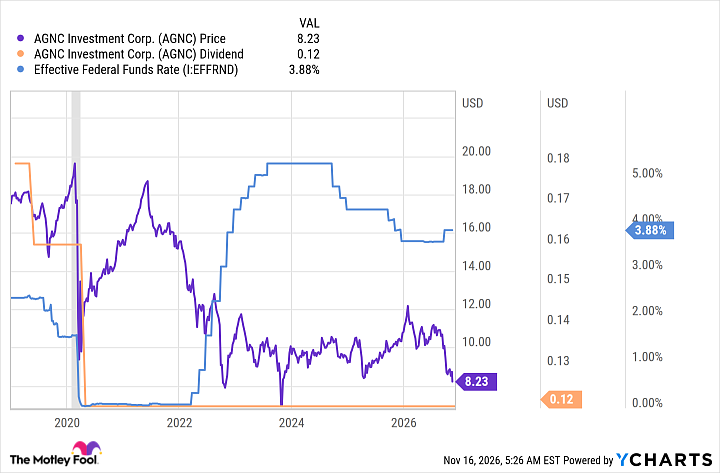
This discussion hasn’t even looked at what can happen during a bear market. Dislocations like that can cause unexpected outcomes. For example, during the 2020 bear market that accompanied the coronavirus pandemic, interest rates fell, the value of AGNC’s portfolio declined, and it cut its dividend.
At the time, AGNC tied the cut directly to the decline in the value of its mortgage security portfolio. It also noted that the cut would allow it to invest for the future. However, the dividend has remained static since that cut. Meanwhile, the cash the mREIT generated in the third quarter of 2026 to pay its dividend was $0.37 per share compared to a dividend of $0.36 per share. That’s not a lot of wiggle room. And it is facing the impact of rising rates on its portfolio, with its value falling nearly 17% in the quarter. To make matters worse, Wall Street is broadly concerned about the risk of another bear market. It isn’t unreasonable to be worried about a possible dividend cut.
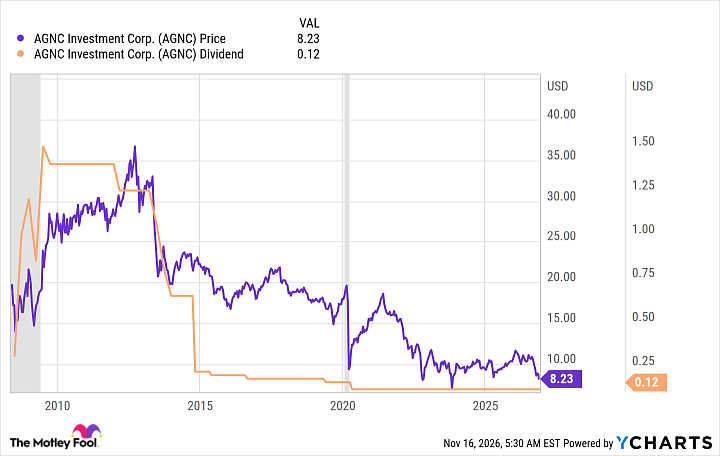
As the chart above highlights, however, the dividend has a much longer history of volatility. Note, too, that the stock price has tended to follow the dividend higher and lower. Given AGNC’s corporate structure, you are likely to continue collecting dividends through both good and bad markets. But its history makes it pretty clear that the dividend simply can’t be counted on if you hope to use it to pay your living expenses in retirement.
AGNC Investment’s dividend is always a question mark
Conservative dividend investors generally look for companies that pay consistent dividends, with a preference for dividends that grow steadily over time. That’s just not what AGNC has to offer. That doesn’t mean it is a bad investment. It simply isn’t a good fit for most income-focused investors given its history of dividend volatility. In fact, AGNC Investment makes the most sense if you reinvest dividends and focus on total return. Indeed, for many investors, this mREIT is a diversification tool rather than an income tool.
Where to invest $1,000 right now
When our analyst team has a stock tip, it can pay to listen. After all, Stock Advisor’s total average return is 802%* — a market-crushing outperformance compared to 205% for the S&P 500.
They just revealed what they believe are the 10 best stocks for investors to buy right now, available when you join Stock Advisor.
*Stock Advisor returns as of November 18, 2026.