Enter Boeing (NYSE: BA) stock in a beauty contest, and it wouldn’t get many votes. But long-term investing isn’t a beauty pageant; it’s about finding good value stocks with plenty of upside potential. Boeing is a winner in that regard, even though its recent update might have been disappointing for some. Here’s why its worth a closer look.
Boeing’s got potential
The manufacturing giant operates out of three segments, and the takeaways from the recent third-quarter earnings are that its global services (BGS) business continues to generate solid earnings to support the other two larger businesses, namely Boeing Defense, Space & Security (BDS) and Boeing Commercial Airplanes (BCA).
Missed Nvidia in 2009? This Rare Signal Is Flashing Again. In 2009, a “Double Down” signal flashed for a little-known chipmaker called Nvidia. For the first time in years, that same “Total Conviction” signal is flashing for a company 1/100th the size of Nvidia. Continue »
Image source: Boeing.
BDS has returned to profitability as it continues to work through problematic fixed-price development programs that have caused significant charges and losses in recent years. The update from Boeing’s most important business, BCA, was disappointing. Specifically, the pushback in expectations for a ramp-up in 737 MAX production. Still, I think management has reset expectations low enough now that there’s plenty of opportunity for Boeing.
Data source: Boeing presentations.
Investors have been able to point to the massive backlogs at the company (currently $745 billion) and at BCA ($612 billion, including more than 6,300 planes), and, to a lesser extent, at BDS, for years. Still, the reality is that the company has had issues executing on them. However, there are real signs of progress here.
Boeing’s defense business
Starting at BDS, management has previously maintained that its issues stem from a few problematic fixed-price development programs (including Air Force One and the KC-46 Tanker) that represent only 15% of its sales, with the rest of BDS generating profit. It’s taken time, but Boeing is working through key milestones on these programs. In July, CEO Kelly Ortberg told investors the KC-46 program “feels very low risk” now that “we’re getting to the end of the production, the fixed-price production that we have,” with repricing to follow.
Moreover, Ortberg recently raised expectations for BDS growth from low-single-digit annual growth to “middle-single-digit or higher.” Ortberg also believes BDS is booking better orders than the problematic ones noted above, as evidence of an improving environment between government and defense companies. I would strongly recommend reviewing the provisions in Lockheed Martin’s (NYSE: LMT) recent agreements with the DOD.
Boeing commercial airplanes
The game plan here is simple: Ramp up production of the narrow-body 737 MAX, and, less importantly, the wide-body 787 Dreamliner. Meanwhile, BCA is aiming for the new wide-body 777X, with certification in 2027 and first delivery to follow.
All three are crucial for free-cash-flow generation, as more deliveries mean more revenue and usually margin expansion as more units are spread around Boeing’s fixed costs. Meanwhile, any delay in the first delivery of the 777X simply increases cash burn on the program.
Unfortunately, management pushed back expectations for 737 MAX deliveries, telling investors that it would now take until 2027 to stabilize the production rate at 47 a month before targeting “52 in the back half of 2027.”
As a reminder, BCA started 2026 with a stabilized rate of 42 a month on the 737 MAX, and expected to hit a rate of 47 a month by the summer. Naturally, this kind of pushout of expectations also led to a pushout of the market’s penciled-in free cash flow (FCF) for Boeing. Here’s management’s FCF guidance on the recent call:
Data source: Boeing presentations, author’s analysis. *Based on current market cap.
However, based on management’s commentary, this guidance may prove conservative. For example, CFO Jesus Malave said the “building blocks of a $10 billion free cash flow on a normalized basis” are:
52 deliveries a month on the 737 MAX
10 deliveries a month on the 787
Deliveries and cash generation on the 777X
Still, he also said that in 2029:
The 2029 conditions significantly exceed what’s required for the “building blocks” of $10 billion in FCF, and note that management is guiding toward a production rate of 52 a month on the 737 MAX in the second half of 2027.
In other words, the main condition (737 MAX) for $10 billion in FCF will be satisfied in terms of production (deliveries will follow) by the end of 2027, and management has set a target of increasing production from 52 per month in 2027 to the “mid to high 50s” in 2029. This may prove conservative.
Image source: Getty Images.
A stock to buy?
Putting it all together, BGS is solid, BDS has returned to profitability, and there’s evidence that the Department of Defense is being more accommodating in its contracts with defense companies. Finally, BCA guidance may prove conservative, and if the building blocks for $10 billion in FCF are met in 2027, the market won’t waste any time pricing it in. As such, the stock is attractive for value-oriented investors.
Should you buy stock in Boeing right now?
Before you buy stock in Boeing, consider this:
The Motley Fool Stock Advisor analyst team just identified what they believe are the 10 best stocks for investors to buy now… and Boeing wasn’t one of them. The 10 stocks that made the cut could produce monster returns in the coming years.
Consider when Netflix made this list on December 17, 2004… if you invested $1,000 at the time of our recommendation, you’d have $336,195!* Or when Nvidia made this list on April 15, 2005… if you invested $1,000 at the time of our recommendation, you’d have $1,241,567!*
Now, it’s worth noting Stock Advisor’s total average return is 875% — a market-crushing outperformance compared to 208% for the S&P 500. Don’t miss the latest top 10 list, available with Stock Advisor, and join an investing community built by individual investors for individual investors.
Lee Samaha has no position in any of the stocks mentioned. The Motley Fool has positions in and recommends Boeing and Lockheed Martin. The Motley Fool has a disclosure policy.
Pershing Square CEO Bill Ackman speaks on CNBC’s “Squawk Box,” Nov. 3, 2026. CNBC Bill Ackman worries that the stock market is broken, saying the rise of speculative trading is leading to wild price swings thanks to the amount of leverage in the system. “Every number of days, I feel like markets are broken,” Ackman
Some companies treat their dividend like a bill they have to pay every month, not a bonus they hand out when times are good. That mindset is what separates a stock that merely offers a dividend from one that has actually built its business around protecting it, through recessions, inflation spikes, and years when growth
The US Capitol is reflected in the Capitol Reflecting Pool in Washington, DC, US, October 27, 2026. Umit Bektas | Reuters The stock market is not yet pricing in a Democratic sweep of Congress — despite some polls and most prediction markets pointing that way — so that scenario could weigh on share prices Wednesday,
Investors are always on the lookout for the next big thing in technology, and this time around, it may be quantum computing. It offers us an enormous step up from classical computing, allowing us to solve many of today’s impossible problems. While classical systems use bits to store information in the form of a zero
A roaring market is obviously good news for stock and commodity exchanges, because it prompts more revenue-generating trading activity. To this end, with the market still within sight of record highs, the exchanges are doing pretty well, although they’re not at the levels they reached earlier this year, when over $1 trillion in investments exchanged
Lumentum Holdings (NASDAQ:LITE) did just about everything right this morning, and its stock got punished anyway. Shares of the laser and optics specialist were down 14.9% as of 12:55 p.m. ET. Q1 2027 results beat Wall Street’s expectations and the company agreed to be acquired by Marvell Technology (NASDAQ:MRVL) in an all-stock deal. Marvell’s stock
Shares of AppLovin (APP +0.15%) are down 65% so far in 2026, making it the worst performer in the S&P 500 as of the end of October. It’s been an abysmal performance for the tech stock. And rather than one big sell-off, it’s been a continually slow, painful decline for the company’s shareholders. The adtech
California Resources has rewarded long term holders over the past five years, which naturally puts a spotlight on whether the current share price really lines up with what its sales can support. After a period that includes both a sizeable reported loss and new clean power ambitions, the question is how much revenue strength the
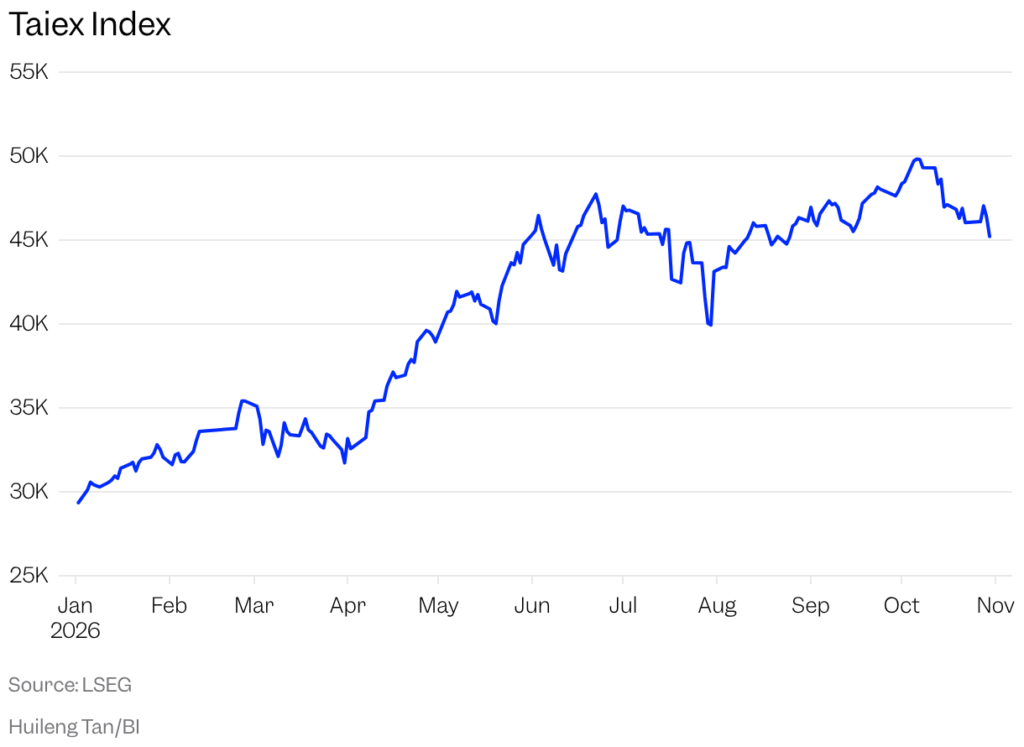
Taiwan’s AI stock boom is creating more ways for investors to profit from its chip supply chain, making early-stage startups a tougher pitch. Taiwan’s benchmark Taiex index is up more than 50% this year, making it the world’s best-performing major index after pulling ahead of South Korea’s Kospi. The gains extend well beyond Taiwan Semiconductor
MGM Q3 deep dive: margin recovery and digital growth offset soft leisure demand Hospitality and casino entertainment company MGM Resorts (NYSE:MGM) met Wall Street’s revenue expectations in Q3 2026, but sales were flat year on year at $4.21 billion. Its non-GAAP loss of $0.11 per share was significantly below analysts’ consensus estimates. Is now the
Shares of Amplitude (NASDAQ:AMPL) were among the winners last month as the data analytics software stock benefited from a broader rotation out of AI infrastructure stocks into undervalued stocks like Amplitude, and it also got a number of positive analyst notes during the month. Though there was no major company-specific news out on Amplitude, those
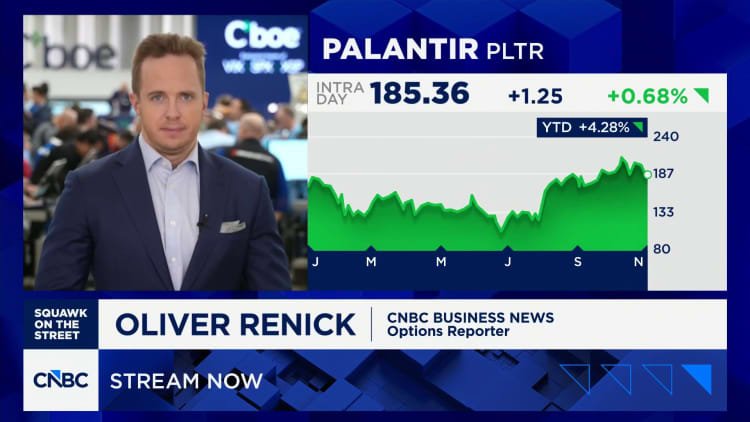
It’s not just the neoclouds and hyperscalers that investors are anxious about. Options data show a surge in bearish trading in anticipation of both Palantir and Apple earnings Monday afternoon. The two stocks have been on trajectories that are distinct from the broader AI trade – with Apple, in particular, trading almost inversely to the
Five days after Oracle (ORCL) promised to rein in its fundraising, it raised the full $20 billion in a single day. Oracle kicked off a $10 billion bond sale Monday and, at the same time, filed to sell $10 billion of stock. Together, that’s every dollar of new debt and stock it said at last
Wall Street mostly swept up last week’s tech wreckage Monday. Chip stocks kept tracking mud back through the house. About 7 in 10 S&P 500 stocks rose Monday, yet nearly every chip stock fell, and the group shed more than $400 billion in market value in a single session, by Yahoo Finance calculations. Intel (INTC)
Vancouver, British Columbia–(Newsfile Corp. – November 2, 2026) – Talent Infinity Resource Developments Inc. (CSE: TICO) (OTCQB: TIRDF) (FSE: ON8) (the “Company” or “TICO“) announces that it has completed the cancellation of stock options described in its news release dated October 14, 2026. Further to its news release dated October 14, 2026, issued at the
The “Magnificent Seven” stocks are a collection of the leading tech stocks in the world. But this year, they haven’t been doing well. The S&P 500 has surprisingly been outperforming nearly all of them. It’s particularly surprising given that the broad index is up only 11%. It’s doing well, but that doesn’t seem like a
Wall Street mostly swept up last week’s tech wreckage Monday. Chip stocks kept tracking mud back through the house. About 7 in 10 S&P 500 stocks rose Monday, yet nearly every chip stock fell, and the group shed more than $400 billion in market value in a single session, by Yahoo Finance calculations. Intel (INTC)
Oracle (ORCL -8.76%) shares have plunged about 15% since Wednesday’s close, when the tech giant held its investor day and was worth about $437 billion. It’s now worth about $372 billion, marking a steep loss of over $60 billion in less than a week. The latest leg down came on Monday, as shares fell another
Buckle up for another wild week in markets. Investors are still coming off a roller coaster ride that included a painful sell-off in the AI trade on Friday, but the volatility isn’t expected to die down soon, and a handful of potential catalysts is lies ahead for investors. This week’s docket includes more Big Tech
The highly anticipated Anthropic IPO could be one of the largest in history, with an expected valuation of between $1.5 billion and $2 billion. The Anthropic hype train, however, was knocked off the tracks a bit when the company filed its registration documents on Oct. 26. While Anthropic posted strong revenue growth in the first