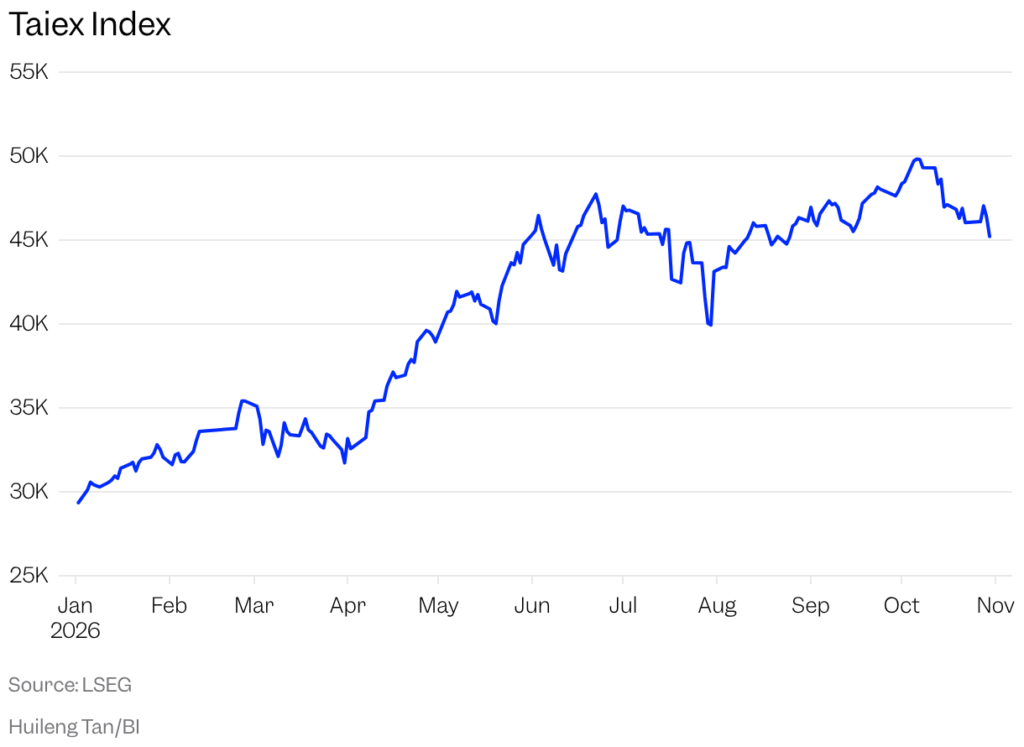
A roaring market is obviously good news for stock and commodity exchanges, because it prompts more revenue-generating trading activity. To this end, with the market still within sight of record highs, the exchanges are doing pretty well, although they’re not at the levels they reached earlier this year, when over $1 trillion in investments exchanged hands in a few days.
In its recently ended third quarter, CME Group (CME +1.02%) grew its top line by 13% to $1.7 billion in revenue, the bulk of which came from ordinary transaction fees and clearing services.
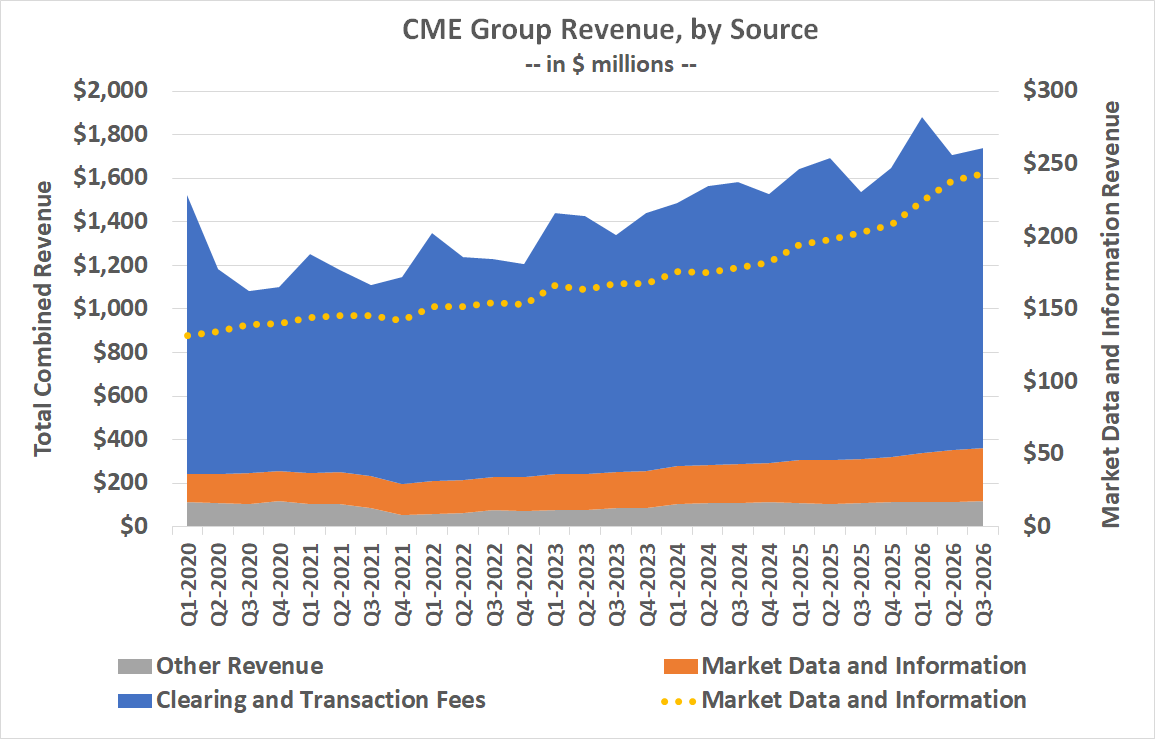
That’s not all this commodities-and-futures middleman does, though. While trading is its biggest business, like most exchanges, CME also sells data about the very securities it handles. In fact, this profit center produced its own record-breaking $243.1 million worth of revenue during the three-month stretch ending in September.
Image source: Getty Images.
And this raises the question: When (not if, but when) the current heightened trading activity slips into a lull, can this company’s market data business offset some of that weakness? The chart below answers the question.
Good, but not game-changing … not that it really matters
Even at a record $243.3 million, data still accounted for only 14% of last quarter’s total top line. While not a meaningless amount, it’s not enough to carry the company through the soft spots that CME’s trading business will inevitably encounter. Indeed, given the uncharacteristic swell of data and information revenue reported since the beginning of this year, it shouldn’t be surprising if the company’s data business growth slows to a disappointing pace next year.
Nevertheless, there’s much to like about this relatively small side business. Chief among them is its consistency. Even when CME Group’s transaction and clearing fee revenue unexpectedly wane, the company’s information revenue remains in place, continuing to grow at a reasonably predictable pace.
Data source: CME Group. Chart by author.
There’s something else worth noting in the graphic above, though. That is, while the fear of a slowdown in trading activity isn’t unreasonable, it may not be merited.
Although trading activity tumbled after the first quarter of 2020 once the COVID-19 pandemic took hold, since then we’ve been through a bull market, a bear market, and another bull market, as well as periods when little was going on, followed by periods of extreme activity. None of it appears to have made much real impact on CME Group’s ongoing long-term growth trend.
Credit the nature of its business. As a futures and commodities exchange operator, it’s always got institutions in need of its services regardless of the economy’s condition.
Built to last
This isn’t to suggest CME shares won’t occasionally struggle. They will. They’re inordinately sensitive to surprises, in fact, even if those surprises are modest.
CME CME Group
$306.24+$3.10 (+1.02%)
NASDAQ · As of 4:00 PM ET 11/02/26
Just recognize the bigger growth trend here, remembering this stock bounces back well enough — and quickly enough — from such setbacks, as we’ve seen since midyear. You could certainly do a lot worse than taking on a stake in CME Group, even if its data business isn’t a game changer.