The Stock Market Is Doing Something for Only the 3rd Time in 28 Years, and History Says It’s Clear What Comes Next for Stocks

For the better part of the last four years, Wall Street has handsomely rewarded optimists. Since the 2022 bear market bottomed, the timeless Dow Jones Industrial Average (^DJI -1.09%), benchmark S&P 500 (^GSPC -1.82%), and tech-powered Nasdaq Composite (^IXIC -2.86%) have gained 82%, 115%, and 154%, respectively.

The evolution of artificial intelligence (AI) and the ongoing AI infrastructure build-out have done a lot of the heavy lifting. But don’t overlook record-breaking initial public offerings and S&P 500 share buybacks as catalysts, either.

But when things seem too good to be true on Wall Street, they often are.

Image source: Getty Images.

While the Dow, S&P 500, and Nasdaq Composite have a rich history of rising over multiple decades, their performance becomes far murkier when examined over shorter time frames. Currently, we’re witnessing the stock market do something for only the third time in 28 years — and based on what history tells us, the next directional shift for stocks could be jarring.

This has happened just three times in the stock market’s storied history

To preface the following discussion, nothing that’s happened in the past can ever guarantee what’s to come for the Dow Jones Industrial Average, S&P 500, and Nasdaq Composite. However, more often than not, past events have a knack for foreshadowing the future, which is why history can be a valuable teacher for those willing to listen.

For instance, history has shown that outsize risk-taking, vis-à-vis a rapid rise in outstanding margin debt, can be problematic for Wall Street. But perhaps the biggest risk to the AI-driven bull market is the meteoric rise in stock valuations.

Most investors rely on the time-tested price-to-earnings (P/E) ratio when evaluating and valuing individual companies or the broader market. But the S&P 500’s Shiller P/E Ratio, also known as the Cyclically Adjusted P/E Ratio (CAPE Ratio), can provide more useful apples-to-apples comparisons of the broader market.

Whereas the traditional P/E ratio is derived using trailing 12-month earnings, the Shiller P/E Ratio is based on average inflation-adjusted earnings over the trailing decade. While the former can be disrupted by earnings turning negative during a recession, the latter remains useful in all economic climates.

The Shiller P/E, introduced by economists in 1988, has been backtested to the early 1870s. Over nearly 156 years, it’s averaged a multiple of 17.44. As of the closing bell on Oct. 26, it clocked in at 40.66, or 133% above its long-term average.

A CAPE Ratio above 40 is exceptionally rare, occurring only three times in history (and all since 1999). History says that when the Shiller P/E Ratio tops 40, the stock market is running on borrowed time:

  • January 1999 to September 2000: The first time that the CAPE Ratio exceeded 40 occurred in the lead-up to the bursting of the dot-com bubble in March 2000. Internet-driven euphoria pushed the CAPE Ratio to an all-time high of 44.19 in December 1999. By the fourth quarter of 2002, the bursting of the dot-com bubble had erased 49% and 78% from the S&P 500 and the Nasdaq Composite, respectively.
  • January 2022: The second time that the S&P 500’s Shiller P/E topped 40 was considerably shorter than the first. During the first week of 2022, the CAPE Ratio hovered above 40, fueled by fiscal stimulus amid the COVID-19 pandemic. The ensuing 2022 bear market lopped off a fifth, a quarter, and a third of the Dow’s, S&P 500’s, and Nasdaq Composite’s value over nine months.
  • May 2026 to present: Although the CAPE Ratio surpassed 40 last year, it’s been consistently above 40 over the last six months.

What history shows is that premium valuations aren’t well tolerated on Wall Street. Though it’s impossible to predict when the music will stop or what catalyst(s) will send the broader market over the edge, the Shiller P/E Ratio makes it crystal clear what comes next for stocks.

A smiling person is reading a financial newspaper while seated at a kitchen table.

Image source: Getty Images.

More than a century of historical data favors optimism

However, the great thing about history is that the result can change depending on an investor’s perspective.

To state the obvious, bull markets aren’t indefinite. At some point, a meaningful stock market correction, bear market, or crash is going to occur. Since sizable moves lower in equities are commonly driven by emotions, no amount of fiscal or monetary policy maneuvering can prevent them from occurring.

But history also shows that these downturns don’t have to be scary events. While red arrows can occasionally tug on investors’ heartstrings, historical data says that bear markets are often short-lived.

A May 2026 post on social media platform X (formerly Twitter) by Bespoke Investment Group analyzed every S&P 500 bull and bear market since the start of the Great Depression in September 1929. Analysts found that the typical bull market lasts about 3.6 times longer than the average bear market: 1,023 calendar days vs. 286 calendar days.

Looking back more than a century produces even more appealing results.

Earlier this year, Crestmont Research updated a data set that calculates the rolling 20-year total returns, including dividends, of the S&P 500 since 1900. Since the S&P wasn’t incepted until 1923, researchers had to track the performance of its components in other major indexes back to 1900.

Crestmont analyzed 107 rolling 20-year periods (1900-1919, 1901-1920, and so on, through 2006-2025) and found that each one generated a positive average annual total return. In other words, if an investor had, hypothetically (since S&P 500-tracking funds didn’t trade on U.S. exchanges before 1993), purchased an S&P 500 index fund at any point between 1900 and 2006 and held it for 20 years, they would have made money every time!

Regardless of whether investors navigated a recession, depression, pandemic, an ongoing war, or a historically expensive stock market, they’ve always made money if they maintained perspective and remained optimistic.

Source link

Visited 1 times, 1 visit(s) today

Related Article

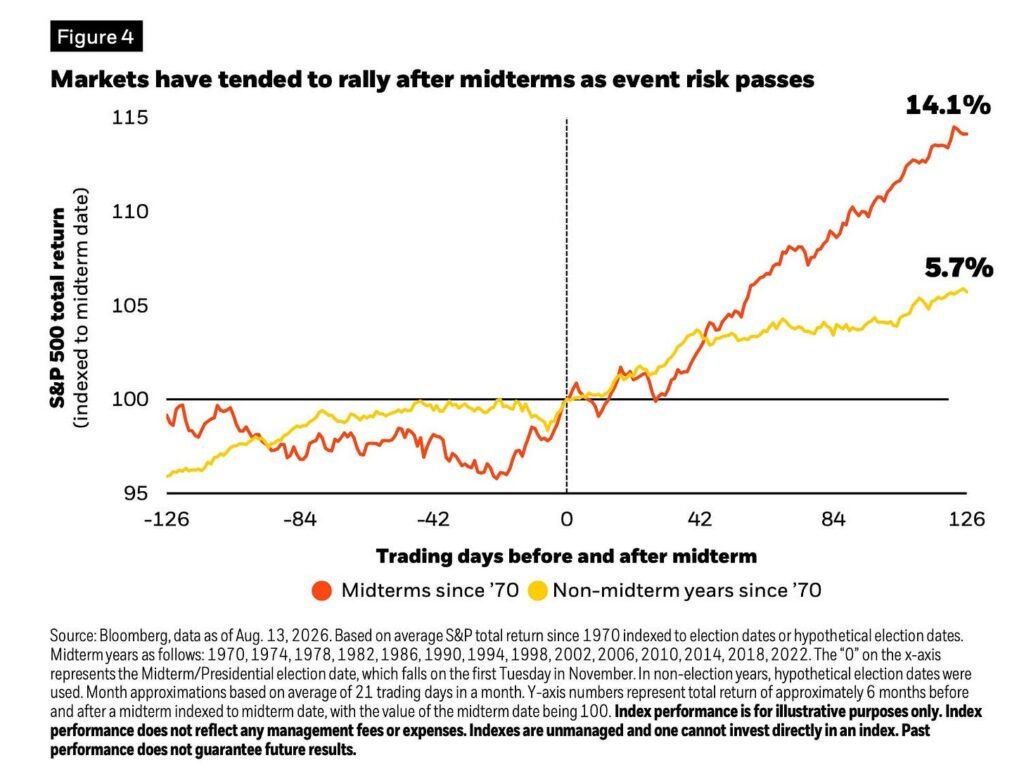
A word of caution about bullish post-midterm election stock market patterns ⚠️

The periods before and after midterm elections are famously volatile for stocks. Historically, midterm election years have had an average intra-year drawdown of 18% for the S&P 500. This is worse than the average 14% drawdown across all years. On the plus side, the stock market has tended to perform well once there’s a clearer

US Hedge Funds Just Sold Every AI Stock They Bought Since 2025

For five straight days in October, hedge funds sold AI stocks. By the end, they had undone every AI purchase they made since the start of 2025, Goldman Sachs data shows. Morgan Stanley says hedge funds have cut more than 8% of their total stock bets since June, their biggest retreat since at least 2017.

Here’s what to expect from the stock market on Election Day

History tells us how the stock market typically performs before and after federal elections. Tanya Breen/Asbury Park Press, U USA TODAY Network, Reuters If you own stocks, you might be wondering whether the impending midterm elections will be good or bad for the stock market. Does the market flourish after Election Day? Do traders care

Allison Transmission (ALSN) Q3 earnings report preview: what to look for

Allison Transmission (ALSN) Q3 earnings report preview: what to look for Transmission provider Allison Transmission (NYSE:ALSN) will be announcing earnings results this Monday after market close. Here’s what to expect. Allison Transmission beat analysts’ revenue expectations last quarter, reporting revenues of $1.57 billion, up 92.4% year on year. It was a very strong quarter for

Capitol Federal Financial (CFFN) Has A Fresh Update, But What Is Drawing Attention?

Capitol Federal Financial earnings and dividend snapshot Capitol Federal Financial (CFFN) just released fourth quarter and full year results, reporting net interest income of US$54.83 million for the quarter and US$211.9 million for the year. The bank also posted quarterly net income of US$22.38 million and full year profit of US$86.4 million, figures that give

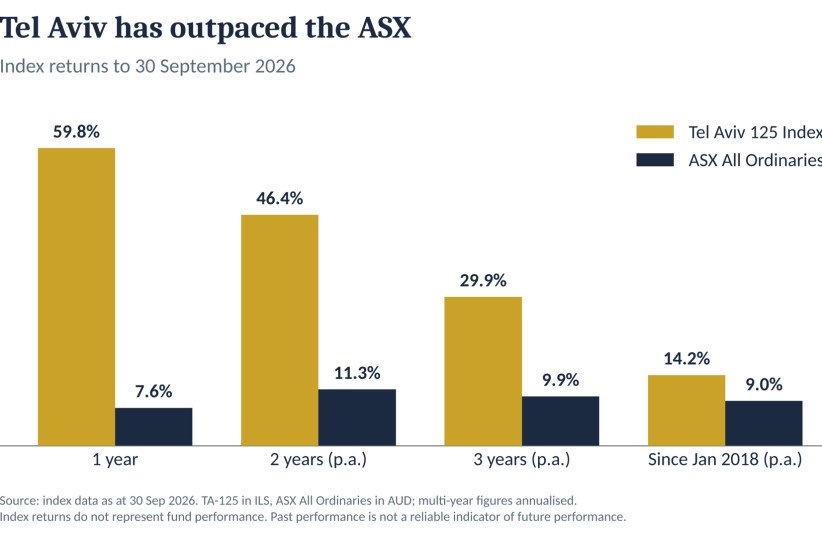
Why Israel, why now: Increasing exposure to the Tel Aviv stock exchange

Israel is one of the developed world’s fastest-growing economies, home to a world-class technology sector, and its stock market remains badly under-owned by global investors. That combination will not last. We believe foreign investors should increase their exposure to Israel now, and the Tel Aviv Stock Exchange is the most direct way to do it.

Tom Lee Thinks One Investor Might Be Behind Nasdaq’s Stock Crash

Tom Lee. Photo by BeInCrypto Intel lost almost a third of its value on Friday. By the close, the Nasdaq Composite had sealed its worst month since March 2025, down 5.3%. Tom Lee of Fundstrat, a Wall Street research firm, has another suspect. He thinks one big investor may have been forced to dump tech

Sejong University team finds link between retail investor attention, lower stock returns

From left are Lee Eun-mi, a professor at Sejong University’s College of Business and Economics, and doctoral students Yang Pujian and Yang Liu. Courtesy of Sejong University A research team at Sejong University has found that stocks attracting greater attention from retail investors tend to generate lower returns in subsequent periods. The university said the

2 Unstoppable Growth Stocks I’d Buy With $1,000 and Hold for a Decade

If you have $1,000 that you can put into an investment account, you have plenty of options — index funds, thematic exchange-traded funds, or single stocks can be solid choices. But as artificial intelligence (AI) and the companies capitalizing on the technology have been one of the biggest generators of wealth in the market, I’m

Peter Schiff: Gold’s Slide Rests on a Bet the Fed Can’t Deliver

Gold prices fell to a one-year low on Friday (October 30) as a drop in technology stocks put pressure on precious metals. Economist Peter Schiff warned this week that inflation could rise further and said the Federal Reserve is not doing enough to control it. According to Reuters, falling technology stocks may have prompted investors

In 1956, A Physics Professor Drove To Nebraska To Hand A Young Investor $120,000. The Investor’s Name Was Warren Buffett. 14 Years Later Homer Dodge’s Stake Grew To About $2.1 Million. By 2013, The Berkshire Shares Alone Would Have Been Worth More Than $2.7 Billion

Quick Read Bloomberg calculated Dodge’s roughly 15,897 Berkshire (BRK-A, BRK-B) shares would have topped $2.7 billion by 2013 if the family held them. Homer Dodge drove 1,500 miles to hand a 25-year-old Buffett $120,000 in 1956, and the stake grew to $2.1 million by 1970. The Avenir Foundation received 2,000 Berkshire shares from Dodge’s estate

Is Delta Air Lines (DAL) Fully Valued After Fresh Earnings Estimate Cuts?

Delta Air Lines (DAL) has been pushed into the spotlight after Zacks assigned the stock a Rank #5 Strong Sell, following sizeable cuts to near term earnings estimates and forecasts. Recent trading shows that momentum in Delta Air Lines has cooled, with the share price down 1.83% over the last day and 3.97% over 30

SpaceX Stock Fell Below Its IPO Price, But Binance’s CZ Is Bullish

JPMorgan SpaceX call sees nearly 80% upside in SPCX stock on AI, shown with bull imagery. Photo by BeInCrypto Binance founder Changpeng Zhao (CZ) said Saturday that SpaceX will be one of the best stocks to hold for years. Hours earlier, the shares closed at $134.72, just under their $135 June listing price. That leaves

Boeing Stock Slumps Again; Time to Buy or Throw in the Towel?

Boeing (BA -0.64%) stock delivered another double-digit one-day drop that investors have, unfortunately, gotten used to over the past decade. In a nutshell, management told investors probably the last two things they would have wanted to hear. Production targets on the narrow-body 737 MAX have been pushed out, as have free cash flow (FCF) projections.

This Dirt Cheap $5 Stock Could Make You Filthy Rich

What’s a beaten-down stock trading for $5 a share, whose company is building one of America’s first electric air taxis and could be worth several times its valuation if it succeeds? My answer: Joby Aviation (NYSE: JOBY). Missed AI’s “Act 1”? Act 2 Could Be 14x Bigger. Most investors think they missed the AI boat

Tech stock meltdown could get a lot of worse if history is any guide

And you thought this week has been painful for the tech trade. If history is any guide, the pain for tech may only be just beginning! The S&P 500 tech sector has seen six pullbacks of 10% or more since 2023, points out Truist chief markets strategist officer (chart below), including the current one. But

Jersey Mike’s CEO says the stock is ‘undervalued’ after post-IPO slump

Jersey Mike’s (JMKE) stock has remained under pressure since its IPO earlier this year, but CEO Charlie Morrison is confident in the state of the sandwich chain. The stock has fallen nearly 13% since it debuted on the New York Stock Exchange at $21 per share in late July. It fell to as low as

0
Would love your thoughts, please comment.x
()
x