Earnings & Expectations – A Wealth of Common Sense

AI is the biggest story in the market this year, this decade and probably this century.

Predicting the boom-bust nature of how this cycle will play out is impossible. That won’t stop people from trying, of course.

The funny thing is you see people are making predictions years out into the future with certainty when the pros can’t even predict what will happen in the next 3, 6 or 12 months.

Stock market earnings are a case in point.

This chart shows how 2026 earnings estimates have changed since the start of the year:

This isn’t earnings estimates 3, 5, 10 years into the future. This is just 2026 earnings!

Analysts estimated S&P 500 earnings of a little more than $310 when the year began. After a few earnings seasons came in much better than expected the year end estimate is now nearly 20% higher.

Not even close.

The S&P 500 is currently up around 12% on the year. Earnings have grown almost 30%. That means that valuations have fallen this year.

Here’s an interesting thought experiment based on these rapidly rising earnings numbers:
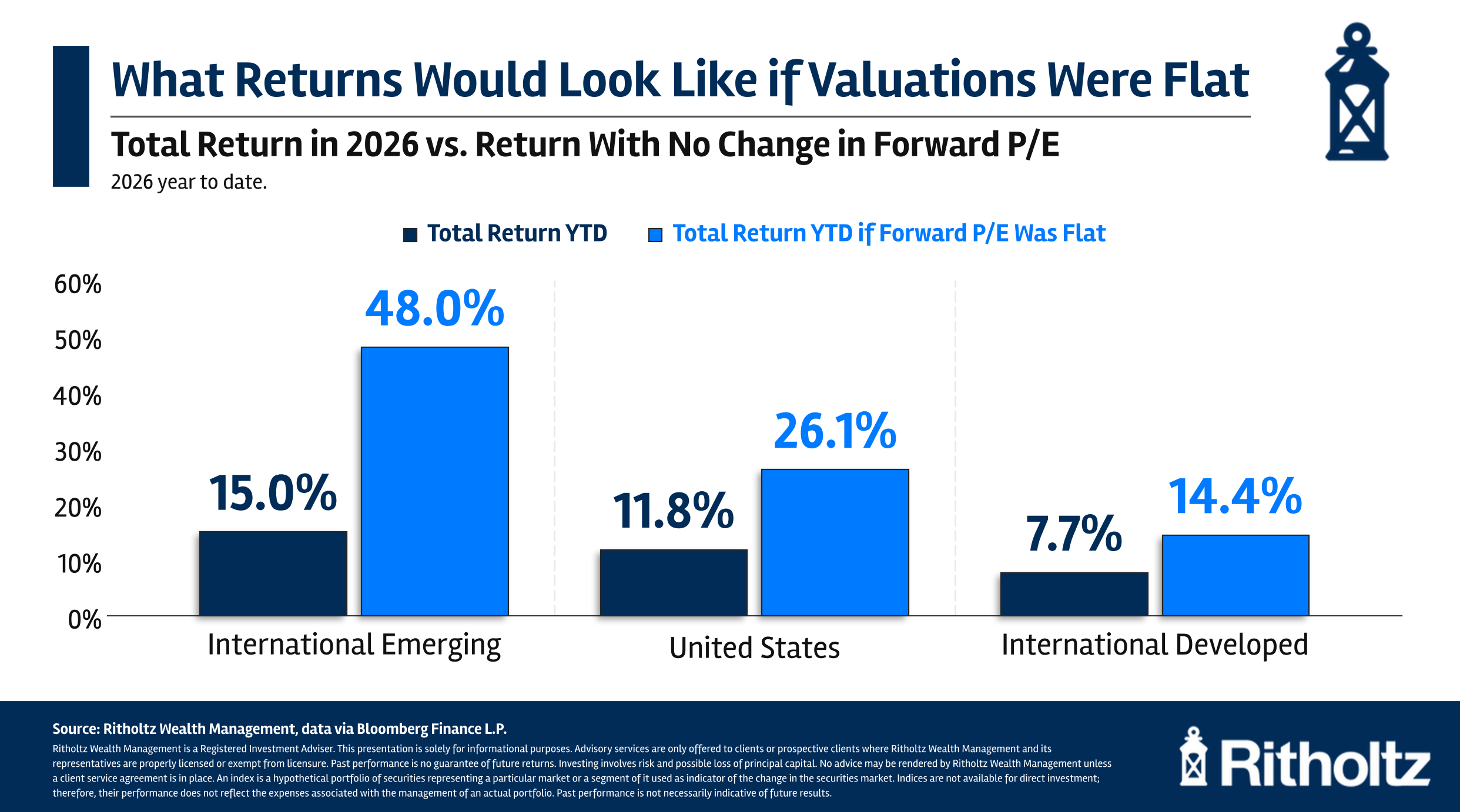
Many investors assume valuations go vertical during the market boom times. Instead they are falling. This chart shows what would have happened if forward P/E ratios had simply stayed the same. Stock market returns around the globe would have been much, much higher.

There are reasons this is happening.

Investors might be cautious that all this AI capex spending is inflating earnings and these numbers will come back down to earth. That could be possible.

It’s also true that it’s perfectly normal for there to be a massive disconnect between earnings and stock market returns.

Here’s a look at earnings growth and total returns on the S&P 500 by decade going back to the 1930s:
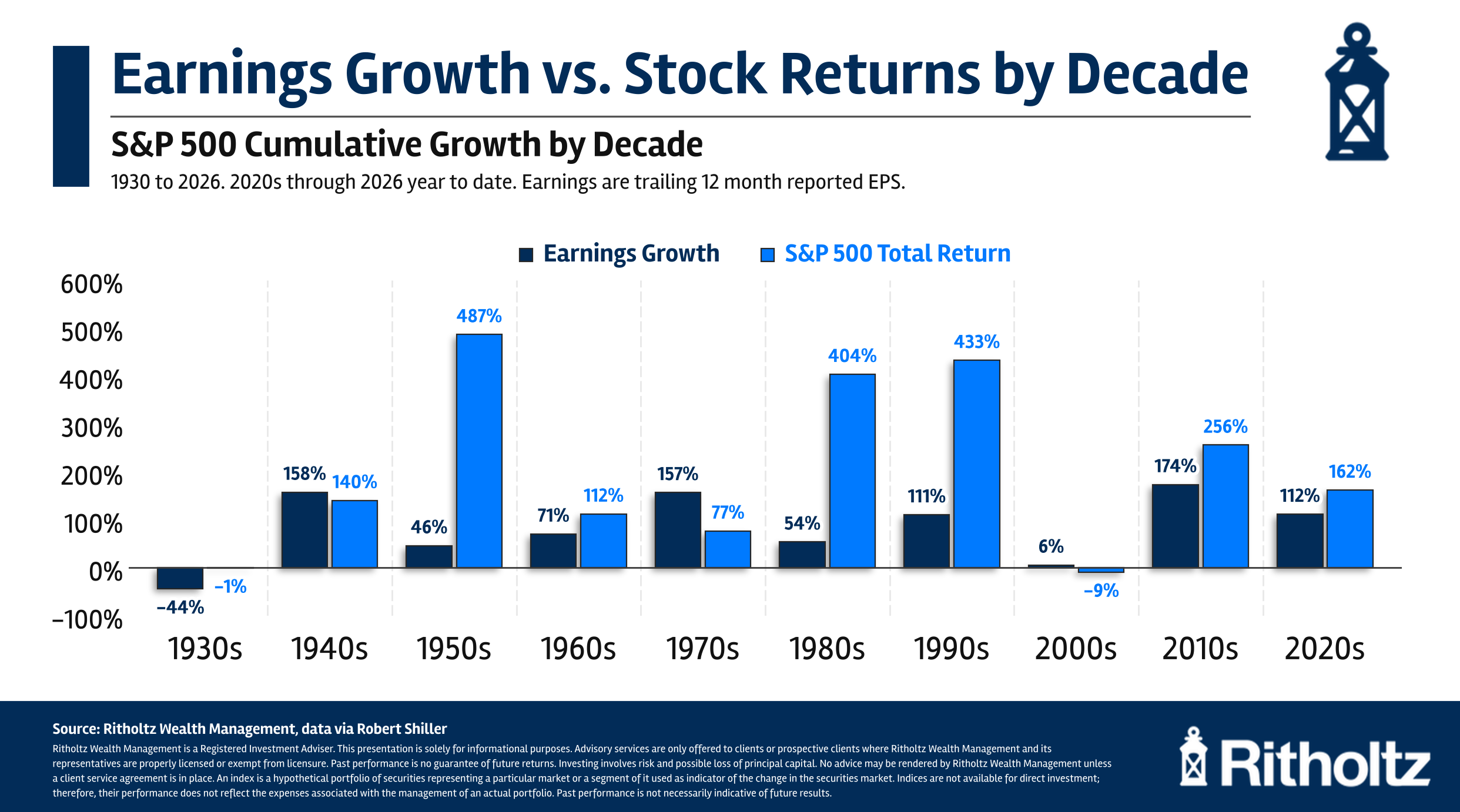
Sometimes there’s a relationship but it can often breakdown.

Earnings growth and stock prices were more or less in line with one another in the 1940s, 1960s, 2000s, 2010s and 2020s (thus far).

As bad as the stock market did in the 1930s, earnings were even worse. Earnings far outpaced the stock market in the 1970s. The stock market was up far more than profits in the 1950s. Same thing in the 1980s and 1990s in terms of growth.

These divergences can be even greater in any given year:
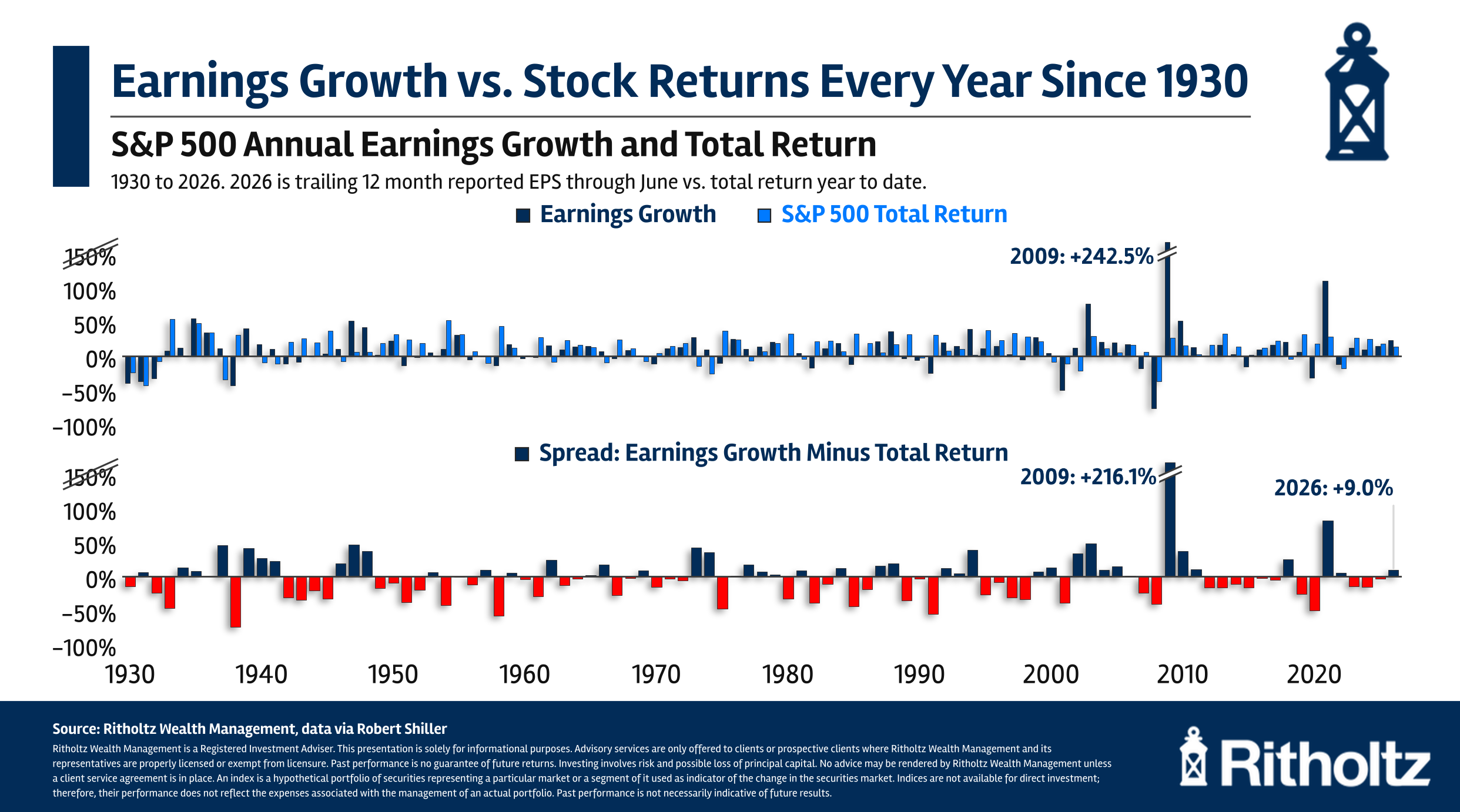
A wide spread between earnings growth and stock market returns looks to be the norm. The average absolute spread between the two numbers is almost 25%.1

This can be even more pronounced in individual securities and sectors.

For example, The Wall Street Journal broke down the individual components of the earnings growth this year by company:
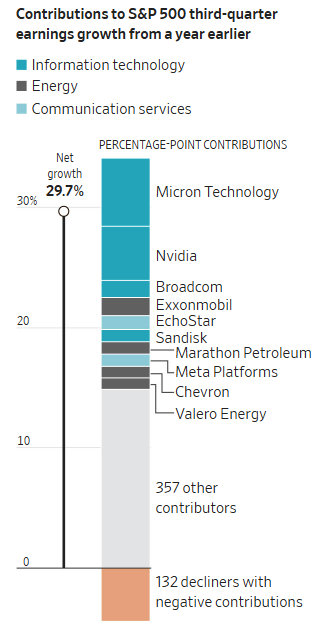
Ten companies are responsible for around two-thirds of the profit growth this year. Just two companies — Micron and Nvidia — make up one-third of the growth.

Yardeni Research made the point that the market doesn’t appear to trust the earnings of the semiconductors like Micron:
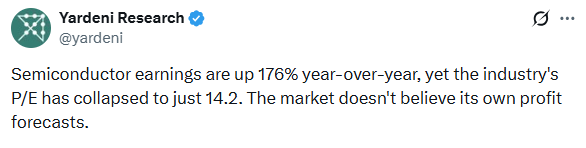
Profits for semiconductors are up nearly 200% while the stocks are up a little more than 40% on the year. And they are currently in a drawdown of more than 20% from the highs.

Fundamentals tell the story but you also have to take into account expectations and what’s priced into stocks. Most of the time no one knows what’s priced in.

In the long run fundamentals drive the stock market. In the short run the market and earnings are not always in lockstep with one another.

This is what makes investing int he stock market equal parts exciting and infuriating.

Michael and I talked about earnings, semiconductors and much more on this week’s Animal Spirits video:


Subscribe to The Compound so you never miss an episode.

Further Reading:
Is This a Bubble?

Now here’s what I’ve been reading lately:

Books:

1The median is 17%.

This content, which contains security-related opinions and/or information, is provided for informational purposes only and should not be relied upon in any manner as professional advice, or an endorsement of any practices, products or services. There can be no guarantees or assurances that the views expressed here will be applicable for any particular facts or circumstances, and should not be relied upon in any manner. You should consult your own advisers as to legal, business, tax, and other related matters concerning any investment.

The commentary in this “post” (including any related blog, podcasts, videos, and social media) reflects the personal opinions, viewpoints, and analyses of the Ritholtz Wealth Management employees providing such comments, and should not be regarded the views of Ritholtz Wealth Management LLC. or its respective affiliates or as a description of advisory services provided by Ritholtz Wealth Management or performance returns of any Ritholtz Wealth Management Investments client.

References to any securities or digital assets, or performance data, are for illustrative purposes only and do not constitute an investment recommendation or offer to provide investment advisory services. Charts and graphs provided within are for informational purposes solely and should not be relied upon when making any investment decision. Past performance is not indicative of future results. The content speaks only as of the date indicated. Any projections, estimates, forecasts, targets, prospects, and/or opinions expressed in these materials are subject to change without notice and may differ or be contrary to opinions expressed by others.

The Compound Media, Inc., an affiliate of Ritholtz Wealth Management, receives payment from various entities for advertisements in affiliated podcasts, blogs and emails. Inclusion of such advertisements does not constitute or imply endorsement, sponsorship or recommendation thereof, or any affiliation therewith, by the Content Creator or by Ritholtz Wealth Management or any of its employees. Investments in securities involve the risk of loss. For additional advertisement disclaimers see here: https://www.ritholtzwealth.com/advertising-disclaimers

Please see disclosures here.

Source link

Visited 1 times, 1 visit(s) today

Related Article

How Private Capital Growth Will Impact BlackRock Stock

BlackRock has recently launched the iShares Future Robotics and Related Technologies Active ETF, expanded its presence in model portfolios through 55ip’s UMA platform, and seen subsidiary Preqin publish a forecast pointing to sizeable growth in global private capital assets under management by 2031. The mix of a new robotics and AI focused active ETF, broader

Arista Networks And 2 More AI Infrastructure Stocks To Watch

When St. Louis Fed chief Alberto Musalem and Dallas Fed’s Lorie Logan both pointed to more rate hikes ahead, the message was simple. Money is not cheap and capital will stay picky. That puts more focus on real infrastructure behind AI, like the switches, routers and server builders that keep model training running. This article

Why Merck Stock Flew Higher on Friday

The positive sentiment engendered by Merck‘s (NYSE:MRK) solid third-quarter results posted on Thursday carried over into the following trading session. It wasn’t only the vibes; several analysts tracking the durable pharmaceutical company raised their price targets on its equity. The stock climbed more than 2% as a result, in contrast to the S&P 500 index’s

Intel stock plunges nearly 29%, its worst day since 1974

Intel’s data center business just grew almost 80% in a year. Its outlook for the fourth quarter just handed the stock its worst day in more than half a century, erasing nearly $140 billion in market value Friday. Intel (INTC) stock closed down nearly 29% Friday after the chipmaker’s forecast for the final three months

Jim Cramer likes 4 consumer staples stocks

Investors looking to diversify beyond the struggling artificial intelligence trade should consider consumer staples stocks, CNBC’s Jim Cramer said Friday. The Nasdaq-100, which tracks the biggest tech stocks, ended October down almost 7%. Investors rotated into other more defensive areas of the market. The S&P 500 Equal Weight gained roughly 5% for the month. (The

The real question we should all be asking about AI

The stock market is turning its back on Big Tech. Google just had its worst day ever. Intel tumbled more than any day since the Nixon administration. Amazon and Meta both had significant declines this week, too. The Nasdaq tumbled and is just over a percentage point away from a correction (a 10% decline from

Alphabet’s October wipeout hits $758 billion, its worst month ever

Big Tech’s brutal week had one clear epicenter. Alphabet (GOOGL) lost $468 billion in market value this week, more than SpaceX, Intel and Nvidia combined. That was the Google parent’s worst week ever and the second-biggest weekly wipeout for any US-listed stock, by Yahoo Finance calculations. Only Nvidia (NVDA) has lost more, about $552 billion

IonQ Is Down 65% From Its High. History Suggests This Is What Happens Next.

IonQ (NYSE: IONQ), a developer of quantum computing systems, went public through a merger with a special purpose acquisition company (SPAC) five years ago. Its stock started trading at $10.60 and eventually hit an all-time high of $82.09 on Oct. 13, 2025. Today, IonQ trades at about $29. Let’s see why it dropped 65% from

Is Nvidia Stock a Trick or Treat?

With its market-leading $5.2 billion valuation, Nvidia (NVDA -4.22%) isn’t sneaking up on anybody these days. The poster child of the AI revolution is the largest provider of accelerators and other chips and hardware solutions fueling the AI boom. It has come a long way from its early days, when it largely served gaming enthusiasts.

AI stocks sell off as investors question AI spending returns

Traders work on the floor at the New York Stock Exchange (NYSE) in New York City, U.S., Oct. 30, 2026. Brendan McDermid | Reuters Market professionals are sounding worried about the artificial intelligence trade after a big week of data points in the technology sector. Investors are focused on the scale of the AI build-out

Wall Street analysts like Amazon’s AWS outlook

Amazon (AMZN) reported mixed results after the bell on Thursday, missing Wall Street’s targets on earnings per share and revenue, but posting better-than-anticipated Q3 AWS revenue. Operating income topped the company’s own estimates. Amazon stock fell more than 7% in premarket action Friday, but pared much of those losses as the trading day went on.

SpaceX has lost more than $400 billion in market value in less than a month

Analysts spent last week raising their SpaceX (SPCX) price targets. Investors spent it selling the stock. SpaceX stock fell about 5% Friday, extending a slide that has erased more than $400 billion in market value since its high on Oct. 6, when the company was worth more than $2.3 trillion. It’s now worth less than

Enrollment Weakness Pressures Universal Technical Institute (UTI)

Conestoga Capital Advisors, an asset management company, released its third-quarter 2026 investor letter. The letter can be downloaded here. Conestoga Capital Advisors released its third-quarter 2026 investor letter, outlining a shifting macroeconomic backdrop for small-cap equities. After a strong start to 2026, 3Q26 headwinds—including elevated oil prices, persistent inflation, and a September Fed rate hike—drove

Blue Lagoon shareholders approve stock market listing and staff share options

By Elías Thorsson October 30, 2026 ‘ Sigríður Margrét Oddsdóttir, CEO of the Blue Lagoon, and Grímur Sæmundsen, chairman of the group’s board. (Blue Lagoon) Shareholders in Blue Lagoon hf. have formally approved a public share offering and an application to list the company’s shares on the Main Market of Nasdaq Iceland. The offering and

INTC Stock Heads For Worst Day In Over 2 Years: Jefferies Calls Q4 A ‘Substantial’ Reset Amid Slew Of Wall Street Price Cuts, Downgrades

Both Bank of America and Roth Capital downgraded Intel to ‘Neutral’ from ‘Buy’. Bank of America also lowered its estimate of the company’s 2030 earnings power. Citi called Intel’s quarterly performance a ‘strong beat’ but said its December-quarter outlook was ‘weak.’ Intel (INTC) shares were on track to wipe out a quarter of their market

Why isn’t China’s AI and tech boom saving its stock markets?

Hong Kong —  The global artificial intelligence boom that has helped sustain Chinese economic momentum this year still can’t offset its domestic woes, particularly in its stock market. Since peaking in June, key Chinese indexes have fallen more than 20%, crossing the threshold for a bear market. Beijing responded last week by pumping $19 billion into

The Magnificent 7 stocks are seeing stunning declines

Call it the Unflattering 7. Long known as the Magnificent 7 stocks, shares of Apple (AAPL), Microsoft (MSFT), Nvidia (NVDA), Amazon (AMZN), Tesla (TSLA), Meta (META) and Google (GOOG) are acting anything but, especially compared to their 52-week highs. Meta and Alphabet are effectively in bear markets, down more than 20% from their 52-week highs,

0
Would love your thoughts, please comment.x
()
x