The Stock Market Is Echoing a Warning From the Dot-Com Bubble, and History Says Investors Should Make This 1 Move
The S&P 500 has been climbing in recent years, reaching multiple record highs, and the momentum has generally continued in 2026. If we look at the past three calendar years and add in the performance this year so far, the gain totals 100%. And one thing in particular has fueled this movement: investors’ excitement about artificial intelligence (AI).
AI, with its potential to transform the way many things are done and supercharge corporate earnings growth, looks like the next big thing in technology — and a bet in such a space could result in a major win for investors. Many investors have already experienced this victory, considering the double-, triple-, and even quadruple-digit gains of some AI stocks over the past few years. For example, AI chip leader Nvidia has jumped 900% in five years, and memory and storage maker Micron Technology has climbed 200% this year alone.
Missed AI’s “Act 1”? Act 2 Could Be 14x Bigger. Most investors think they missed the AI boat because they didn’t buy Nvidia in 2005. But according to our analysts, we’re only at the end of “Act 1″—the R&D phase. “Act 2” is the global rollout. Continue »
Since many companies operating in AI are also tech giants that are heavily weighted in the S&P 500, their gains have offered the index a clear direction. Of course, stocks across industries have also advanced, but tech players have played the biggest role.
Against this positive backdrop, however, a storm may be brewing. The stock market is echoing a warning from the dot-com bubble, and history says investors should make one move in particular.
Image source: Getty Images.
Today’s market situation
So, first let’s dive a little deeper into the current market situation. Investors have been piling into AI stocks in recent years as companies develop the technology, and AI is increasingly being put to use — though we’re in the early days of this phase. As all of that unfolded, certain companies, such as chip designers and cloud companies, began generating significant revenue. Today, with demand for chips and infrastructure high, tech giants must invest heavily to keep pace. For example, Amazon, Microsoft, Alphabet, and Meta Platforms are expected to spend more than $700 billion this year.
Meanwhile, some investors have wondered whether the revenue opportunity will truly justify such spending levels — and this concern has weighed periodically on the performance of AI stocks. Other headwinds include questions about rising inflation and interest rate levels in the months to come as well as general concerns about the economy and geopolitical environment. All of this has put pressure on stocks on occasion this year, but, overall, the S&P 500 and investors have managed to shake off the worries.
Now, let’s consider the storm that’s brewing behind the scenes. The stock market is echoing a warning that we saw at a troubling time, during the dot-com bubble… and this is a significant increase in one particular metric. I’m talking about the Buffett indicator, which measures the value of all U.S. publicly listed companies in relation to the country’s gross domestic product.
Buffett favors this valuation measure
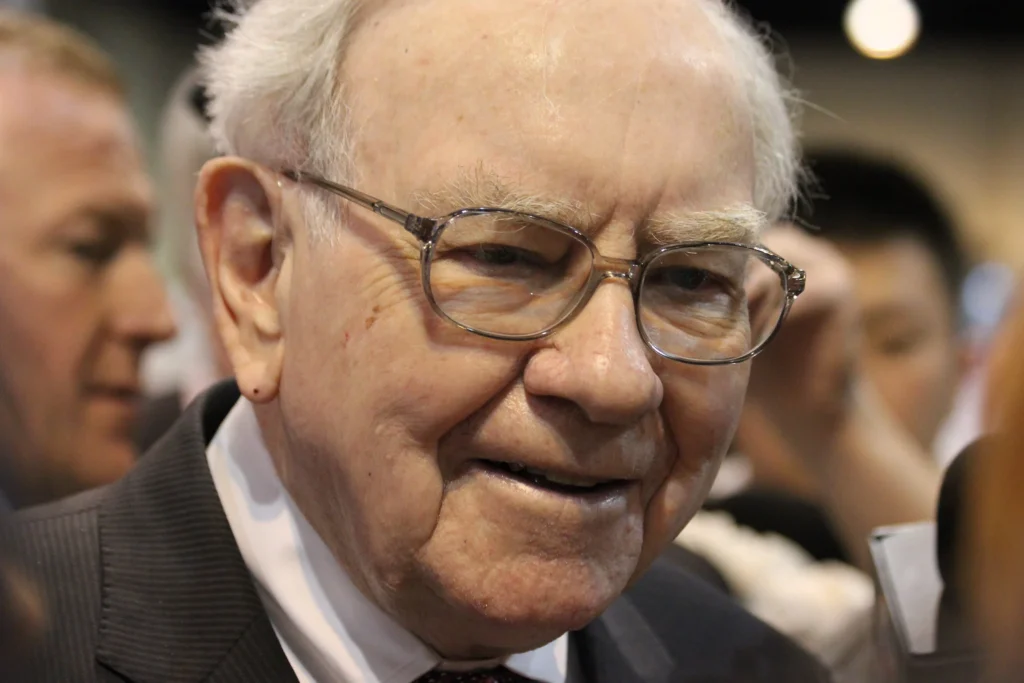
Billionaire investor Warren Buffett introduced this measure in an essay in Fortune back in 2001. “It is probably the best single measure of where valuations stand at any given moment,” he wrote.
Today, this indicator delivers an alarming message: It has reached the level of 238%, its highest ever. For reference, it came in at about 148% during the dot-com bubble. So this tells us that stocks are historically expensive today and the underlying economy isn’t driving the gains.
What may happen next? A look at history, focusing on the dot-com era back in 2000 and late 2021 when the Buffett indicator soared once again, may offer some answers.
The S&P 500 fell following these peak Buffett indicator readings, and that suggests the stock market today may also be heading for a decline. But before you get too worried about this potential happening, it’s important to look a bit farther down the road. And here, we can see that each time, the S&P 500 has always recovered and then gained over a number of years.
History tells us you should make one key move now, and that’s to hold onto your positions for the long term. Even if stocks follow historical patterns and decline, the market has proven its ability to deliver a win to investors over the long run. By jumping out of the market, you could incur losses and miss out on gains farther up the path. So, even if the Buffett indicator is flashing a warning signal, the best thing you can do is stay calm and wait for any potential storm to pass.
Should you buy stock in S&P 500 Index right now?
Before you buy stock in S&P 500 Index, consider this:
The Motley Fool Stock Advisor analyst team just identified what they believe are the 10 best stocks for investors to buy now… and S&P 500 Index wasn’t one of them. The 10 stocks that made the cut could produce monster returns in the coming years.
Consider when Netflix made this list on December 17, 2004… if you invested $1,000 at the time of our recommendation, you’d have $379,986!* Or when Nvidia made this list on April 15, 2005… if you invested $1,000 at the time of our recommendation, you’d have $1,404,152!*
Now, it’s worth noting Stock Advisor’s total average return is 948% — a market-crushing outperformance compared to 215% for the S&P 500. Don’t miss the latest top 10 list, available with Stock Advisor, and join an investing community built by individual investors for individual investors.
Adria Cimino has positions in Amazon. The Motley Fool has positions in and recommends Alphabet, Amazon, Meta Platforms, Micron Technology, Microsoft, and Nvidia. The Motley Fool has a disclosure policy.
Nvidia (NVDA) CEO Jensen Huang is unlikely to ignore the building pressure on CoreWeave’s (CRWV) stock price and bond values. The simple reason why is that he can’t look the other way given how intertwined Nvidia is with the most well-known — and debated — neocloud. For one, in January of this year Nvidia announced
Quick Read Lumentum (LITE) turned a $1,000 investment into $22,715 over 10 years, a 2,171% return dwarfing the S&P 500’s 262%. AI hyperscalers replaced Apple (AAPL) Face ID as Lumentum’s growth engine, pushing Q4 revenue up 109% year over year to $1.01 billion. Nearly all decade-long gains arrived in the past 12 months, yet the
History shows that the 10-year/three-month Treasury yield spread has been one of the most reliable recession indicators. The general premise is that once this spread turns negative, which is to say that the three-month Treasury yield becomes higher than the 10-year yield, a recession is likely to come sometime in the subsequent six to 18
Oura IPO oversubscribed Wall Street stock market trading floor. Photo by BeInCrypto Warburg Pincus CEO Jeffrey Perlman, whose private equity firm backs more than 200 portfolio companies, says investors see public markets as one concentrated, correlated bet. He argues that pushes capital toward private assets. The pitch comes from a firm that calls the initial
Bond yields are going up. Along with a recent Federal Reserve hike in short-term interest rates in September, longer-term U.S. Treasury bond yields recently reached their highest levels in decades. Yields for the 10-year and 30-year bonds are both at their highest since 2002, at well over 5%. Missed Nvidia in 2009? This Rare Signal
New York — High-flying technology stocks are taking a bruising this week, as investors grow more skeptical about whether the AI boom will live up to expectations. Stocks dropped on Wednesday, led by declines in the tech sector, after a hotter-than-expected inflation report bolstered bets that the Federal Reserve will raise interest rates further. The S&P
Image from Pixabay Shares of Cipher Digital (CIFR) fell 12.8% on October 13, 2026, on a day the S&P 500 finished flat. Investors were evaluating a plan to raise $850 million through convertible notes that could eventually become shares. Cipher is taking on this debt to fund data center construction. During the second quarter of
The firm believes the sector’s tough year will continue and does not “see the trend reversing anytime soon.” The Financial Select Sector SPDR Fund has gained just 0.76% year-to-date, while the SPDR S&P 500 ETF Trust has surged nearly 14% higher in the same time. However, the analyst said the market has likely overreacted to
During their recent episode, Taylor, Carlisle, and Jeff Weniger discussed Why the Magnificent Seven Are Holding Up the Stock Market. Here’s an excerpt from the episode: [Jeff] Well, sometimes you get the generals get shot first too. That’s how you can see a market deteriorating when the generals start to go. But the generals are
The nation’s biggest banks delivered mixed third-quarter results this week, but Wall Street’s reaction was overwhelmingly negative, with all six major bank stocks falling despite some strong results. CNBC’s Jim Cramer said Wednesday, on Day 2 of the financial earnings flood, that investors appear more concerned about what lies ahead than what the banks just
CoreWeave (CRWV) stock fell 15% on Wednesday, a day after a chart of its rising borrowing costs gained traction on X. Bloomberg, citing an internal memo, reports that the AI cloud company’s CEO stated in a memo that the market is acting “irrationally.” “When you are building a new type of technology company, there will
Shares of Bank of America (NYSE:BAC) fell hard on Wednesday, down as much as 8.7%, before recovering and ending the trading day with a 4.7% decline. Bank of America reported earnings this morning, missing on both the top and bottom lines. On top of that, after market close yesterday, government regulators announced it was fining
Quick Read HOOD has lost 11% in 2026 to roughly $101, with selling pressure intensifying even as the broader market climbed, pointing to company-specific weakness. IBKR surged 31% while BULL fell 24% this year, bracketing Robinhood between its most established and newest rivals in 2026 performance. Robinhood’s new 24-hour weekend trading could lift transaction revenue,
Stock Preachers News Commentary VANCOUVER, BC, Oct. 14, 2026 /PRNewswire/ — Stocks skidded midweek as the Nasdaq Composite dropped 449 points, or 1.65%, to 26,755.24, pulling its weekly loss to 2.23%. The S&P 500 fell 1.10% on the day and 1.18% for the week, while the Russell 2000 tumbled 1.70% and now carries an RSI
Last month, investing legend Warren Buffett stepped down from his position as CEO of Berkshire Hathaway. This legendary holding company has significantly outperformed the S&P 500 (^GSPC -1.21%) in the roughly six decades that he has been in charge, delivering an average annual return of over 19% compared to the market’s average of 10%. But
Quick Read Burry consolidated his bearish exposure into Nasdaq-100 and VanEck Semiconductor ETF puts, forecasting a major market peak within nine months. The semiconductor ETF surged 67% year-to-date, with Nvidia, TSMC, and AMD together comprising 34.5% of the fund, making it a concentrated chip bet. Put options can expire worthless even when the directional call
CoreWeave (CRWV) stock fell as much as 15% in morning trading on Wednesday, a day after a chart of its rising borrowing costs gained traction on X . On Tuesday, venture capitalist Chamath Palihapitiya posted a chart showing that the yield on $1.25 billion of CoreWeave bonds due in 2032 “touched 15% today, then closed
Quick Read A 3-bucket system across dividend growers, REITs, and BDCs generates $13,000 monthly using $3.5 million versus $6.2 million for an all-conservative portfolio. J&J and P&G raised dividends over 64% in a decade, meaning the conservative bucket’s $52,000 could grow to $87,000 without adding new capital. Place REITs and BDC holdings inside an IRA
U.S. equity investors have been rewarded mightily over the past 20 years. In the past decade, the S&P 500 (SNPINDEX: ^GSPC) has generated an average annual total return of 15.7%. You might be less impressed by the index’s 20-year average annual total return of around 11.2%, but keep in mind that this period began right