US drops sanctions bombshell that delivers huge blow to Iran and China’s secret mates rates oil trade network

“The Strait of Hormuz,” Secretary of State Marco Rubio told Fox News this week, “is an economic nuclear weapon.”

He was describing the IRGC’s core strategic intention, to hold the world’s most critical oil chokepoint as leverage over global markets and Washington itself, but Iran never got to pull that trigger.

The US Navy’s blockade of the Strait denied the IRGC that instrument before it could be used, and Operation Economic Fury now ensures the failure compounds, turning against Tehran the same economic pressure Iran spent decades positioning itself to inflict on the world.

What most ceasefire commentary has missed is that the military campaign pausing does not mean the conflict has paused, because the economic campaign is running at full force, its targets extending from Tehran’s financial network to the Chinese industrial architecture that kept it alive.

That architecture took decades to build.

Donald Trump rejects Russia’s offer to help with Iran enrichment

For years, the IRGC sustained itself through shell companies, rotating vessel identities, and shadow banking corridors that kept oil revenue flowing far from formal financial channels, turning every prior sanctions round into a temporary inconvenience absorbed and rerouted within months.

Washington kept targeting individual nodes while leaving the broader network intact, which gave Tehran reasonable confidence that Epic Fury’s ceasefire, like every pause before it, would open another recovery window.

That calculation is wrong this time, because the cost of each passing week compounds rather than eases, with Treasury’s action targeting the evasion architecture itself rather than its individual components, ensuring that what Tehran reads as time purchased is in fact institutional capacity being permanently stripped away.

That architecture survived as long as it did for one reason: China built the infrastructure to sustain it, and Xi Jinping made that a deliberate strategic choice on three levels.

First, Beijing built the financial plumbing, developing methods for shadow banking, obscuring Iranian crude origins, rotating ship identities, and layering payments through third-country intermediaries.

Second, its teapot refinery sector absorbed most of Iran’s total oil exports to China, conducting those transactions through the US financial system in dollar-denominated deals and providing the IRGC the hard currency needed to fund missiles, drones, and weapons transfers to regional proxies.

Third, and most critically, Xi used Iran as a rehearsal space, refining evasion techniques he intended to deploy at far greater scale if Washington’s pressure ever turned toward Chinese core interests directly.

The volumes document exactly how deeply that relationship ran.

The IRGC operated a rotating fleet of tankers under falsified identities to conceal Iranian crude shipments to Chinese buyers, while Hengli Petrochemical, China’s second-largest independent refinery, received more than five million barrels of IRGC-affiliated crude through that same network.

The arrangement served Beijing on both ends, with Chinese refiners purchasing Iranian crude at steep discounts unavailable on open markets, while every successful evasion transaction simultaneously stress-tested the financial infrastructure Xi intended to activate over Taiwan.

However, the US Treasury’s latest action forecloses that confidence by sanctioning 35 entities and individuals running Iran’s shadow banking architecture, hitting 19 shadow fleet vessels simultaneously, and putting every firm paying IRGC tolls for Strait of Hormuz passage on notice.

The Strait carries roughly 20 per cent of global oil supply, giving Tokyo, Seoul, and every European capital with energy exposure to Gulf shipping a direct stake in whether the IRGC retains the capacity to weaponise that chokepoint, which means Washington is acting on behalf of the entire alliance system, not just its own strategic interests.

The stated objective of Operation Economic Fury is to coerce the IRGC into surrendering its nuclear program and abandoning its revolutionary ambitions across the region, an objective whose outcome remains uncertain.

What is already underway, as a direct consequence of pursuing it, is the dismantlement of the laboratory Xi spent two decades building, with Washington systematically mapping, documenting, and countering the instruments produced there.

What looks like a pressure campaign against the IRGC and a pressure campaign against Beijing’s financial architecture is in fact a single operation.

Zineb Riboua is a research fellow at the Center for Peace and Security in the Middle East at the Hudson Institute.
Source link

Visited 1 times, 1 visit(s) today

Related Article

If I Could Only Invest $500 in AI This Month, I’d Buy This 1 Stock.

If I could only invest $500 in one artificial intelligence stock this month, I’d pick Netlist (NLST +4.67%). Major developments in several court cases have fortified the company’s balance sheet and point toward soaring net profit margins in the years ahead. It’s a mid-cap valued at just $2.1 billion, and it’s still trading well below

Amazon or Alphabet: If I Could Only Own One for the Next Decade, It Would Be This One

Amazon (NASDAQ: AMZN) and Alphabet (NASDAQ: GOOG) (NASDAQ: GOOGL) are two companies that hardly need an introduction. Both are leaders in their respective industries, generally post excellent financial results, and have crushed broader equities over the long run. Investors arguably can’t go wrong with either of these, and I personally own shares of both. But

$4,000 in These 4 Non-Nvidia Chip Stocks Could Be Worth This Much by 2030

Nvidia (NASDAQ: NVDA) is now the largest company on the planet; its market cap represents around 7.5% of the value of the S&P 500. As such, if you own any mutual funds or exchange-traded funds (ETFs) — particularly index funds — you probably already have a lot of exposure to the giant chipmaker. However, if

Here’s What $10,000 Invested in SpaceX and Tesla Could Be Worth in 2030

If you want to invest in the future, splitting your investment between Elon Musk’s two companies, Space Exploration Technologies (NASDAQ: SPCX) and Tesla (NASDAQ: TSLA), could be a solid bet. With just under $10,000 split between the two stocks, investors could buy 14 shares of Tesla and 34 shares of SpaceX. Tesla is the older

3 Reasons to Sell JACK and 1 Stock to Buy Instead

3 Reasons to Sell JACK and 1 Stock to Buy Instead Since April 2026, Jack in the Box has been in a holding pattern, posting a small loss of 4.4% while floating around $12.15. The stock also fell short of the S&P 500’s 8.9% gain during that period. Is there a buying opportunity in Jack

Sports Team Value Gains Lag Stock Market Since 2022

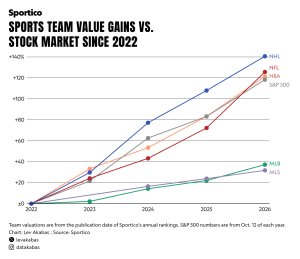
The cost of buying a sports team has soared in recent years, including record price tags in 2026 for the Los Angeles Lakers ($12.5 billion), Seattle Seahawks ($9.34 billion) and Los Angeles Angels ($4 billion). It has spurred talk of a sports valuation bubble. Yes, sports team values are up huge, but they trail stock

Anthropic to publicly file for IPO as early as Friday, sources say

Anthropic (ANTH.PVT) is set to publicly file its S-1 investor prospectus as soon as Friday, according to three people familiar with the artificial intelligence firm’s plans. The move would mark a crucial next step for what could be the biggest IPO in history. The much-anticipated public debut, expected to surpass SpaceX’s (SPCX) June IPO, is

​Europe stands by Ukraine – but how long can that last? | World news

​Europe stands by Ukraine – but how long can that last? | World news

Europe woke up last Friday to another belligerent outburst from Donald Trump – this time berating Ukraine’s wartime leader Volodymyr Zelenskyy again. Just a few days after his diesel deal with the Kremlin, the US president said Zelenskyy was more difficult to deal with than Vladimir Putin and blamed Ukraine’s leader for rocketing oil prices

Prediction: $150 a Month Invested in Micron Stock Will Be Worth This Much by Year-End 2030

Over the last year, memory chip manufacturers have benefited from extraordinary demand for artificial intelligence (AI). In particular, Micron Technology (NASDAQ: MU) has witnessed its market capitalization propel from just $53 billion at the start of the AI revolution to more than $1 trillion today. MU Market Cap data by YCharts Missed Nvidia in 2009?

Micron Tripled in 2026. Can It Repeat in 2027?

Micron (NASDAQ: MU) stock has more than tripled so far in 2026, making it the fourth-best-performing stock in the S&P 500 (SNPINDEX: ^GSPC) this year. That’s an impressive run, but for investors, the past really doesn’t matter; only the future. So, could Micron repeat this feat in 2027? One metric suggests that the answer to

Penang among world’s top 25 places to visit in 2027

Penang has earned further international recognition in tourism after being named one of the world’s 25 best places to visit in 2027 by National Geographic, highlighting the state’s rich heritage, cultural diversity and renowned food scene. The recognition places Penang on the prestigious list of destinations recommended by the internationally acclaimed publication, making it the

GM Just Beat Earnings Estimates. Is Ford Still the Better Dividend Stock?

Quick Read Ford (F) yields nearly 5% versus GM’s (GM) sub-1%, making Ford the clear winner for investors who need cash income today. GM’s dividend is covered 18 times by free cash flow versus Ford’s 2.6 times, making GM’s payout far safer for long-term holders. GM’s stock gained 187% over ten years versus Ford’s 62%,

HKSAR govt issues travel alert for France

People walk past a looted store after violence erupted during nationwide protests against rising living costs and poor conditions in schools in Paris, Oct 19, 2026. (PHOTO/AP) HONG KONG – The Hong Kong Special Administrative Region government on Tuesday issued an amber outbound travel alert (OTA) for France. The move was made in view of

Trumpflation Is Evolving, and There’s a New Twist That Threatens to Sink Stocks

For the better part of the last four years, the stock market has been unstoppable. The artificial intelligence (AI) infrastructure build-out has helped propel the Dow Jones Industrial Average (DJINDICES:^DJI), S&P 500 (SNPINDEX:^GSPC), and Nasdaq Composite (NASDAQINDEX:^IXIC) to several record highs this year. But these gains may prove fleeting, courtesy of Trumpflation — inflation specifically

Data compiled from the International Monetary Fund’s (IMF) World Economic Outlook 2026 and World Trade Organization (WTO) trade statistics tracks economic performance around leadership changes in five countries.

Regime change doesn’t translate into economic recovery: Data

Regime change doesn’t translate into economic recovery or chart a country’s growth path, recent data from South Asia shows. Economic indicators in some South Asian countries have shown signs of gradual improvement following major political upheavals, but they have yet to fully recover, with persistent challenges regarding GDP growth, inflation and trade. Data compiled from

Hong Kong schools weigh pulling out of Paris iGEM event amid unrest in France

Several Hong Kong schools are considering withdrawing from next month’s iGEM competition in Paris amid concerns over unrest in France, as the Education Bureau stressed that student safety should remain the top priority for overseas study activities. More than 30 secondary schools and universities, involving nearly 600 students and teachers, had been scheduled to travel

0
Would love your thoughts, please comment.x
()
x