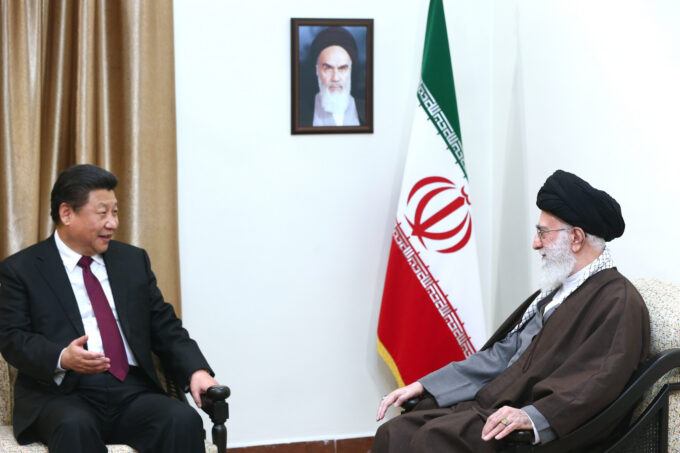
Ali Khamenei met with Xi Jinping in Tehran 2016. Photograph Source: Khamenei.ir – CC BY 4.0
The current volatility in the Middle East has once again placed the global security architecture under immense strain. Despite a fragile ceasefire, the shipping lanes of the Strait of Hormuz remain a graveyard of commercial activity. As of late April 2026, vessel tracking data shows a near-standstill, with fewer than five ships transiting the waterway daily. With diplomatic trust between major powers at a historic low, the international community is witnessing a period of profound geopolitical unpredictability.
Traditionally, such moments of American entanglement have been met with sharp rhetoric from Beijing. However, as the 2026 crisis reaches a critical juncture, China has been demonstrating a posture of strategic patience that signals a significant evolution in its long-term global ambitions.
While the Trump administration is engaged in a high-stakes diplomatic blitz for a second round of negotiations to salvage some kind of peace deal, Beijing’s response has been notably measured. There is a lack of the usual thunderous denunciations that characterized Chinese reactions during previous Middle Eastern interventions. Instead, the prevailing sentiment among Chinese officials and think-tank scholars is one of strategic anxiety. This shift from historical schadenfreude to current bewilderment reflects a China that is now too deeply integrated into the global order to find comfort in chaos.
The primary driver of this restraint is a clear-eyed recognition of economic interdependence. China remains the world’s largest importer of crude oil, and the continued blockade of the Strait of Hormuz directly threatens its industrial heartbeat. Unlike Russia, which often seeks to profit from geopolitical disruption, China operates as a status quo power that requires functioning markets and steady rules of engagement to sustain its growth.
Beijing’s current narrative suggests that the United States is taking the world back to the “law of the jungle.” This is not merely a moral critique; it is a pragmatic concern that an unpredictable hegemon is bad for business. When American policy fluctuates between naval blockades and sudden “surrender-style” peace deals, it undermines the globalized world that China has successfully navigated to build its current strength. Consequently, Beijing is not rushing to fill the military vacuum with its own naval flotillas. It is instead positioning itself as the reliable, continuous alternative to a volatile Washington.
This continuity is being built on the bedrock of frontier technologies. While the world is distracted by the kinetic realities of the conflict with Iran, China is doubling down on the sectors it believes will define the next century. Its dominance in green energy is no longer just a trend, it’s a strategic monopoly. In the first quarter of 2026, Chinese exports of the New Three—electrical vehicles, lithium-ion batteries, and solar panels—surged to record levels. China now controls over 80 percent of the global solar supply chain and more than 60 percent of the global EV battery market, with giants like CATL and BYD widening their lead.
As the energy crisis triggers a global scramble for alternatives, China has made itself the indispensable power. By dominating the supply chains for wind, solar, and battery storage, Beijing is offering other nations a path toward energy independence that relies on Chinese equipment and credit rather than American military protection. This strategy of locking countries into Chinese-made systems is a sophisticated form of soft power that creates long-term dependency without the friction of colonial-style alliances.
This influence is increasingly being felt in the financial sector. For decades, the United States has enjoyed the exorbitant privilegeof the world’s reserve currency. However, as of early 2026, institutions like the World Bank and the European Investment Bank are finding robust demand for non-dollar debt. Beijing has an explicit ambition to turn the renminbi into a global reserve currency. By expanding its bond market, China is creating a safety net for global investors who view American assets as increasingly risky due to domestic political volatility.
Furthermore, China’s approach to regional disputes, such as the situation in Taiwan, is being filtered through this lens of energy security. In March 2026, Beijing made a pointed offer to guarantee Taiwan’s electricity and energy security in exchange for “peaceful reunification,” an attempt to capitalize on the island’s vulnerability as its LNG supplies are choked off by the Hormuz blockade. Although Taipei dismissed the offer as “cognitive warfare,” the move highlighted Beijing’s strategy: providing infrastructure for survival while the United States provides the volatility of conflict. The Islamabad Process highlights another layer of this dynamic. While the U.S. delegation faces deep historical mistrust, China remains a silent but present factor. Beijing’s investment in the Digital Silk Road ensures that the underlying economic architecture of the region will remain heavily tilted toward China.
Beijing is using this specific moment in history to burnish its reputation as a responsible global actor while quietly building its hard power. The strategic patience exhibited today is the calculated silence of a power that believes time is on its side. Xi Jinping is betting that in a world weary of chaos, the power that brings equipment, credit, and continuity will ultimately prevail.
This first appeared on FPIF.