For most beginners, crypto is usually the easier market to get into. It is open 24/7, and on many platforms you can start with a fairly small amount of money. On the other hand, forex is a different beast. It is much bigger, more established, and generally more structured, which is one reason it often feels steadier to trade. The Bank for International Settlements estimated average daily FX turnover at $9.6 trillion in April 2025, so this is not really about deciding which market is better across the board. It is more about which one feels like the better fit.
There is no clear winner because these markets ask different things from traders and reward different skills. Crypto tends to suit people who are comfortable with a bit more noise and a lot more volatility. Forex usually works better for those who prefer a steadier framework and do not mind building their decisions around economic data and market discipline. The better fit depends on whether you handle volatility better than structure, or vice versa.
Editor’s Note (April 15, 2026): We fully updated this article in April 2026 to reflect current forex and crypto market conditions, refresh the beginner-focused comparison, and improve the structure throughout. Compared with the previous version, this update adds a clearer quick verdict, sharpens the accessibility, volatility, cost, and regulation sections and reframes the article around one core question: which market actually makes more sense for beginners.
Crypto vs Forex at a Glance
| Factor | Crypto Trading | Forex Trading |
|---|---|---|
| Market structure | Happens on a mix of centralized exchange platforms and decentralized exchange protocols | Mostly a global OTC market accessed through a forex broker |
| Trading hours | 24/7 | 24/5 across major global sessions |
| Volatility | Usually higher, especially outside Bitcoin and Ethereum | Usually lower in major currency pairs |
| Market liquidity | Deep in large pairs, but can vary a lot by coin, exchange, and time of day | Extremely deep in major pairs, with the BIS Triennial Survey showing average daily OTC FX turnover reached $9.6 trillion in April 2025 |
| Regulation | Uneven and still developing across jurisdictions | More established in many countries, especially for licensed retail brokers |
| Minimum capital | Often low because many platforms allow small purchases and fractional exposure | Can also be low at account level, but smaller moves usually demand more precision |
| Leverage | Widely available, but dangerous in a high-volatility market | Common and often central to the product, which can magnify even small moves |
| Learning curve | Easy to start, harder to manage emotionally | Harder to understand at first, but often better for building process and discipline |
| Fees and costs | Exchange fees, maker/taker fees, withdrawal fees, and sometimes gas fees | Bid-ask spread, commissions on some account types, and overnight rollover or swap fees |
| Best for | Tech-native beginners who want flexible access and smaller starting size | Beginners who like routine, macro themes, and tighter execution |
Crypto is generally easier to access, while forex is more established and more structured. That shapes everything from how the markets move to how beginners usually experience them.
What Is the Difference Between Crypto and Forex Trading?
Both crypto and forex involve directional trading, but the assets, market structure, and risks are different. Forex trades fiat currencies in a macro-driven OTC market, while crypto trades digital assets across exchanges and blockchains.
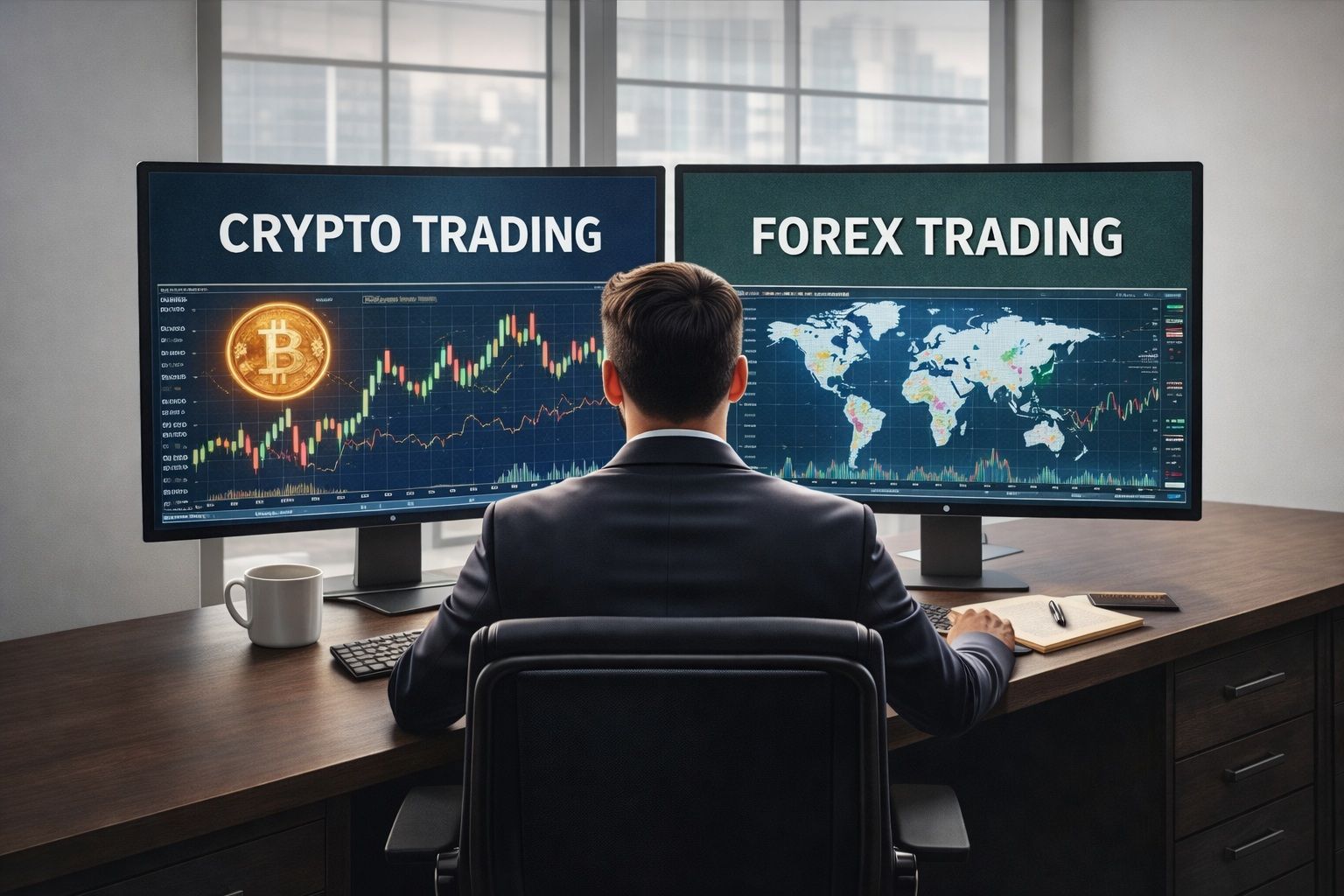 Forex Trades Fiat Currencies While Crypto Trades Digital Assets Across Decentralized Exchanges
How Forex Trading Works
Foreign exchange, or forex, is the global market for trading one fiat currency against another. It mostly operates over the counter, meaning there is no single central exchange sitting in the middle of every trade. Instead, pricing emerges across a network of banks, dealers, and liquidity providers. The BIS overview of OTC FX turnover and the NFA’s Forex Transactions: Regulatory Guide are both useful starting points for understanding how that market structure works.
Most retail traders do not interact with that market directly. They go through a broker instead. On the surface, it looks simple enough: you trade pairs like EUR/USD or USD/JPY and decide whether one currency is likely to strengthen or weaken against the other. But forex is really a market built on comparison. You are looking at one economy against another and trying to work out which side looks stronger based on rates, inflation, central bank policy, capital flows, and the wider macro
Forex is usually more macro-driven than narrative-driven. A euro-dollar trade is usually not about chasing a story. It is about reading the balance between two established monetary systems.
How Crypto Trading Works
Crypto trading happens across both centralized exchanges and decentralized protocols. On a centralized exchange, the platform handles custody for many users, matches orders, and presents trading in a format that feels familiar to anyone who has used a standard brokerage app. On a decentralized exchange, users trade directly from their own wallets through smart contracts and liquidity pools. The Uniswap protocol docs are a useful example because they show how this model works without relying on a traditional
For beginners, crypto trading often starts with pairs like BTC/USDT or ETH/USDC, where the quote asset is a stablecoin rather than fiat. That is one of the first ways crypto feels different from forex. You are not just stepping into a trading market. You are stepping into a broader digital asset system with its own tools, conventions, and risks.
If that part of the market feels unfamiliar, Coin Bureau’s guide to stablecoins explains why they sit at the center of crypto market liquidity.
Even someone who starts out just wanting to trade price usually ends up running into wallets, network fees, token standards, settlement times, and the basics of self-custody. In crypto, the market structure and the underlying technology are much more closely tied together. Forex is mostly about pricing the relationship between fiat currencies. Crypto is a trading market sitting on top of a new financi
Our guide to blockchain technology is helpful here because it frames the market as infrastructure.
The Core Beginner-Level Difference
Forex is a market shaped mostly by macroeconomics. Crypto is shaped by that too, but not nearly to the same extent.
In forex, prices tend to move when central banks shift policy, inflation comes in hotter or cooler than expected, or labour market data changes the outlook for rates. The market is essentially pricing one economy against another. Crypto does not work like that. It has its own rhythm, and that rhythm is often driven just as much by positioning, headlines, product launches, ETF developments, token unlocks, and changes in sentiment as it is by any wider economic backdrop.
This changes how beginners experience risk, timing, and decision-making. Forex can seem dry at first, but its moves are usually tied more clearly to macro data. Moves often have a clear macro reason behind them, even if timing them is another matter entirely. Crypto is more immediate. Beginners often find crypto easier to follow because headlines, listings, and token narratives are simpler to understand than rate differentials. A beginner can understand the excitement around a new token, a major listing, or a bullish ETF headline much faster than they can unpack rate differentials or bond market expectations.
That makes crypto more immediately engaging, not necessarily better. The same accessibility that draws beginners in can also encourage impulsive trading. Crypto’s speed and volatility can pull beginners into chasing moves, trading too often, or confusing momentum with conviction. Forex has its own risks, but it usually feels more measured. Crypto is often easier to access, while forex is often easier to analyze systematically.
The Coin Bureau’s guide to crypto trading psychology is useful because it shows how quickly high price volatility can turn a simple setup into a test of discipline.
Accessibility and Starting Capital
For most beginners, accessibility is one of the biggest decision points. Before they think about advanced strategy, they usually ask a simpler question: which market is easier to enter without making expensive mistakes right away?
Which Market Is Easier to Start With?
Crypto is usually the easier starting point for retail traders. That is partly because the platforms themselves do a better job of easing people in. On most major exchanges, the account setup is straightforward, the interface feels consumer-friendly, and the trading experience is often less daunting than what you get with a dedicated forex broker.
New users can open a crypto exchange account, fund it, and begin small trades without learning much platform-specific jargon. Many apps also make it easy to buy a fraction of an asset rather than a whole unit, which gives beginners room for small experiments. Fractional buying lowers the cash barrier, not the trading risk.
Forex can also be accessible, but it often feels more technical from the first login. Platform layouts tend to be built for active trading rather than general investing. The terminology can be heavier. Even the first few lessons usually assume some comfort with account minimum issues, lots, pips, margin, and macro headlines.
On ease of setup and first use, crypto usually wins.
How Much Capital Do You Need?
In theory, both markets can be started with a relatively small amount of money. In practice, what matters is not just the deposit. It is how price movement interacts with your strategy.
Forex often needs more precision because the underlying price moves in major pairs are usually smaller. That means beginners with small accounts sometimes feel pressure to use margin or leverage just to make a move feel meaningful. The danger is that leverage lowers the capital barrier while sharply increasing the risk of fast losses.
Crypto can feel more rewarding at lower ticket sizes because the moves are bigger. A small position in a volatile market can produce a noticeable gain or loss without needing the same degree of borrowed exposure. That makes crypto feel more alive for smaller accounts, but it also means losses can stack up quickly if position sizing is loose.
This is why capital requirements can be misleading if you think about them only in terms of minimum deposit. A $100 account can survive in either market if the trader sizes carefully and keeps expectations realistic. A larger account can still disappear fast if the trader chases volatility or treats leverage like a shortcut.
If you want a primer on how borrowed exposure changes the game, our guide on crypto margin trading explains the risk clearly.
Volatility, Risk, and Beginner Survival
This is the section beginners should take most seriously. Access matters. Platform design matters. But survival matters more. A beginner-friendly market is one where new traders can survive long enough to learn.
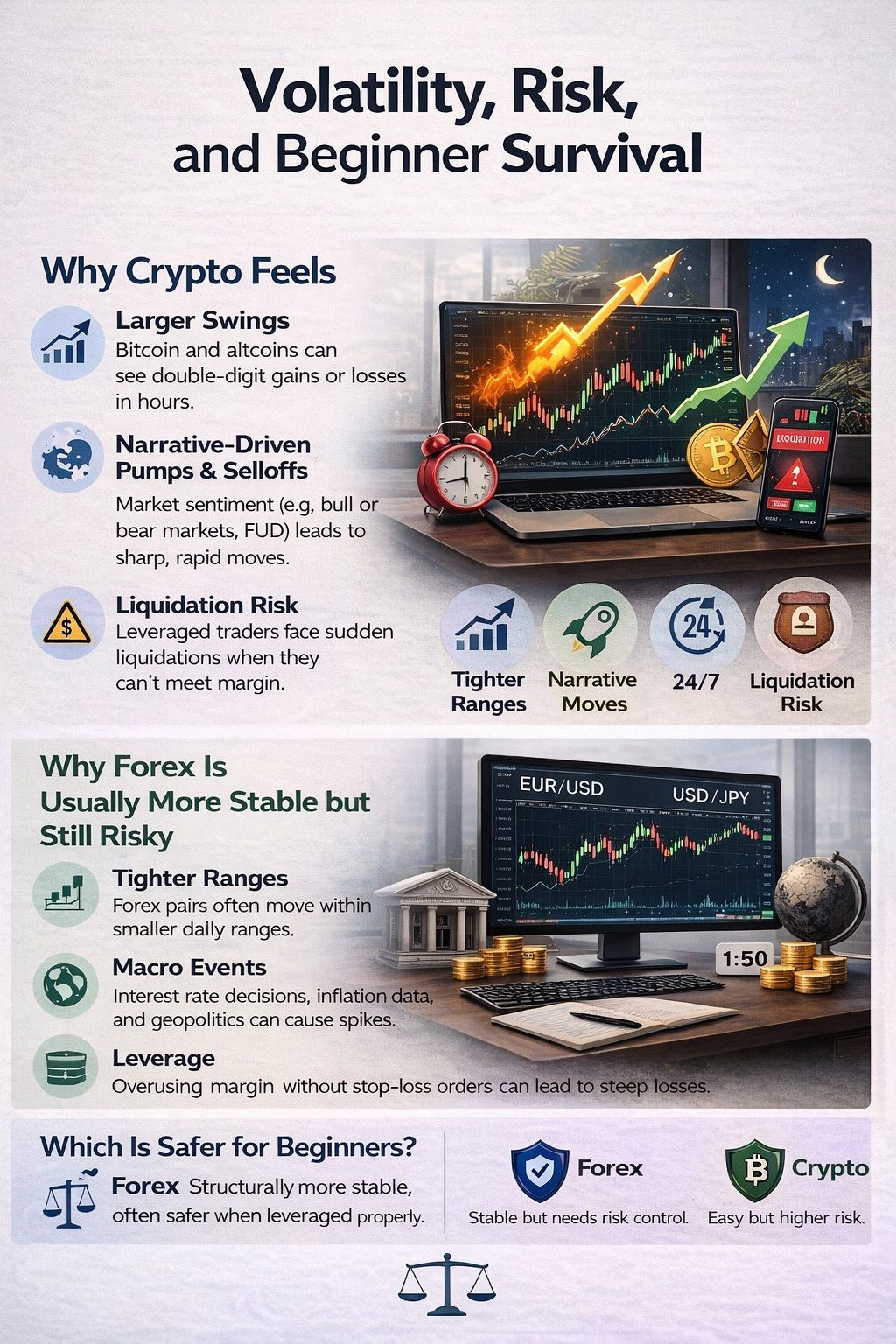 Access Matters, Platform Design Matters, But Survival Matters Most For Every Beginner Trader
Why Crypto Feels More Exciting and More Dangerous
What pulls many people into crypto is the speed of the price action. Bitcoin can swing hard on ETF news, macro shocks, exchange flows, or a quick change in market mood. Altcoins usually take that a step further, partly because liquidity is thinner and confidence can disappear quickly when the narrative starts to crack. In a rising market, that can feel full of opportunity. When conditions turn, it can just as easily become a grind of short-lived rebounds, heavier selloffs, and constant doubt about whether the next move is real.
Crypto is also unusually sensitive to storytelling. A token can rally because a sector becomes fashionable, because a listing rumor spreads, or because traders crowd into the same idea at the same time. Narrative-driven markets can move far faster than fundamentals alone would suggest.
There is also the timing problem. Crypto trades all day, every day. That means large moves can happen overnight or on weekends, when many beginners assume markets will be quiet. Leveraged traders face real liquidation risk in that environment, especially during thin weekend conditions. And emotionally, crypto can be difficult because every move feels urgent. FUD spreads fast. So does greed.
If a market makes you feel like you must always be watching, the position may be too large or the strategy may be too fragile. Oversized positions damage both capital and decision-making.
Why Forex Is Usually More Stable but Still Risky
Forex is usually more stable because the largest pairs sit in an enormous and deeply liquid market. The BIS survey of OTC foreign exchange turnover shows just how large that market is, and that size tends to keep daily moves in major pairs much tighter than what most crypto traders expect.
Lower volatility does not make forex safe, especially when leverage is involved.
Forex takes most of its direction from central banks, interest rates, inflation, and economic data. When the outlook changes, major pairs tend to move with it. Jobs numbers and inflation reports can do the same when they shift expectations around future policy. Because the market often moves in relatively small increments, beginners can mistake it for a gentler environment. It is not. The risk is still there, just packaged differently.
The real problem is leverage. In forex, leverage can turn a modest move into a large percentage gain or loss. This is the reason stop-loss orders are so important. Stability does not equal safety when a trader uses too much borrowed exposure or refuses to accept a small loss. The CFTC’s forex advisory makes the broader point clearly: forex can be risky, and it is not a suitable place for money you cannot afford to lose.
Which Market Is Safer for Beginners?
If you are looking purely at market structure, forex is usually the safer place for a beginner. It is older, deeper, and generally less volatile than crypto, which makes the trading environment feel more stable from the outset.
But that is only part of the story. What a beginner actually experiences can look very different. Crypto is easier to get into, but it often exposes new traders to more day-to-day risk. Prices swing harder, the market is more emotionally charged, and there are more ways to make a mistake beyond the trade itself. Platform failures, poor security practices, and simple custody errors all add risk in ways that do not really exist to the same degree in forex. Forex, by contrast, is usually calmer on the surface, but that calm can disappear quickly when leverage is used carelessly or risk controls are ignored.
In practice, safety depends far less on whether you choose crypto or forex and far more on how you trade, where you trade, and how well you manage risk. In crypto, that also means thinking seriously about custody. Holding your own assets removes one layer of dependence on an exchange, but it also means the responsibility sits with you.
Trading Hours, Lifestyle Fit and Discipline
Beginners often overlook schedule fit, even though it affects discipline. The market that fits your schedule and temperament is usually the market you are more likely to trade well.
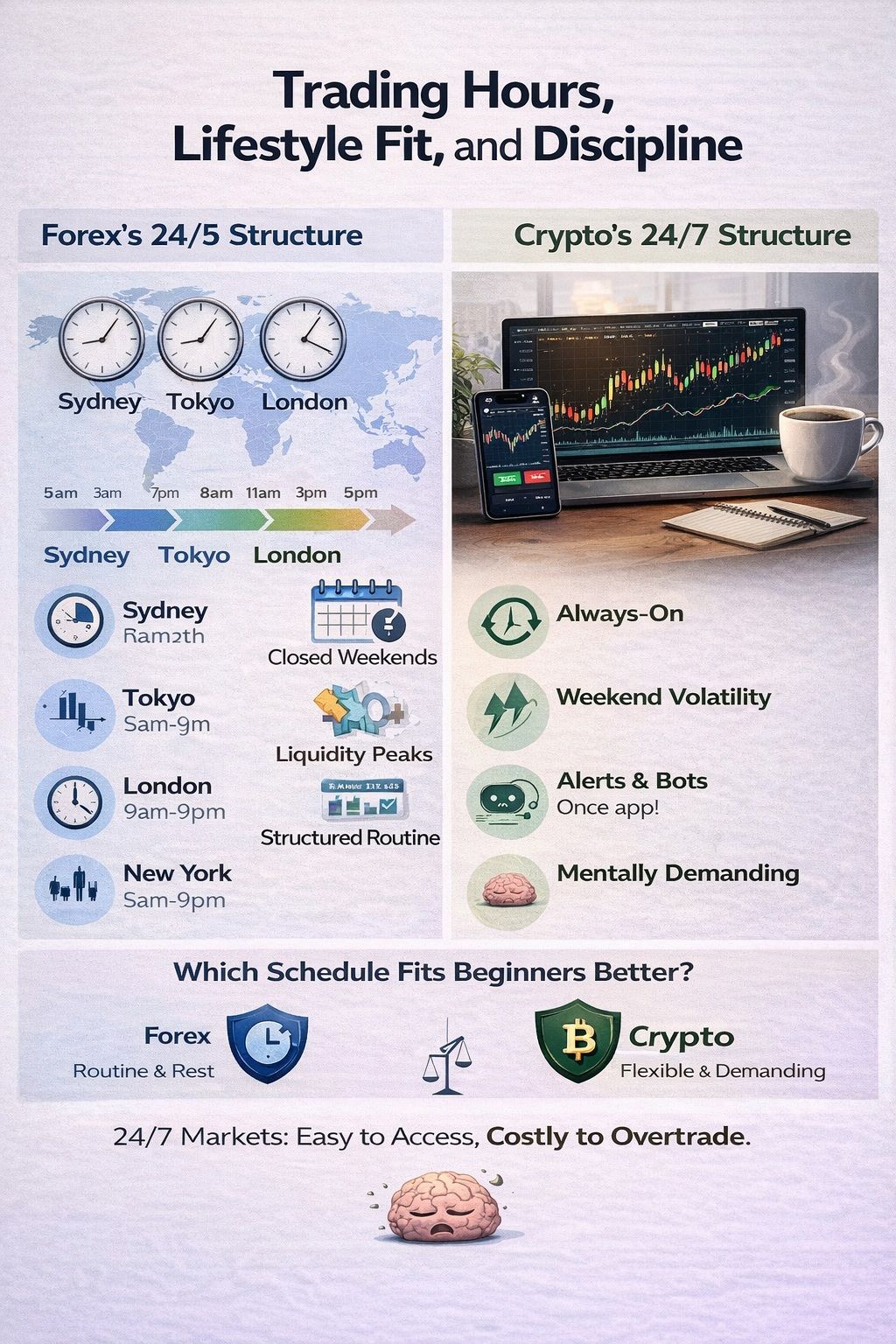 The Market That Fits Your Schedule And Temperament Is The One You Trade Well
Forex’s 24/5 Structure
Forex is a 24-hour market during the business week, with trading activity moving through Sydney, Tokyo, London, and New York as the day unfolds. Daylight saving changes can slightly alter the session clock, but not the structure itself. For beginners, the key benefit is routine, not the exact session clock.
London and New York overlap is often one of the busiest periods, which tends to improve execution in major pairs. More importantly for beginners, the 24/5 structure creates rhythm. The market opens, shifts, slows, and closes. The weekend closure forces a pause. That natural structure can help traders review, reset, and avoid feeling like every hour must be monetized.
Forex tends to suit people who prefer routine. If you like the idea of planning around specific windows rather than staying half-attached to your phone all week, that is a real advantage.
Crypto’s 24/7 Structure
Crypto never closes. The crypto market is live on weekdays, weekends, holidays, and late at night. For beginners, that can feel empowering at first. 24/7 trading means there is always a chart to watch and always a chance to enter.
The downside of 24/7 access is decision fatigue. Crypto can produce meaningful weekend volatility, and it often requires tighter use of market alerts, trading bots, or some form of automated trading support just to keep attention under control. The mechanics are simple enough to learn, but the environment is mentally demanding.
That always-on design is part of why Coin Bureau’s guide to basic crypto trading is helpful for first-timers.
There is a practical issue here too. When a market never closes, it becomes much harder to switch off from it. For beginners, that can turn into a habit before they even realize it. Checking prices in the morning turns into checking them at lunch, at dinner, and again before bed. It does not always feel excessive in the moment. It just starts to creep into the rest of the day.
Which Schedule Fits Beginners Better?
Forex usually fits routine-based learners better. Crypto usually fits flexible users who want access at any time.
The bigger issue is fatigue. Many people underestimate how much mental energy 24/7 markets can drain. Trading discipline is harder when there is no closing bell, no natural review window, and no clear end to the decision cycle. That is how overtrading starts. That is how overtrading gets normalized.
If you learn best through structure, set times, and repetition, forex often has the edge. If you value flexibility and have strong emotional control, crypto may feel more natural. Neither choice is inherently better. It depends on how well the market fits your routine and how honest you are about your own limits.
Costs, Platforms and Execution
Cost matters in both markets, but beginners often look at only the headline fee. The real trading cost is the full mix of spreads, commissions, slippage, platform design, and how well orders are executed when the market gets busy.
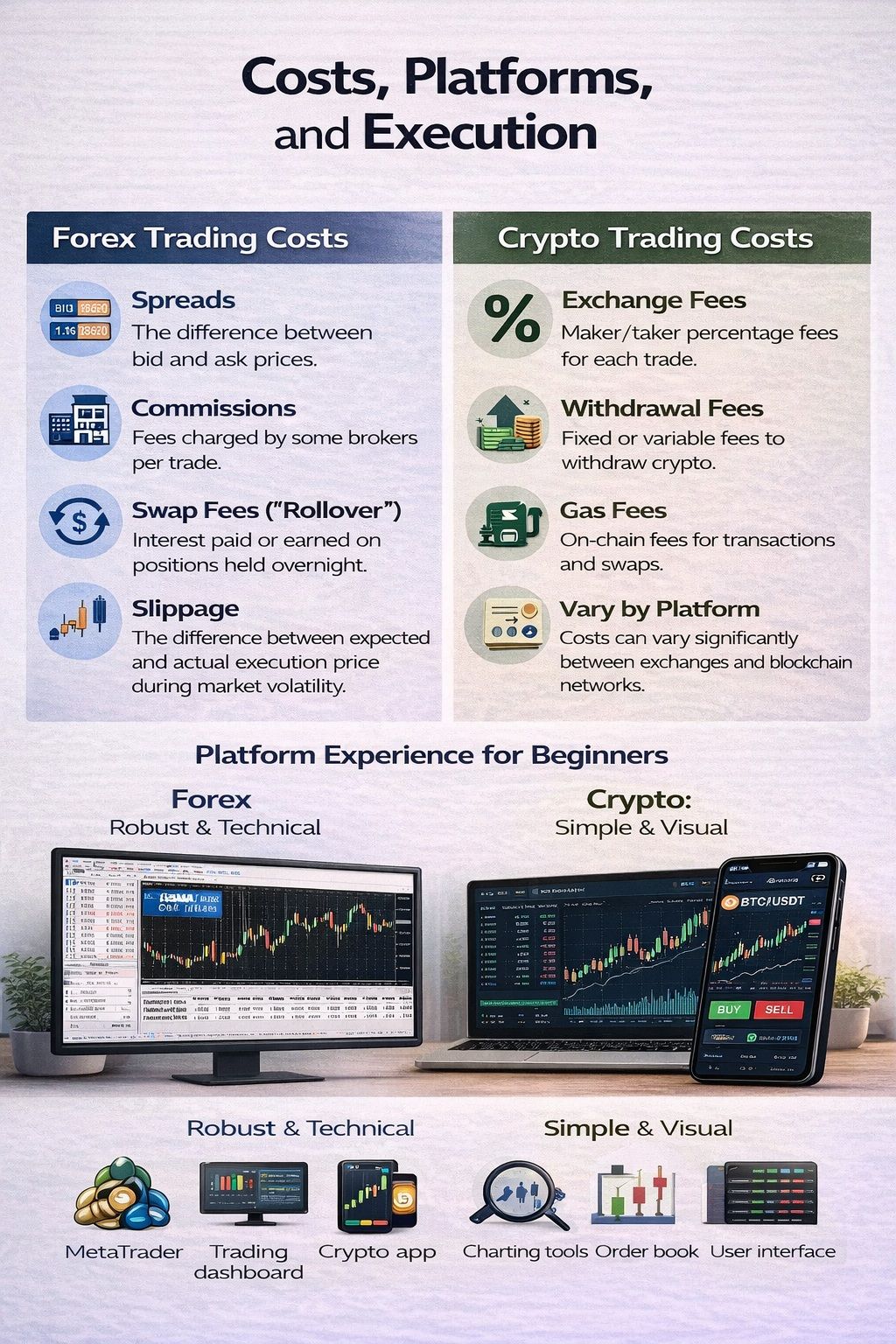 Real Trading Cost Is Spreads, Commissions, Slippage, And Execution Quality Combined
Forex Trading Costs
Forex trading costs usually start with the spread, but that headline number only tells part of the story. On OANDA’s US pricing page, spread-only pricing for some of its most traded pairs is listed at 1.4 pips for EUR/USD, 2.0 pips for GBP/USD, 1.8 pips for EUR/JPY, and 3.1 pips for GBP/JPY. Those figures are useful as real examples, but they are broker-specific snapshots rather than a universal cost for trading forex.
The bigger issue is that the quoted spread is not always the full bill. If you keep a position open past 5 p.m. ET, OANDA’s financing guide says the trade is treated as an overnight position and becomes subject to a financing charge or credit. The same page notes that funding rates can change daily and that OANDA applies an annualized admin fee of 1.00% on most pairs, 2.00% on CZK, HUF, SAR, THB, and ZAR pairs, and 4.00% on TRY pairs. In its own worked example, a 100,000-unit EUR/USD long with a -3.00% long rate produces a daily financing cost of -$9.52.
The key point is that entry cost and total holding cost are not the same. Forex can look cheap at entry and still end up costing more than expected once holding costs and execution are taken into account. A tight spread helps, but it matters less if market conditions deteriorate or if rollover charges start stacking up. In practice, execution quality matters just as much as the published fee schedule.
Crypto Trading Costs
Crypto trading costs are usually less uniform and more platform-dependent. On Coinbase Exchange’s fee schedule, taker fees range from 0.60% to 0.04%, while maker fees range from 0.40% to 0.00%, depending on 30-day volume. Coinbase Advanced also explains the core distinction: taker orders remove liquidity and maker orders add it. On Kraken’s spot fee schedule, standard spot crypto trading starts at 0.25% maker and 0.40% taker, falling as volume rises, with top published tiers reaching 0.00% maker and 0.05% taker.
Even then, the headline trading fee is not always the whole story. Kraken’s broader fee overview makes clear that fees depend on which service a user is actually using, and Kraken’s main fee schedule separately states that instant and recurring trades carry a 1% trading fee while custom orders carry a 1.5% fee. Therefore, two traders can use the same platform and still pay very different effective costs depending on how they place the trade.
On decentralized exchanges, there is a second cost layer that does not exist in the same way on a typical brokerage-style app. Ethereum’s gas documentation explains that every transaction requires gas and that fees rise when demand is high because users offer higher tips to improve their chances of getting into the next block. That makes DEX trading more than just a swap fee problem. You also have to account for network fees, on-chain settlement, and price impact from available liquidity. A trade can look cheap on screen and still turn expensive by the time everything is included.
Platform Experience for Beginners
Crypto platforms are usually easier for first-time users to navigate. The average crypto app tends to be cleaner, more visual, and less intimidating than a traditional trading terminal. This is important because beginners often judge a market by how easy it feels to navigate in the first hour.
Forex platforms can feel more technical. MetaTrader remains one of the best-known tools in the space. It offers deep charting, order control, indicators, and automation. For a complete beginner, though, that same depth can feel dense.
Crypto also offers more product variety inside one interface. That can be useful because a single app may include spot trading, staking, derivatives, wallet connections, and on-chain swaps. It can also be distracting because more buttons do not always mean better decisions. A polished user interface cannot replace understanding the order book, the chart, or the difference between buying an asset and borrowing exposure to it.
Regulation, Security and Trust
Beginners do not just need a market that is easy to use. They need one they can trust enough to learn in without stepping into avoidable platform risk.
Forex Regulation
Forex brokers usually operate within a more established regulatory system than crypto platforms. In the US, retail forex falls mainly under the CFTC and the National Futures Association, which gives the market a level of oversight that still feels patchy in much of crypto.
Forex still has weak brokers and low-quality jurisdictions. There are weak brokers, loose jurisdictions, and plenty of room for bad practice. Even so, the market has been regulated for longer, and that makes the overall framework easier for beginners to understand than what they are likely to run into in crypto.
Even with variation across jurisdictions, forex regulation is generally more mature.
Crypto Security and Regulatory Tradeoffs
Crypto is more uneven. Regulation differs by jurisdiction, and the beginner experience can range from highly polished to dangerously loose depending on the platform. The UK Financial Conduct Authority’s cryptoassets hub is a good example of that patchwork in practice, because it makes clear that parts of the sector sit inside regulatory oversight while large parts of the consumer experience still carry significant risk.
This changes the risk profile for beginners. With a centralized exchange, convenience is part of the package. With a decentralized exchange, control is part of the package. You do not usually get both to the same degree. The tradeoff is not cosmetic. It affects who controls the assets, how settlement works, and who is left carrying the risk when something goes wrong.
Crypto also exposes beginners to a wider range of security problems. It is not just about whether the price goes up or down. There are phishing attacks, fake apps, wallet drains, approval scams, malicious contracts, and rug pulls to think about as well. That makes security part of the beginner experience from the outset, not something you learn later once you are more advanced. The FCA’s page on investing in crypto and its warning on the risks of investing in cryptoassets both make the same point: volatility is only one part of the risk. Firm failure, weak protections, and cyber-related threats matter too.
Self-custody makes that especially clear. It gives you more control, but it also means there is no one to step in when a mistake is made. If a recovery phrase is lost or the wrong transaction is approved, the loss may simply be final. That is not a side issue in crypto. For beginners, it is one of the central tradeoffs.
Which Market Feels More Trustworthy to a Beginner?
For most beginners, forex feels more trustworthy because the structure is clearer and the protections are more familiar.
Crypto can absolutely be used responsibly, but trustworthy access depends much more on platform choice, exchange security, and user behavior. In practice, that means crypto demands more active judgment from day one. You need to think about custody, compliance, wallet setup, scam filtering, and venue quality before you even get to the trade itself.
So if a beginner says they want the market that feels most straightforward from a trust perspective, forex usually wins. If they are willing to take on more personal responsibility in exchange for more flexibility and broader product access, crypto becomes more viable.
Who Should Choose Crypto and Who Should Choose Forex?
This is where the comparison becomes practical. The best market is not the one with the strongest community or the loudest online advocates. It is the one that matches your capital, mindset, and learning style.
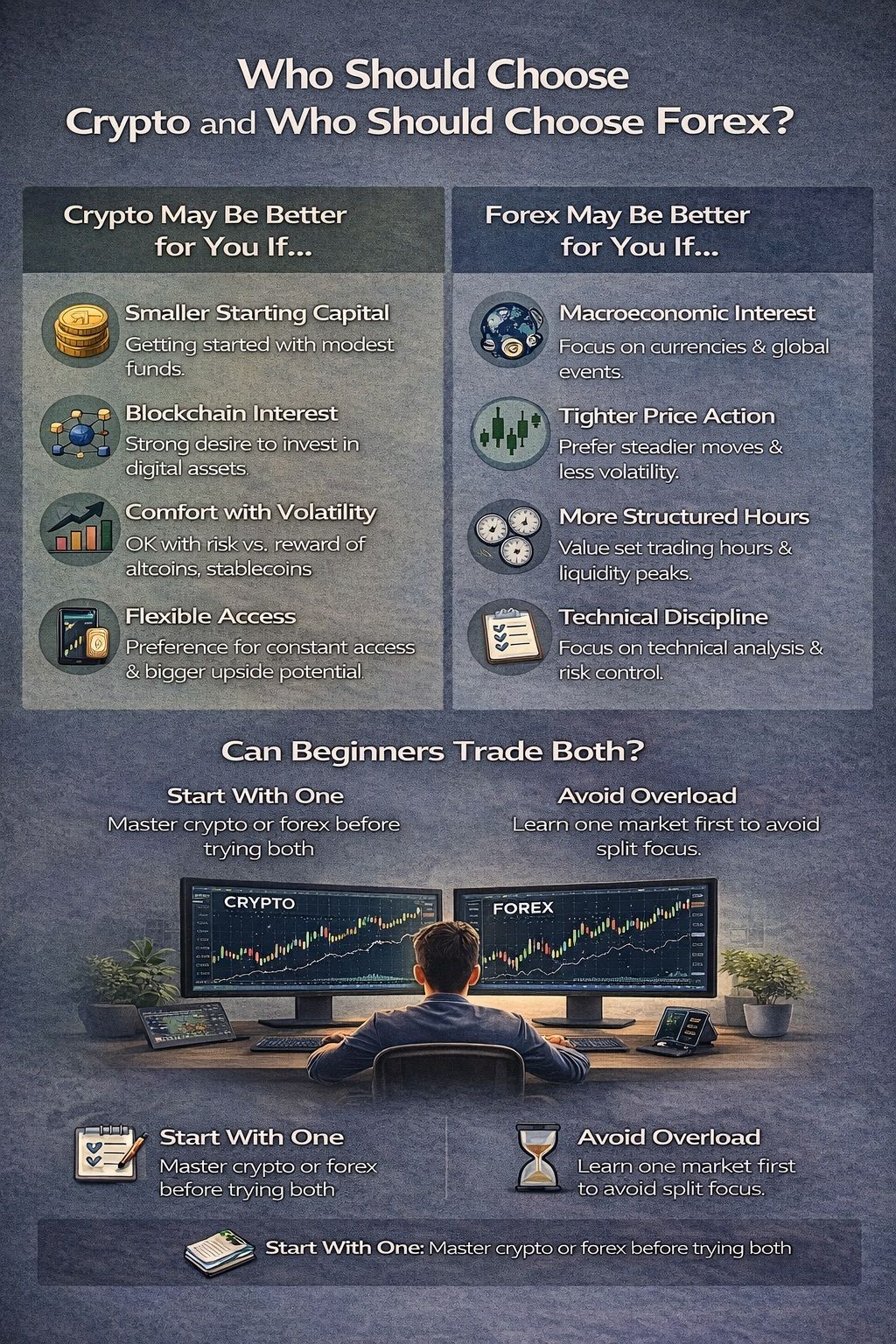 The Best Market Matches Your Capital, Mindset, And Personal Learning Style
Crypto May Be Better for You If…
Crypto may be the better fit if you are starting with a smaller amount of money, already have an interest in blockchain and digital assets, and do not mind a more volatile market.
It also tends to suit people who want flexibility. Crypto is easier to access at any time, the tools are often built with retail users in mind, and the learning curve can lead into much more than trading alone. Once you spend time in the market, you quickly run into wallets, altcoins, stablecoins, and the wider mechanics that keep the ecosystem running. For some beginners, that makes crypto more engaging in a useful way rather than just a speculative one.
Crypto can also feel more approachable when the starting account is small. But that does not make it safer. It simply makes the entry process easier.
Coin Bureau’s guide to crypto market structure is helpful here, because it explains how the market’s underlying plumbing shapes the way it behaves.
Forex May Be Better for You If…
Forex may be a better fit if you are naturally more interested in currencies, economic data, and the bigger forces that move markets.
It also tends to work better for people who like structure. The market has a clearer rhythm, price moves are usually tighter, and the trading style often rewards patience more than impulse. A lot of forex traders use charts, but the good ones are usually defined less by indicators and more by discipline. If you prefer routine, like focusing on a specific session, and want to build skill in a market that feels more measured, forex will often make more sense.
Put simply, forex is usually better suited to people who would rather trade with a plan than chase excitement.
Can Beginners Trade Both?
They can, but most probably should not start that way.
The problem is not that crypto and forex clash. It is that learning to trade at all is already enough work on its own. You are trying to build a process, learn how risk actually feels when real money is involved, and figure out how you behave when a trade goes against you. That is a lot to absorb in one market. Trying to do it in two at once usually means you stay scattered for longer than you need to.
A lot of beginners also tell themselves they are diversifying by following both. Usually, they are not. They are just dividing their focus. One market starts to make sense, then the other pulls them in a different direction. Before long, they are flipping between two sets of charts, two types of news flow, and two completely different trading rhythms without really getting comfortable in either.
The smarter move is usually the less exciting one. Pick one market, stick with it, and give yourself enough time to understand how it behaves. Once you are no longer changing your size on emotion, second-guessing every entry, or chasing action just to feel involved, then branching out starts to make more sense.