Neither President Donald Trump nor Gov. Gavin Newsom, D-Calif., talk about dyslexia and the people who’ve been diagnosed with it with the care and nuance that the topic deserves. Newsom, who’s been publicly talking about his dyslexia as of late, can be too glib about the challenges dyslexia pose, and Trump, not surprisingly, has talked about people with dyslexia as if they’re broken.
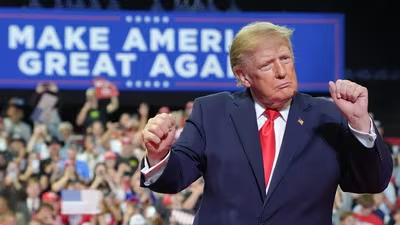
Newsom, as everyone knows, will likely seek the Democratic Party’s presidential nomination in 2028, and Trump referred to him Monday when he said from the Resolute Desk, “Honestly, I’m all for people with learning disabilities, but not for my president. I think a president should not have learning disabilities.”
Honestly, I’m all for people with learning disabilities, but not for my president. I think a president should not have learning disabilities.
president donald trump
Trump went on to insult Newsom even more, saying, “Everything about him is dumb.” My mind immediately flashed back to elementary school, where I was regularly pulled out of class for a program called “Handwriting Without Tears.” I had dyspraxia, which impedes motor skills, and had to grip an extra-large red pen to make my penmanship legible. Though my grades shot up and I eventually got high marks for my essays, I still remember the hurtful comments from my classmates. Later, when I was pulled out of class for intensive assistance, known as “RSP,” my classmates mocked that the initials were for “Really Stupid People.”
I only recently learned that RSP stood for “Resource Support Program,” but the “Really Stupid People” taunt I heard on the playground sticks in my head 25 years later.
Trump’s statement that nobody with a learning disability should be president fits a pattern of his that began at least as early as 2015, when he mocked a disabled reporter at The New York Times. He doesn’t think disabled people have a role in public life, and he’s gone so far as to wrongly blame intellectually disabled people for a deadly air collision that happened soon after the start of his second term. Trump misrepresented a policy that pushed for the Federal Aviation Administration to hire people with such disabilities for some positions with the falsehood that the Obama and Biden administration wanted them to be “air traffic controllers. I don’t think so.”
If people with disabilities are not in public life, then they are out of the public’s mind and not seen as a group of people whose needs must be addressed but a problem that must be hidden.
I carried an internalized ableism to college, and at some point I even convinced myself that I must not be truly disabled if I was there. But I had difficulty grasping the concept of abstract ideas, a common trait among some people with autism spectrum disorder, and after I turned in a column for my class on Southern politics, my professor called me into his office and asked, “Do you have Asperger’s?” using a now-outdated term for a part of the autism spectrum. I felt exposed. I’d kept my being on the spectrum on a need-to-know basis.
I write columns today because I had a professor who showed me I could be disabled and be a writer.
Thankfully, my professor had some familiarity with my particular issues from his own life, never judged me and let me workshop my ideas for columns with him. I write columns today because I had a professor who showed me I could be disabled and be a writer.
I have no particular love for Newsom. Growing up in California, I constantly saw the then-mayor of San Francisco on television and never warmed to him.

Eric Garcia is an author and senior correspondent for The Independent.