U.S. President Donald Trump’s comment that he is discussing potential arms sales to Taiwan with Chinese President Xi Jinping is raising concerns in Taipei as the island democracy relies on U.S. backing in the face of China ’s territorial claims.
On Monday, Trump told journalists he is discussing the potential sales with the Chinese leader, an unexpected statement that experts say might violate decades-old foreign policy principles defining the United States’ relationship with self-ruled Taiwan.
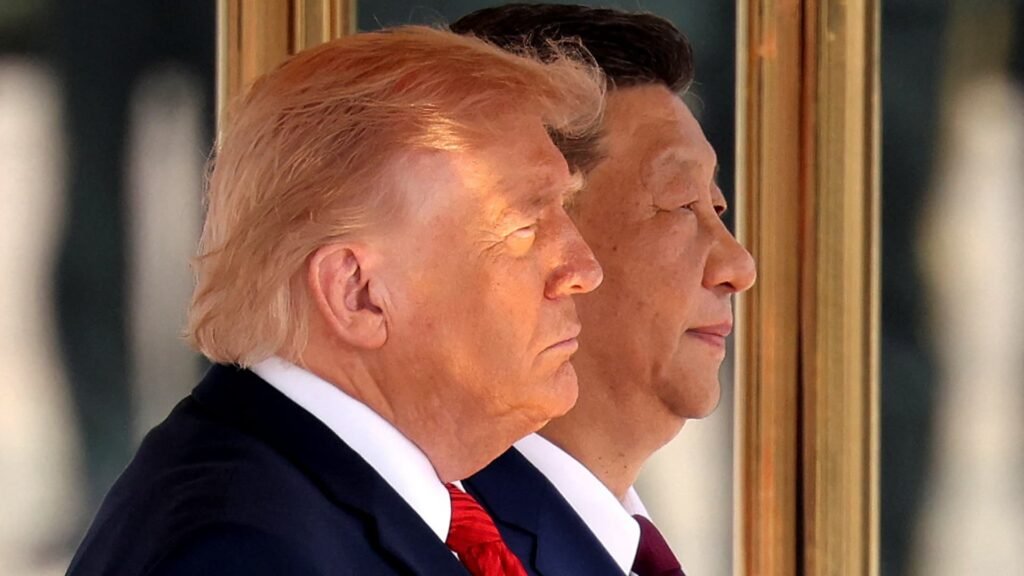
“I’ve talked to him about it, made a good conversation, and we’ll make a determination pretty soon,” Trump said when asked about Xi’s opposition to the arms sales. He added he has “a very good relationship with President Xi.”
His comments have stirred a debate among some experts and politicians about whether this signals a potential change in U.S. policy toward Taiwan ahead of Trump’s planned visit to China in April. Here is some context:
A ‘dangerous precedent’?
Trump consulting Xi about arms sales to Taiwan may violate the so-called Six Assurances, a set of non-binding U.S. policy principles formulated in 1982 under President Ronald Reagan that have helped to guide the U.S. relationship with Taipei, said William Yang, a senior Northeast Asia analyst for the International Crisis Group.
The second of the Six Assurances states that the U.S. “did not agree to consult with the People’s Republic of China on arms sales to Taiwan.”
“That basically has been executed by several U.S. presidents after Ronald Reagan to justify and continue the arms sales to Taiwan without actually discussing the topic with China over the past few decades,” Yang said.
He added that Trump may be creating a “dangerous precedent” allowing for Beijing to make demands regarding U.S. arms sales to Taiwan.
Taiwan’s government, which is observing a weeklong Lunar New Year holiday, has not reacted to Trump’s statements.
China has condemned record U.S. arms sales to Taiwan
The tensions are rooted in China’s claims over Taiwan, which China says needs to be annexed, by force if necessary. Beijing prohibits any country it has diplomatic relations with from having formal ties with Taipei and regularly sends warships and military aircraft near the island.
Despite not having official ties with Taiwan, the U.S. is the island’s biggest informal backer and arms supplier. It is obligated by domestic law to provide Taiwan with sufficient hardware to deter any armed attack from the mainland.
In December, the Trump administration announced a record-breaking arms sales package to Taiwan worth more than $11 billion.
China bristled at the deal, and in a phone conversation with Trump earlier this month, Xi warned that “the U.S. must handle the issue of arms sales to Taiwan with prudence.”
Xi also stressed that “the Taiwan question is the most important issue in China-U.S. relations,” according to a readout of their call published by the Chinese foreign ministry.
Three pillars of U.S.-Taiwan relations
In the absence of formal diplomatic relations with Taiwan, U.S. policies toward the self-ruled island are based on three pillars, said Lev Nachman, a political science professor at National Taiwan University.
The first pillar, and the only one that’s been formalized into law, is the Taiwan Relations Act. It was passed by Congress in 1979, the year the U.S. established formal diplomatic relations with China and severed ties with Taiwan. The act binds the U.S. to provide Taiwan with the means to defend itself while regarding all threats to the island as a security concern.
Secondly, the Three Communiques are three sets of statements by the U.S. and Chinese governments in the 1970s and 1980s that cover a variety of topics including Taiwan. Through the communiques, the U.S. acknowledges that there is only one China without recognizing Beijing’s sovereignty over Taiwan. The Three Communiques form the basis of U.S. strategic ambiguity on Taiwan, leaving the U.S. with room to support the island while not breaking its diplomatic agreements with China.
Finally, the Six Assurances were formulated as a means to reassure Taiwan of continued U.S. support, and they are believed to have been upheld by all U.S. presidents since Reagan.
Trump’s comments give the impression that China may have a say in the quantity of arms sales to Taiwan, said Hoo Tiang Boon, an associate professor of international relations at Nanyang Technological University in Singapore.
“Even if eventually the U.S. will approve whatever arms sales packages to Taiwan, it is a disturbing development, particularly from the perspective of Taiwan because it sounds like it would be an issue that would be bargained away,” Hoo said.
Taiwan to feature prominently in Trump’s China visit
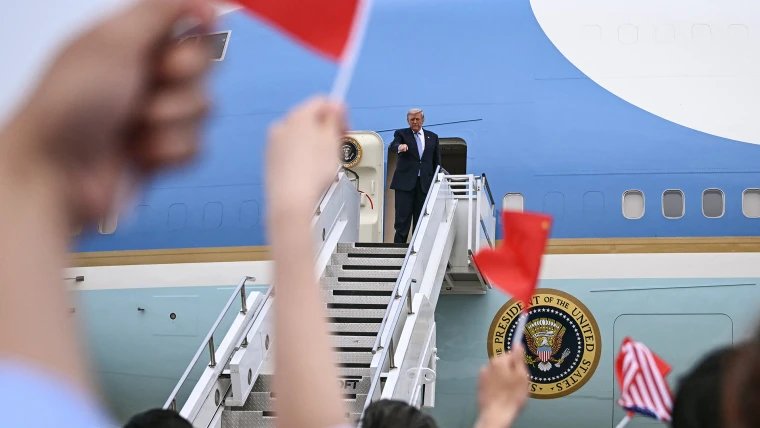
Trump is set to make his first trip to China in his current term in April, and Taiwan likely will feature prominently during his meetings with Xi, along with issues such as trade and access to advanced technologies.
Uncertainty about whether Trump will address the issue of arms sales to Taiwan during his visit is set to amplify skepticism on the island about whether the U.S. would intervene in a potential Chinese attack, Yang said.
“This further surge of skepticism, anxiety about the United States within Taiwan is exactly what China would be aiming for,” he added.
The island’s independence-leaning government led by President Lai Ching-te is already having a hard time securing payment for the existing U.S. arms sales packages, with the budget stalled in parliament.
Taiwan’s opposition lawmakers said Monday they would review a $40 billion special defense budget once they reconvene after the holiday on Feb. 23.
___
AP journalist Huizhong Wu in Bangkok contributed to this report.
© Copyright 2026 Associated Press. All rights reserved. This material may not be published, broadcast, rewritten or redistributed.