Economist sees ‘doom’ in 2026 for stocks, real estate, expects ‘ignorant’ Trump to trigger disaster. Protect your money
Wealthion : Somodevilla / Getty Images
Moneywise and Yahoo Finance LLC may earn commission or revenue through links in the content below.
The upward momentum in the U.S. stock market has been strong, with the S&P 500 finishing 2025 up about 16%. But according to veteran investor and economist Marc Faber, 2026 won’t be sunshine and rainbows — far from it.
When asked what he expects 2026 to bring in a recent interview with Wealthion, Faber didn’t hesitate: “It will be doom.”
His concern stems from decades of money printing and inflation — not just in the cost of living, but also in what he describes as “badly inflated” asset prices over the “last 40 years or so.”
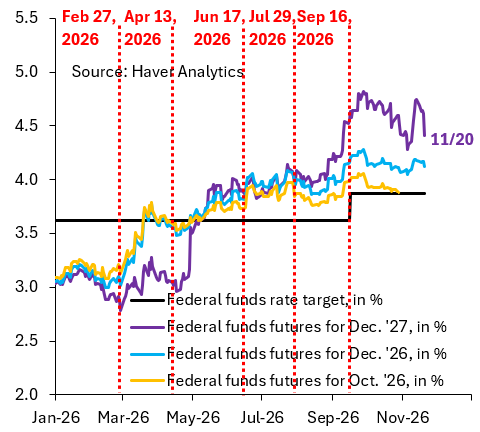
One factor he believes could rattle U.S. stocks this year is interest rates.
“In my view, this year we’ll get a big breakout of interest rates either up or down and the stock market will not like it,” he said.
Markets typically cheer lower rates — so why does Faber think stocks won’t like rates moving in either direction?
He explained that interest rates “are not particularly high” at present, with the 10-year Treasury yielding roughly 4%. At the same time, he doesn’t believe the cost of living is rising at just 4% a year, but rather “between 6% and 12%.”
“So the interest rate is not high in real terms and that is an inflationary environment,” Faber said. “And I believe that the only way interest rates would go down significantly is… we are overestimating growth,” he said.
With the U.S. stock market sitting near all-time highs, the word “bubble” is starting to surface — and Faber says investor behavior is a key warning sign.
“Most people own Tesla and Nvidia around the world,” he said. “They trade them 24 hours a day. And they trade options and all kinds of products. Leverage is a symptom of excessive money in the system and of a bubble.”
Faber says he expects a correction in stocks, but the stock market isn’t the only place where he sees excess. For many Americans, their home is the largest asset they own — and Faber believes trouble is brewing there as well.
“For the middle class the bulk of the assets is residential real estate and that I think will go down because it’s in a colossal bubble as well,” he said.
Faber’s concerns aren’t limited to markets alone. He also warned that political intervention could worsen an already fragile outlook — including under President Donald Trump.
“I would have voted for Mr. Trump any time compared to the Democrats, but he is an ignorant interventionist,” Faber said. “He intervenes in everything and sooner or later he’ll make a major disaster.”
So with such dire predictions, what about simply holding cash?
That’s not Faber’s preference either. He argues bluntly that “all currencies are bad — all paper monies are bad” — a view consistent with his long-standing warnings about inflation eroding purchasing power.
The silver lining? Faber also shared what he does feel confident holding — an asset class he believes could continue to rise even as other markets falter.
Faber has never been shy about his love for precious metals — and in moments like this, he leans into them with even more conviction.
“I feel more comfortable to own silver and gold and platinum,” he said.
Gold and silver have long been viewed as safe-haven assets. Unlike fiat currencies, they can’t be printed at will by central banks and their value isn’t tied to any single country or economy. That scarcity, combined with their history as a store of value, is why investors often flock to the metals during periods of inflation, economic turmoil or geopolitical instability — pushing prices higher.
Those forces have already fueled powerful rallies. When asked whether the recent run-up in precious metals could continue, Faber didn’t hesitate, responding with a simple “Yes.”
He added that despite gold’s increasing popularity, most people still “have very little gold” as a percentage of their total assets.
That view is echoed by Ray Dalio, founder of the world’s largest hedge fund, Bridgewater Associates. Dalio told CNBC last year that “people don’t have, typically, an adequate amount of gold in their portfolio,” adding that “when bad times come, gold is a very effective diversifier.”
And they’re not alone. JPMorgan CEO Jamie Dimon recently said that in this environment, gold can “easily” rise to $10,000 an ounce.
Precious metals IRAs allow investors to hold physical gold, silver or other related assets within a retirement account, thereby combining the tax advantages of an IRA with the protective benefits of investing in gold and silver, making it an option for those looking to help shield their retirement funds against economic uncertainties.
To learn more, you can get a free information guide that includes details on how to get up to $20,000 in free metals on qualifying purchases.
While Faber has issued a dire warning for U.S. stocks broadly, he still favors one specific category — companies that return a generous amount of cash to shareholders.
“I own gold…. but I like cash flow. I like high-dividend stocks. I like stocks that have a dividend yield of 7% or 10%,” he said.
Faber argues that with the power of compounding, dividends can significantly amplify returns over time.
“The impact of compounding interest rates is gigantic. I mean, if you’re born and you have an uncle and so forth and if he gives you just a thousand francs and you put it at 4% per annum, you die very rich,” he said.
Of course, dividend investing isn’t just about chasing the highest yield. If a company can’t generate enough free cash flow to sustain its payout, the dividend may be cut — which can hurt both income and share price.
For investors unsure where to begin, platforms like Moby aim to simplify the process. Their team of former hedge fund analysts does the heavy lifting — breaking down the market, flagging quality stocks and making the research easy to digest.
In fact, across nearly 400 stock picks over the past four years, Moby’s recommendations have beaten the S&P 500 by almost 12% on average. Their research keeps you up-to-the-minute on market shifts and takes the guesswork out of choosing investments.
Seasoned investors — like Faber and Dalio — often stress the importance of diversification — and for good reason. Many traditional assets tend to move in tandem, especially during periods of market stress.
That message feels especially relevant today. Nearly 40% of the S&P 500’s weight is concentrated in its ten largest stocks and the index’s CAPE ratio hasn’t been this high since the dot-com boom.
This is why many investors look beyond the usual mix of stocks and bonds. Alternative assets — from precious metals and private equity to collectibles — can help reduce risk and broaden a portfolio’s sources of return.
But there’s one store of value that routinely flies under the radar: It’s scarce by design, coveted worldwide and frequently locked away by institutions.
We’re talking about post-war and contemporary art — a category that has outpaced the S&P 500 with low correlation since 1995.
It’s easy to see why art pieces often fetch new highs at auctions: The supply of the best works of art is limited and many of the most desirable pieces have already been snatched up by museums and collectors. That scarcity can also make art an attractive option for investors looking to diversify and preserve wealth during periods of high inflation.
Until recently, purchasing art has been a domain reserved for the ultra-wealthy — like in 2022 when a collection of art owned by the late Microsoft co-founder Paul Allen sold for $1.5 billion at Christie’s New York, making it the most valuable collection in auction history (2).
Now, Masterworks — a platform for investing in shares of blue-chip artwork by renowned artists, including Pablo Picasso, Jean-Michel Basquiat and Banksy — can help you get started with this asset class. It’s easy to use and, with 25 successful exits to date, Masterworks has distributed more than $65 million in total proceeds (including principal).
Note that past performance is not indicative of future returns. Investing involves risk. See Reg A disclosures at masterworks.com/cd.
At the end of the day, everyone’s financial situation is different — from income levels and investment goals to debt obligations and risk tolerance — which means the best move for someone else might not be the best move for you.
Advisor.com is an online platform that matches you with vetted financial advisors suited to your unique needs. They can help tailor a strategy to your particular financial situation, whether you’re looking to grow wealth, diversify beyond stocks or plan for long-term financial security.
Once you’re matched with an advisor, you can book a free consultation with no obligation to hire.
Advanced Micro Devices (NASDAQ:AMD) and Nvidia (NASDAQ:NVDA) have experienced contrasting fortunes on the stock market in 2026, with one clearly outperforming the other. Nvidia, the artificial intelligence (AI) pioneer, has had a forgettable year. Shares of the semiconductor bellwether have dropped 20% in 2026, as of this writing. The company’s outstanding growth has been overshadowed
Multiple market-moving events are set to converge. By Adam Levy – Nov 22, 2026 at 11:33AM EST Key Points The FOMC is expected to raise the target federal funds rate. Broadcom will act as a barometer for other AI stocks when it reports earnings. Micron could be a huge buyer of its own stock starting
The AI selloff went global last week. Investors fled to government bonds, sending yields lower almost everywhere. Global profits are still booming, yet valuations fell further. We see the selloff as a buying opportunity. South Korean stocks are pricing in an earnings bust that analysts don’t see coming. In Japan, hotter inflation is raising the
I have seen a lot in the investing world over the past 20 years. Mostly good. A lot of bad. But I have to say: This past week will live on with me until I retire. Anthropic (ANT) just put a $1.2 trillion price tag on the AI dream. The AI lab opened its first
If things seem too perfect for investors, they often are. By Sean Williams – Nov 22, 2026 at 6:36AM EST Key Points It’s been a stellar year for the Dow Jones Industrial Average, S&P 500, and Nasdaq Composite, which vaulted to several record highs on the heels of the artificial intelligence (AI) infrastructure build-out. Stock
Micron’s stock has plunged in recent months, but the next three years could still be lucrative. By Keith Speights – Nov 22, 2026 at 4:26AM EST Micron Technology (MU -13.89%) has lost nearly half its market cap in five months. That’s the bad news. The good news is that the semiconductor stock is still up
It’d be impossible to top last week’s action. Anthropic (ANT) went public, marking the first pure-play generative AI lab to list on the public market in the US. GTA VI was released to near-unanimous adoration and record sales. President Trump, Chinese leader Xi Jinping, and Russian President Vladimir Putin held their first trilateral talks. And
AMD’s fundamentals are more than just a whisper of “buy the dip.” By Prosper Junior Bakiny – Nov 22, 2026 at 3:30AM EST Key Points Hunterbrook alleges AMD firmware reached a blacklisted Chinese company. However, AMD has denied the claims, and another news outlet has been unable to verify them. With the allegations unproven and
Thank you for subscribing to my posts. If you’re not yet a paying supporter, please consider becoming one. That’ll allow you to DM me with questions and comments. Your contribution will help cover the cost of the data I use in my posts, which I fund out of my own pocket. Thanks so much for
Netflix‘s (NASDAQ:NFLX) share price has been cut in half from the all-time high it reached last summer. The stock now trades below $60 per share, as of this writing. While there are reasons for the huge drop in Netflix, including slowing revenue growth and concerns about engagement, the drop prompted billionaire investor Bill Ackman to
Anthropic (NASDAQ:ANT) made history this week with the largest stock market debut on record, securing $81 billion in funding and surpassing SpaceX‘s initial public offering (IPO) earlier this year. There was no shortage of investor enthusiasm either, as the stock popped by more than 17% during its first day of trading. While nobody can say
These three stocks are growing fast, but they’re expensive. By Jennifer Saibil – Nov 21, 2026 at 8:33PM EST Key Points Shopify is leading in commerce tools, and it has expanded to service enterprise clients. Costco’s revenue growth is accelerating, and it’s a recession-proof stock. E.l.f. is a favorite brand, and sales are rapidly increasing
IonQ is getting closer to producing a viable product. By Keithen Drury – Nov 21, 2026 at 5:35AM EST Key Points IonQ makes its breakthroughs public to keep investor sentiment high. Alphabet is more secretive about its quantum computing technology because it is funding itself. While AI gets all the headlines, quantum computing is starting
Intel now sells at a considerable discount from its high, but setting small investors up for life could be a challenge. By Will Healy – Nov 21, 2026 at 10:30AM EST Key Points New leadership has made Intel more competitive in its industry. But it is still a mega-cap stock, which could limit its growth
The right strategy can protect your portfolio against even severe market volatility. By Katie Brockman – Nov 21, 2026 at 7:30PM EST Key Points Stocks have largely thrived this year, but the market has wobbled recently. Not all stocks will survive a downturn, so the investments you choose are more important than ever. Warren Buffett
Nvidia has a lot to lose as AI chips become fungible, while these stocks could gain. By Geoffrey Seiler – Nov 21, 2026 at 6:15AM EST Key Points As the market leader with high prices, Nvidia could see margins compress if AI chips become more commoditized. Cheaper chips and more alternatives would be good news
Has something changed with Abel’s biggest investment so far? By Adam Levy – Nov 21, 2026 at 7:58AM EST Key Points Greg Abel has deployed tens of billions of dollars of capital for Berkshire Hathaway He stopped buying this stock in the third quarter after huge purchases in the first and second quarters The thesis
This pharmaceutical giant has hiked its payout for 53 years in a row, so it’s likely to keep doing so. By Selena Maranjian – Nov 21, 2026 at 8:10AM EST Key Points AbbVie’s dividend yield of 2.4% is solid, but more importantly, it’s been growing at an impressive clip. The stock isn’t cheap, but it
Robinhood’s revenue grew far faster than CME’s over the latest 12 months, yet its debt load tells a very different story about financial risk. By Erin Kennedy – Updated Nov 21, 2026 at 9:20AM EST Key Points CME Group operates a dominant global derivatives marketplace with industry-leading net margins and a conservative balance sheet. Robinhood
Under-the-radar chip stock On Semiconductor trades at a compelling value, and the company has impressive long-term growth prospects. By Lee Samaha – Nov 21, 2026 at 9:22AM EST Key Points More and more products will have AI embedded, and that’s great news for power and sensory chip providers like On Semiconductor. Investors can get exposure