DeepSeek demonstrates strengthen of China’s homegrown innovation

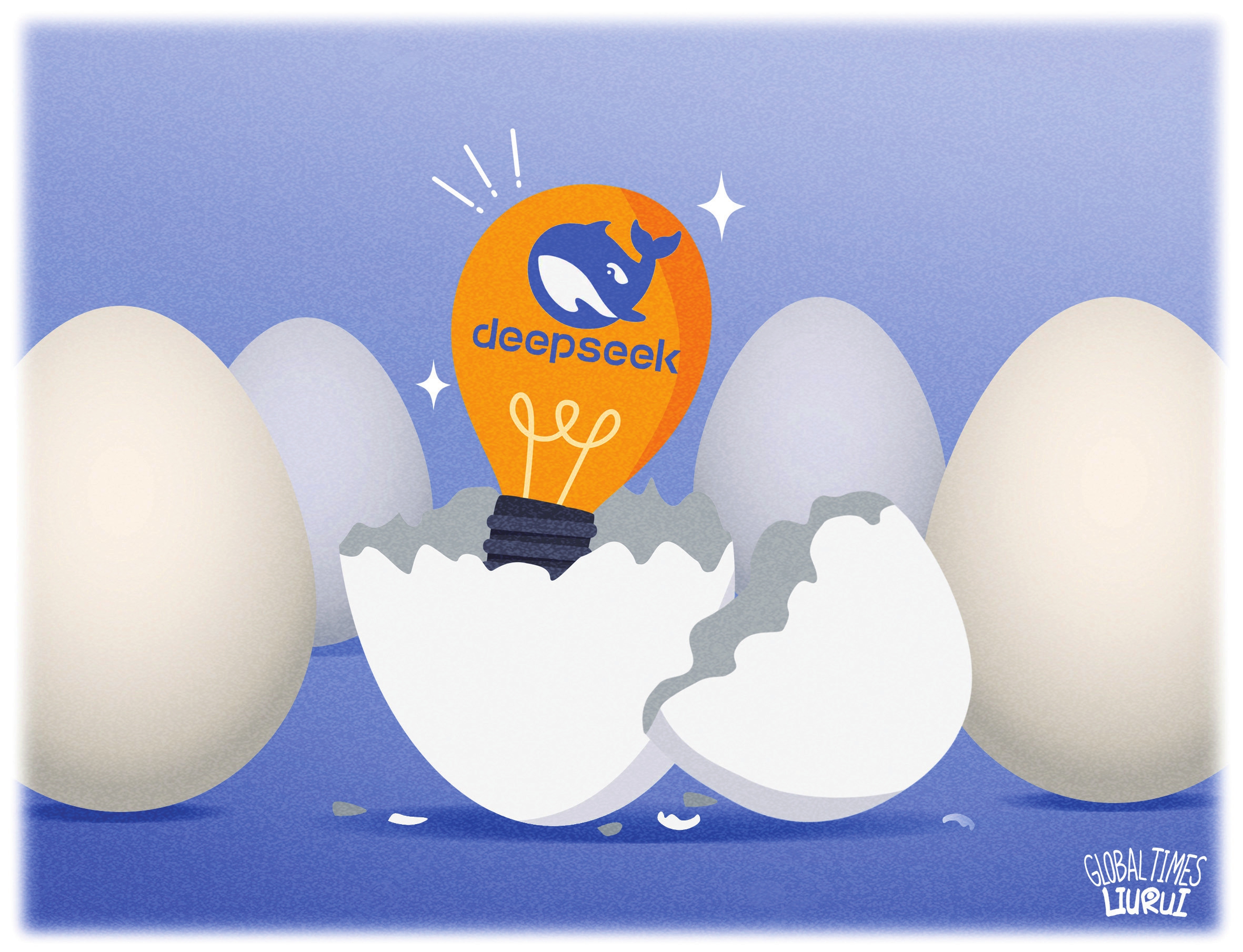
Illustration: Liu Rui/ GT

Illustration: Liu Rui/GT

DeepSeek has emerged as a captivating topic of discussion in the global AI community. This small team of fewer than 140 people has achieved what even some tech giants struggle to accomplish. 

Nearly all the engineers and researchers powering this company’s success were educated at China’s universities, and the average age of the R&D team members is about 28. This challenges long-held assumptions about talent distribution in the tech industry and signals a profound shift in the global innovation landscape. 

DeepSeek’s engineers primarily come from prestigious Chinese universities, such as Tsinghua University, Peking University, Sun Yat-sen University, and Beijing University of Posts and Telecommunications. 

This paints a powerful picture: cutting-edge innovation no longer relies on expatriate expertise or foreign-educated professionals. 

For decades, global innovation narratives have centered on the US, particularly Silicon Valley. The Silicon Valley’s success stems from attracting top minds across the globe, a convergence of talent nurtured by Ivy League institutions and supported by a robust start-up ecosystem. 

The implicit assumption has often been that this model could not be replicated elsewhere, especially in countries like China, where education and innovation systems were once dismissed as rigid and overly focused on rote learning. 

DeepSeek turns that assumption on its head. Its success proves that China’s universities and research infrastructure have evolved to the point where they are producing first-class scientists and innovators. Rote learning has ceded ground to critical thinking, problem-solving, and cutting-edge experimentation. The team’s achievements suggest that China’s education reforms, particularly in STEM fields, are starting to bear fruit globally.

This transformation is no accident. Over the past two decades, China has made dramatic funding in higher education, ramping up funding for research and fostering international collaborations. 

Universities like Tsinghua University and Peking University now rival MIT and Stanford in specific research fields, earning places on global rankings. More importantly, they nurture graduates who can compete with the best minds anywhere. DeepSeek is one of this reform era’s most striking success stories but will not be the last.

For years, the US has relied on attracting international researchers, particularly from China, as a cornerstone of its tech dominance. But the tables are beginning to turn. 

As opportunities improve and ambitious projects like DeepSeek thrive in China, fewer Chinese scientists are leaping abroad. Many are choosing to stay, building cutting-edge companies at home and fueling innovation ecosystems in Beijing, Shenzhen and other rising tech hubs.

While China’s innovation engine is rapidly gathering momentum, it would be premature to conclude it has overtaken the US’ Silicon Valley, which still leads in its sheer concentration of capital and infrastructure and has a profoundly ingrained risk-taking culture. But the gap is unquestionably narrowing. With consistent investment in education and technology, China is emerging as a true contender in the global innovation race.

This shift has important implications for the world. For one, it challenges the notion that talent, and innovation, must be concentrated in a few key regions such as Silicon Valley. 

DeepSeek exemplifies the growing decentralization of innovation. Talent is everywhere, and as countries like China continue to invest in their local ecosystems, global innovation is becoming more evenly distributed. More competition means more breakthroughs and diversity of ideas, as well as faster technological advancement for humanity.

DeepSeek is far more than a story about one company’s achievements. It symbolizes China’s rise as an incubator of world-class talent and innovation.

Source link

Visited 1 times, 1 visit(s) today

Related Article

A Chinese Secret Police Proxy Stole COVID Research. Then He Went to Milan.

A Chinese Secret Police Proxy Stole COVID Research. Then He Went to Milan.

Photo from Italian justice sources of Xu Zewei under arrest. HOUSTON – For more than four years, Xu Zewei moved freely through China’s technology sector, beyond the reach of American justice. A 34-year-old Chinese national based in Shanghai, he had spent the height of the pandemic breaking into American universities, stealing the email accounts of

NasdaqGS:META 1-Year Stock Price Chart

China Blocks Meta Manus AI Deal And Raises New Valuation Questions

Chinese regulators block Meta Platforms’ planned $2b acquisition of AI startup Manus AI. The decision forces Meta to unwind the deal, affecting its cross border AI expansion plans. The move reflects rising scrutiny on AI talent and intellectual property in US China relations. Meta Platforms (NasdaqGS:META), trading at $678.42, faces this setback after multi year

OpenAI-Microsoft shift, China blocks Meta AI deal — TradingView News

OpenAI-Microsoft shift, China blocks Meta AI deal — TradingView News

Global markets and technology sectors saw significant developments on Monday, as OpenAI and Microsoft reworked their partnership to allow broader cloud distribution, China moved to block Meta Platforms’ planned acquisition of Manus, US officials weighed Iran’s latest proposal amid ongoing tensions, and oil prices surged on supply concerns linked to disruptions in the Strait of

China’s AI ambitions face limits as Meta-Manus deal unravels — TradingView News

China’s AI ambitions face limits as Meta-Manus deal unravels — TradingView News

China’s order for Meta Platforms to unwind its $2 billion acquisition of artificial intelligence startup Manus is less about a single deal and more about a broader tension shaping the country’s tech strategy: how to build global champions without losing control. The episode highlights a recurring dilemma for Beijing. While policymakers want domestic firms to

china eir temple og | eTurboNews | eTN

China Turns May Day Into Tourism Boom With Nationwide 2026 Travel Push

China has launched its 2026 May Day Culture and Tourism Consumption Week to boost travel and spending during the holiday. With thousands of events, subsidies, and industry participation, the initiative highlights how May Day has evolved from a labor holiday into a key driver of domestic tourism and economic growth. As millions of travelers prepare

China blocks Meta’s $2B acquisition of AI startup Manus

China blocked US tech giant Meta from acquiring the AI firm Manus on Monday. China’s National Development and Reform Commission (NDRC) said in a one-line statement that it would “prohibit foreign investment in Manus in accordance with laws and regulations, and requires the parties involved to withdraw the acquisition transaction.” The announcement will force Meta

image.png

Nexteer Showcases Full-Stack Steer-by-Wire Technology at Auto China 2026

Gasgoo Munich- The 19th Beijing International Automotive Exhibition kicked off on April 24, with Nexteer Automotive showcasing a suite of technologies in Hall W1, including Steer-by-Wire and Brake-by-Wire systems. Its Electro-Mechanical Braking (EMB) system has completed full development and rigorous validation, and is now officially market-ready. Image credit: Nexteer (same below) The EMB system made

UPI

China to block Meta’s $2B acquisition of AI startup Manus

Meta, led by chairman and CEO Mark Zuckerberg (pictured), will be required to unwind its $2 billion takeover of Manus. File Photo by Will Oliver/UPI April 27 (UPI) — The Chinese government is moving to block Meta’s $2 billion acquisition of Manus, a Singaporean artificial intelligence company originally founded in China. China’s National Development and

White House Accuses China of Large-Scale Theft of US Artificial Intelligence Technology

White House Accuses China of Large-Scale Theft of US Artificial Intelligence Technology

On the eve of U.S. President Donald Trump’s visit to China, the UK’s Financial Times revealed on Thursday, April 23 that the White House is accusing China of stealing American artificial intelligence (AI) technology on an “industrial scale” and is warning that it will intensify crackdowns to curb such activities. According to the report, Michael

PLA Navy destroyer Hangzhou (DDG-136), a Soviet-designed Project 956E vessel operated by China, shown prior to its deep modernization. (Photo: Open source)

China Rebuilt Its Soviet-Era Destroyer—By Removing Everything Russian — UNITED24 Media

China has completed a deep modernization of a Soviet-designed Project 956E destroyer, replacing nearly all original Russian weapons and systems with domestically produced alternatives. We bring you stories from the ground. Your support keeps our team in the field. DONATE NOW According to Defense Express on April 27, the upgraded vessel—identified as the destroyer Hangzhou—was publicly displayed during events marking the

The logo of Meta is seen during the Viva Technology conference in Paris, France, 12 June, 2025. (Reuters)

China blocks Meta from buying Manus amid AI tensions with US

The logo of Meta is seen during the Viva Technology conference in Paris, France, 12 June, 2025. (Reuters) China has blocked Meta’s attempt to buy one of the world’s most high-profile artificial intelligence startups. The unwinding of the $2 billion acquisition of Manus, which is based in Singapore but was founded in China, comes as

Tech companies in Taiwan

The U.S.-China trade relationship: What’s behind the competition?

U.S. consumers have benefited from lower prices, many favor more cooperation with China, according to a CFR-Morning Consult poll conducted in January 2026. U.S. companies have also profited immensely from access to China’s market. In a 2019 study, economists Xavier Jaravel and Erick Sager found that increased trade with China boosted the annual purchasing power

The Instagram, Facebook, and WhatsApp apps can be seen on a smartphone display in front of the logo of the internet company Meta. Jens Büttner/dpa

China blocks AI start-up’s deal with Meta

The Instagram, Facebook, and WhatsApp apps can be seen on a smartphone display in front of the logo of the internet company Meta. Jens Büttner/dpa China has blocked the takeover of the AI start-up Manus by the US tech giant Meta. China’s National Development and Reform Commission announced on Monday that the authority responsible for

China launches May Day holiday consumption week with 284 mln yuan in vouchers

China launches May Day holiday consumption week with 284 mln yuan in vouchers

China on Monday launched a nationwide consumption week featuring 284 million yuan (about 41.5 million U.S. dollars) in travel and culture vouchers, aiming to boost tourism ahead of the May Day holiday. The campaign, organized by the Ministry of Culture and Tourism, runs through May 5, the final day of the five-day public holiday. To

China blocks Meta’s $2 billion Manus AI deal amid tech concerns — TradingView News

China blocks Meta’s $2 billion Manus AI deal amid tech concerns — TradingView News

China has moved to block Meta Platforms Inc.’s planned $2 billion acquisition of agentic AI startup Manus, in a surprise decision that effectively unwinds a deal already close to completion. The intervention marks a significant escalation in Beijing’s oversight of strategic technology transactions, particularly those involving artificial intelligence and cross-border investment. Regulator orders cancellation of

Macau to showcase Greater Bay Area strengths at APEC tourism meetings, says MGTO chief

Macau to showcase Greater Bay Area strengths at APEC tourism meetings, says MGTO chief

The upcoming APEC tourism meetings in June will provide Macau with an opportunity to showcase the strengths of the Greater Bay Area and tell China’s story on the international stage, according to Maria Helena de Senna Fernandes. Speaking ahead of the 13th APEC Tourism Ministerial Meeting and the 67th Tourism Working Group Meeting, Fernandes said

China bars foreign investment in Manus AI project as scrutiny on AI exports grows · TechNode

China bars foreign investment in Manus AI project as scrutiny on AI exports grows · TechNode

China’s National Development and Reform Commission (NDRC) today announced that, in accordance with laws and regulations, it has issued a decision prohibiting foreign investment in the acquisition of the general-purpose AI agent project Manus. It also requires the relevant transaction parties to immediately withdraw and cancel all related acquisition activities. This decision marks a key

0
Would love your thoughts, please comment.x
()
x