The war in Iran is highlighting the importance of ships – not just warships but cargo vessels – like those carrying oil or gas trapped near the Strait of Hormuz. But American shipbuilding is in shambles, due to decades of shortsighted policies and neglect. Our submarine building program is sluggish. And our commercial shipbuilding is nearly extinct. China makes roughly 1,000 cargo ships a year. The U.S.? Maybe three. The Trump administration has called this a national security crisis. But can this ship be turned around?
This is the Philadelphia shipyard, one of only two left in the U.S. building large commercial cargo ships. Once a symbol of American might and innovation, ships built here helped win our independence in the 18th century, and World War II in the 20th. This shipyard has become a symbol of American industrial decline, a money loser falling decades behind our global rivals. And it still uses a crane from 1942!
Lesley Stahl: Now, talk about a metaphor of how far behind we are.
David Kim: Lotta times people’ll call it a dinosaur.
Lesley Stahl: What else is a dinosaur?
David Kim: Almost everything that you’ve seen out there.
David Kim, the new head of the Philly shipyard, showed us around. He works for Hanwha, a giant shipmaker from South Korea, the country making most ships after China.
Hanwha bought the yard in 2024 for $100 million, then poured in another $100 million and tasked Kim, a Korean-American born and bred in Texas, to bring it into the 21st century.
Lesley Stahl: How many ships do you actually make here?
David Kim: Here at the Hanwha Philly Shipyard we deliver one to one-and-a-half ships a year versus our yard in Korea where they deliver basically one a week.
Lesley Stahl: What? One a year for delivery versus one a week?
David Kim: That’s correct.
60 Minutes 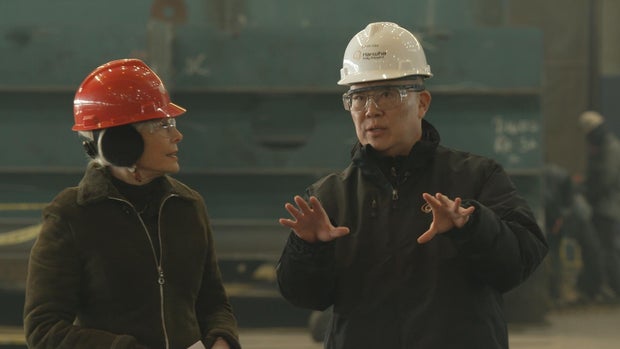
Not building ships in the U.S. is considered a national security threat because if there’s a conflict with China, for instance, Beijing could weaponize its substantial merchant fleet and cut us off from global goods. Hanwha plans to spend $5 billion in Philly and has already sent 50 trainers from Korea to teach American workers.
David Kim: Our aspiration is to get to up to 20 ships a year here at the shipyard.
Lesley Stahl: So we come back in two years. How different will it look?
David Kim: You’ll see robots. You will see automation equipment. And we’re looking to grow the workforce by, call it, 7,000 to 10,000 people.
Sounds great, only there’s a huge shortage in the U.S. of skilled labor in ship-building, including welders and pipe-fitters. This work is grueling: freezing in winter, scorching in summer, and it’s dangerous. And while the yard has a training program, it can only train 20 or so new hires at a time and it takes three years! Still, apprentices Justin, Jeff, and Meg, told us this beats their old jobs.
Justin: I worked at Amazon as a grocery picker.
Meg: Before this job I was a cake decorator at a bakery.
Lesley Stahl: And a nanny.
Meg: And a nanny as well. Yes. I worked many jobs.
Lesley Stahl: If you were to pitch this job and this place to a friend, what would you say?
Meg: I would tell my friend that instead of paying out of pocket to go to a trade school, you’re getting paid while you learn here the entire time.
Lesley Stahl: They pay you?
Meg: Yes.
Lesley Stahl: And health care?
Meg: And health care, which is amazing.
Lesley Stahl: But aren’t the conditions really harsh?
Jeff: Not the easiest work. Like, I go home, granted, I’m more tired but it’s more fulfillin’ to me. Makes you feel like you’re somethin’, part of somethin’ bigger.
60 Minutes 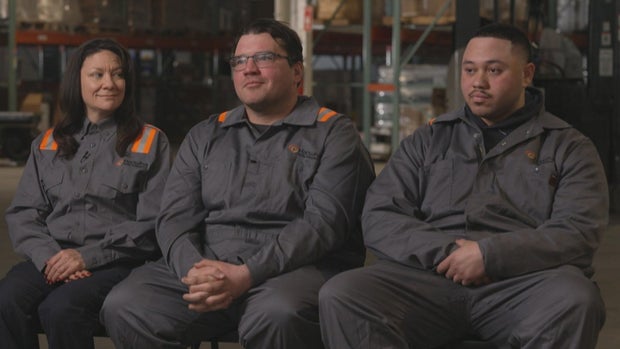
But not only are workers scarce and the yard outdated, the Philly shipyard has to bring key components to the U.S., such as propellers, and even the engine. So ships that take six months to build in Korea or China can take twice as long here, and cost five times as much! And who will buy them?
Michael Coulter: There’s no doubt that we have challenges and headwinds, but I also think we have a unique moment in time.
Michael Coulter, who’s Hanwha’s top executive in charge of U.S. operations, says the way to lower prices is scale up production.
Lesley Stahl: So you’re saying if we build more ships, then the cost per ship will come down.
Michael Coulter: Significantly.
Lesley Stahl: It’s so busy here!
Michael Coulter: It is busy.
He took us to Hanwha’s shipyard in Korea, where nine ships are being built at once, four in a row, like Lego sets the size of football fields. Steel chunks bigger than buildings hover over the ground. They’re lifted above the water, or they just glide by.
He showed us how far ahead they are technologically: rows and rows of robots! But even with all the automation, the human workforce keeps growing. There are over 26,000 workers on site, many getting around on low tech because this place is so vast. And the yard keeps hiring, training 400 workers at once – way more than the 20 in Philly! And they’re taught using cutting-edge virtual reality! He’s learning to paint. It’s a dance of tech, cranes, trucks, and bikes. And this yard also builds military vessels, including submarines, which the U.S. desperately needs, since our fleet is aging and we can barely make new ones.
Michael Coulter: From a Hanwha perspective, we build great submarines.
Lesley Stahl: Here, in Korea.
Michael Coulter: Here, in Korea, yes. We have told the U.S. government that if they so wish, we will build submarines for them in the United States, and in Philadelphia, just like we do in Korea.
Lesley Stahl: Is the ultimate goal for your company to build nuclear submarines for the U.S. Navy?
Michael Coulter: The submarine program in the United States is heading in the wrong direction, and we think we can help.
Another way Hanwha says it wants to help the U.S. is with transporting liquified natural gas, or LNG, hoping to build these giant LNG tankers in Philly.
Lesley Stahl: The United States is the largest producer of natural gas. And yet, we don’t have any LNG ships that we make ourselves. Is that correct?
Michael Coulter: That’s correct. Not a single one.
60 Minutes 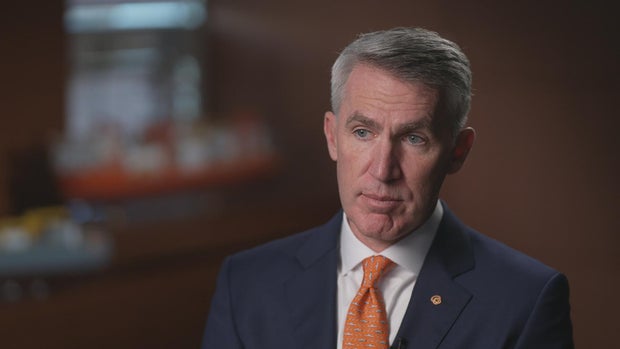
This leads to an absurd situation: while we export LNG on foreign carriers to over 30 countries –
Colin Grabow: One country we don’t send it to is other parts of the United States.
Colin Grabow, a trade expert at the libertarian CATO Institute, explains that a century-old law called the Jones Act requires that any cargo shipped between U.S. ports – say from Baltimore to Boston, or Seattle to Juneau – that cargo has to be on an American-made ship. So if the cargo is LNG, it has to be on an American made LNG ship.
Lesley Stahl: But we don’t build any.
Colin Grabow: That’s right. There aren’t any.
Lesley Stahl: Oh, my god.
Colin Grabow: And you might think, “Well, seems like an easy problem to solve. Go build the ship, transport the gas,” except the math doesn’t work. If you want to build one of those ships in Asia, the cost is around $260 million; here in the United States? About $1 billion!
Lesley Stahl: Well, wait. Are there parts of this country that cannot get natural gas because of this law?
Colin Grabow: That’s right, New England.
In winters, New England has to import pricier natural gas from abroad, even though it’s extracted only a few states away.
Colin Grabow: In fact, Puerto Rico imported Russian natural gas the same month as Russia invaded Ukraine.
Lesley Stahl: No. (GASP)
Colin Grabow: So we take a stance against Russia. On the other hand, we’re importing their energy, something that we have in abundance. You can’t make this stuff up.
Last year, President Trump made solving our ship crisis a national priority, signing an executive order creating a multi-agency action plan and a White House office of shipbuilding.
President Trump (4/9/25, signing executive order).: “We’re way, way, way behind. We used to build a ship a day and now we don’t do a ship a year, practically.”
But the White House has conflicting priorities.
Lesley Stahl: So here’s the administration. It wants to build ships and they’re putting huge tariffs– 50% on steel, which is the main component in a ship. What’s wrong with that picture?
60 Minutes 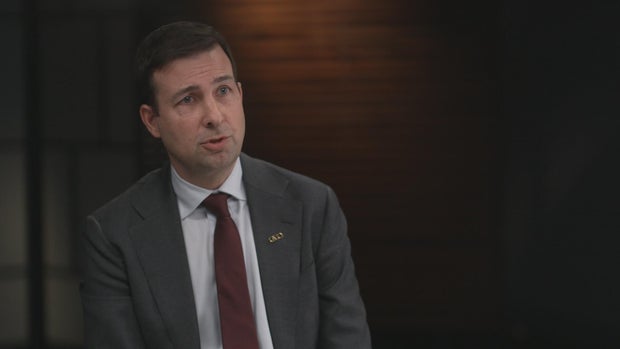
Colin Grabow: Yes. This is one of the paradoxes of the Trump administration. We’re artificially increasing the cost of building ships in this country!
Lesley Stahl: So why can’t shipbuilders just use American made steel? There’s no tariffs on those.
Colin Grabow: That’s true. But when we put heavy tariffs on imported steel, we drive those costs up, that’s a great opportunity for Americans to raise their own price. What we know is today, American steel is roughly twice as expensive as steel in, say, China.
Lesley Stahl: What you’re saying is when the price of steel goes up because of tariffs, then the American steel manufacturer hikes the price of steel?
Colin Grabow: These are profit oriented enterprises.
He actually thinks we should be able to just buy and use ships from our ally, South Korea, not build them. And he points to another conflicting White House priority: making it harder to grant skilled immigrants work visas.
Colin Grabow: Traditionally, a lot of immigrants have been willing to do this kind of work. And yet, we are turning our back on immigration and adopting a more hostile stance.
Lesley Stahl: The administration seems to be fighting its own policy.
Colin Grabow: Yes.
It didn’t help when last September, ICE raided a Korean battery plant in Georgia, alleging visa violations. Agents dragged off 300 Korean technicians and engineers in cuffs and chains, despite their coming here to train American workers. Hanwha’s Michael Coulter says this caused a backlash in Korea.
Lesley Stahl: Have you been assured that what happened in Georgia will not happen in Philadelphia?
Michael Coulter: We’ve been assured that our visas are the right visas and our team is not going to be impacted.
The White House is committed to making ships here. So last year, when President Trump threatened to put tariffs on Korean imports, Korea’s president offered instead to invest $150 billion to revive the U.S. shipbuilding industry, promising Philly is just the start.
Michael Coulter: There’s a recognition that the United States has a problem that Korea may be uniquely positioned to help.
Lesley Stahl: That’s like aid for the United States. Wow. Wouldn’t it be more profitable and wiser if the United States just bought the ships from Korea?
Michael Coulter: That doesn’t solve the problem. At the end of the day, shipbuilding is a national security necessity. The U.S. needs to be able to secure our own commerce. We need to be able to export our own energy.
Lesley Stahl: The idea that we now rely on Korean expertise to help us build an industry that we need for national security reasons. Should we be ashamed of ourselves? Should we feel weak?
Michael Coulter: I don’t think we should be fearful or feel weak. We are in a shipbuilding crisis in the United States, and every American should be aware of that. But that doesn’t mean that it’s not solvable.
We once deployed ships to save South Korea. Now we’ve been forced to turn to South Korea to save us.
In a statement to 60 Minutes, the White House said, quote: “no president has done more to bolster American maritime power.” This past week, with gas prices soaring, the president suspended the Jones Act for 60 days, to ease the transport of oil and gas within the U.S..
Produced by Shachar Bar-On and Jinsol Jung. Broadcast associate, Aria Een. Edited by Matthew Lev