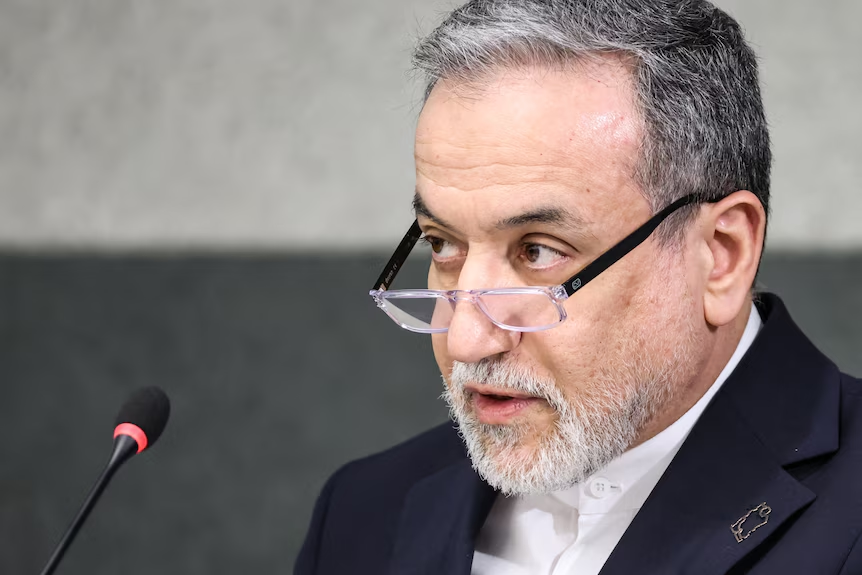
Islamabad, Pakistan – When Pakistan’s Ministry of Foreign Affairs confirmed on Monday that Deputy Prime Minister and Foreign Minister Mohammad Ishaq Dar would travel to Beijing the following day, it reached for familiar language, highlighting the longstanding ties between the two nations.
According to the ministry, both sides would hold “in-depth discussions on regional developments, as well as bilateral and global issues of mutual interest”, as the two countries “enjoy an all-weather strategic cooperative partnership”.
Recommended Stories
list of 4 itemsend of list
But Dar’s visit to China comes at a time when Islamabad is trying to calm particularly turbulent weather — not in its relationship with Beijing, but in Pakistan’s neighbourhood.
Over the weekend, Islamabad hosted the foreign ministers of Turkiye, Egypt and Saudi Arabia for a quadrilateral meeting aimed at pushing the United States and Iran towards negotiations, a month into a war that has rapidly expanded to multiple theatres across the entire Middle East while leading to soaring energy prices and the mounting risk of a global recession.
Dar’s decision to travel to China despite medical advice to rest following a hairline shoulder fracture, sustained after slipping while receiving Egypt’s foreign minister in Islamabad on Sunday, underlines a sense of urgency within Pakistan’s diplomatic efforts.
During a March 27 call, Chinese Foreign Minister Wang Yi told Dar that Beijing appreciated Islamabad’s “untiring efforts to cool down the situation”. That stance was reiterated by Chinese Foreign Ministry spokesperson Mao Ning, who said China “commends and supports Pakistan’s mediation effort for de-escalation and stands ready to enhance communication and coordination with Pakistan and others to jointly work for a ceasefire and peace in the region”.
But Dar, said analysts, was not visiting China in the search for more back-slapping messages. At a time when US President Donald Trump swivels daily — at times hourly — between promoting diplomacy and threatening military escalation against Iran, and Tehran remains untrusting of Washington’s intent, Dar’s trip, they say, will hinge on the answer to a single question: Can Islamabad draw Beijing into going beyond rhetorical statements to take on a more consequential role in the ongoing mediation efforts?
Coordinating positions
According to Baqir Sajjad Syed, a former Pakistan fellow at the Wilson Center, Dar’s visit is aimed at briefing the Chinese leadership on the recently concluded Islamabad quadrilateral.
He said the trip would also help refine five principles for a potential US-Iran dialogue: an immediate ceasefire, resumption of talks, protection of civilians, maritime security, and adherence to the United Nations Charter.
“These principles were first discussed in the Wang Yi-Dar telephone conversation last week,” Syed told Al Jazeera. “One of the main objectives of this trip is to translate these into a more concrete framework or outcome document. Last week’s phone call was preliminary. In-person engagement allows more detailed coordination, possible alignment on parameters, and consideration of a joint statement,” he said.
Hours later, China and Pakistan announced these five principles as the cornerstone of their mediation efforts.
Ishtiaq Ahmad, an emeritus professor at Quaid-e-Azam University in Islamabad, views the visit through Pakistan’s established intermediary role.
“Pakistan normally takes China into confidence since China is a permanent ally with a different profile from the US,” he told Al Jazeera.
“This is classical intermediary behaviour, a country that sometimes signals its own interests and expectations in return for facilitating others. Pakistan is trying to remain relevant, and this is how it does so,” Ahmad said.
Yun Sun, director of the China Program at the Stimson Center in Washington, DC, drew a sharper distinction between the diplomatic roles that Islamabad and Beijing could play.
“Pakistan can mediate between the US and Iran,” she said. “China cannot. Most of the calls China has made are with Gulf countries and Iran.”

The guarantor question
Among the more notable interpretations of Dar’s visit has come from Vali Nasr, a former US Department of State official and a leading Iran expert.
“Iran has asked for guarantees in any deal with the US,” Nasr posted on X on Monday. “Word is that Pakistan Foreign Minister is going to Beijing to get a guarantor for the potential deal. Likely that is Iran’s condition for talks with US. And FM would not be going to China without having floated the idea with both Washington and Beijing. No guarantees of China biting but Beijing is now the front line in the diplomatic effort.”
Ahmad disagreed with that premise. “The assumption that Beijing would step in as a guarantor for Tehran is analytically weak,” he said.
“Guarantees are extended by strong, stable actors seeking to preserve order, not by powers aligning themselves with a regime whose position is visibly eroding. Iran’s operational space has narrowed largely to Strait of Hormuz disruptions and Houthi activity. No serious power, least of all China, underwrites the interests of a declining actor,” he said.
The Strait of Hormuz, a narrow waterway between Iran and Oman, carries roughly a fifth of the world’s daily oil and gas supplies and has been effectively disrupted since the war began on February 28 following US-Israeli attacks on Iran, which killed Iranian Supreme Leader Ayatollah Ali Khamenei and other military and political leaders.
Syed, however, said Beijing was “well-positioned and increasingly willing to act as a credible underwriter of this process”, given its economic ties with Iran, broadly stable relations with all parties, and its financial and diplomatic weight.
“Chinese officials clearly link Beijing’s support for Pakistan’s mediation to ‘restoring Hormuz transit’ and ‘regional peace and stability’,” he said. “China will not be a neutral bystander. It would rather see a stabilised Iran-US track as serving its core interests.”
What China stands to gain
Even without a guarantor role, China has clear incentives to see the conflict end.
Data from tanker-tracking firm Kpler shows China imported about 1.38 million barrels per day of crude from Iran in 2025, roughly 12 percent of its total imports.
The stakes at the Strait of Hormuz are significant. According to the US Energy Information Administration, about 20 million barrels per day flowed through the strait in 2024, nearly 20 percent of global petroleum consumption.
The International Energy Agency estimates that close to 15 million barrels per day passed through the strait in 2025, with China and India accounting for 44 percent of those imports.
Researchers at Columbia University estimate that between 45 and 50 percent of China’s crude oil imports transit the strait, making any disruption a direct threat to its energy security.
According to the US-China Economic and Security Review Commission, total China-Iran trade, including unreported oil imports, reached about $41.2bn in 2025.
In 2021, Iran and China signed a 25-year strategic cooperation agreement under which Beijing pledged up to $400bn in investment in exchange for discounted Iranian oil. Much of that investment, however, has yet to materialise due to US sanctions on Chinese firms.
Syed described China’s motivations as “clear and self-interested”.
“These include protecting energy security, safeguarding BRI and CPEC investments across the region, and burnishing its image as a global peace broker. A prolonged war and high oil prices directly hurt China’s economy,” he said.
The Belt and Road Initiative (BRI) is a web of highways, railways and ports that spans more than 150 countries, while the China-Pakistan Economic Corridor (CPEC) — a part of the BRI — is valued at about $62bn, and links China’s Xinjiang region to the Arabian Sea port of Gwadar.
“Islamabad’s on-the-ground shuttle diplomacy gives China a low-risk, credible face to push de-escalation without direct engagement with Washington on this issue,” Syed said.
Ahmad, however, sees China’s approach as more cautious.
“The Chinese are very pragmatic and calculated. They will assess where things are heading, and at the end of the day, China would not want Iran to become a Venezuela with Americans at the door,” he said.
“Trump, ruthless as he is, has been transparent about it, openly saying they want Iranian oil. The closure of the Strait of Hormuz is affecting Asia and Europe most acutely, and China will feel that impact,” he said.
Syed said China is likely to rely on diplomatic tools such as “public endorsements, envoys, joint framework-building”, alongside economic leverage, including “trade and investment incentives or quiet pressure on Iran” to engage in negotiations, while avoiding direct military involvement.
Ahmad agreed. “I do not think China will do anything militarily. Economically, they have wider interests and will make their expectations clear to Pakistan,” he said.

Watching Washington and Beijing
Before the US-Israeli attacks on Iran, Trump had been scheduled to visit Beijing from March 31 to April 2, but he postponed the trip. The summit is now expected to take place on May 14 and 15. Chinese President Xi Jinping is also expected to visit the US later in the year.
Ahmad said these meetings could offer clues about broader alignment.
“Two trips are planned this year: Trump to China and Xi to the United States. If they meet twice, there is clearly some degree of understanding between the two great powers. And what you see right now under Trump is, in a way, more transparency; he says what he means. That dynamic is worth watching carefully,” he said.
Meanwhile, the military situation continues to escalate. An amphibious task force of about 3,500 US Marines and sailors, led by the USS Tripoli, has arrived in the Gulf. Another 2,200 Marines are deploying to the region, along with 2,000 soldiers from the US Army’s 82nd Airborne Division.
Trump has signalled that military options remain under consideration, with reports suggesting the Pentagon is preparing for possible ground operations lasting weeks.
China’s deeper calculus
Ahmad argues that China’s position is rooted in broader strategic interests.
“It is in China’s core interest for this conflict to end,” he said. “Unlike imperial powers, it has not harboured expansionist ambitions. When China has expanded its footprint in recent years, it has done so by developing a greater stake in global stability.”
Beyond Taiwan and the South China Sea, he said, Beijing has little appetite for military engagement elsewhere.
“Do not expect China to have military ambitions elsewhere,” he added.
Syed, however, argued that China might adopt a more active posture.
“A prolonged Hormuz crisis, a destabilised Iran, or a wider regional war carries direct costs for China in terms of energy shocks, disrupted shipping, and BRI risk,” he said. “China will not be a neutral bystander.”
Sun, who has studied China’s engagement in conflict zones, however, cautioned against overstating Beijing’s role.
“China does not impose mediation on other countries,” she said. “And China needs to be cognisant of the potential fallout of the mediation and what if it doesn’t work.”