Will a Historic Energy Supply Disruption Ignite a Stock Market Crash Under President Donald Trump? Here’s What 86 Years of History Have to Say.

Over the last century, no asset class has been able to hold a candle to the annualized returns that stocks have brought to the table. Nevertheless, Wall Street still endures its fair share of volatility.

In a little over one month, the Dow Jones Industrial Average (^DJI 0.13%) and Nasdaq Composite (^IXIC +0.18%) have fallen into correction territory, with respective declines of 10.01% and 12.56% below their record-closing highs, through March 27. The broad-based S&P 500 (^GSPC +0.11%) isn’t too far behind, either, with a pullback of 8.74%.

While pullbacks and stock market corrections are par for the course when putting your money to work in the world’s greatest wealth-building machine, sometimes these downturns can turn into full-fledged crash events.

President Trump overseeing Operation Epic Fury. Image source: Official White House Photo by Daniel Torok.

With stock market volatility effectively coinciding with the start of the Iran war, the question has to be asked: Will a stock market crash take shape under President Donald Trump? Given the variables we’re witnessing, such as historic energy supply disruption, 86 years of history offer a big clue.

Is a stock market crash imminent under Donald Trump?

On Feb. 28, U.S. and Israeli forces commenced military operations against Iran. Shortly thereafter, Iran announced the virtual closure of the Strait of Hormuz to oil exports. Approximately 20 million barrels of petroleum liquids pass through the Strait of Hormuz daily, accounting for 20% of the world’s demand, per the Energy Information Administration.

As of this writing in the early morning hours of March 29, the Strait of Hormuz remains closed. As a result, we’ve witnessed the largest energy supply disruption in history unfold — and gas prices have soared in its wake.

Major geopolitical events almost always increase near-term uncertainty and put investors on edge. We’ve certainly witnessed this uncertainty play out on Wall Street in recent weeks. However, there’s been one scenario over the last roughly nine decades that’s sparked a higher probability of significant downside (or even a crash) than others.

According to a data set posted to social media platform X (formerly Twitter) by Carson Group’s Chief Market Strategist, Ryan Detrick, there have been 43 major geopolitical and historical events since the start of 1940. Over 86 years, many of these events turned out to be much ado about nothing. One year after the beginning of 40 of these events, the benchmark S&P 500 was higher 65% of the time.

The one exception has been oil price shock events. Although not all geopolitical events that caused oil prices to skyrocket resulted in significant downside for the S&P 500 or a stock market crash, instances of elevator-down moves often coincided with oil price shocks.

For instance, the S&P 500 tumbled 45% in less than a year following the start of the five-month oil embargo by OPEC’s Arab nations in October 1973, and it plunged by double digits three weeks after Iraq invaded Kuwait in August 1990.

Things are especially precarious for the stock market at present. In addition to entering 2026 at its second-priciest valuation in 155 years, according to the Shiller Price-to-Earnings Ratio, investor optimism has been fueled by the prospect of future rate cuts by the Federal Reserve. With inflation forecasts worsening as a direct result of the aforementioned historic energy supply disruption, it’s becoming likelier that the nation’s central bank will raise, not lower, interest rates.

While history can’t concretely predict short-term directional moves in the Dow Jones Industrial Average, S&P 500, or Nasdaq Composite, the necessary puzzle pieces for a stock market crash under President Trump appear to be in place.

A smiling person reading a financial newspaper while seated at a table in their home.

Image source: Getty Images.

Historic events often beget opportunity for long-term-minded investors

It’s certainly within the realm of possibilities that things get worse for stocks before they get better. But it’s important to note that major geopolitical and historical events have typically paved the way for long-term-minded investors to profit.

As noted, pullbacks, stock market corrections, bear markets, and crashes are normal and inevitable events. No amount of fiscal or monetary policy maneuvering, nor well-wishing by investors, can keep stocks from the occasional event- or emotion-driven swoon.

But the common theme among Wall Street downturns is that they resolve quickly.

In February, analysts at Bespoke Investment Group published a data set to X that compared the length of every S&P 500 bull and bear market dating back to the start of the Great Depression (September 1929). Over the last 96 years, there have been 27 instances in which the S&P 500 lost at least 20%, and 27 where it climbed by at least 20%.

On the one hand, the average S&P 500 bear market has lasted just 286 calendar days (less than 10 months) since September 1929, with none surpassing 630 calendar days.

At the other end of the spectrum, the typical S&P 500 bull market stuck around for 1,011 calendar days (about two years and nine months). Furthermore, 10 of 27 bull markets have lasted at least 1,200 calendar days, including the current bull market.

Statistically, being a long-term optimist gives investors the highest probability of success. If this historic energy supply disruption incites a stock market crash under Trump, opportunistic long-term investors shouldn’t be afraid to pounce.




Source link

Visited 1 times, 1 visit(s) today

Related Article

Where to Invest As the S&P 500 Heads for ‘Lost Decade’ of Returns: CIO

The days of socking of your money into the S&P 500 and forgetting about it might be in the rearview mirror. Loading audio narration… That’s according to Richard Bernstein, a longtime strategist and the chief investment officer of Richard Bernstein Advisors. Speaking to Business Insider this week, the portfolio manager said he’s concerned about a

A once-in-a-decade chance to buy this S&P 500 stock?

Image source: Getty Images The S&P 500’s tech stocks have dramatically fallen out of favour with the stock market this year. And the main reason is artificial intelligence (AI). AI looks like it’s here to stay, but investors don’t know what to make of it. That’s why share prices have been falling – and I’m

Could Investing $10,000 in SPYM Make You a Millionaire?

The stock market has delivered 10% average annual returns for the past 50 years. And when we say, “the stock market,” we are talking about the S&P 500 index — the 500 largest publicly traded stocks in America. If you want an easy way to buy the S&P 500 index while saving money on fees,

Hong Kong Stock Market Update

Technology stocks collectively declined today, dragging the Hang Seng Tech Index down by more than 2.5% in the afternoon. As of the latest update, Alibaba-W (09988) fell 4.07% to HKD 117.7; Kingsoft Software (03888) dropped 3.36% to HKD 22.4; Tencent (00700) declined 1.89% to HKD 487.2. According to Zhitong Finance APP, technology stocks collectively declined

This Under-the-Radar Fintech Stock Has Been Quietly Gaining Market Share

As people look for ways to navigate high living costs, some of them are turning to buy now, pay later (BNPL) services like Sezzle (SEZL +0.33%). This payment model lets people break everyday purchases into four installment payments, and the demand for this service transformed Sezzle from a penny stock to a multibillion-dollar fintech company

Key Pillar for Stocks’ Bull Case Could Be Set to Crumble: SocGen

Amid all the Iran-war-driven chaos, one pillar that bulls have been able to lean on is the resiliency of earnings. Loading audio narration… That pillar might be starting to wobble, however, according to Société Générale strategist Albert Edwards. Forward 12-month profit estimates, which tend to be the primary driver of stock performance, were revised up

Is This Healthcare Stock Undervalued Relative to Its Growth Potential?

Healthcare stocks have been beaten down yet again in 2026. Whether pharmaceutical companies or health insurers, the entire sector’s stock prices are generally down. One stock that keeps hitting new lows is Oscar Health (OSCR +1.62%). This is even though the upstart health insurer expects massive growth in 2026, which the market is not fully

Why Better Home & Finance Holding Stock Zoomed Almost 23% Higher This Week

Next-generation mortgage company Better Home & Finance (BETR +8.54%) was a star on the stock market this week. Following its announcement that it was vastly expanding a key market segment, investors snapped up its shares as eagerly as if they were buying a home. Consequently, Better’s stock rose by nearly 23% over the week, according

US Stock Market Today S&P 500 Futures Edge Lower As Traders Eye Jobs Report

The Morning Bull – US Market Morning Update Friday, Apr, 3 2026 US stock futures are slightly softer this morning, with E mini S&P 500 contracts down about 0.2%, as investors weigh rising global costs against a key US jobs update. The FAO Food Price Index sits at 128.5, its highest level since September 2023,

Why Redwire Stock Crushed it This Week

Redwire (NYSE: RDW) was red-hot on the stock market over the past few business days. The company’s involvement with a high-profile space exploration project, and new work for a major client in Europe put some real zip into its shares. They rose by 19% over the course of the week, according to data compiled by

Nvidia Stock Will Be Worth This Much In 2027

Hot tech stock NVIDIA (NASDAQ:NVDA) has delivered one of the most extraordinary runs in semiconductor history. With the stock at $174.40 and AI infrastructure spending accelerating, our model points to meaningful upside through 2027. The 24/7 Wall St. price target for NVIDIA heading into 2027 is $207.45, implying roughly 18.95% upside from current levels. Our

The first War inflation tests – Markets Weekly Outlook

Elior Manier Market Analyst Elior brings over seven years of experience in financial markets to our analyst team. Since 2018, he has actively engaged in observing, charting, and trading, driven by his passion for mastering market dynamics. With a profound understanding of the geopolitical and macroeconomic forces that shape market movements, Elior focuses on analysing

Why is Israel’s stock market so resilient?

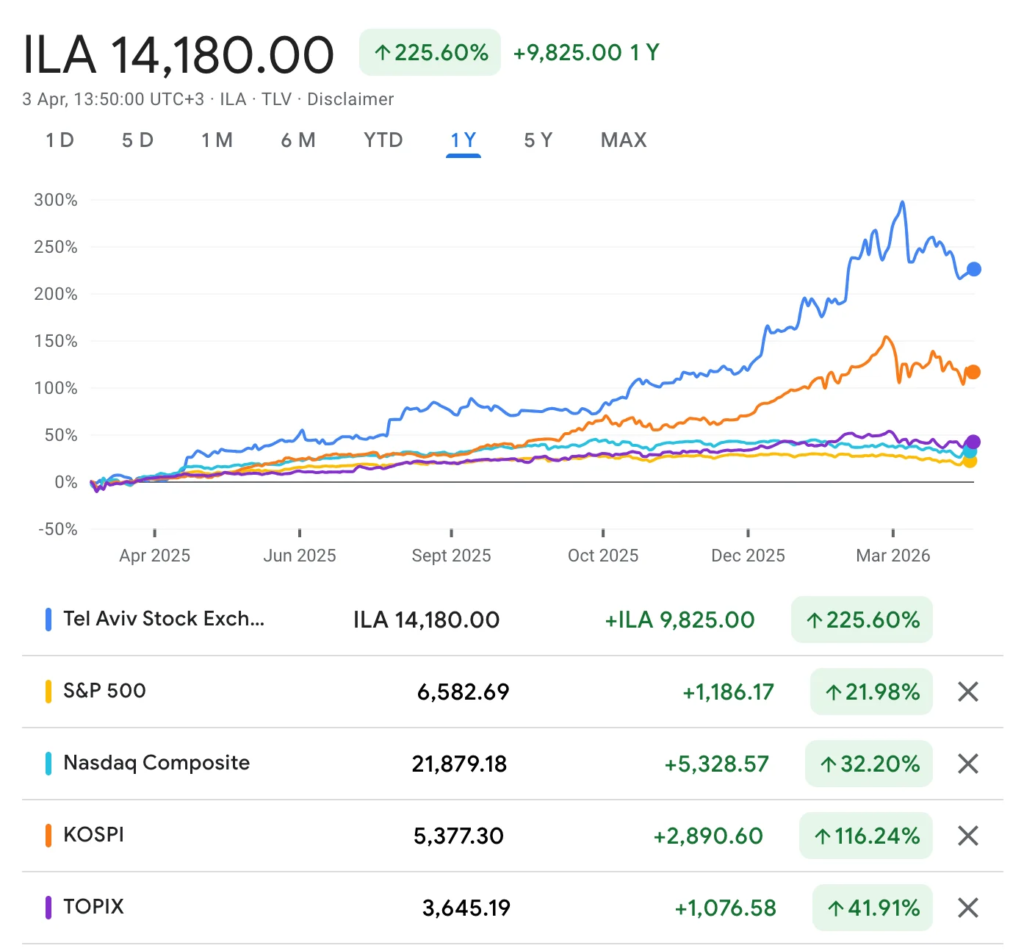
With the S&P 500 down 7.5% YTD, Nasdaq down 10.5%, and crude oil reaching $105/barrel, there’s one country posting positive returns since the year began. Israel. But the question is, why? (comparison between TASE, S&P 500, Nasdaq, KOSPI & TOPIX international indices) 2026 has been a tale of two halves. January started extremely strong, with

Meet the Monster Stock That Continues to Crush the Market

Vistra (VST 1.79%), one of the largest competitive power generators in the U.S., has seen its stock surge 530% over the past three years, while the S&P 500 rose only 60%. Let’s see why this energy stock crushed the market — and if it’s still worth buying today. Why did Vistra’s stock skyrocket? Vistra owns

Valeo : Implementation of the share buy-back program (press release Implementation of the share buy back program 20260403)

Market Closed – Euronext Paris 11:55:00 2026-04-02 am EDT 5-day change 1st Jan Change 10.40 EUR -4.98% -0.38% -10.61% Published on 04/03/2026 at 11:32 am EDT Publicnow ‌Implementation of the share buy-back program‌‌‌‌‌ ‌April 3, 2026 – Paris, France – Valeo has requested the assistance of an investment services provider in order to achieve certain

Prediction Markets Attract Wall Street and Law Enforcement Scrutiny

Got story updates? Submit your updates here. › The rapid growth of prediction markets has created a new frontier for financial trading that requires increased scrutiny from regulators and law enforcement.NYC Today Prediction market trading volume has skyrocketed from $1.2 billion in 2025 to $20 billion per month, attracting the interest of Wall Street firms

Stock Market Remains Calm Amid Iran War Tensions

Got story updates? Submit your updates here. › As geopolitical tensions simmer, the stock market remains focused on the fundamentals of the financial system.Los Angeles Today Despite the ongoing conflict between the U.S. and Iran, the stock market has not seen a major downturn, with the S&P 500, Dow Jones, and Nasdaq indices only falling

Hope for Hormuz lifts markets

👋 Good morning! Stocks had an interesting Thursday, opening deep in the red before paring back the losses after news broke about Iran drafting a protocol with Oman to manage ship traffic in the Strait of Hormuz. As managing traffic means there must be traffic to manage, investors grasped that news and cast aside some

0
Would love your thoughts, please comment.x
()
x