Where Will the S&P 500 Be in 10 Years? Nobel Laureate Robert Shiller Weighs In

The last 10 years have been an excellent run for the stock market. Despite two bear markets (2020 and 2022) and two nearly bear markets (2018 and 2025), the S&P 500 (^GSPC 0.11%) has produced a total return of 282% over the last decade, a compound annual return of 14.4%. That’s well above the historical average return for the index. The Nasdaq Composite (^IXIC +0.35%) has fared even better, up 394% (17.3% annually), thanks to the strong performance of tech stocks.

But investors always need to be looking forward. The next 10 years will certainly unfold differently from the last 10 years. And the stock market will likely produce significantly different returns. Nobel Prize-winning economist Robert Shiller thinks that investors should be prepared for what comes after years of exceptionally strong market performance.

Image source: Getty Images.

Shiller’s preferred valuation metric is flashing a major warning sign

The cyclically adjusted price-to-earnings (CAPE) ratio, developed by Shiller as part of his Nobel Prize-winning research, measures the price of an equity (or a group of equities) relative to its average earnings over the last 10 years, adjusted for inflation. The metric smooths out economic cycles and helps produce better long-term return estimates.

The S&P 500 CAPE ratio topped 40 before the end of last year. That’s a level the index hasn’t seen since the height of the dot-com bubble. The index ended the year at a CAPE ratio of 39.9. After the sell-off in the stock market so far this year, the CAPE ratio now sits around 38. That’s still one of the highest levels it’s reached throughout history.

There’s an inverse relationship between the CAPE ratio and future long-term returns. The higher the CAPE ratio, the lower the expected future returns. When the S&P 500 CAPE ratio peaked at the end of 1999, the next decade delivered total returns of negative 9% for the S&P 500. That’s what’s known as the lost decade.
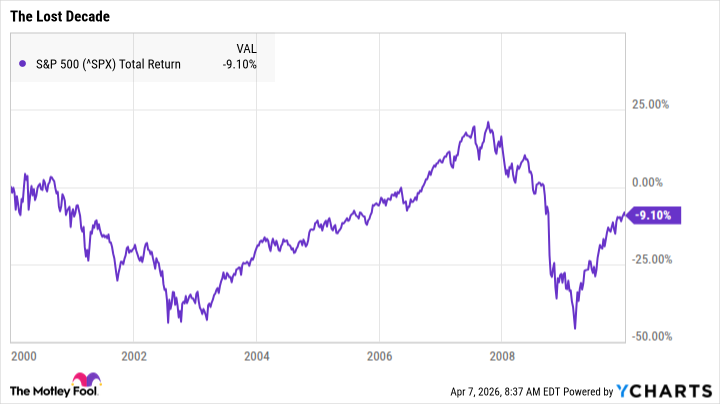
^SPX Chart

Data by YCharts.

Shiller sees a similar story playing out over the next decade. With index returns driven by a handful of stocks tied to the artificial intelligence (AI) story, he expects only a few survivors out of the group over the long run. The rest, as in the dot-com bubble, may see a significant reduction in their market value as the winners emerge. That’s going to weigh significantly on market returns, just as it did in the early 2000s.

As a result, Shiller’s model expects the S&P 500 to produce total returns averaging just 1.3% over the next decade. Note that this includes dividends. If you look only at nominal returns, Shiller’s model forecasts an annualized return of negative 0.7% over the next 10 years. Based on the S&P 500’s level at the end of 2025, Shiller puts the index level at 6,381 by the end of 2035 — another lost decade.

How to invest in today’s market

Shiller still sees opportunities in today’s market. While AI enthusiasm has pushed the valuations of many tech companies to extremes, there are still stocks trading at attractive values. A company that trades at a good value relative to its earnings and reasonable growth expectations is likely to outperform over the long run.

Investors may consider buying a value stock ETF. Alternatively, they can research individual stocks to determine their fair value and ensure that they buy them with a wide margin of safety, just in case their expectations don’t pan out as well as expected.

Shiller also sees opportunities in international stocks. He points out that the major European and Japanese stock indexes are trading at much more attractive CAPE ratios. The MSCI Europe index has a CAPE ratio of just 22.3, which led Shiller to forecast average annual total returns of 7.8% for European stocks over the next decade. The MSCI Japan index trades at a higher CAPE, 26.4 as of the end of the year, but it still trades below its 20-year average. As such, Shiller’s model expects it to return 6.2% per year over the next 10 years.

Investors should also be wary of over-reliance on the CAPE ratio at extreme valuations. As mentioned, the S&P 500 has only traded above a CAPE ratio of 40 once before. That’s a pretty small sample size. The next 10 years are likely to be different from the last 10 years, but they’ll also look different from the “lost decade.” That said, seeking stocks trading below their fair value and avoiding overhyped stocks is a winning strategy in any market.

Source link

Visited 1 times, 1 visit(s) today

Related Article

Stock Market’s Resilience Raises Questions About Investor Complacency

Got story updates? Submit your updates here. › The stock market’s resilience in the face of global crises may mask the long-term implications of each event, as the focus on short-term gains overlooks the broader economic impact.Today in Miami The stock market’s resilience in the face of global crises, from the pandemic to the Iran-Israel

Is Strategy’s Bitcoin Bet Brilliant, or Reckless?

Usually, the playbook for when an asset drops 46% from its peak is to stop buying it. Strategy (MSTR 0.17%) — formerly known as MicroStrategy — missed that memo, and the company now holds 766,970 Bitcoin (BTC 2.64%) after purchasing another 4,871 BTC in the first week of April alone, despite the cryptocurrency’s price of $68,536

Market Crash: This Dividend Stock Becomes a No-Brainer Buy at a Discount

I feel like it’s time for a confession, so here it is: Not every stock that I love is a winner right now. But I tend to fall hard for companies that I know are solid and will rebound when the time is right. Case in point: During the COVID-19 pandemic, travel restrictions meant nobody

Could Trump Ignite a Stock Market Rally by Suspending Tariffs?

President Trump watches the stock market. If you want proof, all you have to do is look through his social media posts. Or you can watch his 2026 State of the Union message, where he proclaimed, “The stock market is at 53 all-time record highs since the election.” The president has seemed in the past

Is Archer Daniels Midland (ADM) Still Attractive After Strong 12 Month Share Price Gains

Find your next quality investment with Simply Wall St’s easy and powerful screener, trusted by over 7 million individual investors worldwide. If you are wondering whether Archer-Daniels-Midland (ADM) is still offering value at today’s levels, this breakdown will help you see what the current share price really reflects. The stock last closed at US$69.73, with

The Vanguard ETF That Could Set You Up for Life if You Buy It in April

Despite its volatility and occasional bear markets, the U.S. stock market remains one of the best long-term wealth-creation tools for everyday investors. It represents the potential, growth, and possibilities of the global economy in a way that nothing else really does. What’s interesting is that it often rewards those who do the least with it.

Stock Market Trends Today – NSE & BSE Stocks Analysis

Got story updates? Submit your updates here. › An extreme close-up of the intricate machinery powering the stock market’s complex financial ecosystem, reflecting the technical analysis and data-driven insights that guide investment decisions.Boston Today The article provides an in-depth analysis of the current stock market trends, focusing on the performance of major Indian stock indices

Is It Too Late to Buy Nvidia and Broadcom? Here’s What History Tells Us

Nvidia (NVDA +2.59%) and Broadcom (AVGO +4.69%) are two of the top AI computing companies to invest in right now. Each of their stocks has done incredibly well over the past few years, with Nvidia up 36% since the start of 2025 and Broadcom up over 50%. Each stock has risen so much over the

Here’s What the Debt Market Is Saying

The market is, completely understandably, focused on artificial intelligence (AI) hyperscalers to determine whether there’s an AI bubble brewing. Those concerns are magnified by the share price performance of the leading hyperscaler companies in 2026 (see chart). The two that stand out the most are Oracle (NYSE: ORCL) and Alphabet (NASDAQ: GOOG) (NASDAQ: GOOGL), and

Goldman Warns Investors Stock Market Volatility Is Here to Stay

Stock market volatility is the new norm, Goldman Sachs says, and it’s not as simple as markets being upset by geopolitical turmoil like the Iran war. Loading audio narration… The conflict in the Middle East has fueled the recent spike in equity volatility, Goldman says, but the firm’s macro strategy research team sees an ongoing

Prediction: Nvidia Stock Is a Buy Before May 20

Nvidia (NVDA +2.59%) remains the leader in the artificial intelligence (AI) industry thanks to its market-leading advanced chips that are ideal for training AI models, as well as its CUDA software platform that unlocks the power of its chips and makes it hard for competitors to lure developers away, which has given Nvidia a competitive

0
Would love your thoughts, please comment.x
()
x