This article is part of FT Globetrotter’s guide to Hong Kong
Hong Kong — Cantonese for “fragrant harbour” — has often taken the “kong” part lightly. Long blighted by highways, piers, sewage plants, car parks, abattoirs and cement works, the Asian financial centre’s waterfront has only relatively recently been seen as something to promote.
Billions of dollars have been invested in new parks and promenades, following years of public activism to demand better access to the waterfront. Now it is home to joggers, guitar players, art displays and — here and there — a place to buy a beer. These new seaside venues are increasingly popular with locals and visitors alike, seeking relief from Hong Kong’s typically blazing sunshine.
Take the Harbour Fun Restaurant & Bar in Hong Kong Island’s busy Wan Chai district, where commuter ferries, fishing boats, yachts, recreational canoes and the occasional hulking cruise ship glide and honk by. Allen Ma, the three-year-old eatery’s manager, rattles off the nationalities of recent visitors: “Mainland Chinese, Russian, German, English, Japanese, American.”
Many of Hong Kong’s bars and restaurants have imposing sea or harbour views, from Skye at The Park Lane hotel and The Repulse Bay on Hong Kong Island to Eyebar on the Kowloon side. Here are five that are unmissable — two of them ideal for anyone who wants to breathe in the sea air, get sand between their toes and chill just an ice-cube’s throw from the water.
The Hong Kong Outpost
Mong Tung Wan, Lantau Island
-
Good for: Lingering views of a perfectly blue sea
-
Not so good for: Spontaneous decisions to go there
-
FYI: The watermelon and tofu skewer evokes meat more than it should

Jumping on a ferry to Hong Kong’s outlying islands is one option for seaside dining in less urban locales. Indeed, one of our visits required a 40-minute trek along a dirt road before we turned to the corner to a secluded beach and restaurant.
The walk to quiet Mong Tung Wan from Pui O, a lively village on Lantau Island, brings you to The Hong Kong Outpost, a beachside restaurant and bar run by Roland Buser, a South African watchmaker of Swiss and Belgian descent. “Rain is not our friend,” says Buser, adding that a stormy forecast can result in 100 per cent cancellations.
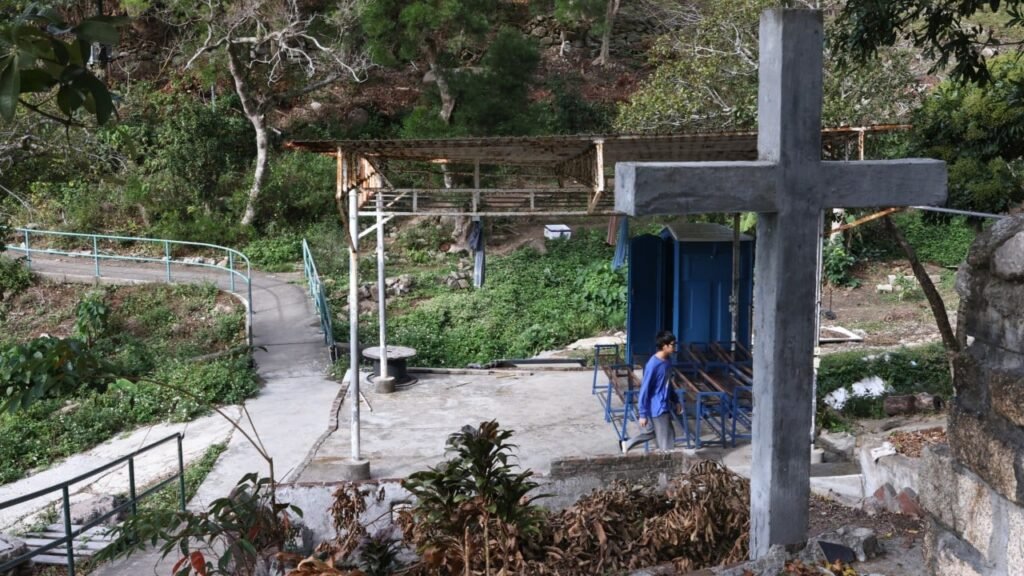
The Outpost has a colourful history as a failed property development, Christian outreach centre, drug rehabilitation facility and location for the 1991 Jean-Claude Van Damme film Double Impact, before it lay idle for years until Buser opened an invitation-only restaurant in December 2021.
Buser says his clientele — The Outpost is now open to all — are mostly expatriates who enjoy the beer-garden atmosphere after a long walk. “I mean, nobody comes here by chance,” he says.


It’s a relaxed oasis offering a colourful and boldly presented barbecue theme: Swiss-style bratwurst, rösti and potato salad, South African braai and — after Buser saw increasing numbers of disappointed vegetarians — a kebab of grilled watermelon, which tastes surprisingly like steak.
The Outpost attracts a lot of groups looking to unwind after a day of sports or exercise, and has the sort of hearty fare that works well after a workout. And unless you’re coming by yacht or helicopter, brisk exercise is the only way to get there.
Pier 7 Café & Bar
Shop M, Level R, Central Pier 7, Central
-
Good for: After-work socialising
-
Not so good for: Panoramic views . . . stretch your neck to see the harbour
-
FYI: Customers ebb and flow with ferry timetables

Pier 7 Café and Bar reopened in 2024 after renovations, among the bustling ferry piers that carry commuters, tourists and goods to Kowloon and outlying islands. Owners Café Deco Group debuted the restaurant in 2007, but closed it after the Covid-19 pandemic triggered strict lockdowns. “We had no choice but to close down for some years,” says sales director Catherine Yuen. “But then when we looked at it, we knew this is a good place. You have the Victoria Harbour really next to you.”
And to be sure, Pier 7 is a cut above most Central harbourfront destinations. The comfortable terrace draws drinkers and diners, but its harbour view is somewhat restricted.

The menu presents takes on eastern Mediterranean cuisine, and highlights include baba ganoush made with butternut squash and falafel served with amba, a mango chutney.
Yuen describes the clientele as a split between commuters heading for after-work or pre-ferry drinks, and cruise passengers who disembark at Kowloon and take the Star Ferry to Central. It also attracts visiting conference delegates, especially from Hong Kong’s booming fintech sector.
Harbour Fun
Water Sports & Recreation Precinct, Hung Hing Road, Causeway Bay
-
Good for: Sundowners by the sea
-
Not so good for: Access — negotiate a busy promenade or web of walkways
-
FYI: Enjoy the daily parade of joggers

Harbour Fun, one of the few places close to the Hong Kong Island side of the harbour, is in Causeway Bay’s Water Sports & Recreation Precinct, near the Royal Hong Kong Yacht Club and adjacent typhoon shelter for small craft.
“The shelter was a small floating village back in the 1960s and ’70s, hosting karaoke bars, mah-jong tables and more,” says Simran Savlani, a Hong Kong food and drinks consultant and author of A Spark of Madness, an Asian vegetarian cookbook.
She adds that “the next generation sought better opportunities, which led to the village’s decline”. But the area has been revived by the running track and green spaces of the precinct, which was completed in December 2023.

The atmosphere is more local than at other venues, with Cantopop and Mandopop playing in the background, and a pan-Asian approach to the extensive menu. You can pretend you’re a member of the exclusive Royal Hong Kong Yacht Club right next door, without the extortionate fees.
Indeed, the location is great for vessel-watching, with sailboats, six-man outriggers and rickety fishing boats cruising in and out of the shelter and yacht club. It also offers diverse people-watching as strollers and joggers pass at varying speeds on the promenade. This all gives Harbour Fun a nautical feel, though the premises look more like a shipping container than any other maritime theme.
The Harbour Fun offers a strange mix of cuisines that would normally set off alarm bells. We heard the chef was Indian, so we went for lamb aloo curry and in-house naan bread. It hit the spot. Why, then, were pan-fried salmon with saikyo miso sauce and river eel kabayaki also on the menu? Turns out those tasty recipes came from the previous Japanese chef, who was lured away by the competition. With typical Hong Kong flexibility, they quickly adjusted.
Ink
G/F, Hong Kong Museum of Art, 10 Salisbury Road, Tsim Sha Tsui, Kowloon
-
Good for: People-watching
-
Not so good for: A tranquil time
-
FYI: Ink’s own brand of ice cream is made on the premises

One of the first big waterfront projects was the Tsim Sha Tsui promenade, home since 2004 to the Avenue of the Stars, an HK$40mn celebration of Hong Kong’s film and television industries.
What the nearby boxlike Ink, on the ground floor of the Hong Kong Museum of Art, lacks in rustic charm, it makes up for in sheer popularity. Tourists and commuters alike gather here each evening to read the avenue’s plaques, watch the sun sink and catch the nightly waterfront laser light show.


“Ultimately, the promenade remains a beautiful spot to view the Hong Kong Central skyline,” says Bronwyn Cheung, who co-founded the Woolly Pig restaurant group with husband Chris Woodyard in 2010 and opened Ink in 2019.
Cheung found that customers wanted comfort food, “like burgers and fish and chips”. Since then, Ink has boomed, offering pub grub with a Hong Kong twist, such as soft-shelled crab and egg and vegetable fried rice.
The Bay
7 Mo Tat Wan, Lamma Island
-
Good for: Meals shared among a group
-
Not so good for: People in a rush as ferries are not too frequent
-
FYI: The beach vendors immediately out front rent paddle boards
-
No website; Directions
Raymond Chan has run The Bay since 2009, but remote Mo Tat Wan has been his home for all of his 65 years. The Chan and Chow clans (the latter’s most famous member being actor Chow Yun-fat) are among Lamma Island’s oldest residents, predating British rule.
Many customers come in to Mo Tat on junks and boats, or via the 35-minute trip on a kaito — a small ferry — from Aberdeen on Hong Kong Island. Visitors also make the one-hour hike across Lamma from Yung Shue Wan, the island’s main settlement. Many bring their dogs, sometimes in prams, for which a bowl of water will be provided.
Mo Tat is a popular destination for Hong Kong’s many yachties, as well people who work in its important maritime industry. Day trippers on boats and junks — plus corporate team-building groups from insurers, boatbuilders and chandlers — are laden with jugs of sangria and mojitos, or Chan’s own homemade non-alcoholic lemonade.
They also come for the food, with specialities such as African chicken — inspired by a Portuguese colonial dish popular in nearby Macau — and Boston lobster drenched in butter.
The beach offers a panoramic view of the East Lamma Channel, one of the world’s busiest sea lanes, but somehow Mo Tat remains tranquil.
“Mo Tat Wan, in some ways, is a bit of a hidden secret away from the crowds,” says Chan, pointing out the lights of Aberdeen, and several islands. “Hard to imagine that when I was growing up there was none of that.”
Additional reporting by Angel Law
Tell us about your favourite waterfront restaurants and bars in Hong Kong in the comments below. And follow us on Instagram at @ftglobetrotter
Cities with the FT

FT Globetrotter, our insider guides to some of the world’s greatest cities, offers expert advice on eating and drinking, exercise, art and culture — and much more
Find us in Hong Kong, London, Tokyo, Washington DC, New York, Los Angeles, Lagos, Paris, Rome, Singapore, Miami, Toronto, Madrid, Melbourne, Frankfurt, Zürich, Milan, Vancouver, Edinburgh, Copenhagen, Istanbul and Venice