Investors haven’t had to deal with many deep market corrections over the past two decades.
Since the 2008-2009 financial crisis, there was the 2018 mini-bear market that cut about 20% off the S&P 500. But it was back to new highs within several months. The COVID pandemic sparked a bear-market drawdown of more than 30%, but it also surged back to new highs following trillions of dollars in government stimulus. The 2022 bear market was the lengthiest drawdown. It was the end of 2023 before the S&P 500 fully recovered. The “Liberation Day” correction turned out to be a quick blip.
The point is that investors don’t have a lot of recent experience dealing with extended pullbacks. With fear beginning to creep in, there’s a real possibility that the next one might not be far off if the economy slows.
When investing to take advantage of a recovery cycle, it’s important to keep one idea in mind. It’s usually not large caps that lead the way back up. More often than not, it’s small caps.
Image source: Getty Images.
The COVID bear market recovery cycle
Take, for instance, what happened during the COVID bear market.
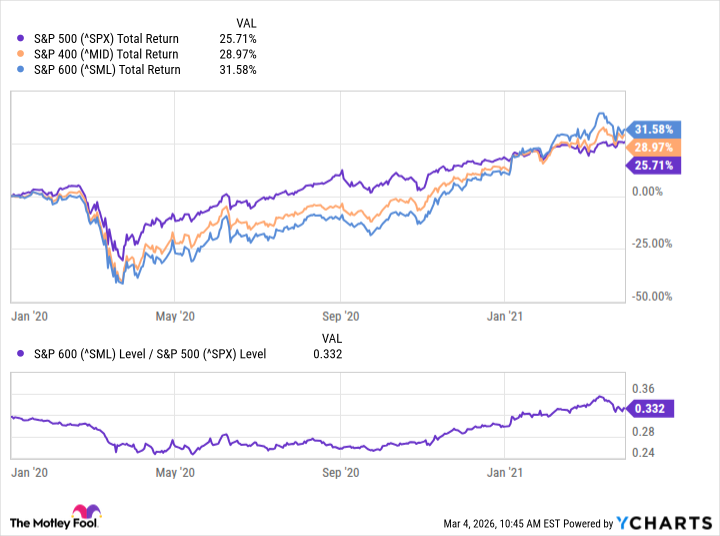
Small caps fell further than the S&P 500 at their lowest point. Large caps and small caps performed fairly similarly during the initial recovery period from May to September. After that, though, small caps started outperforming for most of the next six months.
The financial crisis recovery cycle
Or consider what happened during the financial crisis.
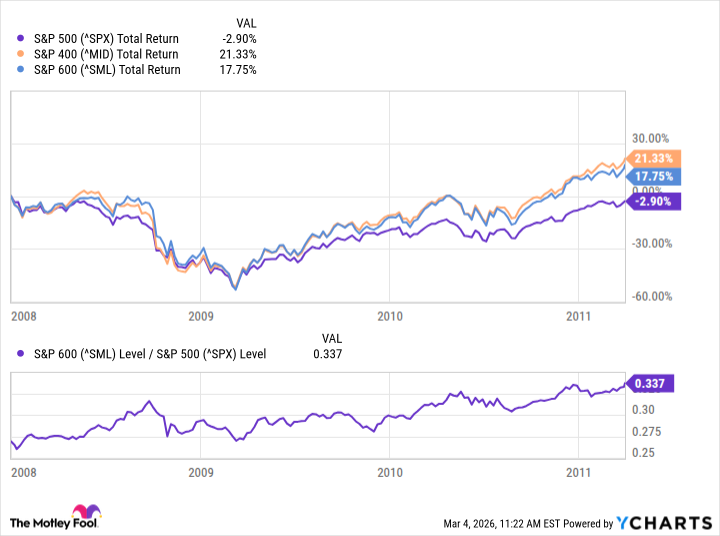
U.S. stocks bottomed in the first part of 2009. After that, however, small caps led for the next two years.
In a recovery scenario, investors eventually begin to think the worst is over. Once they do that, they start buying stocks, prices begin to recover, and it’s the riskier stocks that often perform better. Part of that is due to the general risk-on sentiment, but another part is due to the fact that smaller companies can disproportionately recover more quickly than giant companies. It’s easier to turn a smaller ship around.
Small caps vs. total market
All of this would seem to make the argument for a small-cap ETF in a recovery cycle, such as the iShares Core S&P Small Cap ETF (or the Vanguard Small-Cap ETF. Instead, I prefer to go with the Vanguard Total Stock Market ETF (VTI 0.58%).

Vanguard Total Stock Market ETF
Today’s Change
(-0.58%) $-1.94
Current Price
$329.47
Key Data Points
Day’s Range
$326.13 – $329.97
52wk Range
$236.42 – $344.42
Volume
256K
The reason is that I still like to use large caps and small caps as a combination. In isolation, small caps may have greater return potential, but large caps still add a durability and quality that many smaller companies can’t offer. Using a total market ETF brings small-cap exposure into the equation and helps capture some of that extra upside potential. But it doesn’t do so in a way that makes it an overly aggressive bet. It’s a bit more of a conservative play on the recovery cycle.
Any one of the three ETFs mentioned would be a good way to try to outperform in a recovery cycle. In my opinion, the Vanguard Total Stock Market ETF provides the best balance.
David Dierking has positions in Vanguard Total Stock Market ETF. The Motley Fool has positions in and recommends Vanguard Index Funds-Vanguard Small-Cap ETF, Vanguard Total Stock Market ETF, and iShares Core S&P Small-Cap ETF. The Motley Fool has a disclosure policy.