The white dome of Boudhanath rises like a silent guardian over the chaotic sprawl of Nepal’s capital, Kathmandu, crowned by a golden spire that pierces the sky. Painted on each of the spire’s four sides are the benevolent eyes of the Buddha — wide, calm, and unblinking — said to see all that unfolds below.
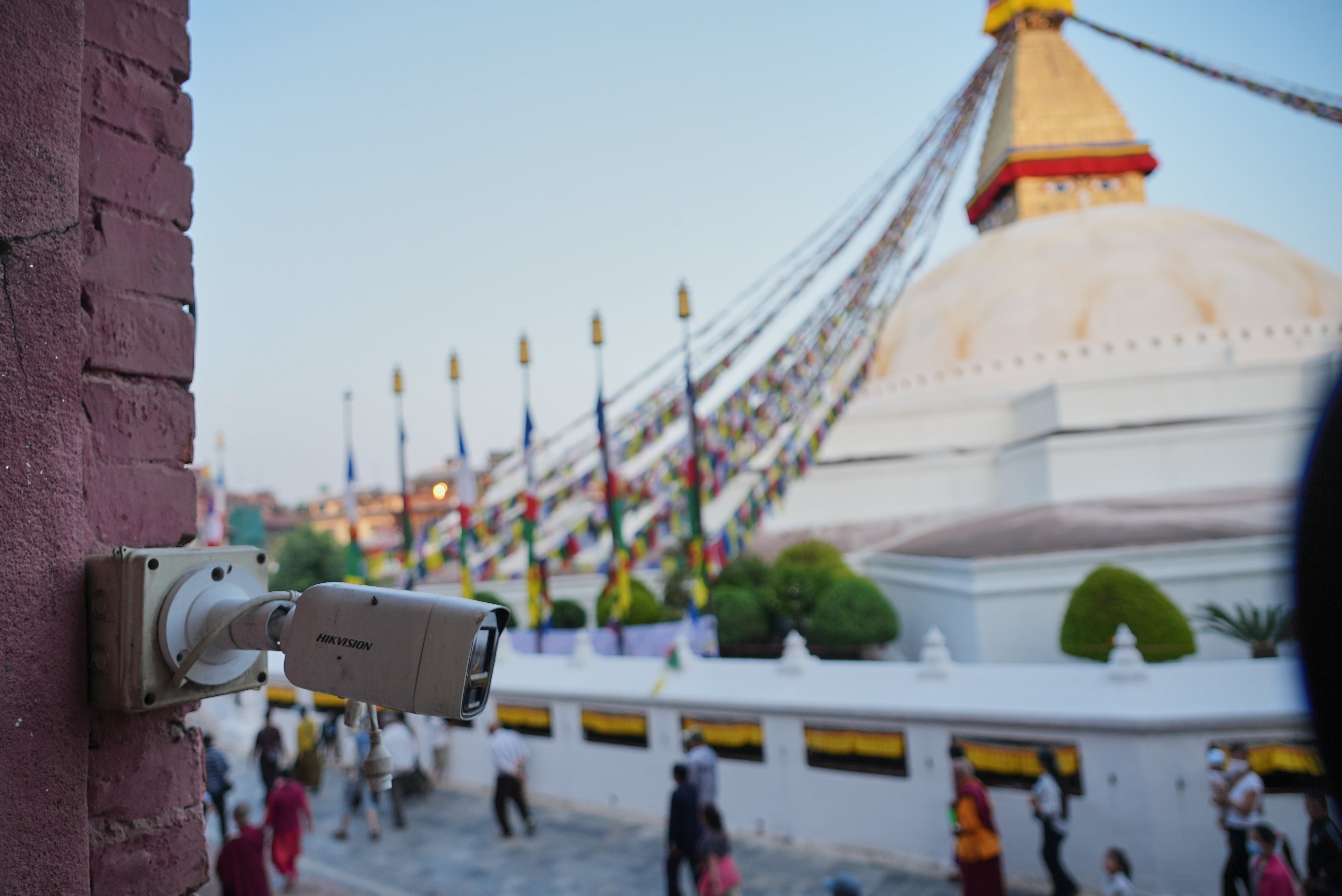
Those eyes have served as a symbol of sanctuary for generations of Tibetans fleeing the Chinese crackdown in their homeland. But today, Tibetan refugees are also watched by far more malevolent eyes: Thousands of CCTV cameras from China, perched on street corners and rooftops to monitor every movement below. This intense surveillance has stifled the once-vibrant Free Tibet movement that had resonated around the world.
Nepal is just one of at least 150 countries to which Chinese companies are supplying surveillance technology, from cameras in Vietnam to censorship firewalls in Pakistan to citywide monitoring systems in Kenya. This technology is now a key part of China’s push for global influence, as it provides cash-strapped governments with cost-effective, if invasive, forms of policing — turning algorithms and data into a force multiplier for control.
The irony at the heart of this digital authoritarianism is that the surveillance tools China exports are based on technology developed in its greatest rival, the United States, despite warnings that Chinese firms would buy, copy or outright steal American designs, an investigation by The Associated Press has found.
For decades, Silicon Valley firms often yielded to Beijing’s demands: Give us your technology and we will give you access to our market. Although tensions fester between Washington and Beijing, the links between American tech and Chinese surveillance continue today.
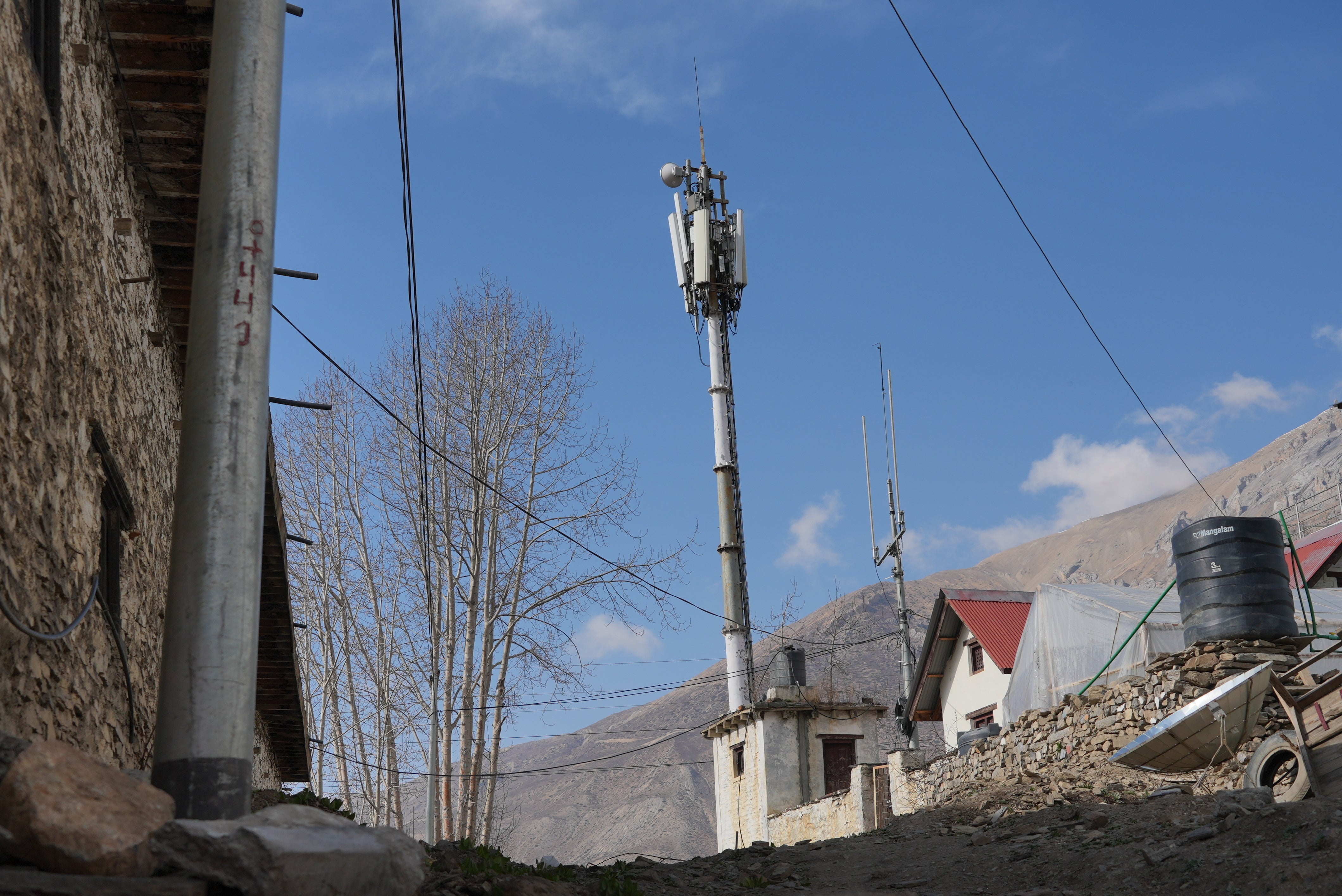
For example, Amazon Web Services offers cloud services to Chinese tech giants like Hikvision and Dahua, assisting them in their overseas push. Both are on the U.S. Commerce Department’s Entity List for national security and human-rights concerns, which means transactions with them are not illegal but subject to strict restrictions.
AWS told AP it adheres to ethical codes of conduct, complies with U.S. law, and does not itself offer surveillance infrastructure. Dahua said they conduct due diligence to prevent abuse of their products. Hikvision said the same, and that they “categorically reject any suggestion that the company is involved in or complicit in repression.”
Chinese technology firms now offer a complete suite of telecommunications, surveillance, and digital infrastructure, with few restrictions on who they sell to or how they’re used.
China pitches itself as a global security model with low crime rates, contrasting its record with the United States, said Sheena Greitens, a political scientist at the University of Texas at Austin.
“It’s got a set of solutions that it’s happy to share with the world that nobody else can offer,” she said. “(But) they’re certainly exporting the tools and techniques that are very important to authoritarian rule.”
The AP investigation was based on thousands of Nepali government procurement documents, corporate marketing material, leaked government and corporate documents, and interviews with more than 40 people, including Tibetan refugees and Nepali, American and Chinese engineers, executives, experts and officials.
While thousands of Tibetans once fled to Nepal every year, the number is now down to the single digits, according to Tibetan officials in Nepal. In a statement to AP, the Tibetan government in exile cited tight border controls, Nepal’s warming ties with China and “unprecedented surveillance” as reasons for the drastic plunge.
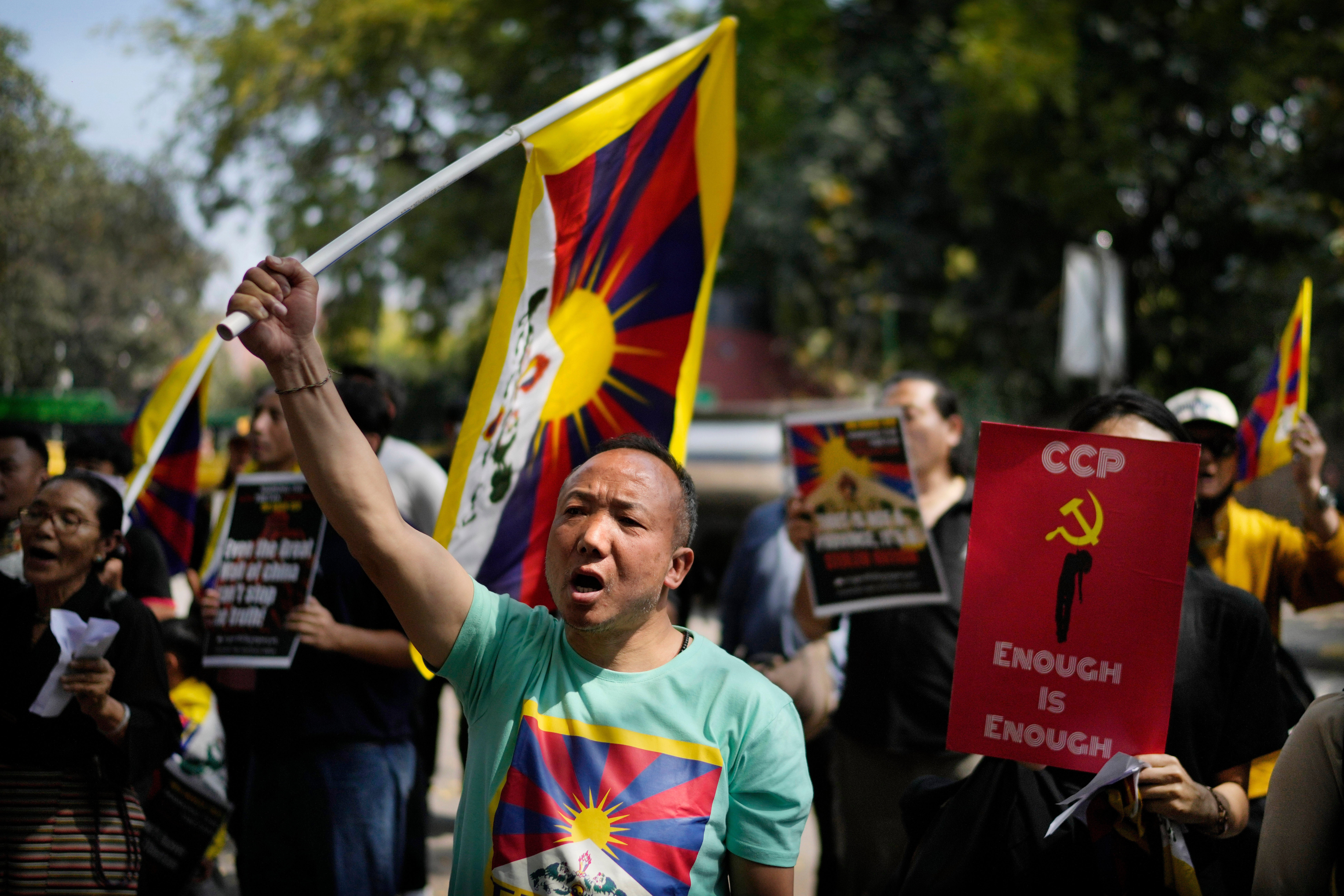
A 2021 internal Nepali government report, obtained by AP, revealed that China has even built surveillance systems within Nepal and in some areas of the border buffer zone where construction is banned by bilateral agreements. In a statement to AP, the Chinese Ministry of Foreign Affairs denied coercing Western companies to hand over technology or working with Nepal to surveil Tibetans, calling it a “sheer fabrication driven by ulterior motives.”
“Attempts to use Tibet-related issues to interfere in China’s internal affairs, smear China’s image, and poison the atmosphere of China-Nepal cooperation will never succeed,” the statement said.
The Nepali government and the Chinese-controlled Tibetan authorities did not respond to requests for comment.
Under pressure, many Tibetans are responding the only way they can: Leaving. The Tibetan population in Nepal has plunged from over 20,000 to half of that or less today.
Now 49, one-time protester Sonam Tashi is just a father trying to get his 10-year-old son out — before the net pulls tighter. The boy was born in Nepal but has no document proving he is either a refugee or a citizen, a result of Chinese pressure.
Tashi described how those considered likely to protest are picked up in advance around key dates — like March 10, which marks the 1959 Tibetan uprising, or July 6, the Dalai Lama’s birthday. In 2018, Nepal confirmed that it was building predictive policing, which allows officers to watch people’s movements, identify in advance who they think will protest and arrest them preemptively.
“There are cameras everywhere,” Tashi said on a winding bus ride toward the Indian border. “There is no future.”
‘They gave us all the hardware’
After China crushed a Tibetan uprising in 1959, thousands fled across the Himalayas to Nepal, carrying only what they could: Religious paintings, prayer wheels and the weight of families left behind.
Their exodus, led by the charismatic Dalai Lama, captured the American imagination, with Hollywood films and actor Richard Gere’s congressional appeals putting Tibet in the spotlight. Washington trod a careful line, defending the rights and religious freedom of Tibetans without recognizing independence.
Today, the future of the Free Tibet movement is in question. Without refugee cards that grant basic rights, Tibetans in Nepal can no longer open bank accounts, work legally or leave the country.
Nearly all police cameras monitoring Kathmandu link back to a four-story brick building just a few blocks down from the Chinese embassy, where officers watch the country in real time.
The building hums with the low breath of cooling fans. Inside, a wall of monitors blinks with feeds from border towns, busy markets and clogged traffic crossings.
Officers in crisp blue uniforms and red caps sit in the glow, scanning scenes. Beneath the screens, a photo published in a Nepali daily shows, a sign in English and Chinese reads: “With the compliments of the Ministry of Public Security of China.”
Their reach is vast.
Operators can track a motorbike weaving through the capital, follow a protest as it forms, or patch an alert directly to patrol radios. Many cameras are equipped with night vision facial recognition and AI tracking — able to pick a single face out of a festival crowd or lock onto a figure until it disappears indoors. The system not only sees but is learning to remember, storing patterns of movement, building a record of lives lived under its gaze.
A 34-year-old Tibetan cafe owner in the city watched the city change in quiet horror. “Now you can only be Tibetan in private,” he said. He and other Tibetans in Nepal spoke to AP anonymously, fearing retaliation.
The first cameras in Boudhanath were installed in 2012, officially to deter crime. But after a Tibetan monk doused himself in petrol and set himself ablaze in front of the stupa in 2013, police added 35 night vision cameras around it.
The Chinese embassy in Kathmandu worked closely with the police, said Rupak Shrestha, a professor at Simon Fraser University in Canada who studied surveillance in Nepal. He said the police received special training to use the new cameras, identify potential symbols associated with the Free Tibet movement and anticipate dissent.
In 2013, a team of Nepal Police officers crossed the northern border into Tibet for a seemingly straightforward mission: Collect police radios from Chinese authorities in Zhangmu, a remote border town, about 120 kilometers (75 miles) from Kathmandu. A truck was loaded with equipment and a few handshakes later, they were driving back to Kathmandu.

The radios — made by the partly state-owned Chinese firm Hytera — looked like walkie-talkies but ran on a digital trunking system, a scaled-down mobile network for police use. Officers could talk privately, coordinate across districts, even patch into public phone lines. The entire system — radios, relay towers, software — was a $5.5 million gift from China.
“They didn’t give us the money,” recalled a retired Nepali officer who made the trip. “They gave all the hardware. All Chinese.”
He remembered not the border guards but the tech — sleek, reliable, and far ahead of anything they’d used before. He spoke on condition of anonymity to describe sensitive internal discussions.
He said Nepal had initially considered buying the technology from the U.S. and only wanted to deploy the system in its two biggest cities. Hytera was a fraction of the cost and performed comparably, but China also wanted coverage near the border with Tibet. Nepal acquiesced.
They installed the technology in Sindhupalchowk, a border district with a key road to China used by Tibetan refugees. “We understood their mindset,” the retired officer said. “A secure border.”
A police envoy from the Chinese embassy began making regular visits to the Nepal Police headquarters. He’d chat over coffee, flip through brochures from Chinese companies. “He’d say, ‘You want anything?’” the retired officer recalled.
China began donating tens of millions in police aid and surveillance equipment, including a new school for Nepal’s Armed Police Force. Hundreds of Nepali police traveled to China for training on policing and border control, according to Chinese government posts.

Ahead of a summit of South Asian leaders in 2014, among the goods on offer were ones from Uniview, China’s pitch for an all-seeing eye.
The company was the Chinese surveillance business of what was then Hewlett Packard, or HP, before it was spun off in a 2011 deal. Since 2012, Uniview has been selling mass surveillance solutions to the Tibetan police, such as a command center, and developed cameras that track ethnicities such as Uyghurs and Tibetans.
Uniview installed cameras in Kathmandu for Nepal’s first “safe city” project in 2016. It started with the city’s roads, then went up across the capital — in tourist areas, religious sites, high-security zones like Parliament and the prime minister’s home.
The cameras didn’t just record. Some could follow people automatically as they moved. Others were designed to use less data, making it easier to store and review footage.
Hewlett Packard Enterprise, or HPE, a successor company to HP that sells security solutions, has no ownership in Uniview and declined to comment. Hytera and Uniview did not respond to requests for comment.
Nearly all the cameras installed in Nepal are now made by Chinese companies like Hikvision, Dahua and Uniview, and many come bundled with facial recognition and AI tracking software.
Hikvision’s website and marketing materials advertise camera systems in Nepal linked via Hik-Connect and HikCentral Connect, cloud products that rely on Amazon Web Services. Hikvision sells to the Nepali police and government, and a template for Nepali tenders indicates CCTV cameras procured for the government are required to support Hik-Connect.
In return for Beijing’s support, top Nepali officials have thanked China repeatedly over the years, promising never to allow “anti-China activities” on Nepali territory.
The Nepali police head offices aren’t far from the now-forlorn Tibetan reception center, which used to shelter tired, hungry Tibetans fleeing across the border.
The building is nearly empty. The gates are locked. Those who do escape, like Namkyi, arrested at 15 for protesting Chinese rule, often have to wait for weeks confined indoors until they’re smuggled out again to the Tibetan capital in exile in India.
Silence has become survival.
“They know they are being watched,” she said. “Even though we are free, the surveillance cameras mean we’re actually living in a big prison.”
From clients to competitors
From the start, U.S. companies eager for China’s vast markets exchanged technology for entry.
Many were required to start joint ventures and research operations in China as a precondition for being allowed in. Dozens, if not hundreds, complied, transferring valuable know-how and expertise — even in sensitive areas like encryption or policing.
Little by little, Chinese companies chipped away at the lead of American tech companies by luring talent, obtaining research, and sometimes plain copying their hardware and software. The flow of technology continued, even as U.S. officials openly accused China of economic espionage and pressuring American companies for their technology.
“China is by far the most egregious actor when it comes to forced technology transfer,” Robert D. Atkinson, then-president of a think tank focused on innovation, warned Congress in a 2012 hearing.
American tech resistance came to a final, definitive end later that year with Edward Snowden’s revelations that U.S. intelligence was exploiting American technology to spy on Beijing. Spooked, the Chinese government told Western firms they risked being kicked out unless they handed over their technology and provided security guarantees.
After companies like HP and IBM agreed, their former partners became their fiercest global competitors — and unlike American firms, they faced few questions about the way their technology was being used. Companies like Huawei, Hikvision and Dahua have now become global behemoths that sell surveillance systems and gear all over the world.
American technology was key to this:
- Uniview, the Chinese AI-powered CCTV camera supplier, supplied the first phase of Nepal’s safe city project in 2016, installing cameras in Kathmandu. Uniview was carved out of California-based HP’s China surveillance video business.
- Hytera provided data infrastructure for the Nepali police, such as walkie-talkies and digital trunking technology, which enables real-time communication. Earlier this year, Hytera acknowledged stealing technology from U.S. company Motorola in a plea agreement, and had acquired German, British, Spanish, and American tech businesses in their growth phase.
- Hikvision and Dahua, China’s two largest surveillance camera suppliers, sell many of the cameras now in Nepal. They partnered with Intel and Nvidia to add AI capabilities to surveillance cameras. Those ties ended after U.S. sanctions in 2019, but AWS continues to sell cloud services to both companies, which remains legal under what some lawmakers call a loophole.
- Chinese tech giant Huawei has become one of the world’s leading sellers of surveillance systems, wiring more than 200 cities with censors. In Nepal, they supplied telecom gear and high-capacity servers at an international airport. Over the years, the company benefited from partnerships with American companies like IBM, and has been dogged by allegations of theft — including copying code from Cisco routers wholesale, a case which Huawei settled out of court in 2004.
Huawei said it provides “general-purpose” products “based on recognized industry standards.” Intel has said it adheres to all laws and regulations where it operates, and cannot control end use of its products. Nvidia has said it does not make surveillance systems or work with police in China at present.
IBM and Cisco declined comment. Policing gear maker Motorola Solutions, a successor company to Motorola after it split, did not respond to requests for comment.
U.S. technology transfer to Chinese firms has mostly stopped after growing controversy and a slew of sanctions in the past decade. But industry insiders say it’s too late: China, once a tech backwater, is now among the biggest exporters of surveillance technologies on earth.
Few realized “the U.S. shouldn’t be selling the software to China because they might copy it, they might use it for these types of surveillance and bad stuff,” said Charles Mok, a Hong Kong IT entrepreneur and former lawmaker now living in exile as a research scholar at Stanford. “Nobody was quick enough to realize this could happen.”
‘The great big eye in the sky’
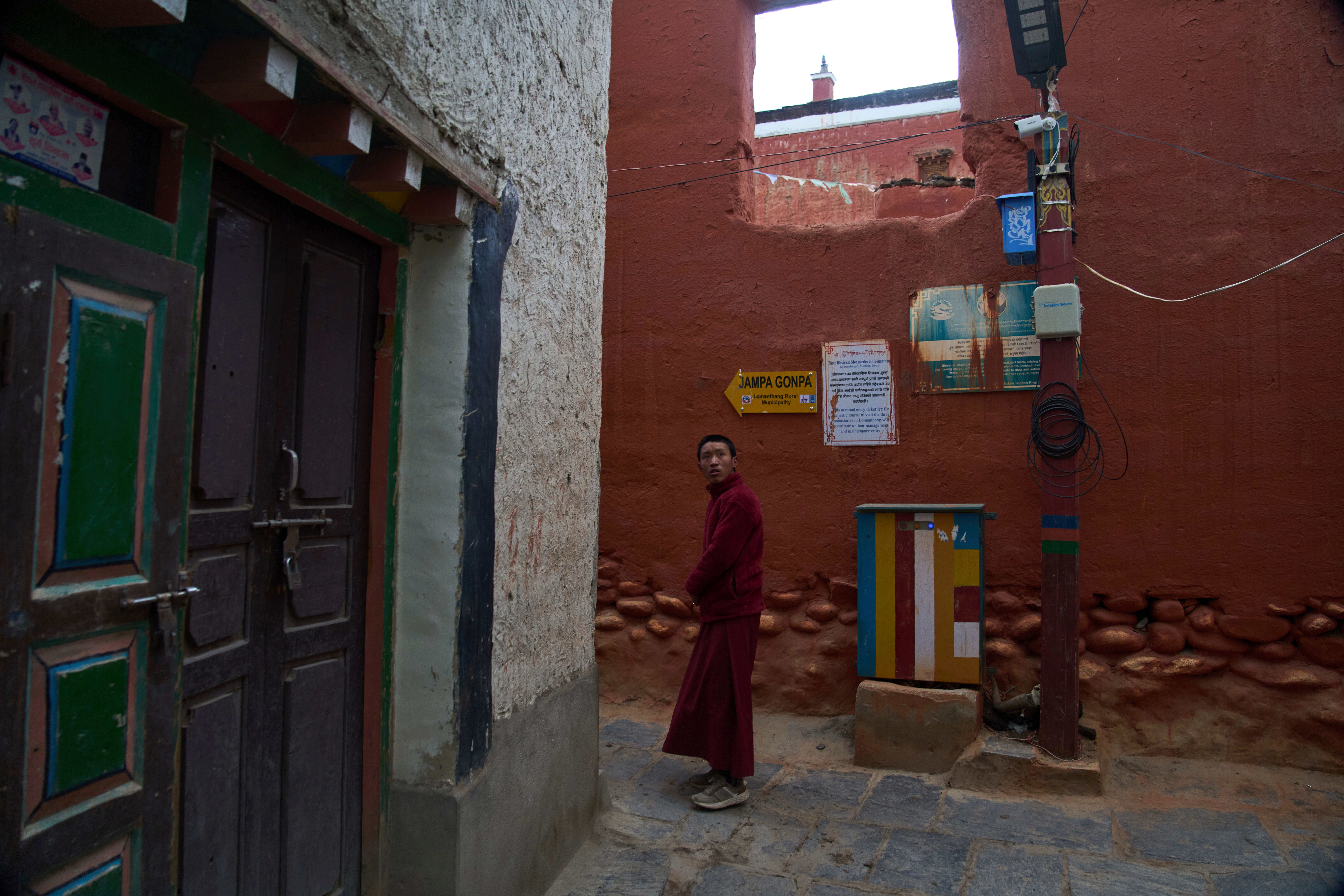
Inside a 15th-century monastery in Lo Manthang in Nepal’s Mustang district, light slants through wooden slats, catching motes of dust and the faded faces of bodhisattvas.
Crumpled notes of Chinese currency lie at the feet of deities in the walled city along the Tibetan border. Here, shops stock Chinese instant noodles and cars with Chinese plates rumble down mountain roads.
A gleaming white observation dome just inside Chinese territory looms over the city. Visible from 15 kilometers (9 miles) away, it’s trained on the district that has long been a refuge for Tibetans, including a guerrilla base in the 1960s.
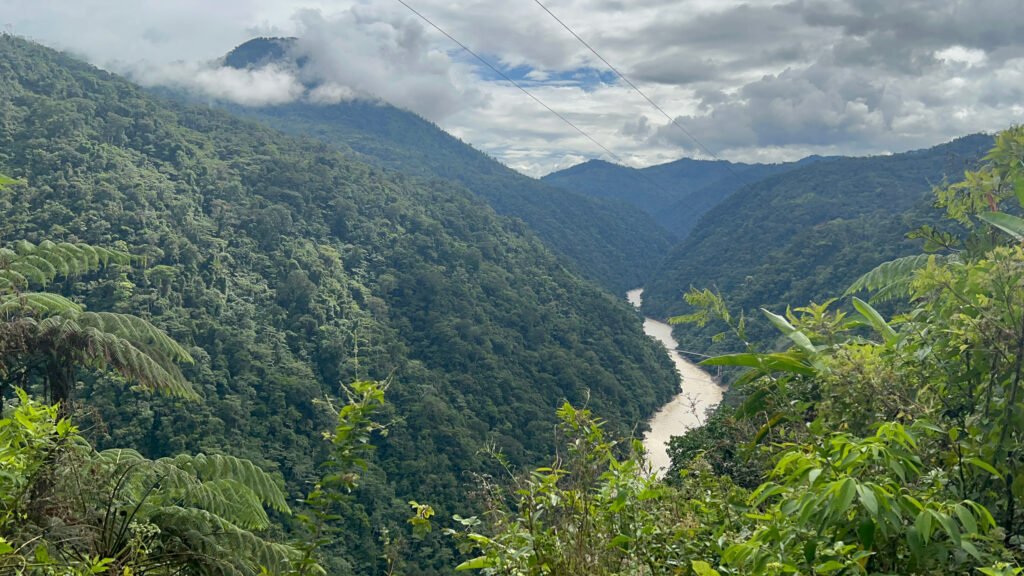
The dome is just one node in China’s vast 1,389-kilometer (863-mile) border network with Nepal — a “Great Wall of Steel” of fences, sensors and AI-powered drones.
Chinese forces have barred ethnic Tibetans from accessing traditional pastures and performing sacred rites. They have pressured residents of Lo Manthang to remove photos of the Dalai Lama from shops. And a “China-Nepal joint command mechanism” meets several times a month on border patrols and repatriations, according to a post by the Chinese-run Tibetan government.
The result is that the once-porous frontier is now effectively sealed, and China’s digital dragnet reaches deep into the lives of those who live near it.
In April 2024, Rapke Lama was chatting with a friend across the border on WeChat when he received an invitation to meet. He set out from his village and crossed into Tibet — only to be arrested almost immediately.
Lama believes his WeChat exchange was monitored; Chinese police appeared with unsettling precision, as if they knew where to look. After accusing him — wrongly, he maintains — of helping Tibetans flee into Nepal, the police seized his phone, which had photos of the Dalai Lama and Tibetan music. Then came months in a Lhasa prison, where isolation and inadequate medical care hollowed him out.
Lama did not return to Nepal until May 2025, gaunt and shaken. He later said he entered Tibet to harvest caterpillar fungus, valued in traditional Chinese medicine. Another friend who crossed the border remains in custody.
“Even now, I’m scared,” Lama says. He wears masks when wandering the streets, he says, “because of that lingering fear.”
The Chinese observation dome is a giant symbol of the same fear, towering over the border.
“It’s the great big eye in the sky,” said a 73-year-old Tibetan hotel owner in Nepal, who spotted the installation during a trip near the border last year. “For Tibetan refugees, Nepal has become a second China.”







![[China Tech] Local Pediatric Hospital's Research Ward Attracts Overseas Patients](https://charm-retirement.com/wp-content/uploads/2025/12/985a6d2b-4f83-44d8-943a-f00ce098c5ab_0-1024x683.jpeg)