US should not be the default IPO choice

Unlock the Editor’s Digest for free

The writer is chief executive of European exchange operator Six Group

For the past two decades or more, the logic for ambitious technology companies considering an initial public offering appeared quite straightforward.

If scale, liquidity and visibility were the goal, then the US often seemed to be the most suitable destination. It boasts deep capital pools, experienced analyst coverage and commands global investor attention. But as global investors now question their US exposure more, the assumption that the country should be the default listings destination deserves a much closer look.

Take liquidity for starters. Recent Cboe data shows average daily notional value traded in US equities reached roughly $1tn last year, reflecting record activity. By comparison, full-year European equity trading averages around €70bn across exchanges according to Rosenblatt Securities, highlighting a persistent scale gap between the regions.

But analysis by Six Group of European exchange data indicates that while US markets generate higher trading volumes overall, post-IPO outcomes show this is concentrated among domestic issuers. In the most recent year of fully comparable data, the average daily value of stocks traded in the US reached about €288bn in 2023 compared with roughly €65bn in Europe, in what was a relatively weak year for the continent’s equity markets. Yet in the US, just 79 mega caps — about 3 per cent of listed companies — accounted for more than half of the total turnover.

This means the headline liquidity advantage is more concentrated than sometimes assumed. For mid-sized issuers, the incremental benefit of listing in the country is often smaller than boards expect. For companies in the $1bn to $5bn equity value range, average daily trading turnover in shares is about 0.1 per cent for European-listed companies outside of Switzerland and 0.3 per cent for foreign issuers in the US. For Swiss-listed companies it is 0.2 per cent.

Valuation dynamics are similarly misunderstood. Headline multiples in the US are heavily influenced by a small group of very large technology stocks that dominate index performance. Technology stocks now represent nearly one-third of the US equity market, more than four times the roughly 7 per cent weighting seen in Europe.

Once these outliers are excluded, valuation comparisons narrow but do not disappear. European indices trade at roughly a 30 per cent forward price-earnings discount to the US, and closer to the high 20s when the largest US technology stocks are stripped out. But that gap largely reflects differences in sector mix and growth expectations at the index level rather than a fixed penalty or benefit applied to individual companies based on where they list.

The headline valuation for the index should not be assumed to apply for individual companies. According to a report last year by the New Financial think-tank, 70 per cent of the 130 European companies that had moved to the US over the past decade to April were trading below their listing price, less than a fifth had beaten the S&P 500 index and three-quarters had not beaten the European market since they moved.

Moreover, the US IPO process itself can sometimes damp pricing outcomes. Restrictions on pre-IPO investor engagement can limit early price discovery, increasing uncertainty around demand. Underwriters can respond by applying larger IPO discounts to ensure execution, partially offsetting any theoretical valuation premium. In addition, underwriting fees are typically higher in the US. In Switzerland, for example, they range from 2 to 5 per cent of gross proceeds, while in the US they average 4 to 7 per cent.

The growing importance of passive investment further complicates the picture. Funds tracking equity indices now account for a substantial share of daily market flows. In more concentrated domestic European markets, issuers can reach index inclusion thresholds earlier. Of the roughly 130 European companies tracked by New Financial that have moved to the US, only two have entered the S&P 500 and just four had joined the Nasdaq 100.

As for analyst coverage, large US companies enjoy extensive attention but smaller and mid-sized foreign issuers listed in the US receive coverage that is comparable with those on European bourses. The average number of analysts covering domestic US companies with a market capitalisation of $1bn to $5bn, for example, is 12. But this falls to nine for foreign issuers, the same level for stocks listed in Europe and Switzerland.

And in general, I believe that for issuers with revenues that are primarily European, being listed where analysts and investors are closest to the story can support more consistent valuation outcomes. None of this diminishes the role of US capital markets. They remain deep, sophisticated and, for certain companies, strategically appropriate. It is just the presumption that a US listing represents the ideal choice for non-US tech issuers should be questioned more.


Source link

Visited 1 times, 1 visit(s) today

Related Article

2 Stocks Down 74% and 40% To Buy Now

Investors came into 2026 worried about an AI bubble. Indeed, a bubble is bursting, but it’s not in AI stocks. Instead, software stocks have dived this year with the iShares Expanded Tech-Software Sector ETF (NYSEMKT: IGV), which counts Microsoft, Palantir, and Salesforce among its biggest holdings, down 24% year-to-date through Feb. 25 as fears of

Jim Cramer drops unexpected take on stock market

Jim Cramer isn’t buying into the AI doomsday scenario. At a point when Mr. Market had gotten rattled by a viral memo from Citrini Research’s Alap Shah, Cramer pushed back, calling it essentially a work of “science fiction” rather than sober forecasting. The fallout from the report was immediate. On Monday, Feb. 23, the Dow

Why Cava Stock Surged Today

The pita purveyor is winning market share. Shares of Cava Group (CAVA +25.91%) climbed on Wednesday after the Mediterranean-style restaurant chain showed progress on its expansion initiatives. By the close of trading, Cava’s stock price was up over 26%. Image source: Getty Images. Cava’s concept is resonating with diners Cava’s revenue rose 21.2% year over

Stock Market Today, Feb. 25: Netflix Jumps After Warner Bros. Bid Fuels Investor Optimism

On Feb. 25, 2026, streaming’s standout dealmaker faces a high-stakes Warner Bros. bidding war and rising antitrust scrutiny. Today’s Change (5.99%) $4.67 Current Price $82.72 Key Data Points Market Cap $329B Day’s Range $79.35 – $83.11 52wk Range $75.01 – $134.12 Volume 3.4M Avg Vol 46M Gross Margin 48.59% Netflix (NFLX +5.99%), a provider of

Wall Street Is Divided on This AI Stock. Here’s Why I’m Bullish.

This company’s growth opportunity could be huge. Palantir Technologies (PLTR +4.11%) posted another blockbuster earnings report in early February. Its fourth-quarter revenue surged 70% year over year, accelerating from the 63% growth in the previous quarter. The main dilemma for investors considering the stock is valuation. It’s expensive, trading at a forward price-to-sales ratio (P/S)

The Best Dividend Stocks to Buy Right Now

Where to invest $1,000 right now? Our analyst team just revealed what they believe are the 10 best stocks to buy right now, when you join Stock Advisor. See the stocks » With the S&P 500 (SNPINDEX: ^GSPC) down just 1% from its all-time high, the stock market isn’t remotely in crash mode. But cracks are

Stock Market Concentration Has Surpassed Its 1930s Peak. Should Investors Worry?

I recently gave a presentation to some new colleagues from the Center for Research in Security Prices, an affiliate of the University of Chicago acquired by Morningstar. One of my slides highlighted the top-heavy nature of today’s US stock market. A graph showed that the top 10 stocks represent a bigger chunk of the market

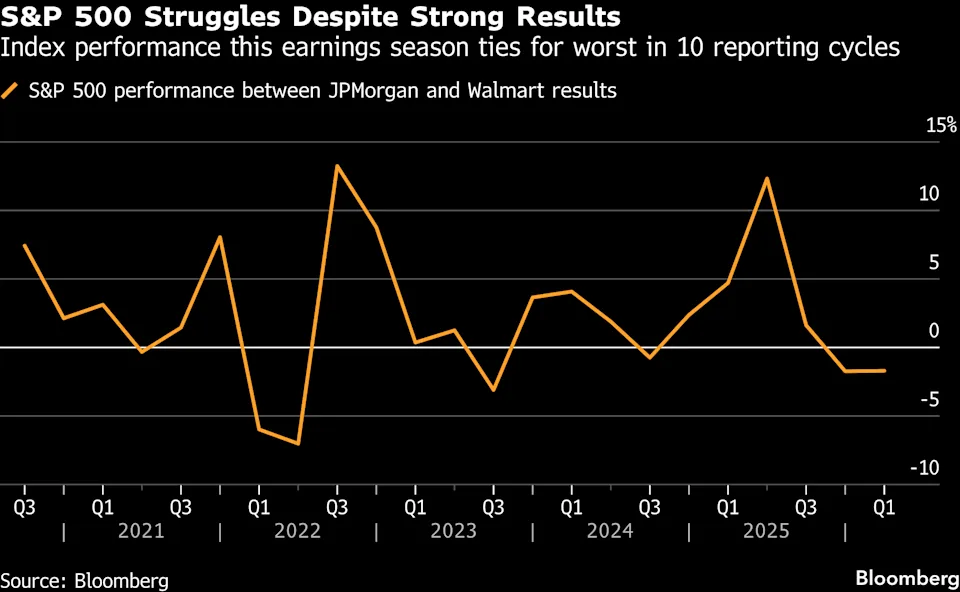
Strong Earnings Not Enough to Power Stocks Past AI, Credit Worry

(Bloomberg) — Corporate America just delivered one of the strongest earnings seasons in recent memory, but you wouldn’t know it looking at the stock market. Companies in the S&P 500 grew earnings by 13% in the fourth quarter, almost six percentage points better than expected. They also served up optimism about the coming year. The

Is Taiwan Semiconductor Stock a Buy Now?

Despite an exceptionally strong 2025 performance, Taiwan Semiconductor still has plenty of room to run this year and beyond. Taiwan Semiconductor (TSM +4.24%) is a core player in the global AI boom. It’s also the world’s largest dedicated chip manufacturer, with approximately 70% market share. The semiconductor foundry has benefited immensely from AI-related demand and

Hong Kong Stock Market Midday Review

According to Zhitong Finance, the Hang Seng Index rose by 2.29%, gaining 604 points to close at 27,017 points; the Hang Seng Tech Index increased by 3.32. The morning trading volume of Hong Kong stocks reached HKD 106.5 billion. Optical communication concept stocks are among the top gainers. Key enterprises in Optics Valley will continue

Insurance stocks collectively surged, with investment returns on the asset side expected to drive improvements in insurers’ profitability.

Insurance stocks collectively rose, as of press time,$AIA (01299.HK)$up over 4%,$PICC GROUP (01339.HK)$surging over 3%,$PING AN (02318.HK)$、$CHINA LIFE (02628.HK)$、$NCI (01336.HK)$with gains exceeding 2%. In terms of news, the National Financial Regulatory Administration previously released annual operating data for the insurance industry. The data showed that in 2025, the insurance industry achieved approximately RMB 6.12 trillion

Hong Kong Stocks Open | Hang Seng Index Up 0.58% at Opening, Semiconductor Sector Strong, Huahong Semiconductor (01347) Rises Nearly 2%

The Hang Seng Index opened 0.58% higher, while the Hang Seng Tech Index rose 0.86%. In the market, the semiconductor sector performed strongly, with Huahong Semiconductor and SMIC rising nearly 2%; AI application stocks weakened. Regarding the future outlook for Hong Kong stocks Galaxy Securities stated that the Hong Kong-listed technology sector remains a long-term

Midday Review of Hong Kong Stocks

According to Futu News on February 25, the three major indexes of Hong Kong stocks rose collectively, with the Hang Seng Index up by 0.75%, the Technology Index up by 0.34%, and the China Enterprises Index up by 0.90%. By midday close, 1,244 Hong Kong stocks had risen, 781 had fallen, and 1,138 remained unchanged.

Morgan Stanley resets Nvidia stock forecast ahead of earnings

Investors are eagerly waiting for Nvidia‘s (NVDA) Q4 earnings, scheduled for February 25. The last earnings report was an absolute smasher, yet the stock market reacted negatively. The stock closed at $186.52 on the day of earnings and closed at $180.64 on the next day. I covered analysts’ reactions to those earnings in my article

3 Breakout Growth Stocks You Can Buy and Hold for the Next Decade

Micron and Broadcom are well-known breakout stocks, but Nokia is also poised to grow as it pivots into AI. The tech sector is getting repriced as investors figure out how AI will disrupt entire industries for the next several years. The picking of winners and losers has begun, and a few companies will stand the

Nvidia Stock Is Outperforming the Market in 2026. Is It a Buy?

Nvidia’s business results have been extraordinary, but are they impressive enough to make the stock a buy after a big run-up last year? Shares of artificial intelligence (AI) chip leader Nvidia (NVDA +0.79%) have held up well in early 2026, edging ahead of the broader market even as several other megacap tech companies have seen

0
Would love your thoughts, please comment.x
()
x