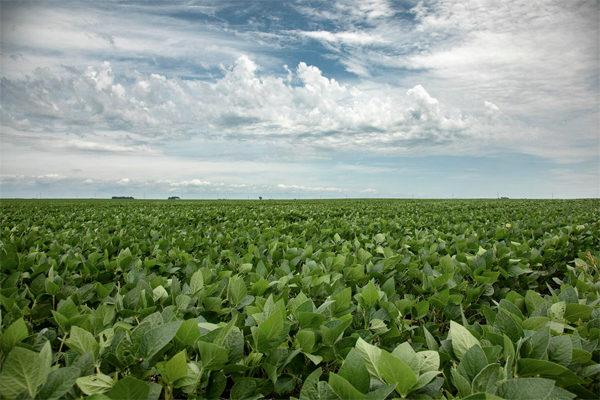
The US is aiming to secure agreement on a broader range of agricultural purchases by China during President Donald Trump’s planned visit there next month. (Photo by Catrina Rawson of FarmWeek)
By TAMMIE SLOUP
FarmWeek
The US is aiming to secure agreement on a broader range of agricultural purchases by China during President Donald Trump’s planned visit there next month, U.S. Trade Representative Ambassador Jamieson Greer said.
“We are talking in terms of aggregate, overall purchases from China. There’s been a lot of talk about soybeans, and we have a very specific commitment on soybeans, but we’re also looking to get a commitment from the Chinese overall, with respect to all agriculture,” Greer testified during a House Ways and Means hearing on trade policy April 22. “We’re trying to establish a mechanism with China to facilitate expanded trade on non-sensitive goods, which would include, of course, agriculture.”
China’s soybean imports from the US have been significantly impacted by trade tensions and tariffs. While China continues to be an important market for US ag products, the administration has been making moves over the past year to open new markets, Greer said.
Committee member US Rep. Darin LaHood, R-Dunlap, shared what he’s heard from farmers in his district on the ag economy, including from his ag advisory committee that met several weeks ago and includes about 40 farmers.
“I just want to stress the anxiety and the uncertainness in the ag community right now, where prices are at, where diesel has gone, fertilizer applications. …About 40% of the corn and soybeans grown in my district and the state of Illinois goes somewhere else around the world. Markets and customers are important to our agriculture industry, and they’re suffering now, and they’re concerned about the direction that we’re going,” LaHood said.
Greer noted the administration has obtained commitments for tariff elimination or reduction for soybeans or soybean meal in Argentina, Cambodia, Ecuador, Bangladesh, Indonesia and Taiwan. In addition, Bangladesh, India, Indonesia, Japan, Taiwan and Thailand have made purchase commitments.
“We’re seeing diverse economies now coming, large and small opening up, wanting to get their trade deficit down, and looking to do it through soybeans and corn,” Greer said. “Corn exports went up by double digits last year. So, when it comes to trade, we are trying really hard to do our part.”
Greer touted a reversal of ag trade deficit trends while noting to the administration’s commitment to domestic fertilizer regulatory reform.
“We are very aware of the input cost issue,” Greer said about skyrocketing fertilizer and diesel prices following the conflict in Iran and specifically the closure of the Strait of Hormuz.
“We know that there’s some concentration in the fertilizer industry, so bringing in more and smaller producers can be helpful,” he said. “We’re also committed to permitting reform and regulatory reform. We have fertilizer producers the United States who want to open new mines or new processes, but they’re slowed down by regulatory process that we’re speeding up. …We want to make sure that the domestic fertilizer we make in the US … is supported and enhanced, and that we can continue to get what we need from overseas as well.”
LaHood, along with other committee members, also pushed for updates on US-Mexico-Canada Agreement (USMCA) talks and the administration’s position on renewal.
The USMCA, which replaced the North American Free Trade Agreement, went into effect July 1, 2020, and provides for the agreement to terminate 16 years after, unless each party confirms that it wishes to continue for a new 16-year term. The countries must meet every six years to conduct a joint review.
During USTR’s public consultation process last year, Illinois Farm Bureau said the review should focus on broadening market access opportunities while preserving the agreement’s existing benefits to support continued trade growth among the three nations.
LaHood asked Greer “what confidence can you give to our farmers that that agreement is going to stay intact and those markets are going to stay vibrant?”
The administration’s goal, Greer said, is to ensure market access into Canada and Mexico, but other imbalances with the agreement must be fixed.
“I don’t think we want to rubberstamp it,” Greer said.
By the July 1 deadline, Greer said, each party of the agreement must indicate support for renewal or whether the parties will enter a longer process of renegotiation.
“We now have six years of data, and we see problems. We also see good areas,” Greer said. “We think ag is in a great place (in USMCA), so we want to maintain that, but we do have other areas we need to fix.”
––––––––––––––––––––
■ This story was distributed through a cooperative project between Illinois Farm Bureau and the Illinois Press Association. For more food and farming news, visit FarmWeekNow.com.