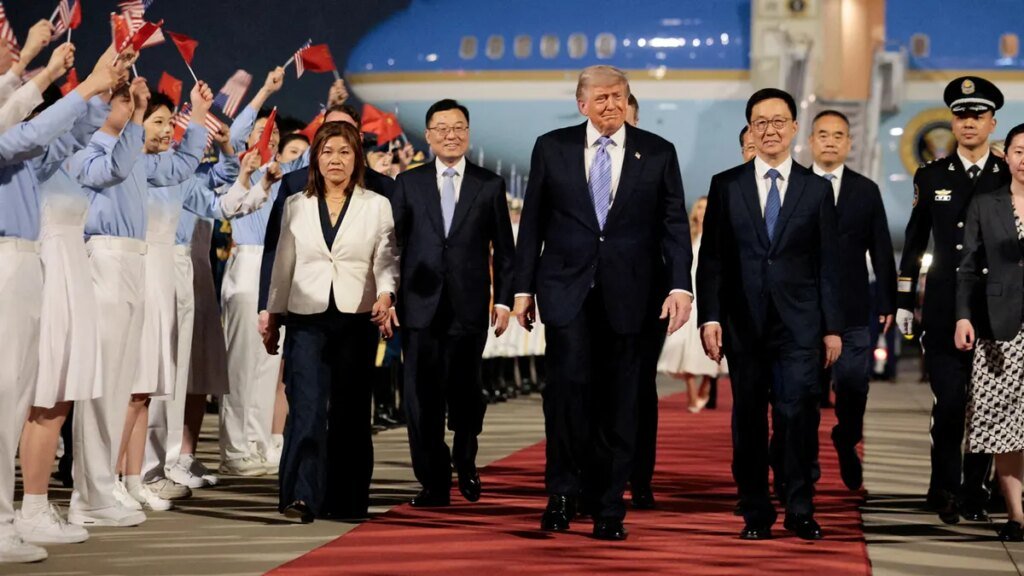
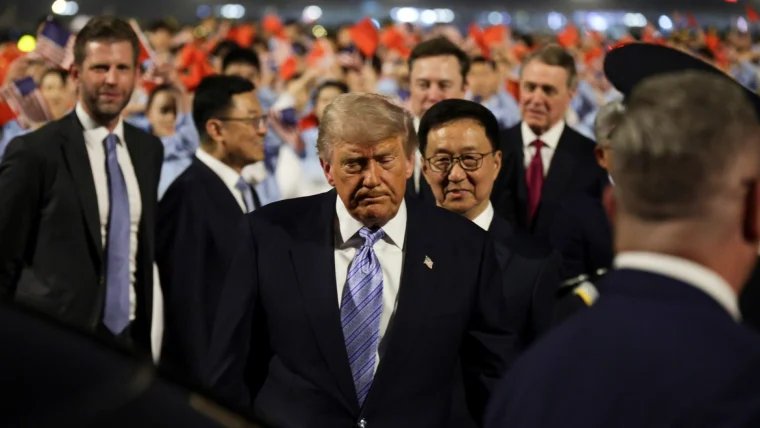
Members of the Trump administration will have to go digitally dark ahead of the president’s highly anticipated meeting with Chinese President Xi Jinping in China on Wednesday.
The visit will require hundreds of officials, aides, and security personnel to leave their personal cellphones behind as they travel with temporary devices designed to minimize the risk of surveillance, hacking, or data collection.
Officials will receive “clean” items such as temporary laptops as they navigate a country considered one of the most aggressive cyber threats to the U.S. government.
• Entire Trump family called out for ‘double standards’ over China trip
• Trump spends flight to China relentlessly ranting in latest social media blitz
Their digital footprint and social media presence can be completely erased during their time in the country, as it’s customary for the U.S. government to assume that any devices brought into China, such as phones, laptops, tablets, and even hotel Wi-Fi connections, may be compromised.
The heavy precautions could create a logistical snafu, as messages that would normally be sent instantly through encrypted apps or synced devices are instead sent through controlled channels, temporary accounts, or shared in person.
Officials that have sensitive conversations have to go through secure channels -Credit:AFP via Getty Images
If officials have to engage in conversations involving extremely sensitive information, the planning required is even more complex.
U.S. officials who travel to other countries often rely on temporary, sensitive compartmented information facilities, known as SCIFS, which are enclosed, secure facilities designed to block electronic surveillance or eavesdropping.
The SCIFS can be established in hotels or other locations during major diplomatic visits.
With so many technological precautions, many members of the White House delegation traveling overseas may turn to paper documents and understand that they must send messages through much more strictly controlled channels.
Even non government officvials aren’t immune to the strict security precautions when traveling to China.
Executives from major American businesses, including Boeing, Apple, Qualcomm, and BlackRock, are expected to be a part of the delegation traveling with the president and have been told to leave their devices behind.
Security precautions are even enacted in the U.S., as officials are often told to leave their phones behind when they enter environments such as the Chinese Embassy.
National security experts have warned that something as passive as charging one’s phone can become a security issue.
Click here to follow the Mirror US on Google News to stay up to date with all the latest news, sports and entertainment stories
U.S. cybersecurity guidance warns travelers to avoid connecting their devices to unknown USB ports or untrusted charging systems.
Compromised hardware can potentially extract data or install malicious software, in a hacking tactic called “juice jacking.”
Officials traveling to high-risk countries often use pre-approved charging equipment, external battery packs, and government-issued accessories instead of relying on local charging devices.
The Chinese government rejected claims that it engages in improper surveillance.
“In China, personal privacy is protected by law,” Chinese Embassy spokesperson Liu Pengyu told Fox News Digital. “The Chinese government places a high priority on protecting data privacy and security in accordance with the law. It has never required—and will never require—enterprises or individuals to collect or store data in violation of the law.”