
STOCKHOLM (AP) — Three scientists won the Nobel Prize in physics Tuesday for research on the strange behavior of subatomic particles called quantum tunneling that enabled the ultra-sensitive measurements achieved by MRI machines and laid the groundwork for better cellphones and faster computers.
The work by John Clarke, Michel H. Devoret and John M. Martinis, who work at American universities, took the seeming contradictions of the subatomic world — where light can be both a wave and a particle and parts of atoms can tunnel through seemingly impenetrable barriers — and applied them in the more traditional physics of digital devices. The results of their findings are just starting to appear in advanced technology and could pave the way for the development of supercharged computing.
Click to Gallery
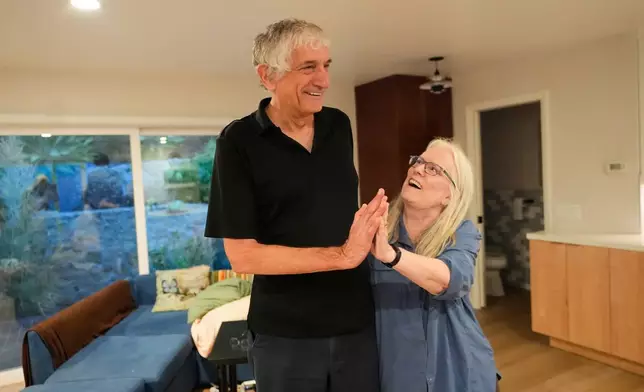
John Martinis stands with his wife Jean in their living room after winning the Nobel Prize in Physics for his work on quantum tunneling on Tuesday, Oct. 7, 2025, in Santa Barbara, Calif. (AP Photo/Mark J. Terrill)
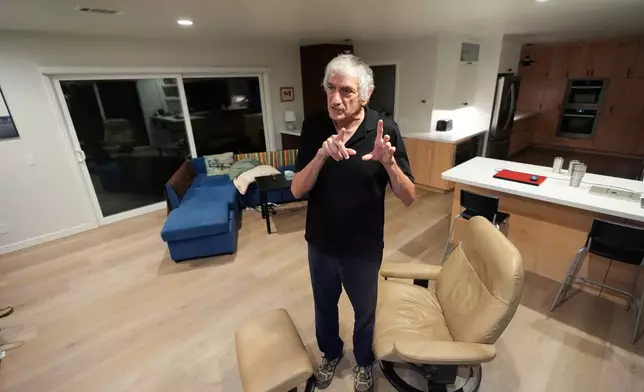
John Martinis stands in his living room after winning the Nobel Prize in Physics for his work on quantum tunneling on Tuesday, Oct. 7, 2025, in Santa Barbara, Calif. (AP Photo/Mark J. Terrill)
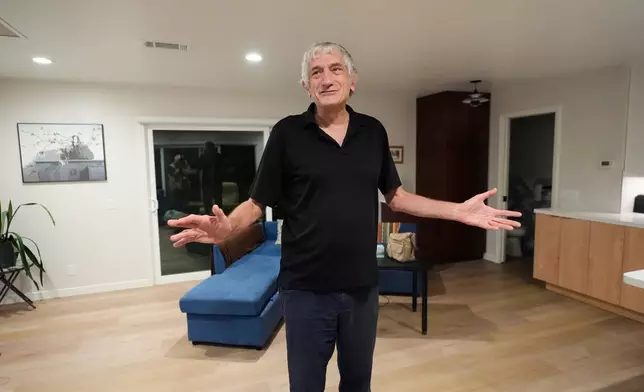
John Martinis stands in his living room after winning the Nobel Prize in Physics for his work on quantum tunneling on Tuesday, Oct. 7, 2025, in Santa Barbara, Calif. (AP Photo/Mark J. Terrill)
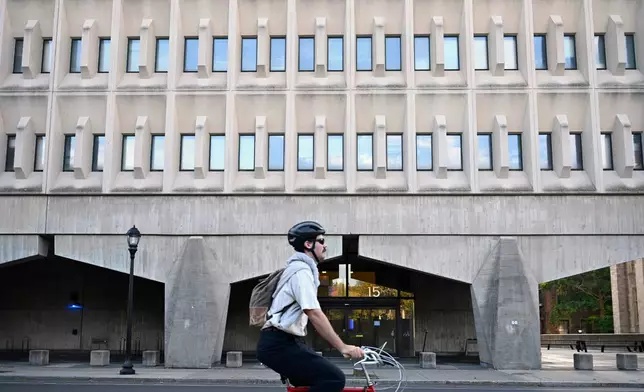
A bicyclist rides past the Becton Engineering and Applied Science Center at Yale University where Yale Professor Emeritus of Applied Physics Michel Devoret has an office and laboratory, Tuesday, Oct. 7, 2025, in New Haven, Conn. (AP Photo/Jessica Hill)
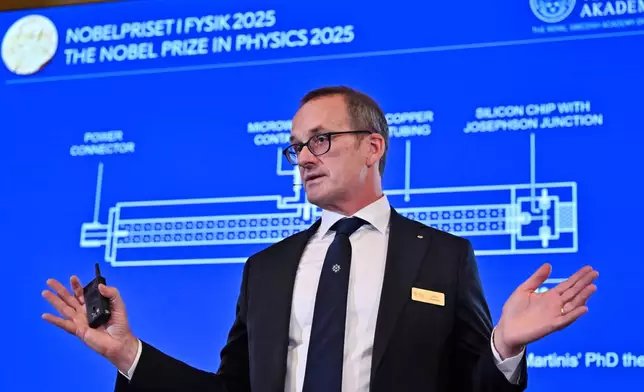
Member of the Nobel Committee for Physics Goran Johansson explains this year’s Nobel Prize in Physics, awarded to John Clarke, Michel H Devoret and John M. Martinis, at the Nobel Assembly of the Karolinska Institutet, in Stockholm, Sweden, Tuesday, Oct. 7, 2025. (Christine Olsson/TT News Agency via AP)
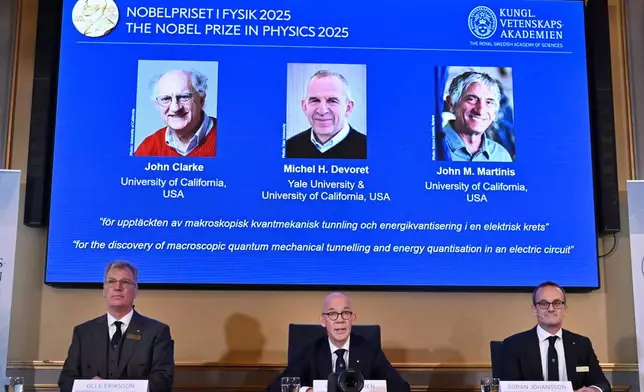
From left, Chair of the Nobel Committee for Physics Chair Olle Eriksson, Secretary General of the Swedish Academy of Sciences Hans Ellegren and Member of the Nobel Committee for Physics Goran Johansson announce John Clarke, Michel H Devoret and John M. Martinis, on screen behind, as the recipients the Nobel Prize in Physics, at the Nobel Assembly of the Karolinska Institutet, in Stockholm, Sweden, Tuesday, Oct. 7, 2025. (Christine Olsson/TT News Agency via AP)
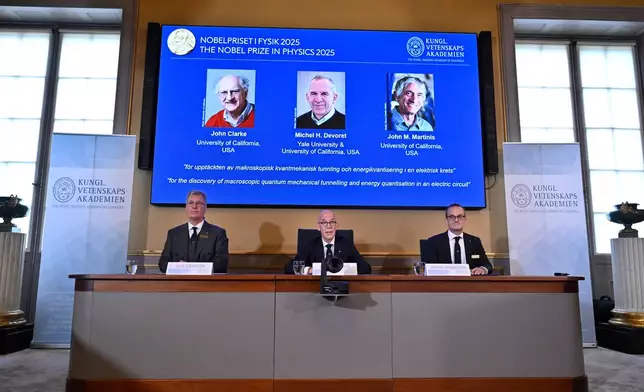
From left, Chair of the Nobel Committee for Physics Chair Olle Eriksson, Secretary General of the Swedish Academy of Sciences Hans Ellegren and Member of the Nobel Committee for Physics Goran Johansson announce John Clarke, Michel H Devoret and John M. Martinis, on screen behind, as the recipients the Nobel Prize in Physics, at the Nobel Assembly of the Karolinska Institutet, in Stockholm, Sweden, Tuesday, Oct. 7, 2025. (Christine Olsson/TT News Agency via AP)
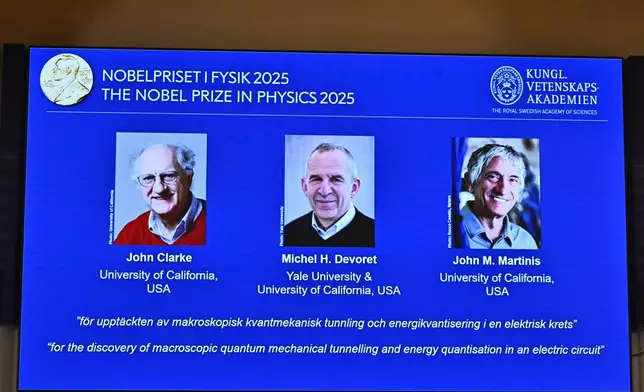
Photos of John Clarke, Michel H Devoret and John M. Martinis are pictured on a screen after they were announced as winners of the Nobel Prize in Physics, at the Nobel Assembly of the Karolinska Institutet, in Stockholm, Sweden, Tuesday, Oct. 7, 2025. (Christine Olsson/TT News Agency via AP)
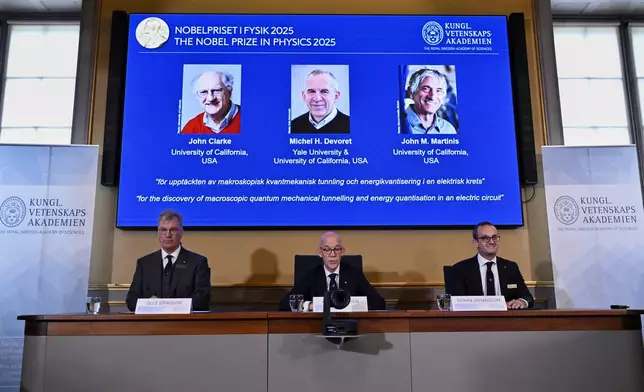
From left, Chair of the Nobel Committee for Physics Chair Olle Eriksson, Secretary General of the Swedish Academy of Sciences Hans Ellegren and Member of the Nobel Committee for Physics Goran Johansson announce John Clarke, Michel H Devoret and John M. Martinis, on screen behind, as the recipients the Nobel Prize in Physics, at the Nobel Assembly of the Karolinska Institutet, in Stockholm, Sweden, Tuesday, Oct. 7, 2025. (Christine Olsson/TT News Agency via AP)
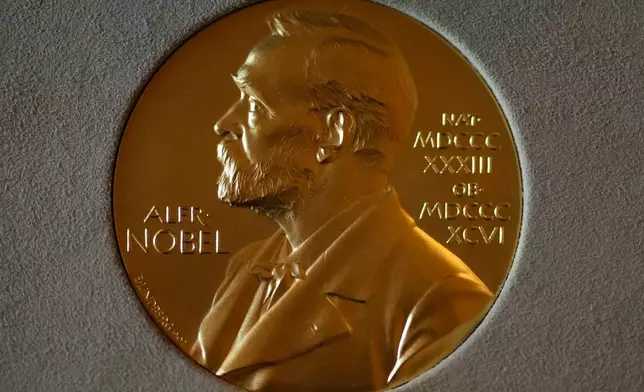
FILE – A Nobel Prize medal is displayed before a ceremony at the Swedish Ambassador’s Residence in London, Monday, Dec. 6, 2021. (AP Photo/Matt Dunham, File)
The prizewinning research in the mid-1980s took the subatomic “weirdness of quantum mechanics” and found how those tiny interactions can have real-world applications, said Jonathan Bagger, CEO of the American Physical Society. The experiments were a crucial building block in the fast-developing world of quantum mechanics.
Speaking from his cellphone, Clarke, who spearheaded the research team, said: “One of the underlying reasons that cellphones work is because of all this work.”
When quantum mechanics first came to light in 1926, a prominent physicist sought to illustrate its many paradoxes with the example of a cat in a box that was both alive and dead at the same time. The three Nobel winners showed that science can put such principles to work, said Physics Today Editor-in-Chief Richard Fitzgerald, who was in a competing research group in the 1990s.
“They didn’t take it that far, but they showed that it can be done,” Fitzgerald said.
The winning physicists took “the scale of something that we can’t see, we can’t touch, we can’t feel” and brought it “up to the scale of something recognizable” and made it “something you can build upon,” Fitzgerald said.
Clarke, 83, conducted his research at the University of California, Berkeley. Martinis, 67, worked at the University of California, Santa Barbara. Devoret, 72, is at Yale and also at the University of California, Santa Barbara.
Martinis’ wife, Jean, told Associated Press reporters who called at his home hours after the announcement that he was still asleep and did not yet know. In the past, she said, they stayed up on the night of the physics award, but at some point they decided that sleep was more important.
When his wife woke him and told him about the journalists seeking an interview, the new Nobel laureate remembered that the prizes were being announced this week. He opened his computer, looked at the announcement and saw his picture along with the other winners.
“So I was kind of in shock,” he said.
Clarke said it never occurred to him that he would win a Nobel Prize.
“I practically collapsed,” Clarke told AP. “I was completely stunned. I mean, it’s something that I had never, ever dreamed of in my entire life.”
Martinis — who was a senior Google scientist working toward quantum computing before co-founding his own company, Qolab — said the big future goal is quantum computing, which would be a giant leap in speed and sophistication by relying on the power of the contradictory states in that subatomic world.
That is still eight to 10 years away. But he said the team’s experiments showed “a computer could be much, much more powerful.”
Devoret is now chief scientist for Google’s quantum computing efforts.
Quantum computers are “one very sort of obvious use,” but the research could also help develop sensors that detect and measure faint phenomena, such as magnetic fields, and advance cryptography to encode information, said Mark Pearce, a professor of astrophysics and Nobel physics committee member.
And through better understanding of precision chemistry, it could develop better materials for daily living and even give an added boost to artificial intelligence, Martinis said.
Before the work at Berkeley, scientists knew single electrons or pairs of tiny electrons could tunnel through an impenetrable barrier. What Clarke said his team learned was “if you design the circuity properly, you could actually have tunneling” of objects larger and more useful than just a couple of electrons.
That discovery “can be used to make very sophisticated things that would not otherwise be able to work out,” Clarke said at a news conference, mentioning his iPhone and quantum computers.
He also criticized the Trump administration for its deep cuts to science funding, saying they would “cripple science.”
“If this continues … it may take a decade to get back to where we were half a year ago,” Clarke said.
Martinis, Bagger and Fitzgerald said it’s a bit of a stretch to say cellphones now use the breakthrough made by Clarke and colleagues. But ultra-sensitive measuring devices rely on the team’s work, including MRI machines, which would be far less useful without their advances, Bagger said.
“Quantum mechanics is everywhere in everything we do, from the cellphone to the satellite communications that are connected to the cellphones, to the screens on which we watch our videos on our cellphones,” Bagger said.
Tuesday’s award was the 119th time the prize has been given. Last year, artificial intelligence pioneers John Hopfield and Geoffrey Hinton won the physics prize for helping create the building blocks of machine learning.
On Monday, Mary E. Brunkow, Fred Ramsdell and Dr. Shimon Sakaguchi won the Nobel Prize in medicine on Monday for discoveries about how the immune system knows to attack germs and not our bodies.
Nobel announcements continue with the chemistry prize on Wednesday and literature on Thursday. The Nobel Peace Prize will be announced Friday followed by the Nobel Memorial Prize in economics on Monday.
The award ceremony will be held Dec. 10, the anniversary of the 1896 death of Alfred Nobel, the wealthy Swedish industrialist and the inventor of dynamite who founded the prizes.
The prizes carry priceless prestige and a cash award of 11 million Swedish kronor (nearly $1.2 million).
Corder reported from The Hague, Netherlands, and Borenstein from Washington. Associated Press journalist Adithi Ramakrishnan in New York contributed to this report.
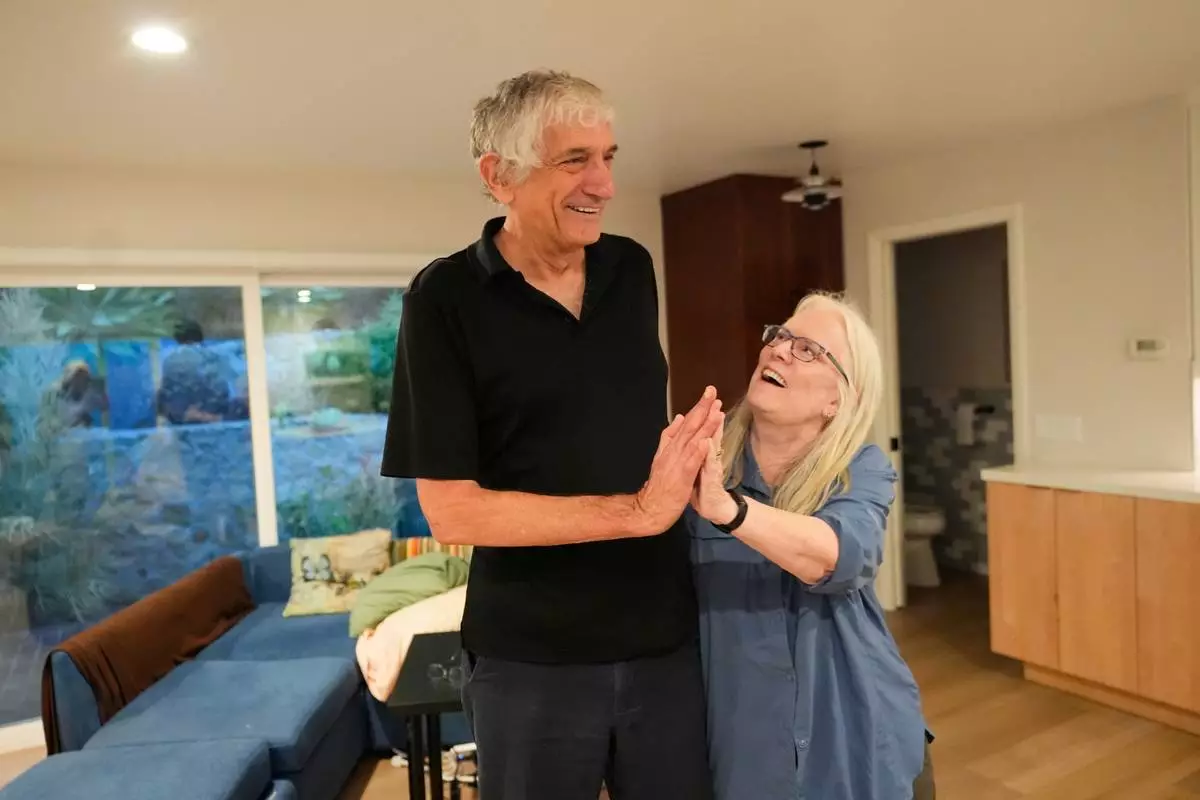
John Martinis stands with his wife Jean in their living room after winning the Nobel Prize in Physics for his work on quantum tunneling on Tuesday, Oct. 7, 2025, in Santa Barbara, Calif. (AP Photo/Mark J. Terrill)
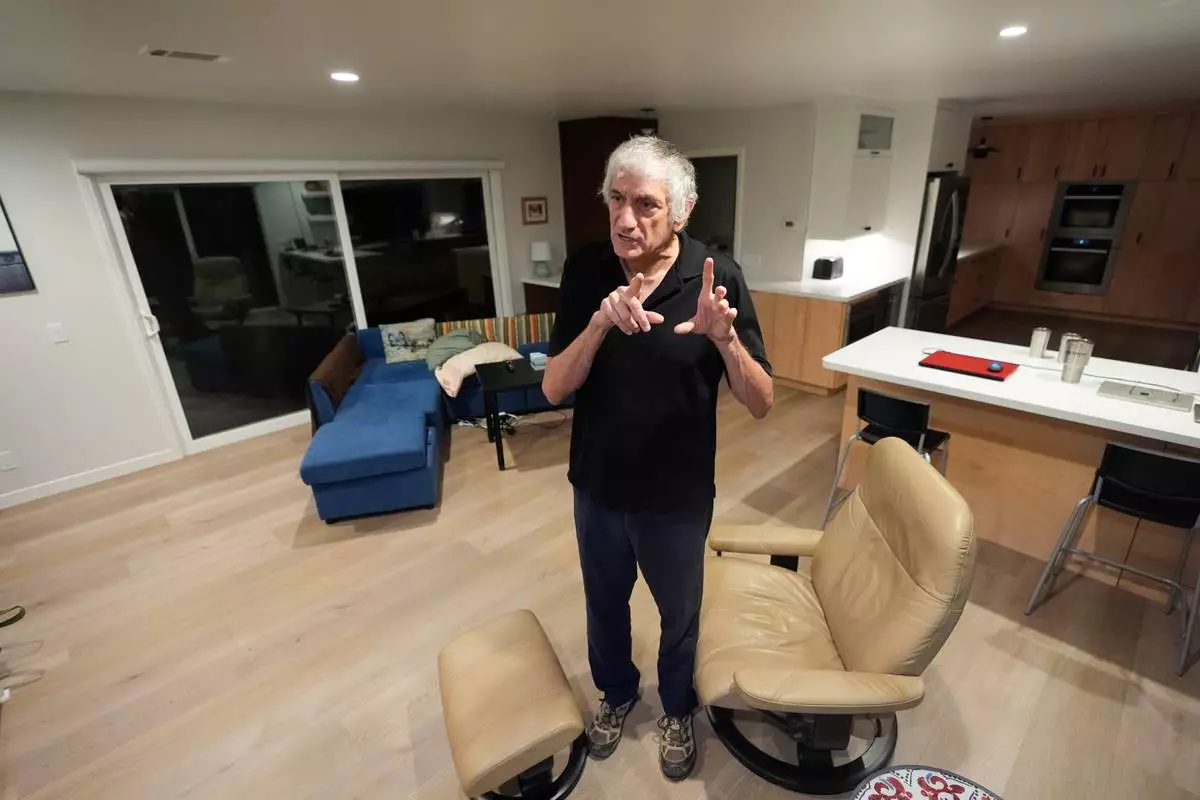
John Martinis stands in his living room after winning the Nobel Prize in Physics for his work on quantum tunneling on Tuesday, Oct. 7, 2025, in Santa Barbara, Calif. (AP Photo/Mark J. Terrill)
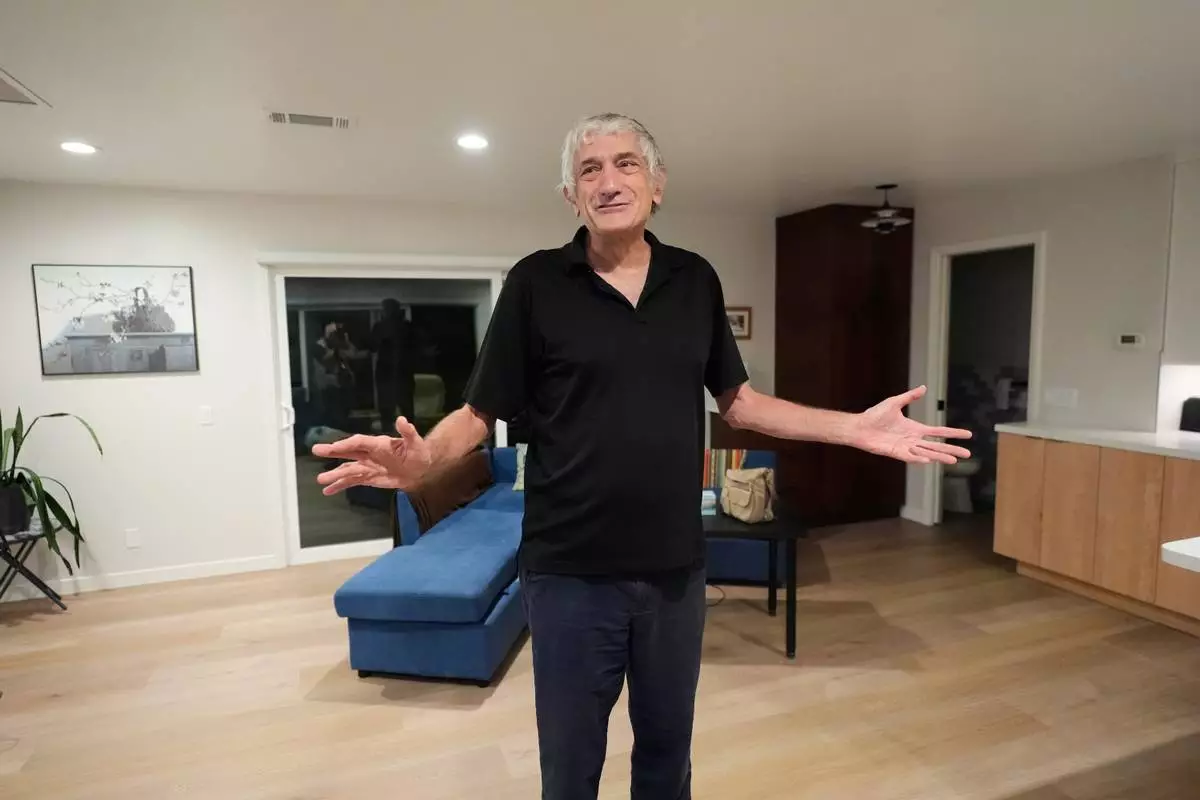
John Martinis stands in his living room after winning the Nobel Prize in Physics for his work on quantum tunneling on Tuesday, Oct. 7, 2025, in Santa Barbara, Calif. (AP Photo/Mark J. Terrill)
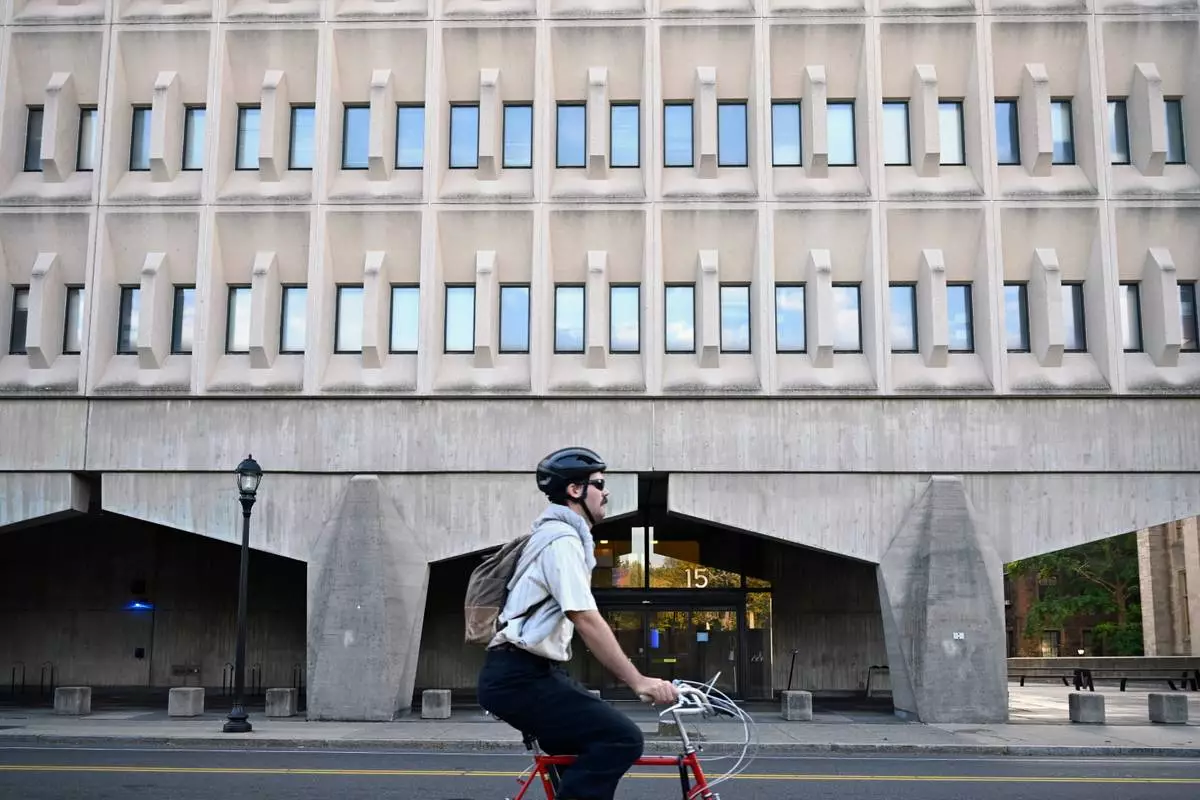
A bicyclist rides past the Becton Engineering and Applied Science Center at Yale University where Yale Professor Emeritus of Applied Physics Michel Devoret has an office and laboratory, Tuesday, Oct. 7, 2025, in New Haven, Conn. (AP Photo/Jessica Hill)
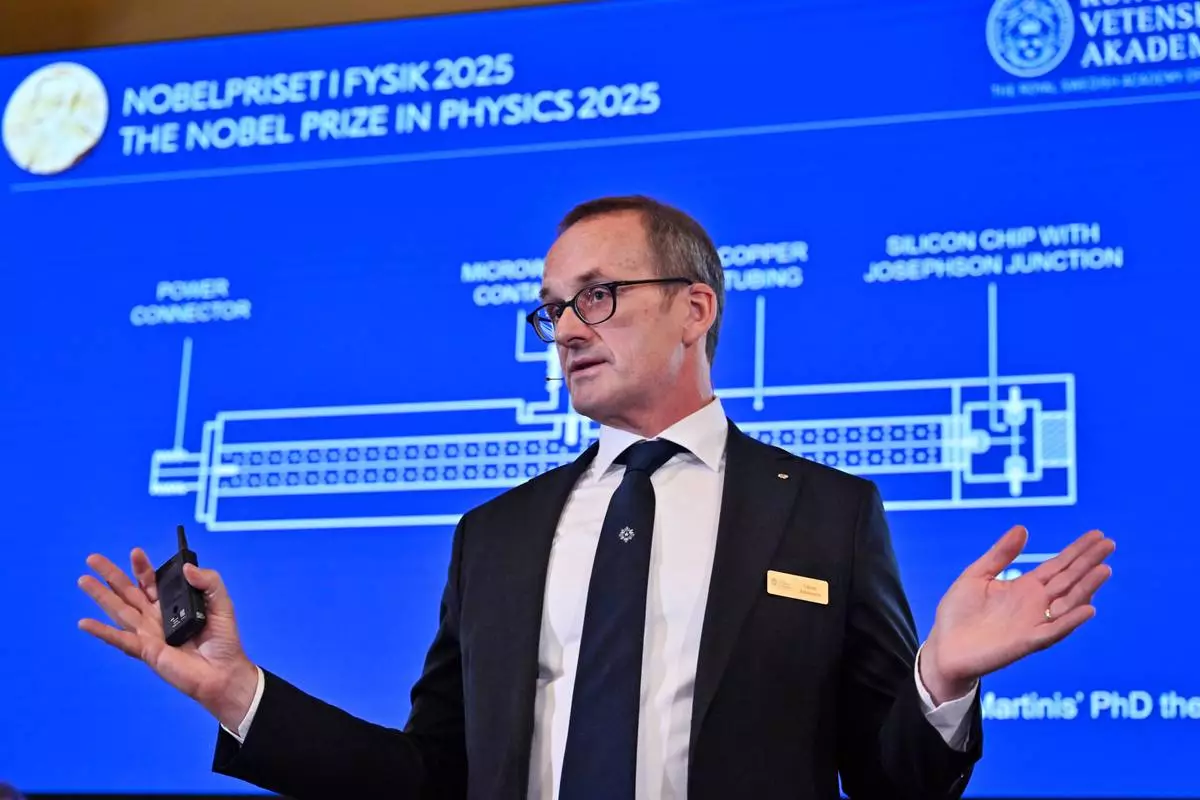
Member of the Nobel Committee for Physics Goran Johansson explains this year’s Nobel Prize in Physics, awarded to John Clarke, Michel H Devoret and John M. Martinis, at the Nobel Assembly of the Karolinska Institutet, in Stockholm, Sweden, Tuesday, Oct. 7, 2025. (Christine Olsson/TT News Agency via AP)
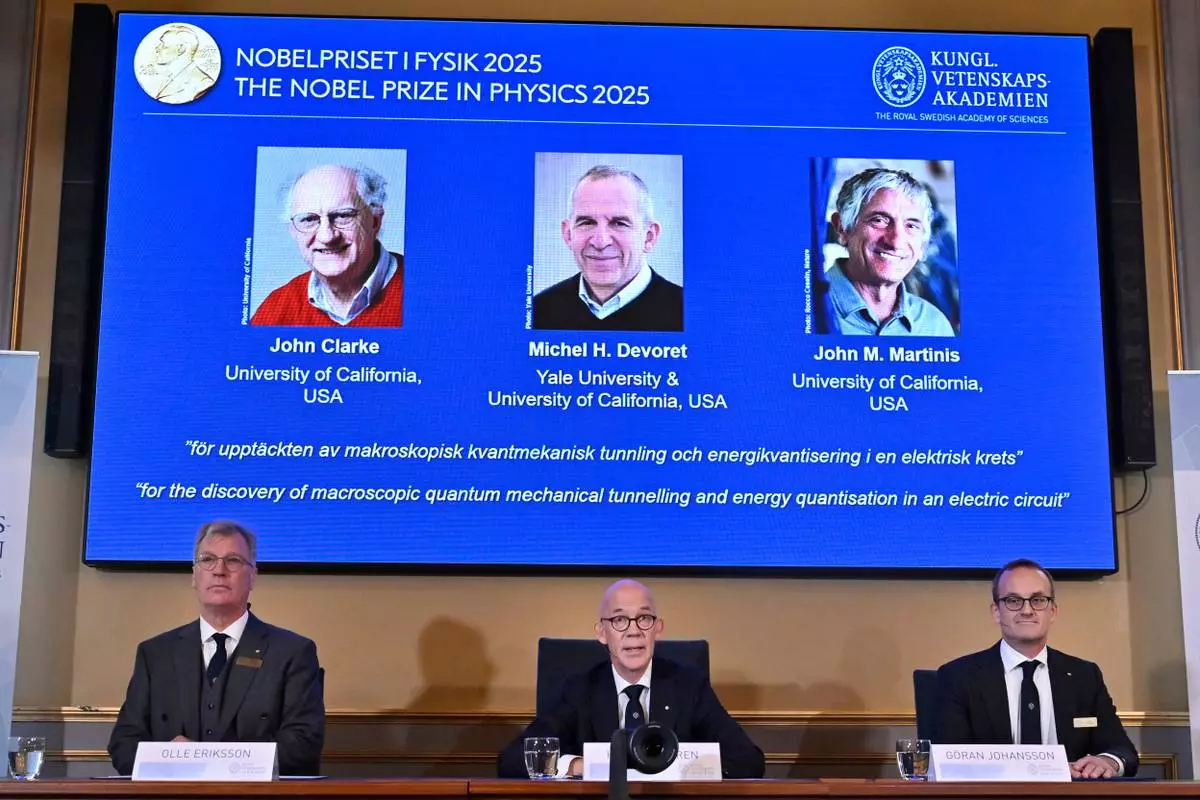
From left, Chair of the Nobel Committee for Physics Chair Olle Eriksson, Secretary General of the Swedish Academy of Sciences Hans Ellegren and Member of the Nobel Committee for Physics Goran Johansson announce John Clarke, Michel H Devoret and John M. Martinis, on screen behind, as the recipients the Nobel Prize in Physics, at the Nobel Assembly of the Karolinska Institutet, in Stockholm, Sweden, Tuesday, Oct. 7, 2025. (Christine Olsson/TT News Agency via AP)
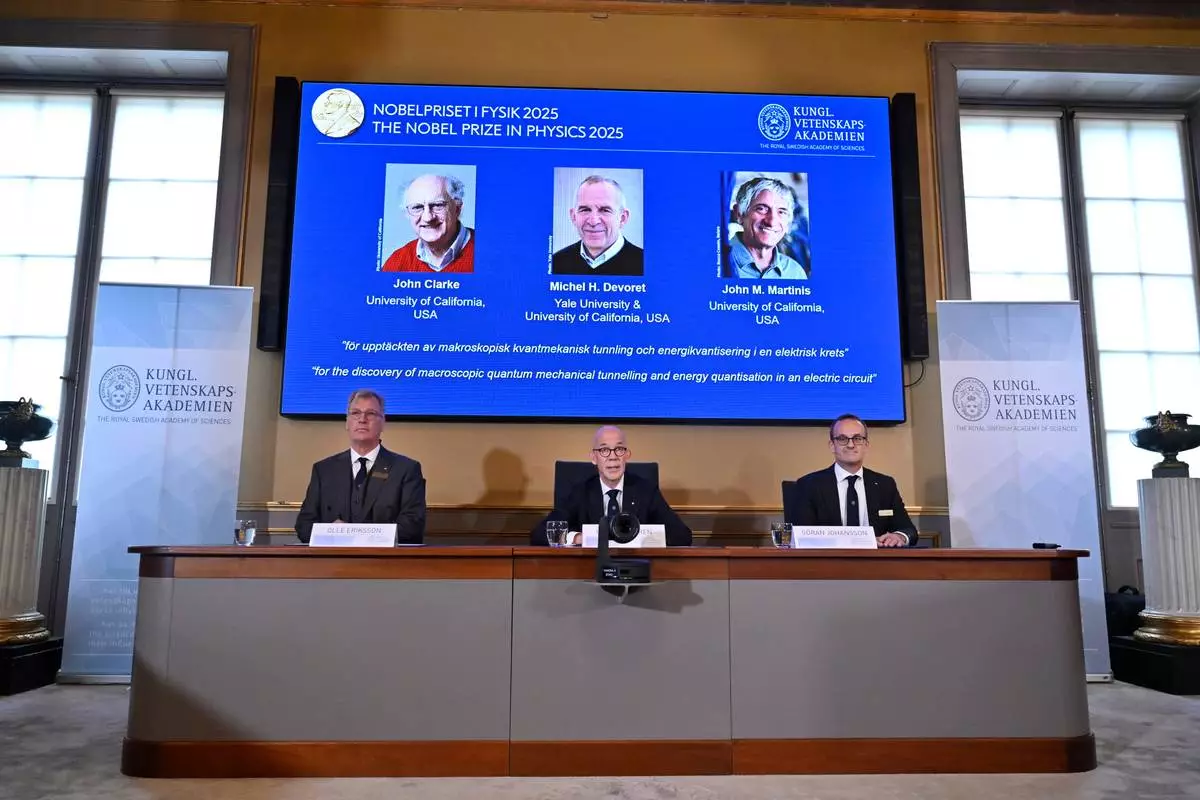
From left, Chair of the Nobel Committee for Physics Chair Olle Eriksson, Secretary General of the Swedish Academy of Sciences Hans Ellegren and Member of the Nobel Committee for Physics Goran Johansson announce John Clarke, Michel H Devoret and John M. Martinis, on screen behind, as the recipients the Nobel Prize in Physics, at the Nobel Assembly of the Karolinska Institutet, in Stockholm, Sweden, Tuesday, Oct. 7, 2025. (Christine Olsson/TT News Agency via AP)
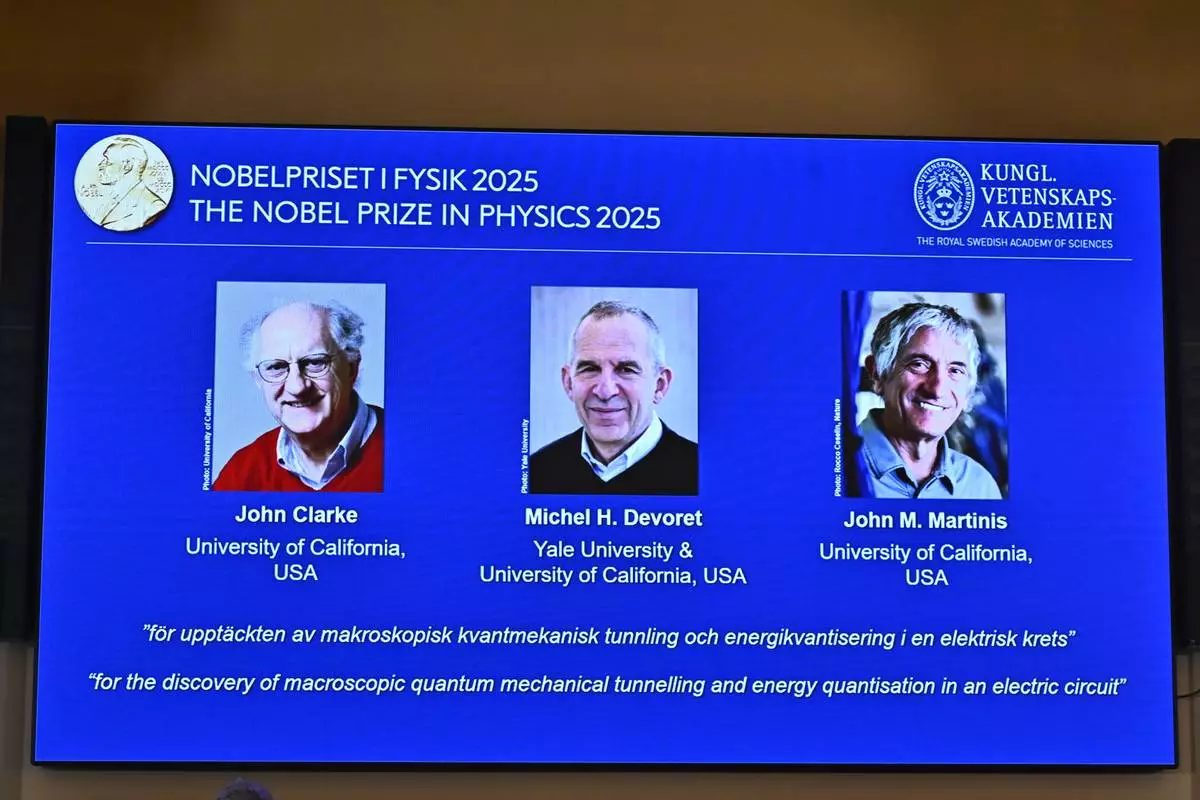
Photos of John Clarke, Michel H Devoret and John M. Martinis are pictured on a screen after they were announced as winners of the Nobel Prize in Physics, at the Nobel Assembly of the Karolinska Institutet, in Stockholm, Sweden, Tuesday, Oct. 7, 2025. (Christine Olsson/TT News Agency via AP)
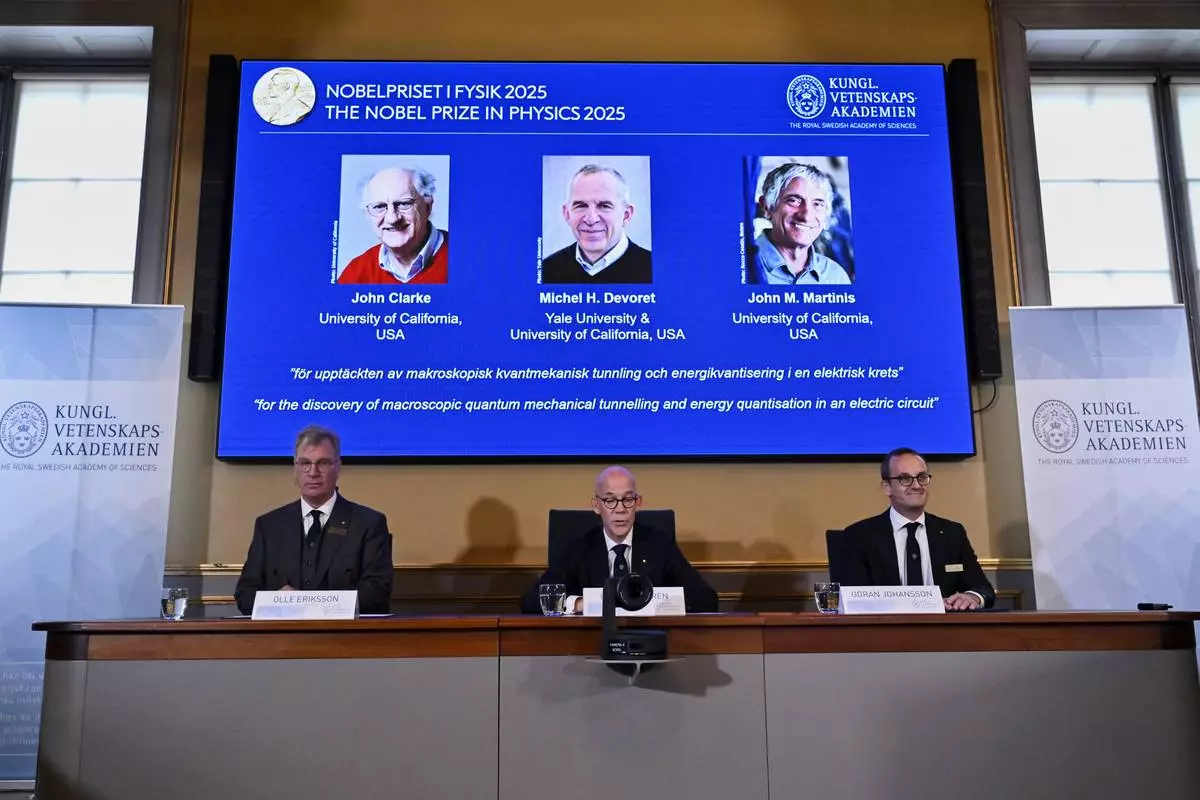
From left, Chair of the Nobel Committee for Physics Chair Olle Eriksson, Secretary General of the Swedish Academy of Sciences Hans Ellegren and Member of the Nobel Committee for Physics Goran Johansson announce John Clarke, Michel H Devoret and John M. Martinis, on screen behind, as the recipients the Nobel Prize in Physics, at the Nobel Assembly of the Karolinska Institutet, in Stockholm, Sweden, Tuesday, Oct. 7, 2025. (Christine Olsson/TT News Agency via AP)
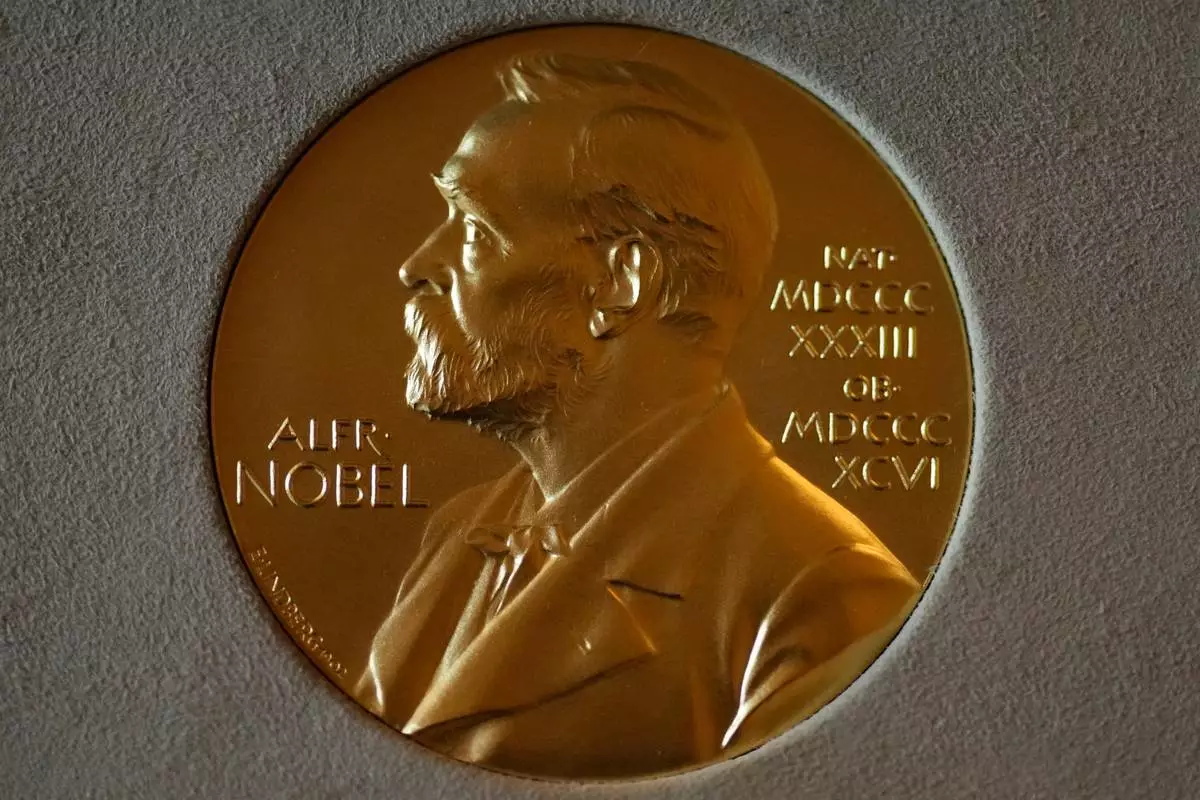
FILE – A Nobel Prize medal is displayed before a ceremony at the Swedish Ambassador’s Residence in London, Monday, Dec. 6, 2021. (AP Photo/Matt Dunham, File)
At least two people were killed in a drone attack in Russia’s southwestern Saratov region and parts of Ukraine went without power following targeted assaults on energy infrastructure, local authorities said Saturday, as U.S.-led peace talks on ending the war press on.
The drone attack damaged a residential building and several windows were also blown out at a kindergarten and clinic, said Saratov regional Gov. Roman Busargin.
Russia’s defense ministry said it had shot down 41 Ukrainian drones over Russian territory overnight.
In Ukraine, Russia launched overnight drone and missile strikes on five Ukrainian regions, targeting energy and port infrastructure. Ukrainian Interior Minister Ihor Klymenko said Saturday that over a million people were without electricity in the country.
Ukrainian President Volodymyr Zelenskyy said Russia had sent over 450 drones and 30 missiles into Ukraine overnight.
An attack on the Black Sea city of Odesa caused grain silos to catch fire at the port, Ukrainian deputy prime minister and reconstruction minister Oleksiy Kuleba said.
Two people were wounded in attacks on the wider Odesa region, according to regional head Oleh Kiper.
Kyiv and its Western allies say Russia is trying to cripple the Ukrainian power grid and deny civilians access to heat, light and running water for a fourth consecutive winter, in what Ukrainian officials call “weaponizing” the cold.
The latest round of attacks came after Kremlin adviser Yuri Ushakov said Friday that Russian police and National Guard will stay on in eastern Ukraine’s Donbas and oversee the industry-rich region, even if a peace settlement ends Russia’s nearly four-year war in Ukraine. This underscores Moscow’s ambition to maintain its presence in Donbas post-war. Ukraine is likely to reject such a stance as U.S.-led negotiations drag on.
Moscow will give its blessing to a ceasefire only after Ukraine’s forces have withdrawn from the front line, Ushakov said in comments published in Russian business daily Kommersant.
Meanwhile, Germany is set to host Zelenskyy on Monday for talks as peace efforts gain momentum and European leaders seek to steer negotiations.
For months, American negotiators have tried to navigate the demands of each side as U.S. President Donald Trump presses for a swift end to Russia’s war while growing increasingly exasperated by delays. The search for possible compromises has run into a major obstacle over who keeps Ukrainian territory currently occupied by Russian forces.
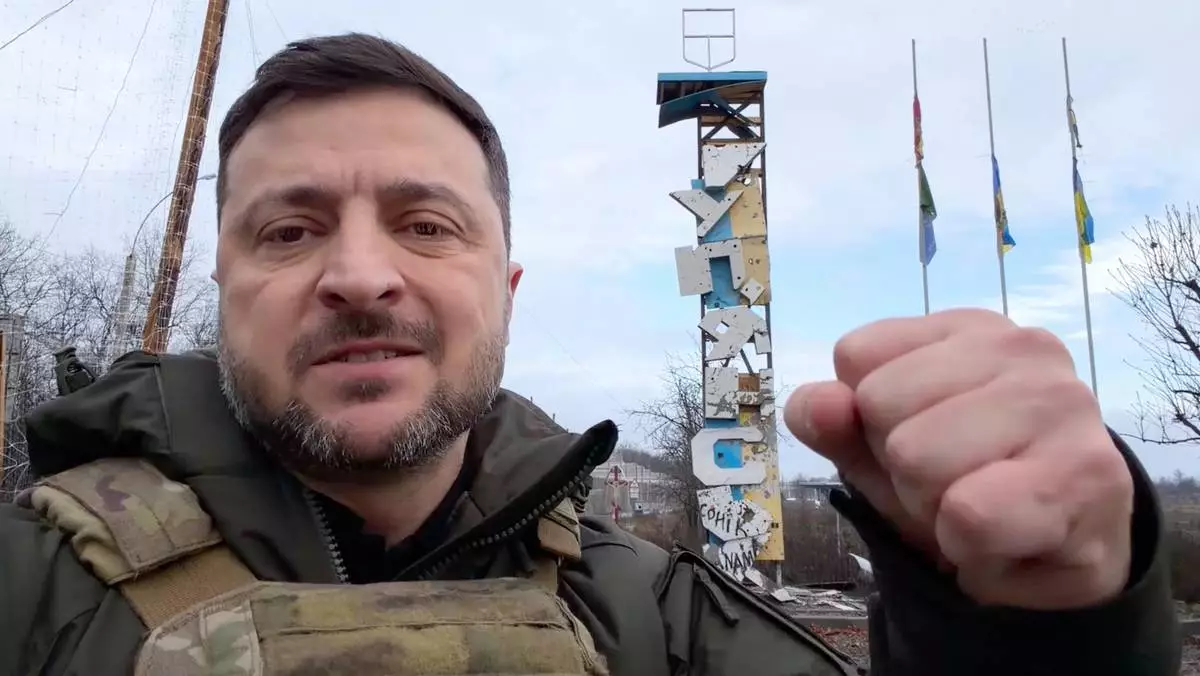
In this grab from a video provided by the Press Service Of The President Of Ukraine on Friday, Dec 12, 2025, Ukraine’s President Volodymyr Zelenskyy records a video at the road entering of Kupiansk, Ukraine. (Press Service Of The President Of Ukraine via AP)
