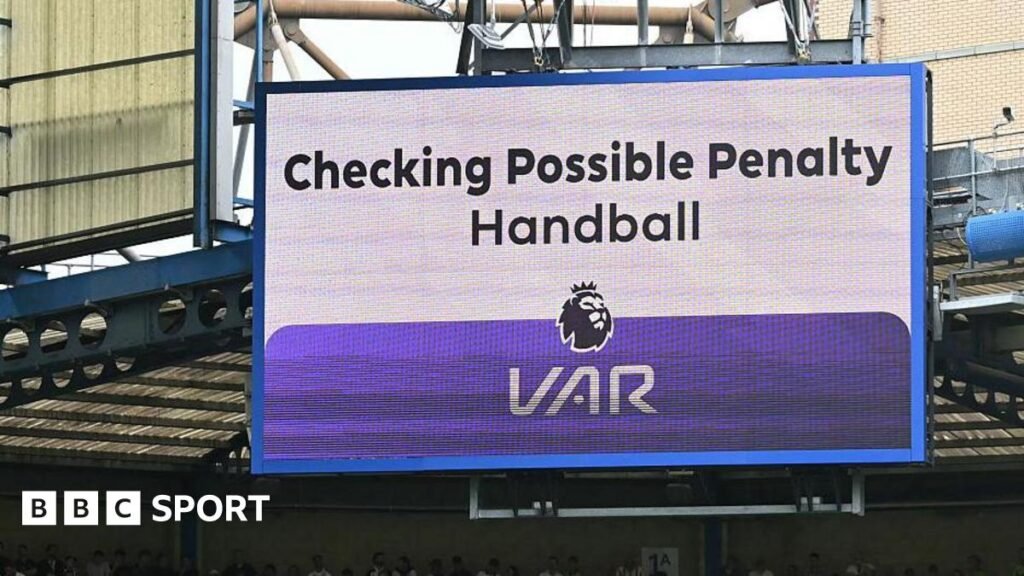
Three out of four Premier League fans want to scrap the Video Assistant Referee (VAR), with nine out of ten fans believing its introduction has made football less enjoyable.
These findings are among several in a new survey by the Football Supporters’ Association (FSA), the organisation that represents fans in England and Wales, that should worry the global game’s lawmakers.
Five years after its first survey highlighted wide dissatisfaction with the introduction of VAR, the FSA’s latest questionnaire reveals that opposition to VAR has not shifted. In fact, it has hardened.
In 2021, 74 per cent of FSA’s members said they were against VAR but that number has grown to 76 per cent now, although this survey was only for Premier League fans.
Last month, the International Football Association Board (IFAB), the body that determines the game’s laws, approved FIFA-backed plans to extend VAR’s remit to include checks for corner kicks and second yellow cards.
European football’s governing body UEFA is less convinced of the need to increase VAR’s role in the game – and is keen to see it only used to correct “clear and obvious errors”, as was originally intended – but does not believe football can return to the non-VAR era.
That, however, is not what domestic Premier League fans seem to want.
Over 15 questions about their overall experience of VAR, their support for the various tweaks that have been introduced to its application and their views on its extension, the survey’s respondents make their dissatisfaction with VAR very clear.
Asked if they are in favour of retaining VAR reviews for fouls or handballs in the build-up to a goal, offsides leading to goals and red card decisions, there was only a small majority in favour of the latter, with significant majorities against the first two uses of VAR.
Only 47 per cent said they either supported or strongly supported introducing a challenge-based approach to VAR, where a team would be limited to a small number of challenges, as is seen in cricket, the NBA or NFL. And there were majorities against IFAB’s decision to extend VAR’s use to check corner kicks and second yellows.
Neither matchgoing fans nor those watching at home on TV believe VAR is getting quicker or even more accurate, which will disappoint Professional Game Match Officials, the body that manages all match officials, including VARs, across the English Football League, Football Association competitions and Premier League.
And only minorities believe moves to improve the explanation of VAR decisions, such as the match official’s announcements over the public address system, have improved matters.
When asked if VAR has made football better, only 3.4 per cent of matchgoing fans agreed, but 92 per cent said it had “removed the spontaneous joy of goal celebrations”, while 81 per cent said they preferred watching games without VAR.
“These findings back up FSA’s previous survey in 2021, where fans expressed misgivings about the introduction of VAR,” said FSA Premier League network manager Thomas Concannon.
“The vast majority are reporting the same concerns five years on: the loss of spontaneity when celebrating goals and an overall worsening of the matchgoing experience.
“We have shared the survey results with the Premier League and PGMO, and look forward to discussing its findings with them.”
After a series of trials, VAR was formally added to football’s laws in March 2018 and was first used in a major tournament at that year’s World Cup in Russia. The Premier League did not introduce VAR until 2019.
Sweden’s top flight is the only major league in Europe that has voted to resist VAR’s introduction, although a move to scrap VAR in Norway was only narrowly defeated in a contentious vote last year.
In 2024, Wolverhampton Wanderers made a proposal to ditch VAR in the Premier League but the other clubs voted 19-1 against the idea.
In a statement responding to the FSA’s survey, a Premier League spokesperson said recent changes to VAR were designed to improve “clarity, speed, and communication”, and insisted that the technology is less instrusive in the English top flight than elsewhere in Europe – with around 100 correct VAR decisions per season in recent campaigns.
The spokesperson added: “As part of ongoing dialogue with supporters, Premier League research indicates fans are largely in favour of keeping VAR, but improving the way it is used. This remains a priority for both the Premier League and PGMO, and the League will continue to engage with all stakeholders to build on the progress made through the VAR Improvement Plan.”
For its part, PGMO believes its use of VAR is getting better and faster, and notes that VAR is only used to overturn an on-field decision in one in four games in England, which is significantly less than all other major European domestic leagues and UEFA competitions.
And last week, the Premier League’s independent Key Match Incidents (KMI) panel revealed that the number of errors made by VARs fell from 35 in the 2022/23 season to 18 last season. It also reported that the average time taken for a VAR intervention fell from 64 to 48 seconds.
Overall, the KMI panel believes that almost 87 per cent of all decisions made by match officials are accurate but VAR boosts this to almost 97 per cent.
The Athletic has contacted IFAB, PGMO and the Premier League for comment.