You’ve already noticed this, but go ahead and browse the App Store or Google Play Store. Scroll through some of the apps and you’ll see plenty marked “Free.” In a good portion of them, you’ll also see “Contains in-app purchases.” The reality is that these apps are free to install, but not free to use.
What happened? Free apps used to be free. But now, in 2026 more than ever, they’re going extinct. Even apps that used to be free with optional paid upgrades have dropped the free tier entirely. The free tier is now called “Basic” and you still have to pay for it. The best you can get is a 7-day trial. So… what happened?
We had already moved everything online
Seamless sync!

There have always been costs to developing, publishing, and maintaining an app, but if you wanted to cut them down to the hard, quantified essentials, it used to be simple. The developer paid a one-time fee to get the app published on app stores and maybe a small fee to host a website. That was it.

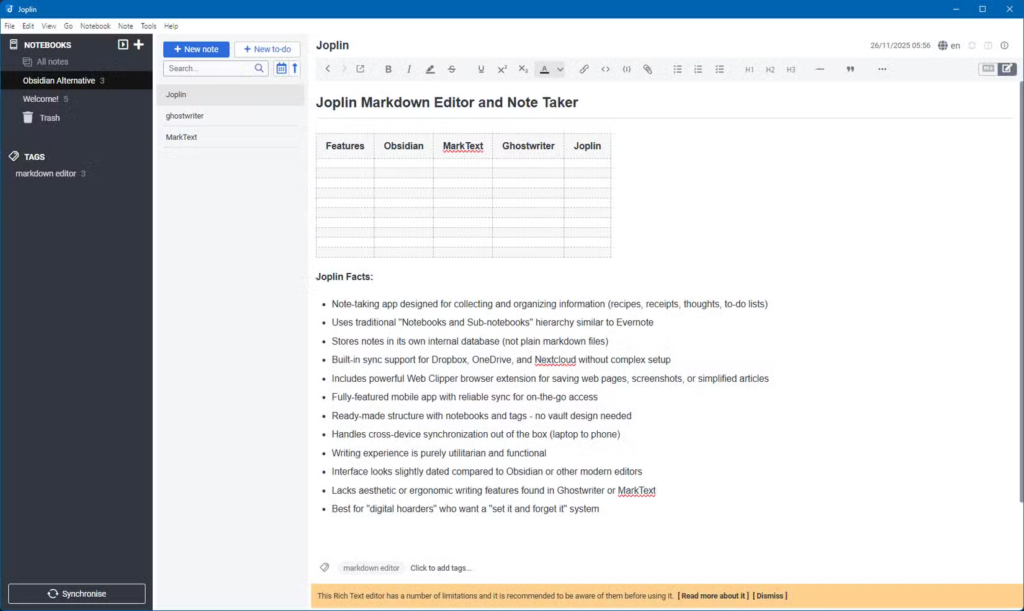
It’s not like that anymore. Everything is online now. Apps have features that require internet, and usually servers to support them. The clearest example is sync. At this point, if a note-taking app can’t sync between devices, what good is it? And if the sync requires you to set it up yourself, like what Joplin offers, it’s considered a “hassle.” Not seamless enough. But seamless, built-in syncing requires servers, and servers cost money.
Obsidian handles this well. The app is entirely free, you can set up your own sync method if you want, and if you’d rather have something seamless, you subscribe to Obsidian Sync. And that was the model for a while: free to use, with an optional paid tier for extra convenience.
Then a second, bigger shift happened.
AI broke the economics
Compute isn’t a one-time cost

You saw this coming, but let’s lay it out fully. AI went mainstream and became the buzzword of the entire industry. Everyone raced to include it in their products. We reached the point where Microsoft was pushing employers to use AI. Developers and companies want AI everywhere — and like to believe their users do too. But AI costs money. Not just once. It costs money with every single use, and it’s expensive.
Unlike cloud storage for sync, where a server simply holds your data, AI servers need to compute. Heavy compute. If you’ve ever run a local AI model, you know how taxing it is on hardware. Now imagine running that at scale, for millions of users, continuously.

|
|
Sunsama, the AI-powered calendar app, starts at $20 a month with no free tier. |
Gradually, instead of building software for the consumer’s hardware, developers now build it for a server and rely on the consumer’s internet connection. Your device is just a viewport — you send the input, the server does the work, and you receive the output. It’s the same logic as cloud gaming. Why buy a gaming machine and pay for individual games when you can subscribe and play anything over the internet?
Of course, apps could run AI on your own hardware. But that requires more complex development, optimization across every processor and hardware configuration out there, and it means the developer has no guarantee users will get a consistent experience — a problem that has plagued HDR on Windows for years.
Moises is a good illustration of the contrast. It’s a creative utility for musicians with AI features that split songs into stems, separating vocals, drums, and guitar tracks. The main app requires a subscription because the compute runs on their servers. But they also offer Moises Live, which runs entirely on your machine — and that one is completely free.
Subscriptions have become the default
Even apps that don’t’ need them charge them

|
|
Motion, the AI-powered productivity app, starts at $50 a month with no free tier. |
The shift isn’t only about AI costs. The industry has set a trend, and developers and companies have followed it regardless of whether it makes sense for their specific app. Because it makes sense for them.
TVQuickActions Pro is a good counterexample. It’s a TV app that lets you remap buttons and a lot more. It’s thoroughly designed, and it costs $4 as a one-time payment. That makes sense because there are no servers, no AI, no online services. The developer built it once and maintains it. A one-time payment is logical, and it’s worth every cent for what you get.
Then there’s AirScreen. It creates a local AirPlay receiver on your device and lets you use AirPlay seamlessly. No AI, no online functions involved whatsoever. And yet, it charges a monthly subscription. That’s not to say it isn’t worth it — AirScreen works great — but why is it a subscription at all?

|
|
Even Readwise, the e-book highlighting app, starts at $6 a month with no free option. |
The answer seems to be that companies have gotten used to the model, and so have users. They’ll argue that no one’s going to pay $25 upfront for an AirPlay app, but if it’s $2 a month, it feels more accessible — and they still collect $24 from anyone who sticks around for a year. The long-term economics favor the company and developers. The downside for the user is that if the developer ever drops the app, it stops working. Not because it needs a server. But because it can’t authenticate your payment, and it shuts itself off.
The rent-don’t-own model has been taking over the broader economy for a while.
To be fair, this isn’t unique to tech. The rent-don’t-own model has been taking over the broader economy for a while. Most people lease their cars rather than buy them. Even smaller everyday purchases are shifting — services like Klarna have made it normal to split a grocery run into monthly installments.
The preference for smaller recurring payments over a larger upfront cost is a real, widespread behavioral shift, and developers know it. The difference with physical goods, though, is that you still have the option to buy and own them outright. With software, increasingly, you don’t.
Open-source is pushing back
Immich is a great pioneer

The same wave of AI that made software more expensive also made programming more accessible. AI is particularly good at writing code, which means open-source alternatives are easier to build and maintain than ever.
Immich is a great example. It’s a self-hosted photo backup service and a genuine alternative to Google Photos. Just like Google Photos, it has AI features: face tagging, OCR, and text-based photo search. Immich could have put those behind a paid tier, or at least required you to enter your own OpenAI or Gemini API key. Instead, the AI features run entirely locally on your machine. It’s slower at cataloging than Google’s infrastructure, obviously, but it works well, and it’s all yours.

- OS
-
Linux, Windows, macOS, Android, iOS
- Price model
-
Free
The free lunch is over
and we ordered it ourselves

Most of this comes back to how AI is being used — by us and by developers. Last week I saw someone ask Gemini in Google Sheets to sort a column alphabetically. Gemini did it perfectly, but there’s a sort button right there in Sheets! There are also a dozen native functions that do exactly the same thing. I worry that if Google Sheets were built today, that sort button wouldn’t exist — you’d just ask Gemini.
Most of what AI does in these apps could have been a native feature. Before, developers had to get clever. They had to write intelligent algorithms to solve problems. Now they’re outsourcing all of that thinking to AI, and attaching a $10 a month subscription to cover the cost of it.
The open-source community is doing what it can, and local-first software is quietly proving that not everything needs a server. But for most users, the default is a subscription, and the baseline expectation is that useful software costs money every month, forever. That’s not inherently wrong. Developers deserve to eat.
But, the irony is that we didn’t lose free apps because software became too complex to sustain. We lost them because the industry found a better business model. AI gave developers a legitimate cost to point to, and subscriptions gave them a reliable revenue stream to depend on. The two arrived together, and the free tier never recovered.