There’s a Chinese expression—zuò shan guan hǔ dòu—which roughly translates to “Sit on the mountain and watch tigers fight.”
For attendees at this year’s World Economic Forum (WEF) annual meeting in Davos, Switzerland, this image was on full display. Inside WEF’s Congress Center, wealthy nations circled and lunged. U.S. President Donald Trump’s Greenland theatrics made him the loudest, but Canadian Prime Minister Mark Carney’s well-received warning that middle powers must stand up to bullies made him the surprising victor. Outside, along the promenade, emerging-market governments—from India to Nigeria—clamored to have their voices heard, taking over storefronts with glossy displays and bigger-than-life branding.
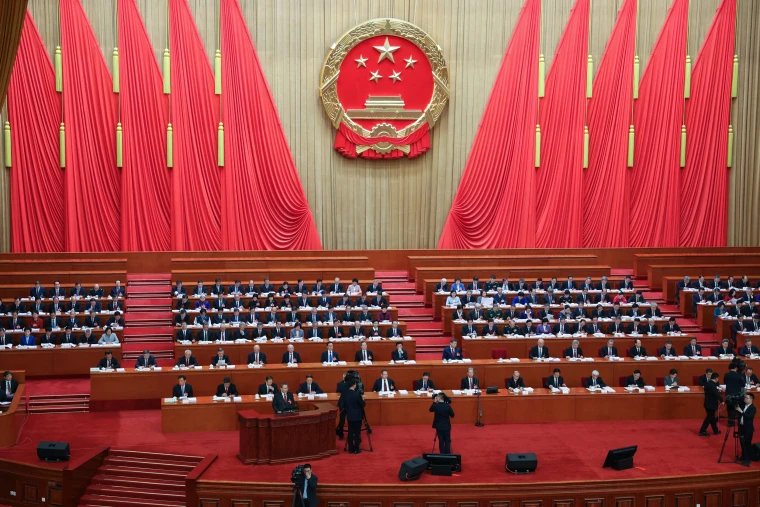
China wasn’t represented on the promenade, and the speech from He Lifeng, the country’s Vice Premier, didn’t dominate headlines. But his message is hard to ignore: China wants to be the world’s stabilizer, a protector of free trade, and defender of the rules-based order. As part of that leadership, he said, China will provide the world with the clean technology necessary to address climate change—a topic barely brought up at Davos. “China will work with all parties to … ensure the free flow of quality green products globally,” he said on Jan. 20. “We invite enterprises from all over the world to embrace the opportunities from the green and low-carbon transition.”
Beijing sees itself as a central node in a transition to a new energy future—not so much for what it’s doing to cut its own emissions as for its role making and selling the things that will advance clean energy around the rest of the world. China owns more than 80% of the global solar supply chain and produces more than 70% of the world’s electric vehicles. Its clean-tech exports reach almost every country.
Its position as a clean-tech manufacturing super-power has become the subject of much consternation. Top of mind for many leaders is how the country might reshape global trade. The U.S. has been throwing up tariffs and other trade barriers. Meanwhile, American automakers have scrambled to reinvent their EV manufacturing to better compete with affordable Chinese EVs. International Monetary Fund managing director Kristalina Georgieva told me in December that “a flood of China-produced green goods towards the rest of the world” risks creating a “counter reaction.” Her advice? “Let competition run its course. Don’t pick winners. Do not use -industrial policy on steroids.”
For years, China’s clean-tech dominance has been treated as an international trade issue. But now it’s also a climate story big enough to bend global emissions trajectories downward, and volatile enough to trigger a protectionist backlash that could slow the transition. If Chinese clean technology continues to decline in cost and adoption grows at an accelerating rate, emissions will drop. Analysts have, of course, observed the trend, but their scenarios are yet to fully reflect it. “Exports of Chinese goods and products are knocking off giga-tonnes of global emissions,” Simon Steill, who heads the U.N. Framework Convention on Climate Change, told the crowd at the China Pavilion at last November’s annual COP climate conference.
It’s a development that promises to reshape every-thing we know about global climate dynamics. Suddenly, cutting emissions feels less challenging, particularly in emerging-market countries where emissions are projected to grow the most. But, for all the benefits, addressing climate change could also become a vector for geopolitical conflict. A central tension in the coming years will be how to harness the benefits of Chinese technology while avoiding getting crosswise with governments more focused on trade and national security.
There’s an irony at the center of China’s climate story: the technology that could save the world was born from a decision that had almost nothing to do with climate change. In 2008, as the global economy entered a deep recession, policymakers around the world looked to stimulus programs to chart a way out, with green-technology investments representing a key focus. It was a strategic bet on the future of industry; in China, it had the added value of cleaning up polluted air. As budget deficits grew, leaders in the U.S. and Europe lost interest and pursued austerity instead. China doubled down with trillions in cumulative investment to build a clean-tech manufacturing base and invest in green infrastructure.
It would be an understatement to say it worked. Today, China accounts for around 70% of global manufacturing across the six core clean technologies identified by the International Energy Agency (IEA)—EVs, solar, wind turbines, batteries, electrolyzers, and heat pumps—anchoring what is fast becoming a multitrillion-dollar market. And Chinese manufacturing prowess has driven down prices: the cost of solar modules has dropped by roughly 90% since 2010, and lithium-ion battery-pack prices are down by around 80% to 90%. This shift has turned once boutique climate technologies into some of the cheapest sources of power and storage on the planet. But clean-tech exports don’t necessarily cut emissions immediately. In China, and many of the countries that buy its technology, solar power is being installed rapidly, but the new capacity is primarily used to support new electricity demand rather than driving out fossil-fuel plants. Most baseline scenarios assume that trend will continue—leaving ample space for fossil fuels in the mix. That dynamic, however, may be changing.
When analyzing national climate policies, Pakistan isn’t the most obvious place to focus, as the 29th largest emitter with relatively slow economic growth. But this past year, Pakistan’s story was all the rage. For years, the country had faced a broken power system—electricity was unreliable and expensive. In 2023, as Pakistanis were literally burning their electric bills in the streets, Chinese solar manufacturers began flooding the market with cheap panels supported by government policy that cut import costs and allowed customers to sell power back to the grid. Solar imports expanded roughly fivefold from 2022 to 2024, and this year solar is expected to provide 20% of the country’s power. Chinese lithium-ion battery imports into Pakistan have expanded too, allowing customers to store electricity for 24/7 usage.

Developments in Pakistan took the climate world by surprise. Government policy helped, but the shift was fundamentally driven by economics: a cheap supply of a product just as the country needed power. “The people in Pakistan, they’re not putting solar on their roof to be nice,” Tom Steyer, the climate investor now running for governor in California, told me last year. “They’re putting solar on their roof because it’s cheap and they want some power.”
The Pakistan experience reveals a blind spot in climate modeling: scenarios that treat policy as static can’t capture moments when economics makes new policies inevitable. For now, the country’s story is an outlier. But there is emerging evidence that others might soon follow suit. The African continent, for instance, may be on the precipice of its own solar boom. According to energy think tank Ember, 20 countries in Africa set records for Chinese solar imports in the year preceding June 2025. In Algeria, imports rose 33-fold. In Zambia and Botswana, they rose eight- and sevenfold, respectively. The list goes on and on. “The market says if you do nothing today, the new energy system will be renewable,” says Francesco La Camera, director general of the International Renewable Energy Agency.
At an even higher level, data from the IEA shows that the countries with the fastest-growing power needs in the coming decade, namely emerging markets, are also the best places to build solar because they’re sunny. That’s in contrast to the past decade, where much of the growth happened in places with lots of money to spend on solar power but unfavorable weather conditions.
And yet all of these developments are hard to capture in the scenario-making that leads to headlines and drives conversation among experts. Just look at the IEA’s World Energy Outlook, released in November, which ignited a heated debate because it suggested a resilient demand for oil and gas. Those numbers, part of the IEA’s “current policies scenario,” depend on an analysis of rules on the books today. But, as clean-technology costs come down and demand for power grows, it is all but inevitable that policies shift. Extrapolating what exactly that will mean for global emissions is a difficult task with many variables at play. But the effect should not be underestimated: an analysis published last summer by climate outlet Carbon Brief found that China’s exports from 2024 alone will shave emissions outside of China by 1%. That might not sound like a lot, but 1% represents a greater share of global emissions than what the U.K. releases each year.
A few years ago, in Mexico City, I rode in a Chinese EV for the first time by total chance after ordering a car on a rideshare app. As a climate journalist, I found it surprising and exciting. By the time of the U.N. climate conference in Belém, Brazil, last year, every other Uber seemed to be a Chinese electric vehicle manufactured by BYD. On Belém’s city-hall campus, a large electronic billboard advertised cars from Great Wall Motors, another Chinese EV maker. Indeed, today, Chinese EVs seem to be everywhere—with the notable exception of the U.S. and, to a lesser extent, Western Europe.
Their complete absence from the U.S. market and their relatively low penetration in Europe is the simple consequence of restrictive trade policy. Chinese EVs face a tariff of up to 45% entering the E.U. The U.S. has imposed a 100% tariff; new national-security restrictions that begin this year make it virtually impossible to buy one stateside. And therein lies the challenge for Chinese clean tech—and perhaps what keeps it from bending the world’s emissions curve. Even if the clean technologies can compete on price with traditional alternatives, key governments may reject them.
To some, it’s about fairness. China’s state backing has only grown since 2008. State-directed capital spending helped the country top $600 billion in climate-tech investment in 2024 alone, according to the IEA. As a result, the country has myriad barely profitable companies that make their goods very cheaply. Companies located elsewhere simply can’t match that—and it provides other governments with a reason to retaliate. And then there are the national-security considerations. If countries accept they won’t be able to beat the cost of Chinese goods, their energy sector is fated to rely on the country. That’s fine in good times, but creates complications in times of conflict. These concerns already underpin tariffs and trade restrictions in Europe, North America, and India. It’s easy to imagine the discontent growing.
But it’s also possible things go in the other direction. The Trump Administration’s wrecking-ball approach to global trade is pushing countries to expand their relationships with China. India, a longtime Chinese rival, has sought to tighten its trade restrictions while acknowledging it will remain reliant on Chinese imports for the foreseeable future. In Europe, the tide is shifting even with its stiff tariff on Chinese EVs, which have gained ground on Tesla and other Western automakers. And Germany recently included Chinese-made cars in its €3 billion EV subsidy program. Canada meanwhile has made a complete about-face. In Beijing in January, Carney struck a deal to cut the country’s tariff on Chinese EVs from 100% to just 6.1%.
For years, Republicans in the U.S. have argued that climate action is a gift to China because the country manufactures so much of the world’s clean technology. Democrats would retort that investing in the U.S.—in research, development, and manufacturing—offered a path to both compete and decarbonize. During the Biden presidency, the U.S. made a big effort to catch up with hundreds of billions in clean-tech investments in the Inflation Reduction Act. But Trump quickly dismantled the law and, in doing so, turned the GOP rhetoric into reality.
Today, to act on climate change using the most mature technology—namely, solar and wind—necessarily means some part of your supply chain is entangled in China. And that’s unlikely to change. “I wouldn’t say it’s an advantage as much as it’s overwhelming,” says Andrew Light, who served as Assistant Secretary for International Affairs at the U.S. Department of Energy under Biden and now advises companies at DGA Group, a global-affairs consulting firm. “The hill is going to be so steep after four years of this that it’s almost impossible” to contest China’s manufacturing lead.
The U.S. can still play to its advantages with some low-carbon technologies. Geothermal and advanced nuclear are both power sources over which China hasn’t gained decisive ground. And, crucially, they each have bipartisan support. To both cut emissions and position the U.S. as an energy leader, the country must invest more in scaling next-generation technologies. But, realistically in the short term, the path to cutting emissions runs through China.
When imagining the future, it’s easy to think in binaries: embrace China or risk a major trade war; achieve utopia or risk total climate collapse. The truth will likely be sloppier. In Davos, Carney described pursuing “variable geometry … different coalitions for different issues based on common values and interests.” When it comes to climate, other countries will need to find a way to balance trade, emissions, and energy security, aligning with China when it makes sense and competing when it doesn’t. Take India. Over the past few years, the country has slapped a variety of restrictions on Chinese panels in hopes of fostering a domestic manufacturing industry. New solar factories have popped up. Yet Chinese panels keep arriving.
This story is supported by a partnership with Outrider Foundation and Journalism Funding Partners. TIME is solely responsible for the content.