The “Magnificent Seven” Has Gained $4.8 Trillion Since the Start of April. Here’s Why That’s a Risk to the S&P 500 and Nasdaq-100.

The “Magnificent Seven” has captured the investing spotlight in recent years, driving broader market returns since the start of 2023. But a little over a month ago, many Magnificent Seven stocks were down big in 2026. And at multiple points this year, all seven were underperforming the S&P 500 (^GSPC +0.77%). But since the start of April, incredible earnings reports, guidance, and investor optimism for easing geopolitical tensions have propelled the group to new heights.

Nvidia (NVDA +4.39%), Alphabet (GOOG 0.47%) (GOOGL 0.49%), Apple (AAPL 0.27%), Microsoft (MSFT +1.03%), Amazon (AMZN 1.15%), Meta Platforms (META +0.30%), and Tesla (TSLA 0.44%) have gained a combined $4.8 trillion since the start of April.

To put that figure into perspective, consider that no U.S. company was worth more than $1 trillion until August 2018. And the total market cap of the S&P 500 is around $68.2 trillion at recent prices, meaning the added value of the Magnificent Seven since the start of April would be about 7% of the index.

But concentrated gains are a double-edged sword. While growth investors have benefited from the big getting bigger, that growth adds considerable risk to the U.S. market, especially through major indexes like the S&P 500 and the Nasdaq-100, which consists of the 100 largest non-financial companies of the Nasdaq Composite (^IXIC +0.88%).

Here’s a look at what’s driving these market-leading stocks to new heights, why the big companies keep getting bigger, and what it means for investors looking to maintain diversified portfolios.

Image source: Getty Images.

Magnificent Seven dominance

As of market close on Thursday, over half of the S&P 500 was in just 20 stocks, and over 80% of the Nasdaq-100 was in 19 stocks. At first glance, it looks like textbook market euphoria, akin to the dot-com bust roughly 25 years ago or the stock market crash of the early to-mid-1970s.

While there are examples of smaller red-hot growth stocks at sky-high valuations, the Magnificent Seven (except Tesla) are earnings-driven stories. This means stock prices are going up because revenue growth is accelerating and margins are staying high.

Company

March 31, 2026
Market Cap

May 14, 2026
Market Cap

Change

Nvidia

$4.24 trillion

$5.73 trillion

35.2%

Apple

$3.73 trillion

$4.38 trillion

17.6%

Alphabet

$3.48 trillion

$4.86 trillion

39.7%

Microsoft

$2.75 trillion

$3.03 trillion

10.4%

Amazon

$2.24 trillion

$2.87 trillion

28.6%

Meta Platforms

$1.45 trillion

$1.57 trillion

8.5%

Tesla

$1.4 trillion

$1.67 trillion

19.4%

Total

$19.29 trillion

$24.11 trillion

25.0%

Data source: YCharts.

Unlike the hot stocks of those previous eras, today’s tech leaders aren’t as constrained by the physical world or consumer appetites. Their digital frontiers offer virtually limitless growth opportunities. Nvidia generates over 90% of its revenue from data centers but has significant upside potential in physical artificial intelligence (AI) across end markets like robotics and self-driving cars. Similarly, the majority of Alphabet’s business is still Google Search, but it also powers its Gemini large language models, which have synergies with YouTube, Google Cloud, and Waymo.

The blueprint for many of today’s largest companies is to pair a reliable stream of cash flow from a proven yet innovative business with a leading position in new markets. The result is a snowball effect. The core business grows, funding new opportunities. Those opportunities eventually reach positive free cash flow and then fund more ventures. The best example is Alphabet, where cash flow from Google Search helped scale YouTube, which in turn provided cash to help grow Google Cloud, which is now contributing to Alphabet’s AI investments and other bets like Waymo. The only limiting factor seems to be antitrust intervention, but that is highly unlikely under the current administration.

Managing risk in today’s market

There’s a lot of talk about how the market is expensive compared to historic valuations. And while it’s true that the S&P 500’s forward price-to-earnings ratio is relatively expensive, the index arguably deserves a premium valuation considering how much higher-quality its components are now than when the S&P 500 was dominated by lower-growth consumer-facing companies, industrial conglomerates, and energy majors.

So while valuation is worth monitoring, at least the premium price is grounded in logic. The bigger concern for individual investors is the composition of the major indexes. A staggering 35% of the S&P 500 was made up of tech stocks as of April 30. If Alphabet, Meta Platforms, Amazon, and Tesla were in the tech sector, it would have been more than half.

Buying and holding an S&P 500 index fund simply doesn’t provide the diversification it once did, because the U.S. stock market has become much more of a growth index. And the Nasdaq-100 is even more extreme. The major indexes can swing based on the performance of a handful of stocks. And a cooldown in the AI investment narrative or AI energy bottlenecks squeezing tighter could spark a major sell-off or even a bear market.

Even with these risks, investors shouldn’t smash the sell button and run for the exits, as buying and holding quality companies tends to pay off over the long term. And the major indexes have had plenty of periods in history when they became overly concentrated, only to balance out over time.

Rather, a better approach is to simply be aware of what’s driving the market and the cracks that could form. If you own index funds or exchange-traded funds that are weighted by market cap, like the S&P 500, then you may have more exposure to growth stocks than your risk tolerance can handle.

Alternatively, investors could consider the Invesco S&P 500 Equal Weight ETF (RSP +0.36%), which weights each S&P 500 component equally rather than by market cap — meaning that a relatively small S&P 500 component like Domino’s Pizza will have the same impact as Nvidia. Another approach could be to invest in funds with less exposure to growth stocks, like the Vanguard Value ETF (VTV +0.31%), which charges an identical 0.03% expense ratio to the Vanguard S&P 500 ETF but doesn’t hold any Magnificent Seven stocks. It holds many of the value-oriented components of the S&P 500, which could make it a good fit for risk-averse investors or folks who don’t want to keep adding to their growth stock positions.

All told, it’s easy to gloss over concentration risks when the market is making new all-time highs. But when the tide goes out, it’s the portfolios that were overly concentrated or leveraged that get exposed.


Source link

Visited 2 times, 1 visit(s) today

Related Article

Unlocking APAC Semiconductor Bottleneck Opportunities: CSOP Solactive Asia AI Bottleneck Index ETF to List on HKEX tomorrow | 主頁 – 新聞

HONG KONG, Sept. 16, 2026 /PRNewswire/ — CSOP Solactive Asia AI Bottleneck Index ETF (3499.HK) will list on HKEX tomorrow (17th September 2026). 3499.HK seeks to provide investment results that, before deduction of fees and expenses, closely correspond to the performance of Solactive Asia AI Bottleneck Index (net total return version) (the Index). It has a

Property News Weekly Digest – Property News

〈The Standard, Sept 19, 2026 〉New World Development (0017) has proposed to set up a commercial real estate investment trust fund to spin off Shanghai Hong Kong New World Tower for a separate listing in Shanghai. The REIT’s manager, GF Fund Management, has submitted the application materials to the China Securities Regulatory Commission and the

Warren Buffett’s Successor, Greg Abel, Just Went Shopping in the Tech Sector Again!

This has been a year of historic change for the trillion-dollar conglomerate that Warren Buffett built. Following the Oracle of Omaha’s retirement as Berkshire Hathaway‘s (NYSE:BRKA)(NYSE:BRKB) CEO on Dec. 31, the oversight of the company’s day-to-day operations and its $363 billion portfolio passed to Greg Abel. It took Buffett’s understudy just one quarter to really

Why Wall Street Is Turning to Quality Stocks As AI Trade Jitters Grow

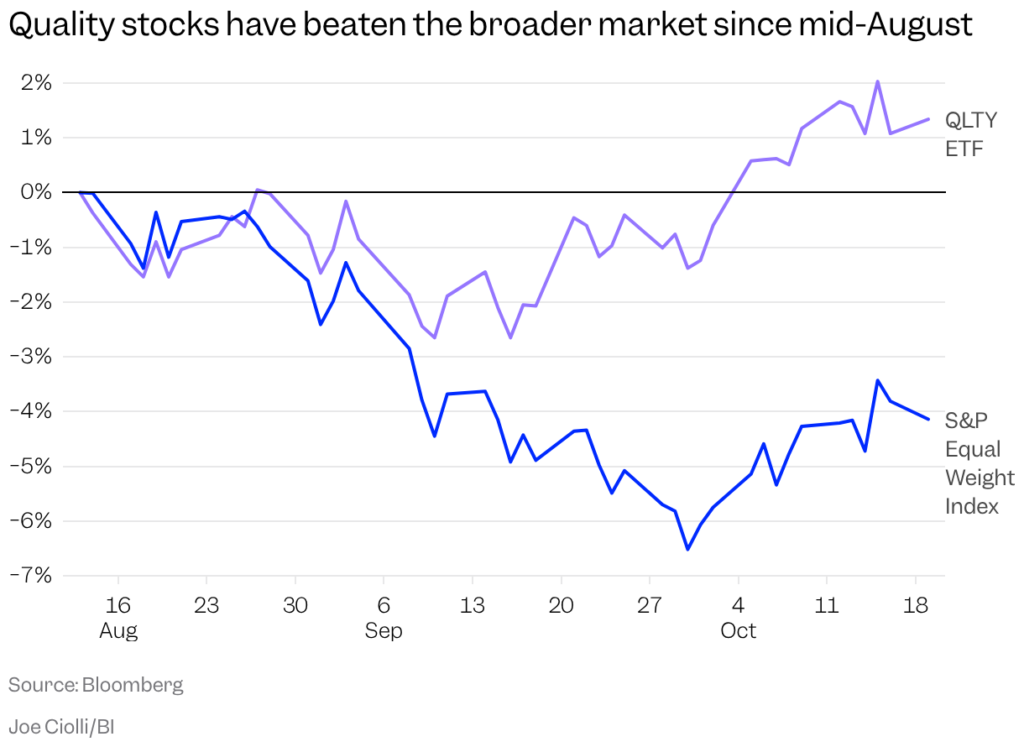
Wall Street always seems to have a new favorite word or phrase. When the AI trade launched in earnest, it was the “Magnificent Seven.” Then came “AI enablers,” “picks and shovels,” and, more recently, “momentum.” Now, as investors fret over rising interest rates, expensive AI ambitions, and a top-heavy market, the word du jour is

Not Lilly. Not Johnson & Johnson. This Stock Will Be the Biggest Healthcare Winner of 2026

Healthcare stocks have rebounded this year. Many leaders in the sector have helped drive that performance. Eli Lilly (LLY -1.01%), the largest healthcare stock by market cap, has gained 16%, while Johnson & Johnson (JNJ -0.61%), another major healthcare player, has climbed 22%. However, among large-cap healthcare stocks, none has performed better than Moderna (MRNA

MEXC’s New-Token Trading Volume Rises 77% in September as

MUTSAMUDU, Comoros, Oct. 21, 2026 (GLOBE NEWSWIRE) — MEXC, a pioneer in 0-fee digital asset trading, has released its September trading data. New-token and TradFi spot trading volumes rose 77% and 78% month over month, respectively, while tokenized U.S. stock trading volume increased 81%. Stock Meme projects also took the top two spots by new-token spot

Stock Market Today: S&P 500, Nasdaq 100, Dow Jones Futures Gains as Iran Prolongs US Talks Ahead of Midterms— NFLX, SPCX, SMCI in Focus (UPDATED)

Editor’s Note: The ETFs tracking benchmark indices and the headline were updated in the story. U.S. stock futures were higher on Wednesday, as the Dow Jones, S&P 500 and Nasdaq 100 indices rose, following Tuesday’s mixed close. Reuters reported that Iran is prolonging negotiations with the U.S. to undermine President Donald Trump ahead of the

Why Is Rocket Lab Stock Rising in Pre-Market Trading?

Rocket launching ©Rawpixel Rocket Lab Corporation (NASDAQ:RKLB) shares advanced 3.9% to $52.87 in pre-market trading on Wednesday as investors assessed the company’s upcoming earnings announcement, progress on a NASA spacecraft mission and developments surrounding its proposed acquisition of Iridium Communications. The increase followed a period of declining share prices after Rocket Lab delayed the launch

What Does Seabridge Gold (TSX:SEA) Acquiring Slaughterhouse Mean For Investors?

Seabridge Gold (TSX:SEA) has agreed to acquire a 100% interest in the Slaughterhouse copper and gold project in southern Wyoming from Orogen Royalties. The purchase agreement covers both the Slaughterhouse property and associated technical data, along with future milestone-based payments and royalty terms. The Slaughterhouse Project is located in a historically productive copper and gold

Why Is EchoStar Stock Rising in Pre-Market Trading?

Satellite dishes on telecoms tower ©Shutterstock EchoStar Corporation (NASDAQ:SATS) shares advanced approximately 4.8% in pre-market trading on Wednesday, extending recent gains following a rating upgrade from JPMorgan and continued investor interest in the company’s spectrum transactions and investment in SpaceX. The increase followed JPMorgan’s decision on 16 October to upgrade EchoStar from Underweight to Overweight,

If Alphabet Does This on Oct. 28, the Stock Could Skyrocket

Like many big tech companies, Alphabet (NASDAQ: GOOG) (NASDAQ: GOOGL) has had a lackluster year. It’s only up about 7% for the year, but that figure was over 25% at the start of May. Alphabet has slowly sold off and is now losing to the S&P 500 (SNPINDEX: ^GSPC). However, I think that could be

If I Could Only Invest $500 in AI This Month, I’d Buy This 1 Stock.

If I could only invest $500 in one artificial intelligence stock this month, I’d pick Netlist (NLST +4.67%). Major developments in several court cases have fortified the company’s balance sheet and point toward soaring net profit margins in the years ahead. It’s a mid-cap valued at just $2.1 billion, and it’s still trading well below

Amazon or Alphabet: If I Could Only Own One for the Next Decade, It Would Be This One

Amazon (NASDAQ: AMZN) and Alphabet (NASDAQ: GOOG) (NASDAQ: GOOGL) are two companies that hardly need an introduction. Both are leaders in their respective industries, generally post excellent financial results, and have crushed broader equities over the long run. Investors arguably can’t go wrong with either of these, and I personally own shares of both. But

$4,000 in These 4 Non-Nvidia Chip Stocks Could Be Worth This Much by 2030

Nvidia (NASDAQ: NVDA) is now the largest company on the planet; its market cap represents around 7.5% of the value of the S&P 500. As such, if you own any mutual funds or exchange-traded funds (ETFs) — particularly index funds — you probably already have a lot of exposure to the giant chipmaker. However, if

Here’s What $10,000 Invested in SpaceX and Tesla Could Be Worth in 2030

If you want to invest in the future, splitting your investment between Elon Musk’s two companies, Space Exploration Technologies (NASDAQ: SPCX) and Tesla (NASDAQ: TSLA), could be a solid bet. With just under $10,000 split between the two stocks, investors could buy 14 shares of Tesla and 34 shares of SpaceX. Tesla is the older

3 Reasons to Sell JACK and 1 Stock to Buy Instead

3 Reasons to Sell JACK and 1 Stock to Buy Instead Since April 2026, Jack in the Box has been in a holding pattern, posting a small loss of 4.4% while floating around $12.15. The stock also fell short of the S&P 500’s 8.9% gain during that period. Is there a buying opportunity in Jack

Sports Team Value Gains Lag Stock Market Since 2022

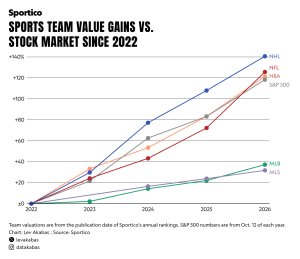
The cost of buying a sports team has soared in recent years, including record price tags in 2026 for the Los Angeles Lakers ($12.5 billion), Seattle Seahawks ($9.34 billion) and Los Angeles Angels ($4 billion). It has spurred talk of a sports valuation bubble. Yes, sports team values are up huge, but they trail stock

Anthropic to publicly file for IPO as early as Friday, sources say

Anthropic (ANTH.PVT) is set to publicly file its S-1 investor prospectus as soon as Friday, according to three people familiar with the artificial intelligence firm’s plans. The move would mark a crucial next step for what could be the biggest IPO in history. The much-anticipated public debut, expected to surpass SpaceX’s (SPCX) June IPO, is

Prediction: $150 a Month Invested in Micron Stock Will Be Worth This Much by Year-End 2030

Over the last year, memory chip manufacturers have benefited from extraordinary demand for artificial intelligence (AI). In particular, Micron Technology (NASDAQ: MU) has witnessed its market capitalization propel from just $53 billion at the start of the AI revolution to more than $1 trillion today. MU Market Cap data by YCharts Missed Nvidia in 2009?

0
Would love your thoughts, please comment.x
()
x