According to Zhitong Finance, against the backdrop of uncertain economic conditions and escalating geopolitical risks, investors have flocked to the most favored safe-haven assets in the technology sector—high-dividend telecommunications stocks.
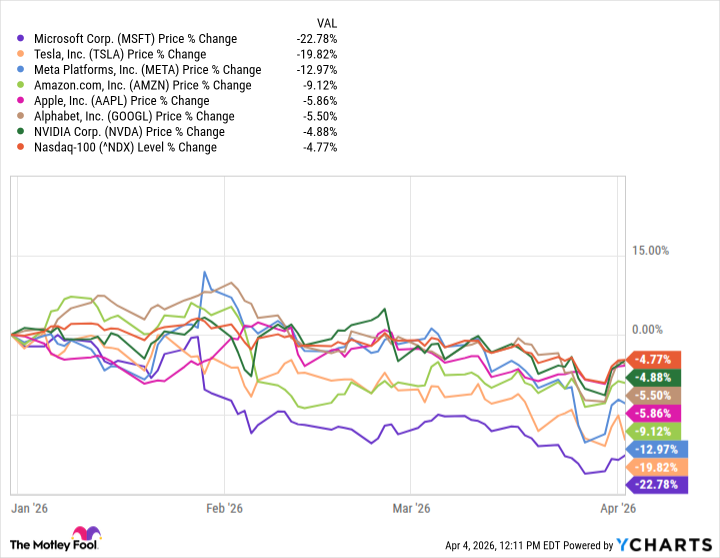
After a dismal 2025, the telecommunications sector has become one of the best-performing sectors in the S&P 500 Index this year, with a cumulative increase of 9.6%, while the broader market index fell by 3.3% during the same period. Verizon Communication Inc. (VZ.US) shares surged over 19% in 2026, while AT&T Inc. (T.US) rose by 13%. Meanwhile, the Nasdaq 100 Index entered a correction zone in March, and an index tracking the ‘Magnificent Seven’ U.S. stocks retreated 13% from its peak in October last year.
Sergey Dluzhevskiy, portfolio manager at Gabelli Funds, stated that the reason behind this divergence is quite straightforward. As the economic outlook becomes increasingly uncertain, investors place greater emphasis on predictable cash flows and above-average dividend yields, which telecom stocks happen to fulfill.
Dluzhevskiy noted, ‘Market capital is shifting from certain tech stocks and broad AI trades to more defensive sectors.’
The dividend yield of the S&P 500 Communication Services Sector Index stands at 4.3%, roughly equivalent to the yield on 10-year U.S. Treasury bonds—which fell below 4% in late February and early March. Specifically, Verizon’s dividend yield is as high as 5.6%, while Comcast’s (CMCSA.US) payout ratio is 4.8%.
Randy Hare, portfolio manager at Huntington National Bank, stated, ‘When Treasury yields decline, high-dividend stocks become very attractive. Those dividend aristocrats are outperforming the broader market.’
Dividend-paying stocks are favored by investors concerned about future growth, who seek to protect their portfolios by securing predictable returns amid market volatility. This aligns with the current market sentiment, driven by turmoil sparked by conflicts in Iran and concerns over large tech companies investing billions in building AI infrastructure—these AI investments support numerous industries and stocks, and any slowdown in capital expenditure could pressure related sectors—collectively fueling this trend.
Bill Mann, chief investment officer and portfolio manager at Motley Fool Wealth Management, stated, ‘In an era where growth makes people uneasy—and I believe we have clearly seen this in 2026—people are beginning to focus on downside risk protection.’ Thus, dividends ‘naturally become an attraction for investors.’
This year, Verizon shares led the telecommunications sector, surging 23% in the first quarter—the best quarterly performance since 2010—after falling 7.3% in the fourth quarter of 2025. This rally began in January when the company reported the largest increase in mobile phone subscribers in seven years and expanded its three-year share repurchase plan to $25 billion. AT&T shares also rose significantly following better-than-expected earnings reports.
Even large telecommunications stocks that have not seen price increases by 2026 are outperforming the broader market. T-Mobile US Inc. (TMUS.US) has seen its stock fall by 1.2% this year, while Comcast’s stock dropped by 0.8%, yet both performed better than the S&P 500 Index and the Nasdaq 100 Index. Additionally, these stocks offer stable dividend yields – approximately 4.8% for Comcast and 1.9% for T-Mobile.
Telecom companies are also part of popular HALO trades (heavy asset, low obsolescence). Their assets such as fiber optic cables, base stations, and data centers hold enduring value in an evolving economic landscape. In other words, although they are investing in AI for internal operations, customer service, and network performance, they are less impacted by the AI construction race compared to other sectors in the tech industry.
Hare noted: ‘You cannot replace fiber-optic telephone lines with AI.’
While dividend-paying stocks may not deliver the extreme market returns seen recently in memory and storage stocks, they can provide some protection during market downturns. In the case of telecom companies, they operate reliable businesses that provide essential services to American consumers.
Dluzhevskiy from Gabelli stated: ‘I believe the pandemic has proven and truly highlighted the importance of silicon-based networks and extensive digital infrastructure, as well as the value of connectivity in today’s economy. In the event of a recession, people might cut back on other expenses but will retain wireless and broadband services. I think these factors collectively drive the strong performance of the telecommunications sector.’