A Supreme Court tariff ruling has invalidated Trump’s use of an emergency statute to impose sweeping import duties on trade partners, eliminating the 10 percent “fentanyl” and reciprocal tariffs on Chinese goods. Trump has responded by implementing a 150-day 15 percent global tariff and has vowed to invoke other laws to implement permanent duties in the coming months. The landmark decision introduces significant friction into the administration’s executive-order-driven trade strategy and may have major implications for the US-China truce that was negotiated under the context of the now-voided tariffs.
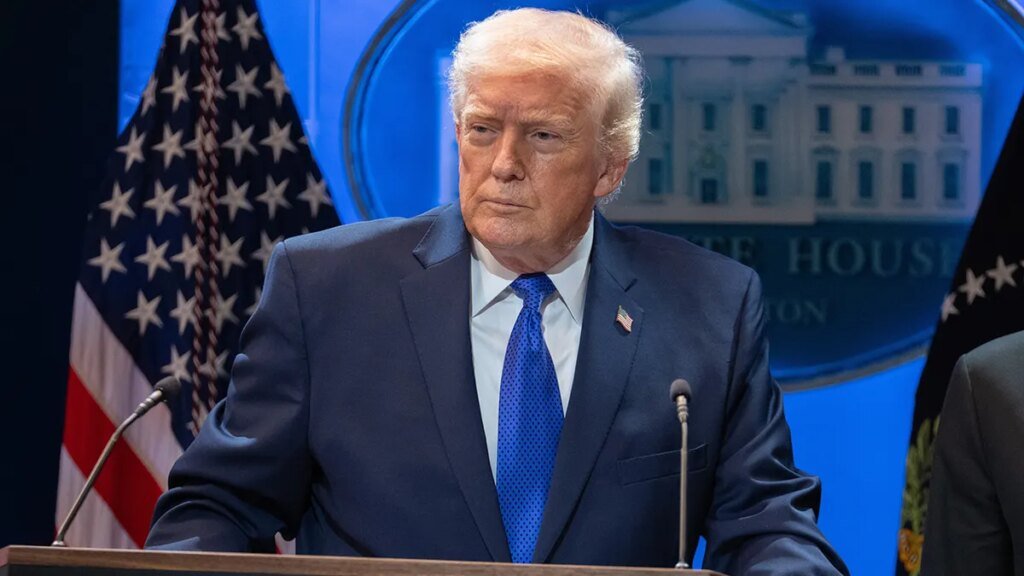
A Supreme Court Opinion reached by a six-to-three decision on Friday, February 20, found that Trump exceeded his authority in implementing sweeping tariffs under the International Emergency Economic Powers Act (IEEPA), clarifying that the power to impose import tariffs under the US Constitution lies exclusively with Congress.
The ruling means that the 10 percent “fentanyl” tariff and 10 percent reciprocal tariff levied on Chinese goods are no longer in effect. It will also impact the minimis exemption, which was suspended for all countries in August 2025, with varying import fees collected based on the IEEPA tariff rate of the parcel’s country of origin.
Shortly after the ruling, Trump signed a proclamation imposing a global 10 percent tariff on all countries under Section 122 of the Trade Act of 1974 (“the Trade Act”) for 150 days starting on Tuesday, February 24. On Saturday, he announced he will raise this further to a “fully allowed, and legally tested” 15 percent, adding that in the coming months “the Trump Administration will determine and issue the new and legally permissible Tariffs”.
Start exploring
Section 122 of the Trade Act allows a president to impose tariffs of up to 15 percent for a maximum period of 150 days “to deal with large and serious United States balance-of-payments deficits”. Any extensions to this period must be approved by Congress.
Trump separately signed an executive order adjusting the fees on de minimis packages to reflect the Supreme Court decision, with parcels sent through the international postal network now subject to a duty on the value of each postal item at the same rate as the interim global tariff – currently 15 percent.
Trump first invoked the IEEPA to impose the fentanyl tariffs on China, Mexico, and Canada in February 2025 to address the “public health crisis” posed by the imports of the drug and related precursor chemicals into the country. The tariff on China – initially set at 10 percent – was raised to 20 percent in March before being cut again to 10 percent as part of the trade agreement reached following the meeting between Trump and Chinese President Xi Jinping in October.
Find Business Support

On April 2, 2025, dubbed “Liberation Day” by the administration, Trump declared a national emergency caused by foreign trade and economic practices to justify the imposition of sweeping “reciprocal” tariffs on almost 70 countries and regions, including an initial 34 percent tariff on China. This rate eventually escalated to a high of 125 percent following a series of retaliatory tariffs from China, before being lowered to 10 percent as part of an interim agreement reached in May. The 10 percent rate was extended until November 10, 2026, following the October meeting.
Also on April 2, Trump ended the de minimis exemption for goods valued under US$800 entering the US from the Chinese Mainland, Hong Kong, and Macao. The de minimis exemption was later suspended for all countries starting in August 2025, with per-item fees of US$80 charged on parcels from countries with an effective IEEPA tariff rate of under 16 percent, and US$200 for parcels from countries with an effective rate of over 25 percent.
Parcels arriving from China, which until Friday had an effective IEEPA tariff rate of 20 percent, were slapped with a US$160 fee.
As the Supreme Court decision only affects tariffs related to the IEEPA, existing tariffs on Chinese goods will remain in place. These are currently the tariffs imposed under Section 301 of the Trade Act during Trump’s first term, which range from 7.5 percent to 100 percent, as well as the tariffs on a variety of products including steel and aluminium, automobiles and components, and certain timber and copper products implemented under Section 232 of the Trade Expansion Act of 1962 (the “Trade Expansion Act”), ranging from 25 percent to 50 percent, which were implemented over the course of 2025.
What is the tariff on Chinese goods now?
The ruling, combined with Trump’s stop-gap response, means that the tariff rate on Chinese imports will be cut by five percentage points starting February 24. This is assuming he does not further raise the global tariff rate or find another way to impose additional tariffs on China in order to make up for the drop – although Section 122 tariffs limits tariff rates to 15 percent and requires that it is imposed consistently on all trade partners, meaning he cannot exclusively target Chinese goods under this statute.
A handful of goods are exempt from the global tariff, including certain critical minerals, energy and energy products, and natural resources and fertilizers that cannot be produced in sufficient quantities in the US, as well as certain agricultural, pharmaceutical, electronic, automobile, and aerospace products.
Goods that are already subject to the Section 232 tariffs – but not the Section 301 tariffs – will also be exempted from the 15 percent global tariff.
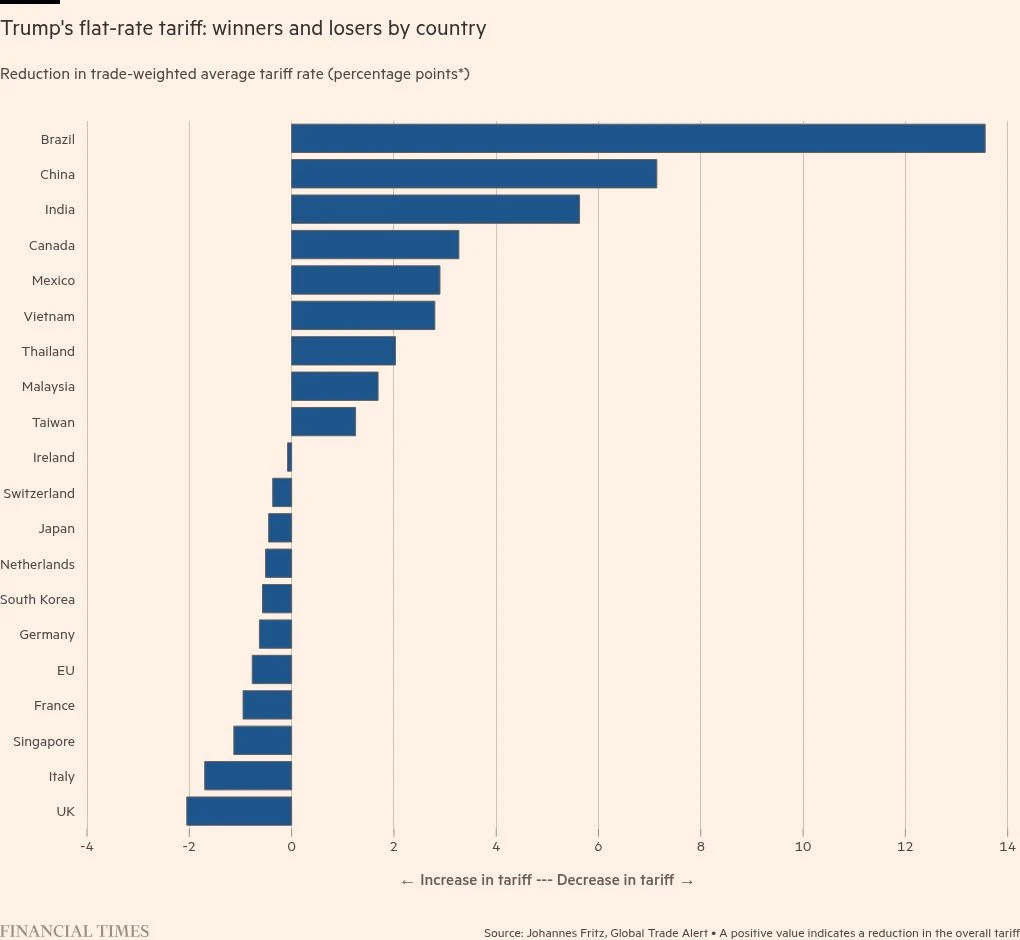
The final tariff rate on Chinese goods will depend on the product, with some goods, such as EVs, still facing rates upwards of 100 percent under Section 301, in addition to the 15 percent global tariff. According to Global Trade Alert, the trade-weighted average tariff rate on China will drop from 36.8 percent to 29.7 percent, meaning it continues to face the highest import duties of any country in the US market.
What will happen next?
Beyond the 150-day stop-gap tariff, Trump and his administration have repeatedly vowed to find a workaround to continue implementing import duties under a range of other laws. In the decision, which was relayed by Trump on Truth Social, the dissenting Justice Brett Kavanaugh outlined the possible statutes that the President could invoke to levy further duties on trade partners, including Section 232 of the Trade Expansion Act, Sections 201 and 301 of the Trade Act, and Section 338 of the Tariff Act of 1930 (the “Tariff Act”).
Find Business Support
However, these provisions come with certain limitations, and generally do not permit the President to impose blanket tariffs on all trade partners. They also require lengthy review processes, and therefore cannot be invoked to implement duties on short notice in the way that Trump has used the IEEPA to do.
Under Section 232, the Commerce Department, on its own accord or upon the request of a third party petitioner, can carry out an investigation into the effects of a specific import on US national security. Only if the Commerce Secretary finds that there is a threat to national security and recommends that action be taken can the President decide to implement import duties. The Commerce Department has up to 270 days to complete the initial investigation.
Section 301 of the Trade Act similarly requires an investigative process before tariffs can be implemented, which can take up to 12 months. This statute gives the US Trade Representative (USTR) the authority to launch an investigation into a specific country if it or a petitioner believes that the rights of the US under a trade agreement are being denied, or the country imposes laws or practices that violate a trade agreement or are “unjustifiable and burdens or restricts United States commerce”.
In addition to consultations with the public and other government agencies, the USTR must also request a consultation with the country it is investigating at the start of the process.
Find Business Support
Under Section 201 of the Trade Act, US industries can petition the US International Trade Commission (USITC) to get import relief if they believe they are threatened by increased imports from a given country. The USITC usually has up to 120 days to reach a decision, and only if it concludes harm is being done to the industry can the President choose to levy import duties.
Finally, Section 338 of the Tariff Act of 1930 allows the President to impose tariffs of up to 50 percent on a country’s goods if it is found to implement discriminatory trade practices against the US. Notably, this statute has as never been invoked to impose tariffs on a foreign country, and it does not detail clear provisions on the investigation process, making its implementation in practice uncertain.
There are a range of other statutes that allow the President to impose duties, including provisions on anti-dumping and countervailing duties under the relevant trade laws; however, these similarly require an investigative process and a positive determination before duties can be levied.
As the administration will be eager to reinstate tariffs as soon as possible, these investigations and reviews are likely to be expedited to the greatest extent possible under the law, and the agencies in charge will be under pressure to conclude in each case that tariff action is required. However, the simple fact that a process is required will prevent Trump from wielding unrestrained power to threaten duties on any country that displeases him.
How will this affect the US-China trade truce?
The ruling could require the current US-China détente to be renegotiated, as the agreement was made under the context of the now-voided IEEPA tariffs.
In a statement given to reporters on February 23, the Chinese Ministry of Commerce (MOFCOM) said that it is “currently carrying out a full evaluation of the relevant content and impact” of the Supreme Court decision.
In the October agreement, China made a range of concessions in exchange for the lowering of IEEPA tariffs, including lifting import duties on US agricultural goods imposed in retaliation to the fentanyl tariffs, suspending rare earth export controls, issuing general export licenses for critical materials, and increasing soybean purchases. The 10 percent tariff on US imports imposed in retaliation to the reciprocal tariffs remains in place at the time of writing.
While China could use the Supreme Court decision to put these issues back on the negotiating table, in an effort to preserve the hard-fought truce, it is possible it will not demand any reevaluations. But this will be heavily contingent on what Trump does next: should he take this opportunity to launch further investigations into Chinese imports, China could decide to nullify parts of the agreement and reinstate prior restrictions. In its statement, MOFCOM noted that it is “closely monitoring” the US’s planned alternative tariffs on trade partners and that it will “firmly safeguard its interests”.
It is not certain that Trump will choose this route. Though he will be desperate to find a long-lasting alternative to the IEEPA tariffs before the end of the 150 days, his increasingly dovish demeanor toward China since the meeting with Xi in October suggests he will be unwilling to rock the boat, in particular before his planned visit to Beijing in April.
Related Reading

As it currently stands, China finds itself in a better position than where it started. The overall tariff rate on Chinese imports has come down by five percent – a modest but welcome drop. Trump’s April visit still presents the best opportunity for both sides to reach a more enduring trade deal – and it will handily occur before the 150-day tariff deadline is up. The most likely outcome – barring any unforeseen diplomatic spats – is therefore that neither side will take any further unilateral action until this time.
For the wider business community, while the ruling is unlikely to dampen Trump’s appetite for import taxes, it could help to curb the rule-by-executive-order strategy that has been the cause of considerable turmoil and uncertainty in his second term. The decision further undermines credibility in the frequent and arbitrary tariff threats against countries that act in ways he doesn’t like, a bargaining tactic that has already been weakened by the “Taco” (Trump Always Chickens Out) reputation it has garnered him.
By the same token, the more cumbersome review and investigative processes required by the remaining legal tools at Trump’s disposal add friction to the frantic tariff strategy employed under his administration, providing a longer lead time for businesses and countries and enabling a more stable and predictable trade environment.
About Us
China Briefing is one of five regional Asia Briefing publications. It is supported by Dezan Shira & Associates, a pan-Asia, multi-disciplinary professional services firm that assists foreign investors throughout Asia, including through offices in Beijing, Tianjin, Dalian, Qingdao, Shanghai, Hangzhou, Ningbo, Suzhou, Guangzhou, Haikou, Zhongshan, Shenzhen, and Hong Kong in China. Dezan Shira & Associates also maintains offices or has alliance partners assisting foreign investors in Vietnam, Indonesia, Singapore, India, Malaysia, Mongolia, Dubai (UAE), Japan, South Korea, Nepal, The Philippines, Sri Lanka, Thailand, Italy, Germany, Bangladesh, Australia, United States, and United Kingdom and Ireland.
For a complimentary subscription to China Briefing’s content products, please click here. For support with establishing a business in China or for assistance in analyzing and entering markets, please contact the firm at china@dezshira.com or visit our website at www.dezshira.com.

![President Lee Jae Myung speaks during the public briefing titled “A Korea that dreams again of becoming a nation of scientists and engineers” at the National Science Museum in Yuseong District, Daejeon, on Nov. 7, 2025. [NEWS1]](https://charm-retirement.com/wp-content/uploads/2026/02/cde6dcbb-9bac-4efa-966b-9bd995b83677-1024x698.jpg)