Supply & Demand in the Stock Market

A reader asks:

You guys have recently quoted Slock in two podcast episodes that Private Equity Companies, those with over 100 million dollars in revenue make up 87 percent of that category versus only 13 percent of publicly traded company fall into the 100 million in revenue category, and that number is only increasing.

With that said, is this ONE of the reasons stock prices seem to continuously increase. As private equity companies continue to increase in number, there are less publicly traded companies therefore there is more money chasing the ever decreasing number of public companies?

Here’s that stat from Apollo’s Torsten Slok:

The Atlantic shared some data about the dwindling number of publicly traded stocks along with the corresponding growth in private equity investments:

The publicly traded company is disappearing. In 1996, about 8,000 firms were listed in the U.S. stock market. Since then, the national economy has grown by nearly $20 trillion. The population has increased by 70 million people. And yet, today, the number of American public companies stands at fewer than 4,000. How can that be?

One answer is that the private-equity industry is devouring them.

In 2000, private-equity firms managed about 4 percent of total U.S. corporate equity. By 2021, that number was closer to 20 percent. In other words, private equity has been growing nearly five times faster than the U.S. economy as a whole.

Private equity managed less than $1 billion in the mid-1970s.  Today it’s more than $4 trillion. There is more than $2.5 trillion in dry powder alone globally:
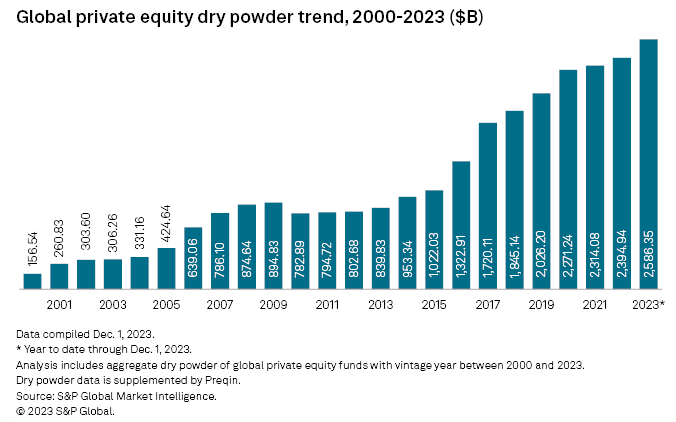
Private equity is a big part of the U.S. and global economy now.

Here’s a look at the shrinking number of public stocks in the U.S. via Barron’s:
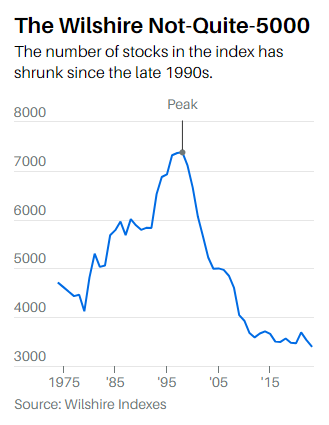
We’ve gone from more than 7,000 stocks in the mid-1990s to more like 3,500 now. The number of public companies has been more than halved.

The Wilshire 5000 is more like the Wilshire 3500. The Russell 3000 currently has only 2,668 stocks, while the Russell 2000 has just 1,665 stocks.

We’ve reached the point where the indexes feel like false advertising.

From a purely supply and demand perspective, it would make sense that more dollars chasing fewer stocks would drive up prices.

But there’s more going on here. You also have to look at the types of companies that have gone away.

That spike in new corporations during the 1990s was something of an aberration of the dot-com bubble. It was mostly tiny micro-cap companies.

Vanguard shared the data on this with Institutional Investor a few years ago:

Rowley says the proportion of large-cap, mid-cap, and small-cap companies that make up overall market capitalization is very consistent going back to 1979. He says many analysts have made 1996, which had a record number of public companies, a de facto anchor point. However, the late 1990s markets were at a high point, with many companies eager to go public and cash in on rich valuations.

“If you look at the general trend in history, there’s an increase in the number of public companies leading up to 1996, and there’s been a decrease down from that point,” says Rowley. “But again, it’s almost exclusively the domain of micro-cap stocks.”

In 1979, there were 2,044 public micro-cap companies. In 1997, there were 4,193, and in 2014 there were 1,549. But they are a small part of the publicly traded universe. In 1979 and 1997, micro caps represented 3 percent of the market. In 2014, micro-caps represented 2 percent of the market. Micro-caps fell to 1 percent by 2016.

Most of those micro-cap companies from the 1990s ended up going out of business because they had no business model or fundamentals. They were looking to cash in on the euphoria at a time when there wasn’t as much VC or PE money sloshing around.

And micro-cap companies are a sliver of the U.S. stock market from a market cap perspective.

Holding ten one-dollar bills doesn’t put you in a better position than the person holding a single one-hundred-dollar bill.

Sure, there are some smaller companies investors have missed out on because of more venture capital money, M&A and buyout activity. But you could argue the remaining companies are now even higher quality because of this.

Michael Mauboussin wrote a paper about the shrinking number of stocks back in 2017 making this exact argument. This was the main takeaway from that report:

As a result, listed companies today are on average larger, older, and more profitable than they were 20 years ago. Further, they operate in industries that are generally more concentrated. The overall size and maturity of listed companies means they are more likely to pay out cash to shareholders in the form of dividends and share buybacks than companies were in the past.

We speculate that the maturation of listed companies has also contributed to informational efficiency in the stock market. Gaining edge in older and well established businesses is likely more difficult than it is in young businesses with uncertain outlooks. In turn, the greater efficiency may be one of the catalysts for the shift that investors are making from active to indexed or rule-based strategies.

It makes sense this has created an environment where it’s now harder to outperform the market.

There are many reasons the stock market has been going up over time.

The number of stocks listed on the exchange is not one of them.

We discussed this question on the latest edition of Ask the Compound:


Barry Ritholtz joined me on the show this week to answer questions about the actual inflation rate, how fiduciary duty works, worries about U.S. government debt and if we will see a flood of homes hit the market when baby boomers begin dying off.

Further Reading:
The Rebirth of the IPO

Source link

Visited 2 times, 1 visit(s) today

Related Article

Multiple factors drive the strength of Hong Kong stock energy storage concept; institutions predict a three-year compound annual growth rate of installations potentially reaching 50%.

①Multiple factors are driving the rise of Hong Kong-listed energy storage stocks. Which individual stocks are leading in gains? ②Institutions predict that installation growth could reach a compound annual growth rate (CAGR) of 50% within three years. Which sectors will emerge as new growth drivers? Cailian Press, March 11 (Editor Feng Yi) Driven by explosive

Hong Kong Stock Market Midday Review

Oil stocks continued their upward trend as the impact of strategic petroleum reserve releases weakened, and the ongoing closure of the Strait of Hormuz is expected to further push up oil prices. According to Zhitong Finance APP, the Hang Seng Index fell by 1.23%, or 319 points, to 25,579 points; the Hang Seng Tech Index

Following the doubling of the stock market, a wave of share sell-offs by major South Korean shareholders has emerged! Morgan Stanley直言states that this trend will accelerate under corporate governance reforms.

As the record-breaking rally in South Korea’s stock market continues to unfold, existing shareholders are launching a wave of share sales. JPMorgan stated that this trend is expected to further accelerate against the backdrop of South Korea’s ongoing corporate governance reforms, gradual dismantling of cross-shareholding by companies, and simplification of equity structures. As the record-breaking

2 Recession-Resistant Dividend Stocks to Buy Now

It’s always hard to predict whether a recession is coming. Even in the current environment marked by serious geopolitical tensions and lingering tariff-related volatility, some experts believe we will go through 2026 without experiencing a full-blown recession. However, it’s also always a good idea for individual investors to hold shares of companies that can perform

Stock Market Today (LIVE): Tesla’s AI Mimics Microsoft; MercadoLibre Expands In Argentina

📌 Top story — scroll down for more updates Closing Bell 4:05 pm — ORCL +9.2% today The Dow closed down nearly 300 points Wednesday as intensifying naval conflict in the Strait of Hormuz pushed West Texas Intermediate crude up 4% to $87. Markets largely shrugged off a historic 400-million-barrel reserve release from the International Energy Agency,

Jim Cramer says these 3 stock market themes could work if the oil shock eases

CNBC’s Jim Cramer is warning against trying to ignore the Iran war because rising oil prices could eventually overwhelm even the best stock ideas. “The war cannot be ring-fenced, no matter what we do. I don’t want to sugarcoat it. We can’t avoid this issue,” Cramer said on “Mad Money” on Wednesday evening. “People are

Is Archer Aviation Stock Going to $13?

Archer Aviation (NYSE: ACHR) makes an electric vertical lift aircraft called Midnight. The company is in the process of getting Midnight approved as an effective air taxi. It is an exciting concept and could create an entirely new market within the aerospace industry. But investors need to go into this stock with their eyes wide

Goldman’s Flood Sees Potential for ‘Extreme’ Rally in Stocks

Source: US Navy (Bloomberg) — Hedge fund positioning across US equities has created a setup for stocks to rip higher after their recent wobble, according to Goldman Sachs Group Inc.’s trading desk. Speculative investors have largely held on to their bullish positions in individual stocks while building hedges through bearish bets on products such as

Can Nvidia’s Stock Reach a $10 Trillion Market Cap by 2030?

Nvidia (NVDA +0.64%) is the most valuable company in the world, and there’s little wonder why that is when you see its financials. Demand for its artificial intelligence (AI) chips is through the roof, and those chips are expensive, enabling the company to grow its business at a high rate while also generating fantastic profit

2 Stocks to Buy and Hold Through Any Storm

Equity markets have been volatile this year, and market downturns have a way of testing even the most confident investors. Amid geopolitical tensions and lingering tariff-related uncertainty, some fear the stock market could take a turn for the worse by the end of the year, though no one can know for sure. But history shows

Inspector holding a chip.

2 Stocks That Will Be Worth More Than Amazon 3 Years From Now

Amazon has been a longtime stock market leader. While I’d still consider it to be one, there are other companies growing much faster that are nipping at its heels and could overtake Amazon in terms of market cap over the next three years. The candidates? Broadcom (NASDAQ: AVGO) and Taiwan Semiconductor (NYSE: TSM). Both of these

Texas Stock Exchange (TXSE) Selects Options’ AtlasInsight for Next Generation Packet Capture and Real Time Analytics

Texas Stock Exchange (TXSE) Selects Options’ AtlasInsight for Next Generation Packet Capture and Real Time Analytics LONDON & TORONTO & NEW YORK & HONG KONG, March 11, 2026–(BUSINESS WIRE)–Options Technology (Options), the leading provider of financial services infrastructure, today announced that its AtlasInsight platform has been selected by the Texas Stock Exchange (TXSE) to deliver

Why Newmont Corporation Stock Dropped Again Today

Newmont Corporation (NYSE: NEM) stock declined 3.2% through 11:30 a.m. ET Wednesday as gold prices took another turn for the worse. This morning, the U.S. Bureau of Labor Statistics reported the Consumer Price Index (CPI) rose 2.4% for a second straight month in February. These two things are connected. Will AI create the world’s first

Richard Haass warns the geopolitical risk tax will burden markets for years to come

If the US-Israel war rages on, the repercussions for investors could continue for years. Richard Haass, former president of the Council on Foreign Relations, told Yahoo Finance’s Opening Bid that the days of ignoring global conflict are over. He specifically dismantled the theory that markets will return to a normal baseline. “When you had oil

1 Glorious Growth Stock, Down 81%, You Might Regret Not Buying on the Dip in March

Duolingo (NASDAQ: DUOL) operates the world’s largest digital language-education platform. Unfortunately, that hasn’t kept its stock from plummeting by 82% from its mid-2025 all-time high. The drop is primarily tied to two reasons: Investors are worried that artificial intelligence (AI) will disrupt its business. Management plans to target faster user growth, which is likely to

Wall Street Traders Hunt for Bottom as War Turmoil Continues

(Bloomberg) — Wall Street traders are poring over charts to determine how much further the S&P 500 Index might fall as war in the Middle East rages on, with technical analysts noting early signs of bearish momentum. The S&P 500 fell 0.2% on Tuesday, dropping further below both its 50- and 100-day moving averages. Breaching

Jim Cramer Highlights the Possible Struggles of Lamb Weston Holdings

Lamb Weston Holdings, Inc. (NYSE:LW) is one of the stocks Jim Cramer discussed amid the reshuffling of the S&P 500. Cramer highlighted the major decline in the stock over the past couple of years, as he said: Third, Lamb Weston sells frozen potatoes. They dominate that entire business. The company was spun off by Conagra

Pre-market Insights | US February CPI in line with expectations, all three major futures indices down; Oracle surges 10% pre-market after beating last fiscal quarter earnings expectations with robust AI orders; NEBIUS rises 8% as NVIDIA announces a $2 bil

Top News Highlights Before the market opened on Wednesday, U.S. stock index futures for the three major indices collectively declined after the release of February’s CPI data. As of the time of writing, Dow Jones futures were down 0.32%, Nasdaq futures fell 0.16%, and S&P 500 futures dropped 0.18%. $Star Tech Stocks (LIST2518.US)$Most stocks rose

0
Would love your thoughts, please comment.x
()
x