To hear President Donald Trump tell it, a push to take control of Greenland is a “national security” necessity, critical to reinforcing control of the Arctic against possible threats from Russia and China.
For America’s allies and Greenlanders themselves, however, Trump’s threats to seize the semi-autonomous Danish territory cut much deeper, and threaten to shatter the decades-old principle of Western defense cooperation.
But there may be little they can do to stop it.
“This is a threat that is completely appalling, to be honest,” Aaja Chemnitz, one of two Greenlandic lawmakers in the Danish parliament, said in an interview Thursday. “You can’t just buy another country, a people, the soul of Greenland,” she added.
“Everybody in Greenland is discussing it, and many people are worried and concerned.”
That alarm is shared across European capitals.
French President Emmanuel Macron accused the United States on Thursday of “breaking free from the international rules that it used to promote,” while German President Frank-Walter Steinmeier warned the world risked descending into a “den of robbers, where the most unscrupulous take whatever they want.”

Though it looms artificially large on a Mercator projection map, where it is stretched to the scale of Africa despite being 14 times smaller in size, Greenland has rarely figured so prominently in mainstream Western consciousness.
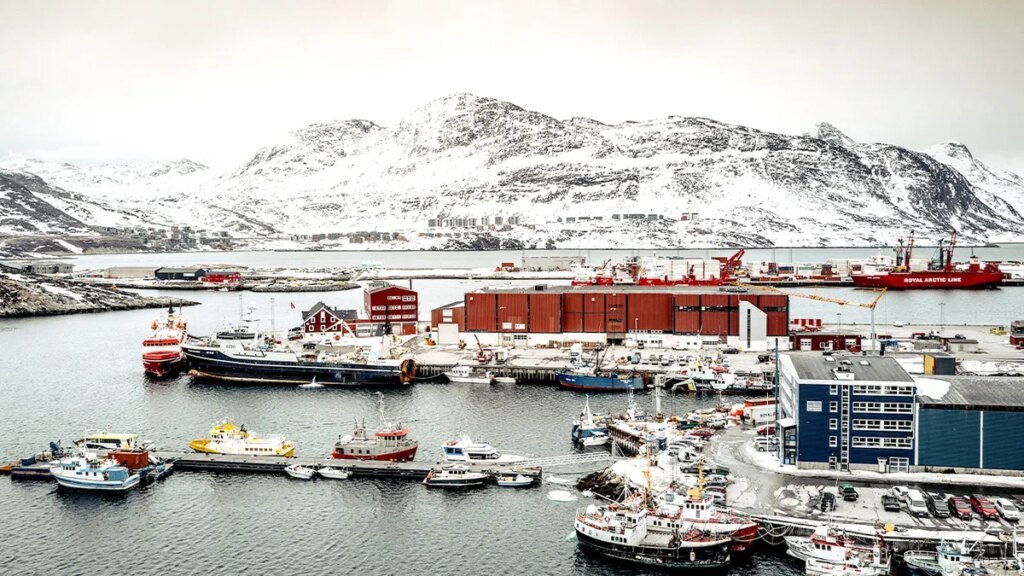
The vast island — around the size of Alaska and California combined — is only inhabited by 57,000 people, about the same as Carson City, Nevada. Around 90% of them are Indigenous Inuit people whose ancestors arrived more than 1,000 years ago.
Denmark colonized Greenland 300 years ago and granted it the status of an autonomous territory in the 1970s, while retaining control of military and foreign policy.
American designs on Greenland go back way further than Trump. In 1867, then-Secretary of State William H. Seward contemplated annexing Greenland, as well as Iceland, having recently bought Alaska from Russia.
The United States briefly took control of Greenland during World War II to stop it from being used by the Nazis, and an agreement has existed since 1951 that allows the U.S. to “construct, install, maintain, and operate” military bases across the island.
Greenland’s sole U.S. military base was used as an early detection post for Soviet nuclear missiles during the Cold War, home to thousands of troops at its peak. Locked in by ice for nine months of the year, the Pituffik base is now overseen by the U.S. Space Force and houses a much smaller number of troops.

When Trump first said he wanted to buy Greenland in 2019, in what he described as a “real estate deal,” it was widely seen internationally as absurd.
But after years of pressure from Trump, and the U.S. attack on Venezuela, few in Europe are laughing.
Secretary of State Marco Rubio will meet with the foreign ministers from Denmark and Greenland next week for further discussions, as officials push for a deal.
But the White House says that all options are on the table, including military action. An attack by NATO’s most powerful member on an ally would likely implode the alliance, which for decades has upheld the principle of collective defense.
“We are going to do something on Greenland, whether they like it or not, because if we don’t do it, Russia or China will take over Greenland, and we’re not going to have Russia or China as a neighbor,” Trump told reporters at the White House on Friday.
“We’re not going to allow Russia or China to occupy Greenland, and that’s what’s going to happen if we don’t own it,” he said during the public portion of a meeting with oil and gas executives.
European powers including Britain, France and Germany said in a joint statement this week they “will not stop defending” the principles of territorial integrity, but most experts agree with White House deputy chief of staff Stephen Miller’s blunt assessment that “nobody’s going to fight the U.S. over the future of Greenland.”
The European Union could impose sanctions on Washington, or limit its use of military bases in Europe, but both would be mutually painful in the extreme, said Mika Aaltola, a Finnish lawmaker who serves on the European Union’s Foreign Affairs Committee.
“We are basically in a trap that is difficult to resolve,” Aaltola told NBC News. “We thought that January would be about peace deals or a cease-fire in Ukraine,” he said, referring to diplomatic efforts between the U.S. and Europe to end that conflict. “But all of a sudden, we realized that Trump has manipulated us into a situation where he wants to have Greenland.”
Iain Duncan Smith, a veteran British lawmaker, said “the reality for Europe is they need to probably offer an alternative to the demand that Trump is making.”
There is bafflement alongside the dismay. Trump already has huge scope to build new military bases on Greenland or negotiate deals for its minerals, but he has refused to compromise on his demand for “ownership” to be transferred.
He said Friday: “When we own it, we defend it. You don’t defend leases the same way. You have to own it.”

Aside from being a good outpost from which to keep an eye on Russia, Greenland also forms one side of the “GIUK gap” (which stands for Greenland, Iceland, United Kingdom), a naval choke point for submarines and other vessels in and out of the Atlantic.
As the global ice sheet melts, new Arctic sea routes are emerging that Trump’s team and other Western officials fear could be exploited by China and Russia.
Beijing has certainly made moves in the region, declaring itself in 2019 to be a “near Arctic nation” and outlining plans for a “Polar silk road” to mirror the infrastructure belt it has constructed on land.
White House press secretary Karoline Leavitt pointed to this motive Wednesday, saying U.S. ownership of Greenland was required “to deter Russian and Chinese aggression in the Arctic region,” though she said there would be “many other benefits.”
Vice President JD Vance cited Greenland’s continued role in missile defense infrastructure in an interview with Fox News on Wednesday, criticizing what he said was a lack of investment from Denmark and Europe that left it vulnerable to potential threats from “the Russians and the Chinese.”

“They haven’t done a good job of securing that area, that land mass,” he said.
Denmark’s Ambassador to the U.S., Jesper Møller Sørensen, said the country has recently invested $4 billion in Arctic security, including expanding the permanent presence of its armed forces.
The retreating ice floes may also yield new opportunities to exploit its vast mineral reserves, a subject that has proven to be at the forefront of Trump’s mind in negotiations over Ukraine and Venezuela.
In 2023, the European Commission carried out a survey that found 25 of the 34 elements it classified as “critical raw materials” were found on Greenland. These substances are crucial in producing everything from electric vehicle batteries to cutting-edge military hardware — vital currency in the global tech battle with China and others.
Trump himself has denied minerals are a factor, positioning Greenland as a “national security” issue, though some around him are eager to take advantage.

“This is about critical minerals. This is about natural resources,” then-congressman Mike Waltz, who would later become Trump’s national security adviser, said last January.
The reality is likely a mix of all these factors, according to William Alberque, former director of NATO’s Arms Control, Disarmament and WMD Non-Proliferation Centre.
“Greenland is a toxic combination of issues in terms of this administration’s interests,” Alberque said. “It brings together the China hawks, the legitimate concerns about Atlantic security, the America Firsters and continental security, and let’s not forget naked economic interests.”