After the 2024 presidential election in the United States, a rising political right wing in Silicon Valley formed a “tech-political complex” with the Trump administration. Centered on tech acceleration and tech nationalism, it is pushing for military-civil integration, technological blockades against China and deregulation of the technology sector.
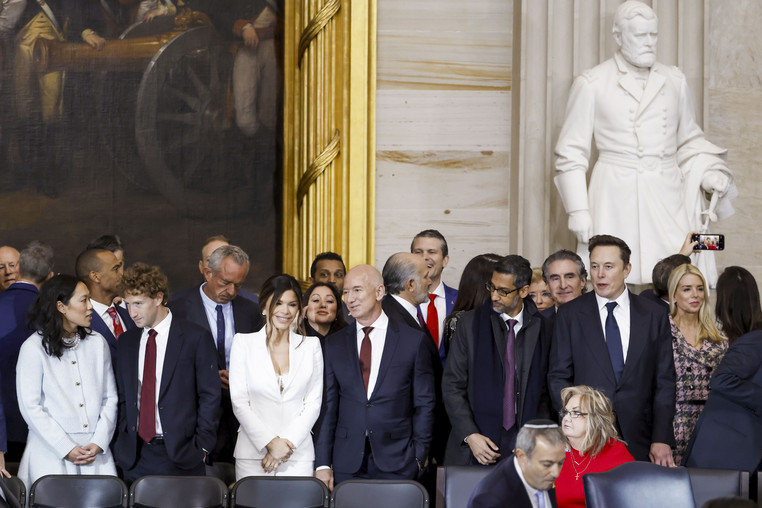
(L-R) Priscilla Chan, Meta CEO Mark Zuckerberg, Lauren Sanchez, Amazon executive chair Jeff Bezos , Alphabet CEO Sundar Pichai, and SpaceX CEO Elon Musk, among other dignitaries, attend the United States Capitol on January 20, 2025 in Washington, DC. (Pool photo by Shawn Thew)
The 2024 U.S. presidential election marks not only a watershed moment in U.S. politics but also a turning point for the global tech landscape. A group of right-wing figures in California’s Silicon Valley, including Peter Thiel, Elon Musk, Palmer Luckey, Marc Andreessen and David Sacks, have surged from a marginal political force to an influential one, creating an interlocking tech-political complex unseen in U.S. history. This development allows tech capital to gain control of federal power while equipping the government with technology and funding, which is expected to restructure the U.S. tech governance system, rules of global tech competition and even the international geopolitical order.
For decades, Silicon Valley was a traditional stronghold and major funding source for the Democratic Party, but this was upended in the 2024 election. The tech right became a decisive force for Trump’s victory, profoundly reshaping his campaign strategy and the Republican Party’s tech policy agenda. In fundraising, it demonstrated extraordinary organizational capacity and financial strength. Figures such as Musk and Thiel provided substantial backing for Trump’s campaign through personal donations, super PACs and tech industry networks, decisively reversing the Democrats’ funding advantage in the tech sector. This historic shift in capital flow signals a profound realignment of political forces within Silicon Valley and provides a new fiscal foundation for the Republican Party. More important, this alliance is not merely transactional but reflects a deep alignment at the ideological and national strategic levels.
Rooted in tech accelerationism and radical tech nationalism, the tech right advocates full domestic deregulation of the tech industry, complete relaxation of antitrust enforcement and preferential access to taxpayer-funded public research resources for private tech giants.
Externally, it supports aggressive technological blockades and selective decoupling, elevating tech competition with China to a top national strategic priority. It also vigorously promotes the deep integration of defense and civilian technologies, with a particular emphasis on the military application of artificial intelligence. It equates the commercial interests of tech companies with U.S. national interests, seeking to maintain absolute American global technological dominance through political and military means.
Upon taking office, Trump quickly integrated core members of the tech right into the federal government’s decision-making apparatus. For example, David Sacks, a longtime Silicon Valley entrepreneur, was appointed special adviser for artificial intelligence and cryptocurrencies; Marc Andreessen, an entrepreneur and investor, was appointed to the president’s council of advisers on science and technology. Numerous tech figures joined central departments including the departments of Defense, Commerce and Energy. This unprecedented personnel arrangement elevated these individuals from policy influencers to policymakers, who then played pivotal roles in strategic initiatives such as the Genesis Mission, Project Stargate and Trump’s “AI Middle East diplomacy.”
Another key trend driven by the tech right is the deep integration of defense and civilian technologies and the full militarization of tech competition. In their view, technological strength equals military power, commercial competition equals national competition and tech companies must serve as the first line of defense for U.S. national security.
This military-civil integration has translated from concept into concrete institutional arrangements and military practice. For example, SpaceX’s Starlink system has been deeply integrated into the U.S. military’s global communications and reconnaissance infrastructure, playing an indispensable role in military operations in Ukraine, the Middle East and other regions. Palantir’s big data platforms are widely deployed as the U.S. military’s primary AI operating system. During the 2025 U.S.-Iran conflict, the Maven Smart System (MSS) was applied by U.S. forces in thousands of precision strikes, demonstrating AI’s decisive role in modern warfare.
In July, the Chief Digital and Artificial Intelligence Office under the U.S. Department of Defense signed $800 million worth of contracts with four leading AI firms: Anthropic, OpenAI, Google and X.AI, to explore the adaptation of AI models for defense applications. These agreements suggest the beginning of an AI-first era in U.S. military strategy and the full militarization of the most advanced civilian AI technologies in the country.
Parallel to military-civil integration is an increasingly radical form of tech nationalism. The Silicon Valley right is the staunchest supporter and driver of the U.S. tech blockade against China, advocating strengthened export controls, investment restrictions, expanded entity list designations and other measures to cut off China’s access to advanced technologies and slow its technological progress. Under its influence, the Trump administration escalated export controls on semiconductors and AI to China, added more Chinese companies and research institutions to the Entity List and pressured allies to adopt similar measures. Recently, three tech giants—OpenAI, Anthropic, and Google—formed an unusual alliance, characterizing adversarial distillation as theft and seeking to block China’s pathways for upgrading the performance of its AI systems.
Though ascendant in U.S. politics, the tech right faces severe challenges and controversies over their policies. Their agenda overly favors the commercial interests of tech firms at the expense of consumer rights, personal privacy, market fairness and social stability. While deregulation boosts short-term innovation and economic growth, it entrenches the monopoly power of the tech giants and heightens risks such as data breaches, algorithmic discrimination and the spread of disinformation.
The rapid advancement of AI, in particular, brings the potential for large-scale job displacement and profound social changes. Without effective regulation and guidance, these changes could trigger severe social crises. With the 2026 midterm elections approaching, partisan divisions between Democrats and Republicans over tech policy are likely to intensify. Should the Democrats win control of Congress, they are likely to push for stricter regulation of the tech industry and even launch new antitrust investigations into tech giants, thereby dealing a major blow to the tech right’s policy agenda.
A more profound challenge arises from international opposition and the structural dynamics of global tech development. U.S. tech nationalism, which runs counter to free trade principles and disrupts global tech industrial chains, has faced widespread international resistance. For example, China has adopted firm countermeasures, significantly increasing R&D investment and making remarkable progress in semiconductors, AI and other fields. European countries such as Germany and France are pursuing a “technological sovereignty” strategy to reduce reliance on U.S. technologies and build more autonomous tech ecosystems.
On one hand, the Silicon Valley right espouses free markets and opposes government intervention; on the other, it vigorously pushes for state-led tech blockades against China and interference in the industrial division of labor globally. This apparent contradiction will ultimately harm the interests of U.S. tech companies and run counter to long-term national interests. In fact, Washington’s tech blockades have not halted China’s technological advancement but instead accelerated its push for greater self-reliance in innovation. A growing number of AI startups in the United States are now turning to cost-effective open-source AI models from China, underscoring the inevitable diversification of global tech development and the fundamental necessity of a global division of labor and cooperation in driving innovation.