📉The stock market fell last week, with the S&P 500 shedding 2.1% to end at 6,368.85. The index is now down 8.7% from its Jan. 27 closing high of 6,978.60 and down 7.0% year-to-date. For more on the stock market, read: If you think things are bad now, just keep in mind that they could get much worse 📉
–
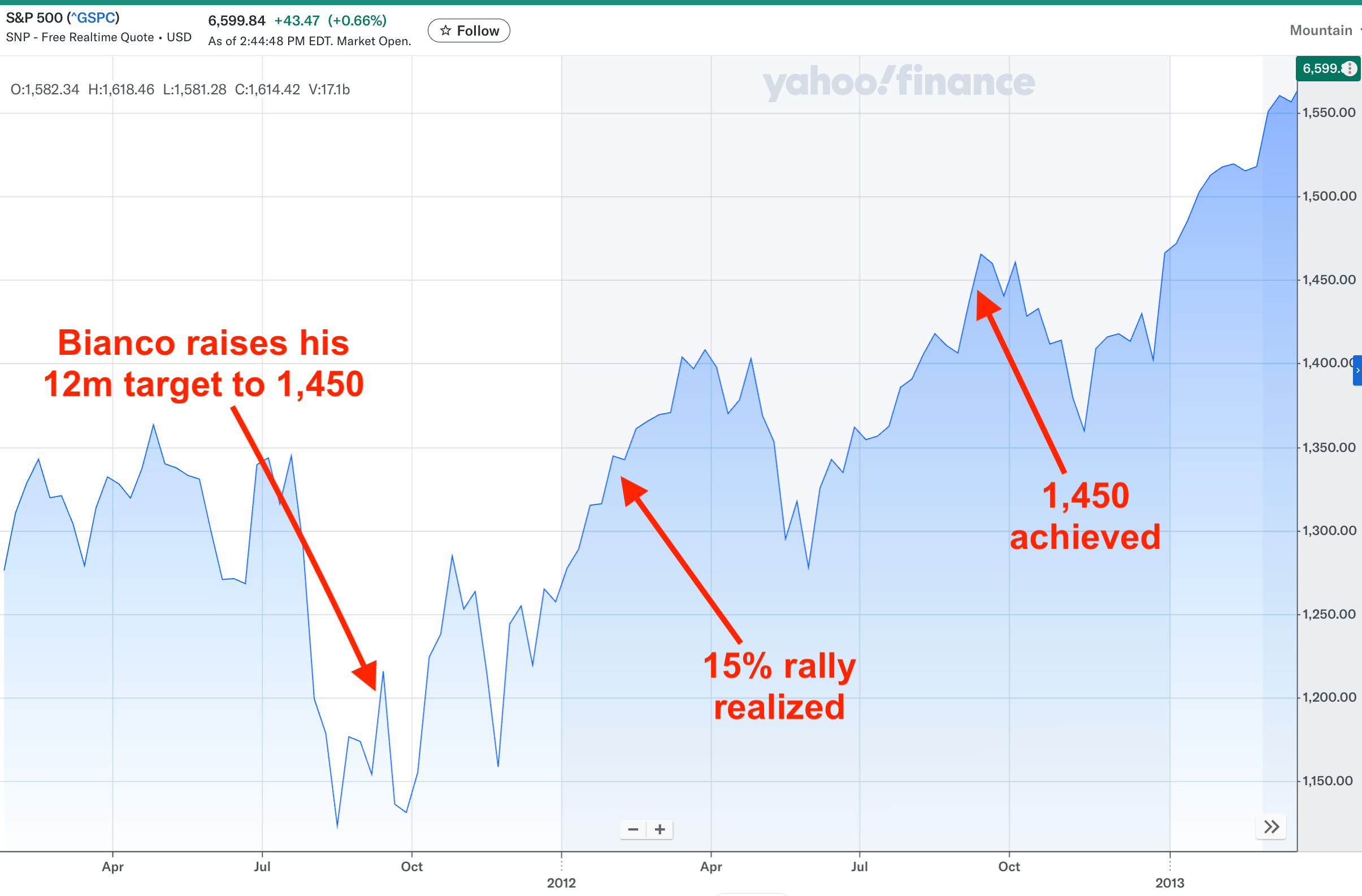
In fall 2011, global stock markets tumbled amid increasing concerns over sovereign debt levels. Debt crises gripped Greece, Ireland, Portugal, and Spain. S&P even stripped the U.S. of its pristine AAA sovereign credit rating.
The S&P 500 fell 19% from its July 7 closing high of 1,353 to its Oct. 3 closing low of 1,099.
It was the kind of move you’d think would have Wall Street strategists tripping over each other as they cut their targets for the market.
But on Sept. 11, when the S&P was at 1,154, then-BofA strategist David Bianco raised his 12-month forecast on the S&P to 1,450 from 1,400. This implied a very bullish 26% return. In his note, he also suggested the market could surge 15% from Sept. to January.
At the time, his calls were widely criticized as delusional optimism. I even wrote that he was the “gutsiest strategist in the world right now.” (Three days later, BofA and Bianco parted ways. He later joined Deutsche Bank as their top equity strategist. Today, he’s CIO at DWS.)
Well, Bianco nailed both calls.
The S&P surged 15% from September to the end of January. And it hit 1,450 on Sept. 13, 2012 — 12 months and two days after he set his 12-month target.
I was reminded of this episode this week because Barclays’ Venu Krishna raised his year-end target for the S&P 500 to 7,650 from 7,400. This, despite the market pulling back amid heightened uncertainty and elevated energy prices stemming from the conflict in Iran.
“Our baseline is that concerns over AI disruption, private credit, and geopolitics reflect real and material risks, but ones that will nonetheless fall short of derailing the current growth cycle at this point in time,” he said.
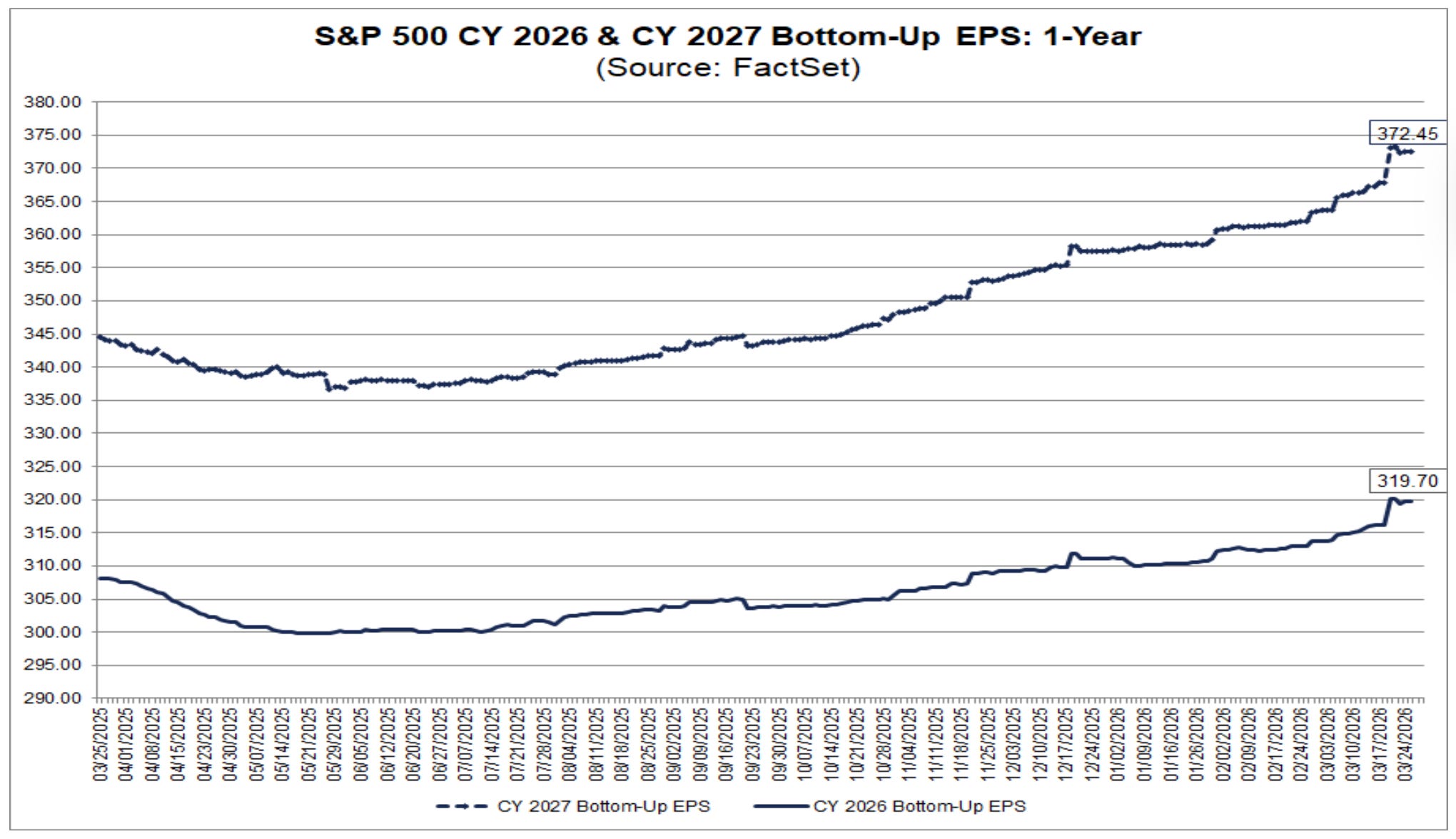
A key driver of his updated call is his expectation for S&P 500 earnings to grow to $321 per share this year, up from his initial estimate of $305.
If you only have time for one metric, it should be earnings. They’re the most important long-term driver of stock prices. And according to FactSet, earnings estimates have been drifting higher.
As Schwab’s Kevin Gordon often says, we have to distinguish between front-page risk and bottom-line risk. Stories on the front page may spark market volatility. But those stories matter to the stock market only to the degree they affect the bottom line, or earnings.
And so far, the earnings narrative continues to be bullish.
It’s not breaking news that the stock market behaves unpredictably and sometimes counterintuitively.
Going into 2025, Wall Street strategists had year-end S&P 500 targets ranging from 6,400 to 7,100.
As the Trump administration rolled out its aggressive trade policy, markets tanked, and strategists slashed their targets. Almost all strategists had revised targets below 6,400.
But to many people’s surprise, the S&P eventually recovered losses and closed the year at 6,845, an impressive 16% gain. That closing price was actually higher than most strategists’ targets at the beginning of the year.
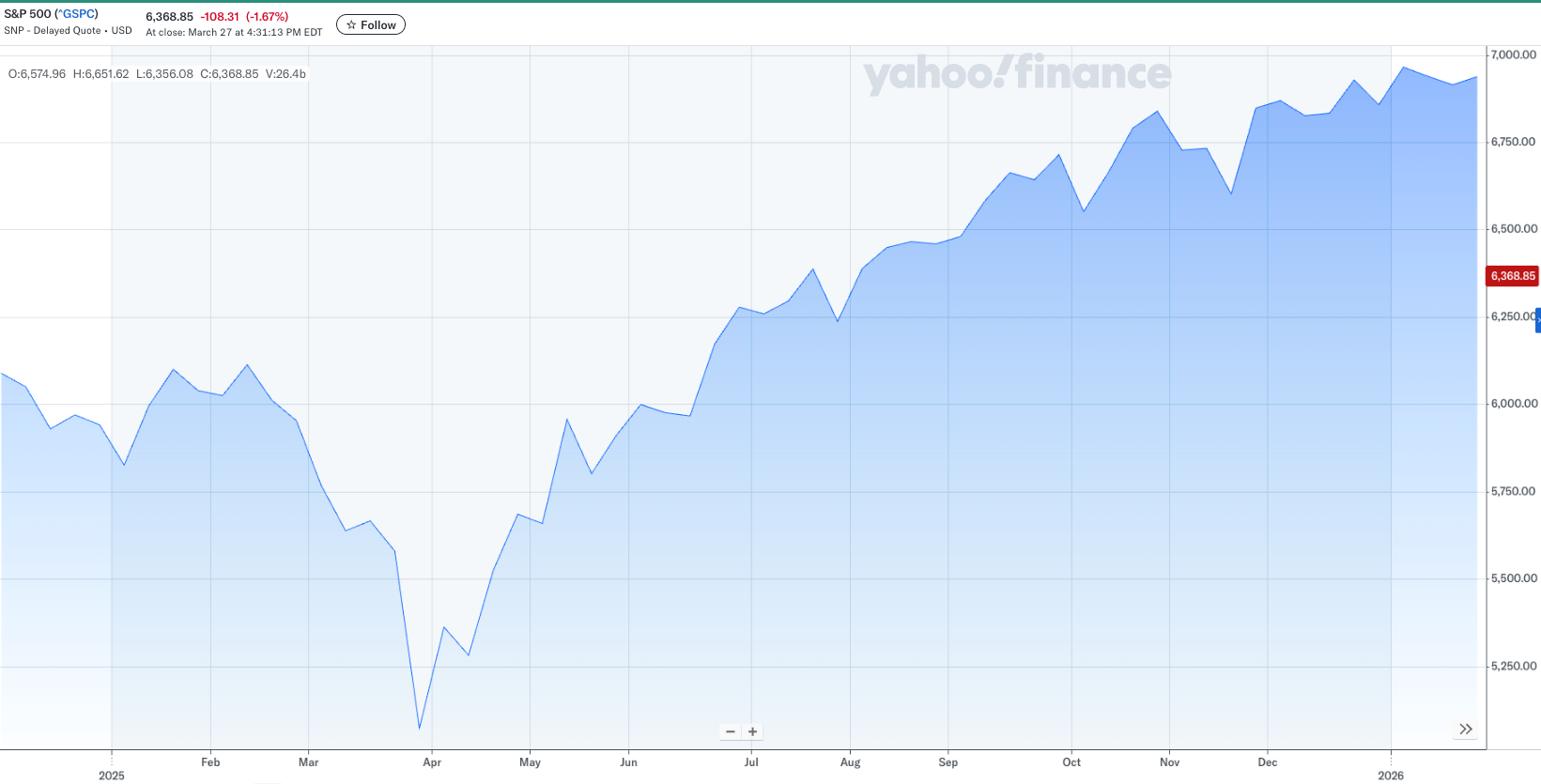
Despite the policy headwinds, earnings growth persisted, helping prices climb to new record highs.
To be clear, this is not me suggesting you should lean on a Wall Street strategist’s one-year target for the stock market. I would never do that.
I’m also not suggesting that markets are sure to recover and rise above everyone’s targets. Things could get worse, and 2026 could be a crappy year.
All I’m saying is that good stock market analysis sometimes yields contrarian findings, even when front-page news and recent price performance point in the opposite direction.
The stock market will do unexpected things, especially over short periods like one year. So don’t be too surprised if we ultimately get better-than-expected results despite what appears to be worsening market conditions.
–
Related from TKer:
I was on The Pinpoint Press, with Rick Newman . We talked about geopolitics, international stocks, the Magnificent 7, and more! Watch it at The Pinpoint Press or on YouTube!
I was also on Facts vs Feelings: Social Hour with Ryan Detrick, Sonu Varghese, and Frank Cappelleri. We talked about geopolitics, oil, monetary policy, the role of diversification in portfolios, and the evolution of the Predator movie franchise. Catch it on YouTube!
There were several notable data points and macroeconomic developments since our last review:
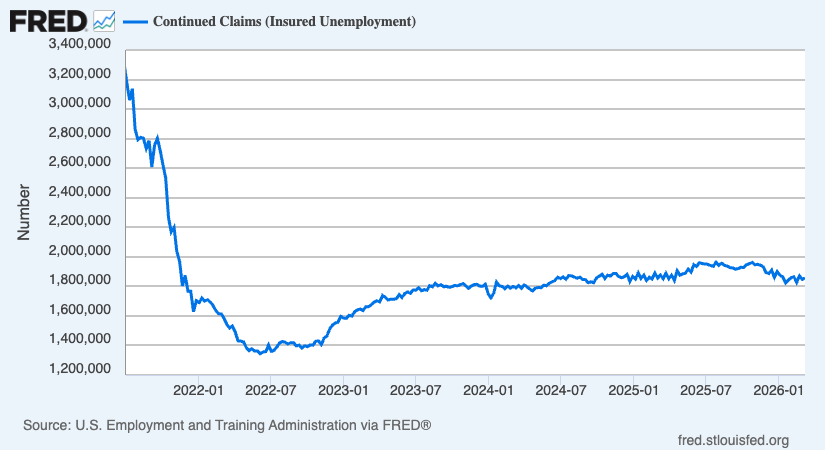
💼 New unemployment insurance claims, total ongoing claims remain low. Initial claims for unemployment benefits ticked up to 210,000 during the week ending Mar. 21, up from 205,000 the week prior. This metric remains at levels historically associated with economic growth.
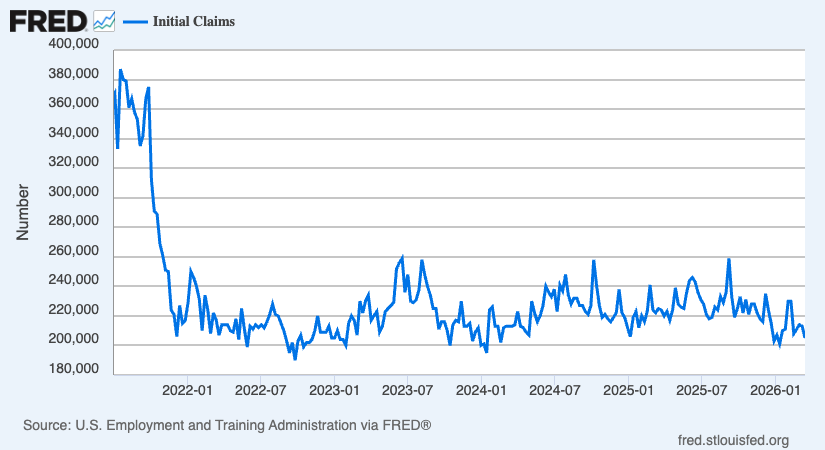
Insured unemployment, which captures those who continue to claim unemployment benefits, declined to 1.82 million during the week ending March 14.
For more on the labor market, read: The next couple of years for the job market could be tough 🫤
👎 Recent job private job growth has been lackluster. According to payroll processor ADP, private U.S. employers added 10,000 jobs in the four weeks ending March 7.
For more on the labor market, read: About that ugly jobs report 📉
⛽️ Gas prices surge. From AAA: “he national average for a gallon of regular gasoline is up 10 cents from last week and one dollar since last month. The line graph below shows the steep rise from $2.98 on February 26 to $3.98 today. Crude oil prices remain high as the Iran conflict nears the 4-week mark. The national average could reach $4/gallon in the coming days for the first time since August 2022. Gasoline demand is also on the rise as spring break season continues, another factor in rising pump prices.”
For more on energy prices, read: Our love-hate relationship with rising oil prices in charts 💔🛢️📊
👎 Consumer vibes remain poor. From the University of Michigan’s March Surveys of Consumers: “Consumer sentiment fell back 6% this month to its lowest level since December 2025. Declines were seen across age and political party. Consumers with middle and higher incomes and stock wealth, buffeted by both escalating gas prices and volatile financial markets in the wake of the Iran conflict, exhibited particularly large drops in sentiment.”
More from the report: “Overall, the short-run economic outlook plunged 14%, and year-ahead expected personal finances sank 10%, while declines in long-run expectations were more subdued. These patterns suggest that, at this time, consumers may not expect recent negative developments to persist far into the future. These views are subject to change, however, if the Iran conflict becomes protracted or if higher energy prices pass through to overall inflation. Interviews for this release were collected between February 17 and March 23, with about two-thirds completed after the start of the US military conflict in Iran.“
For more on consumer sentiment, read: What consumers do > what consumers say 🙊 and The economy may not be working for everyone right now, but it’s at least working for stock market investors 🎭
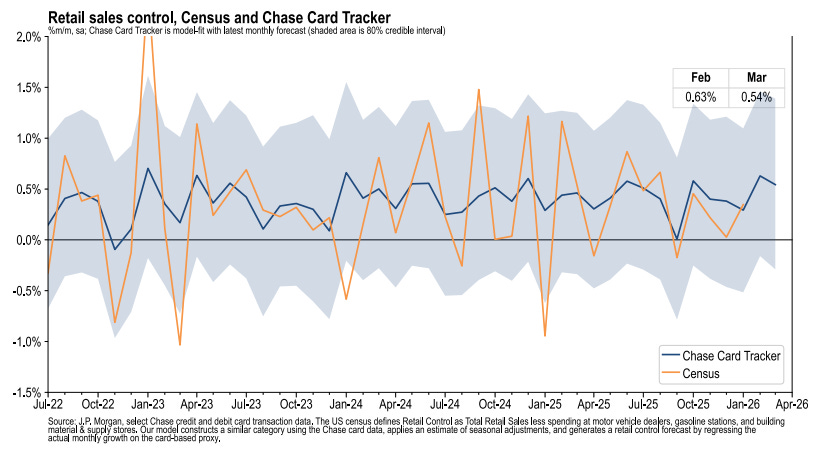
💳 Card spending data is holding up. From JPMorgan: “As of 17 Mar 2026, our Chase Consumer Card spending data (unadjusted) was 6.1% above the same day last year. Based on the Chase Consumer Card data through 17 Mar 2026, our estimate of the US Census February control measure of retail sales m/m is 0.63%.”
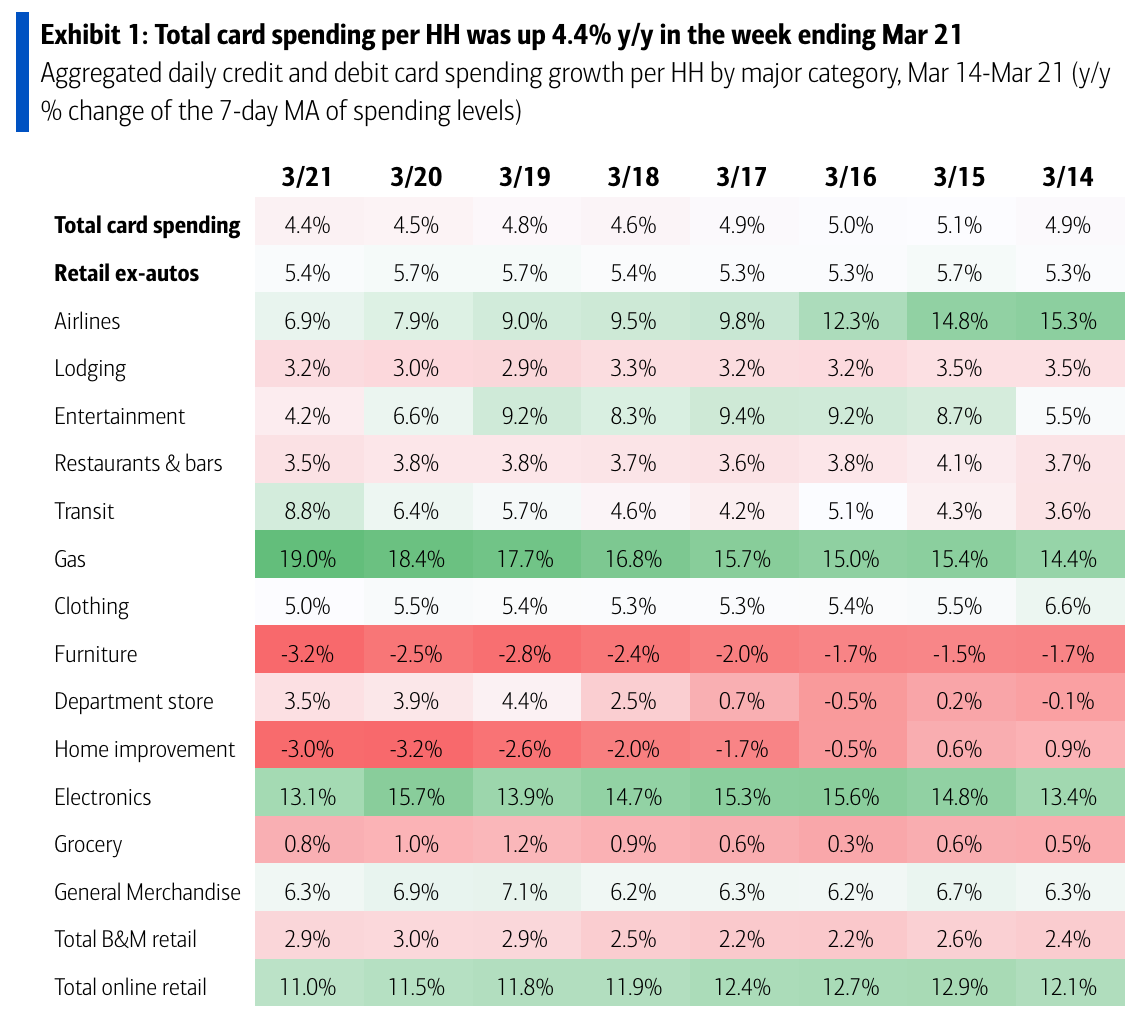
From BofA: “Total card spending per HH was up 4.4% y/y in the week ending Mar 21, according to BAC aggregated credit and debit card data. Total card ex gas spending has slowed but remains solid at 3.6% y/y with a rise in transit & dept. stores since last week. Lower income HHs are driving the slowdown in y/y ex gas card spending while higher income HH spending remains largely stable.“
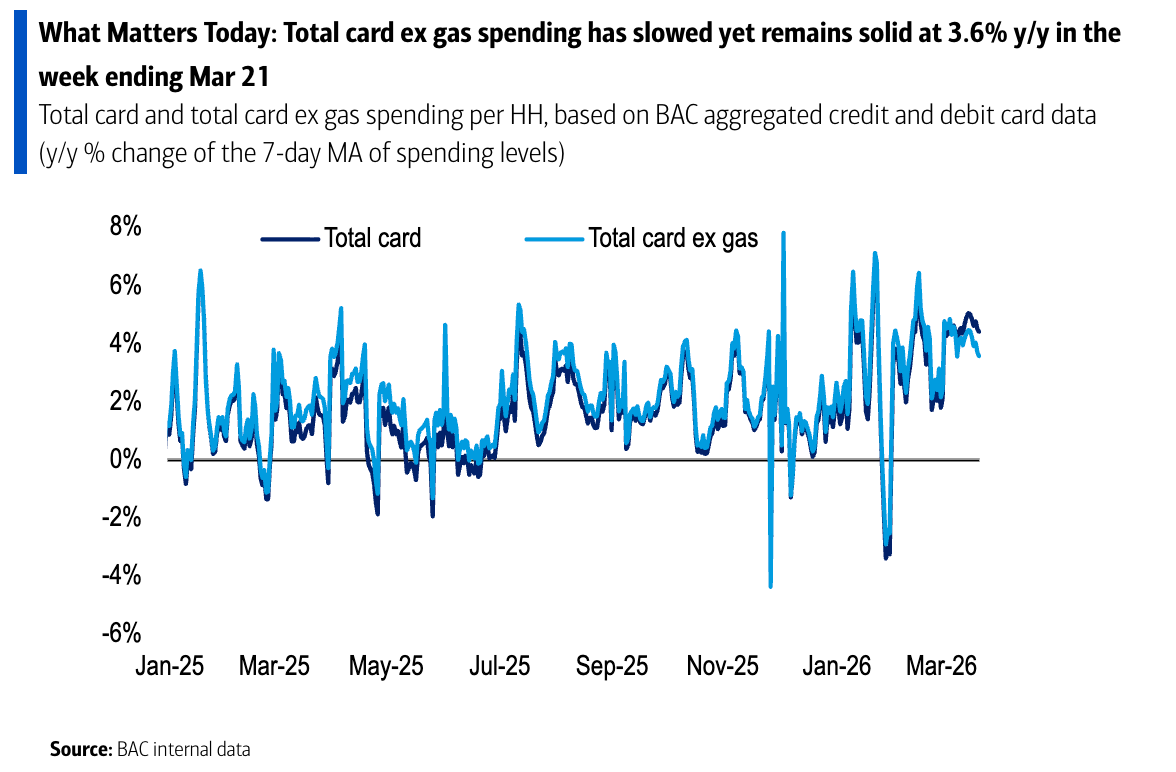
Consumer spending data has looked a lot better than consumer sentiment readings. For more on this contradiction, read: We’re taking that vacation whether we like it or not 🛫 and Household finances are both ‘worse’ and ‘good’ 🌦️
🏠 Mortgage rates rise. According to Freddie Mac, the average 30-year fixed-rate mortgage rose to 6.38%, up from 6.22% last week: “The housing market continues to show gradual improvements compared to a year ago amid recent rate volatility. Purchase and refinance applications are up year-over-year, and rates remain lower than last year when they averaged 6.65%.”
As of Q4, there were 148.7 million housing units in the U.S., of which 87.8 million were owner-occupied and about 40% were mortgage-free. Of those carrying mortgage debt, almost all have fixed-rate mortgages, and most of those mortgages have rates that were locked in before rates surged from 2021 lows. All of this is to say: Most homeowners are not particularly sensitive to the small weekly movements in home prices or mortgage rates.
For more on mortgages and home prices, read: Why home prices and rents are creating all sorts of confusion about inflation 😖
💪 Labor productivity increases. From the BLS: “Nonfarm business sector labor productivity increased 1.8% in the fourth quarter of 2025 … as output increased 1.5% and hours worked decreased 0.2%. … From fourth-quarter 2024 to fourth-quarter 2025, nonfarm business sector labor productivity increased 2.5%. Annual average productivity increased 2.1% from 2024 to 2025.”
For more, read: Promising signs for productivity ⚙️ and The crummy labor market is yielding a ‘tenure dividend’ for corporations 💰
🔨 Construction spending ticked lower. Construction spending declined 0.5% to an annual rate of $2.19 trillion in January.
While we’re on the subject of construction, the Big Tech hyperscalers have committed a fortune to building massive datacenters to support AI. For more on this, read: Struggling to make sense of Big Tech’s $600 billion bet on AI? Here’s a metric to watch 📋
👎 Activity surveys signal growth, but also deterioration. From S&P Global’s March U.S. Flash PMI: “The flash PMI survey data for March signal an unwelcome combination of slower growth and rising inflation following the outbreak of war in the Middle East. Companies are reporting a hit to demand from the additional uncertainty and cost of living impact generated by the conflict. Travel, transport and tourism related issues are compounded by financial market jitters and affordability constraints, notably including concern over the impact of higher interest rates, surging energy prices and supply chain delays. Companies are meanwhile building safety stocks amid concerns that the war may lead to more protracted supply issues and price rises while trimming headcounts to reduce overheads.”
Keep in mind that during times of perceived stress, soft survey data tends to be more exaggerated than actual hard data.
For more on this, read: What businesses do > what businesses say 🙊
📈 Near-term GDP growth estimates are tracking positively. The Atlanta Fed’s GDPNow model sees real GDP growth rising at a 2.0% rate in Q1.
For more on GDP and the economy, read: It’s too ambiguous to just say ‘the economy’ 🤦🏻♂️ and Economic data can often be both ‘worse’ and ‘good’ 🌦️
Earnings look bullish: The long-term outlook for the stock market remains favorable, bolstered by expectations for years of earnings growth. And earnings are the most important driver of stock prices.
Demand is positive: Demand for goods and services remains positive, supported by healthy consumer and business balance sheets. Personal spending activity remains at record levels. Core capex orders, which are a leading indicator of business spending, have been on the rise.
Growth is cooling: While the economy remains healthy, growth has normalized from much hotter levels earlier in the cycle. The economy is less “coiled” these days as major tailwinds like job openings and excess savings have faded. Job creation is hovering at near-zero. It has become harder to argue that growth is destiny.
Actions speak louder than words: We are in an odd period, given that the hard economic data decoupled from the soft sentiment-oriented data. Consumer and business sentiment has been relatively poor, even as tangible consumer and business activity continues to grow and trend at record levels. From an investor’s perspective, what matters is that the hard economic data continues to hold up.
Stocks are not the economy: There’s a case to be made that the U.S. stock market could outperform the U.S. economy in the near term, thanks largely to positive operating leverage. Since the pandemic, companies have aggressively adjusted their cost structures. This came with strategic layoffs and investment in new equipment, including hardware powered by AI. These moves are resulting in positive operating leverage, which means a modest amount of sales growth — in the cooling economy — is translating to robust earnings growth.
Mind the ever-present risks: Of course, we should not get complacent. There will always be risks to worry about, such as U.S. political uncertainty, geopolitical turmoil, energy price volatility, and cyber attacks. There are also the dreaded unknowns. Any of these risks can flare up and spark short-term volatility in the markets.
Investing is never a smooth ride: There’s also the harsh reality that economic recessions and bear markets are developments that all long-term investors should expect as they build wealth in the markets. Always keep your stock market seat belts fastened.
Think long-term: For now, there’s no reason to believe there’ll be a challenge that the economy and the markets won’t overcome. The long game remains undefeated, and it’s a streak that long-term investors can expect to continue.
For more on how the macro story is evolving, check out the previous review of the macro crosscurrents. »
Here’s a roundup of some of TKer’s most talked-about paid and free newsletters about the stock market. All of the headlines are hyperlinked to the archived pieces.
The stock market can be an intimidating place: It’s real money on the line, there’s an overwhelming amount of information, and people have lost fortunes in it very quickly. But it’s also a place where thoughtful investors have long accumulated a lot of wealth. The primary difference between those two outlooks is related to misconceptions about the stock market that can lead people to make poor investment decisions.
Passive investing is a concept usually associated with buying and holding a fund that tracks an index. And no passive investment strategy has attracted as much attention as buying an S&P 500 index fund. However, the S&P 500 — an index of 500 of the largest U.S. companies — is anything but a static set of 500 stocks.

For investors, anything you can ever learn about a company matters only if it also tells you something about earnings. That’s because long-term moves in a stock can ultimately be explained by the underlying company’s earnings, expectations for earnings, and uncertainty about those expectations for earnings. Over time, the relationship between stock prices and earnings has a very tight statistical relationship.
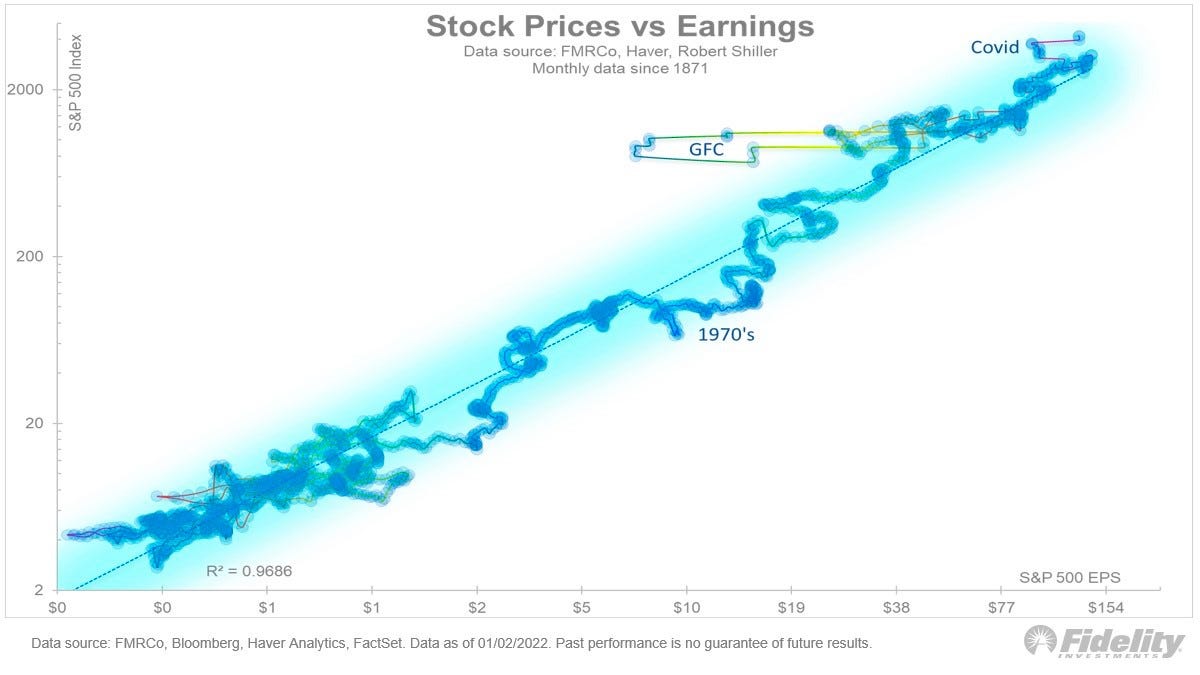
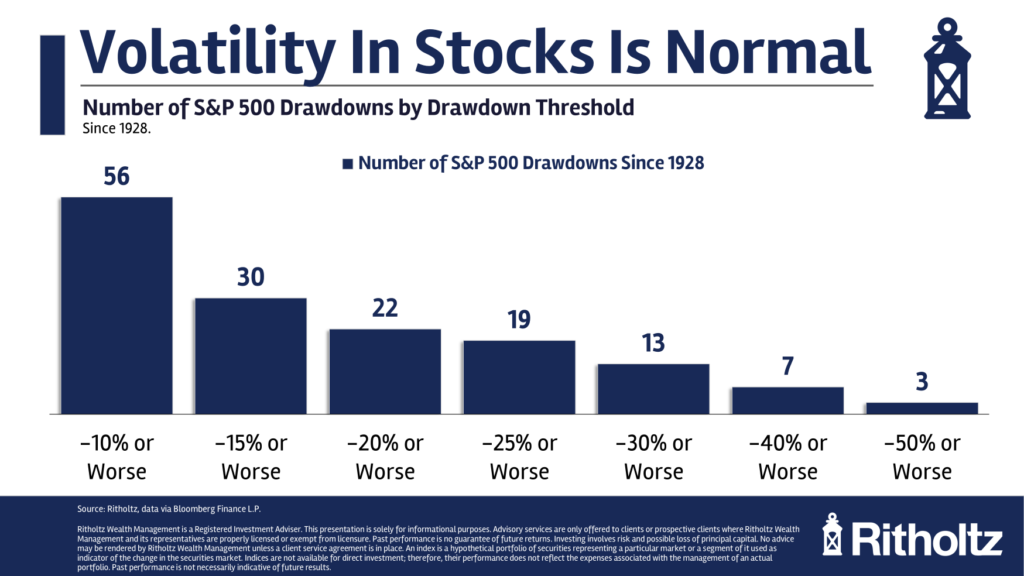
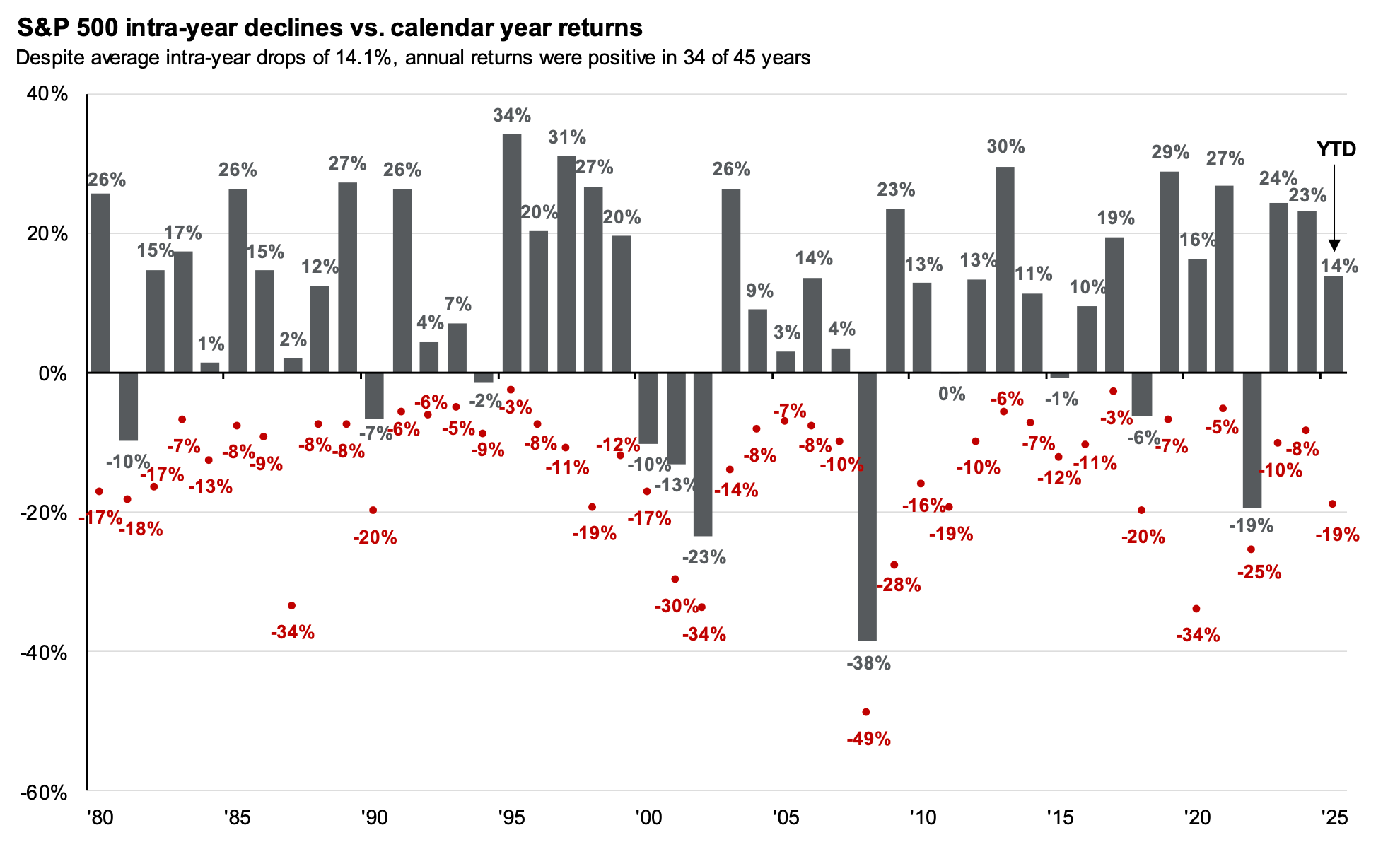
Investors should always be mentally prepared for some big sell-offs in the stock market. It’s part of the deal when you invest in an asset class that is sensitive to the constant flow of good and bad news. Since 1950, the S&P 500 has seen an average annual max drawdown (i.e., the biggest intra-year sell-off) of 14%.
Every recession in history was different. And the range of stock performance around them varied greatly. There are two things worth noting. First, recessions have always been accompanied by a significant drawdown in stock prices. Second, the stock market bottomed and inflected upward long before recessions ended.

Since 1928, the S&P 500 has generated a positive total return more than 89% of the time over all five-year periods. Those are pretty good odds. When you extend the timeframe to 20 years, you’ll see that there’s never been a period where the S&P 500 didn’t generate a positive return.
While a strong dollar may be great news for Americans vacationing abroad and U.S. businesses importing goods from overseas, it’s a headwind for multinational U.S.-based corporations doing business in non-U.S. markets.

…you don’t want to buy them when earnings are great, because what are they doing when their earnings are great? They go out and expand capacity. Three or four years later, there’s overcapacity and they’re losing money. What about when they’re losing money? Well, then they’ve stopped building capacity. So three or four years later, capacity will have shrunk and their profit margins will be way up. So, you always have to sort of imagine the world the way it’s going to be in 18 to 24 months as opposed to now. If you buy it now, you’re buying into every single fad every single moment. Whereas if you envision the future, you’re trying to imagine how that might be reflected differently in security prices.
Some event will come out of left field, and the market will go down, or the market will go up. Volatility will occur. Markets will continue to have these ups and downs. … Basic corporate profits have grown about 8% a year historically. So, corporate profits double about every nine years. The stock market ought to double about every nine years… The next 500 points, the next 600 points — I don’t know which way they’ll go… They’ll double again in eight or nine years after that. Because profits go up 8% a year, and stocks will follow. That’s all there is to it.
Long ago, Sir Isaac Newton gave us three laws of motion, which were the work of genius. But Sir Isaac’s talents didn’t extend to investing: He lost a bundle in the South Sea Bubble, explaining later, “I can calculate the movement of the stars, but not the madness of men.” If he had not been traumatized by this loss, Sir Isaac might well have gone on to discover the Fourth Law of Motion: For investors as a whole, returns decrease as motion increases.
According to S&P Dow Jones Indices (SPDJI), 79% of U.S. large-cap equity fund managers underperformed the S&P 500 in 2025. As you stretch the time horizon, the numbers get even more dismal. Over three years, 67% underperformed. Over 5 years, 89% underperformed. And over 20 years, 93% underperformed. This 2025 performance was the 16th consecutive year in which the majority of fund managers in this category have lagged the index.
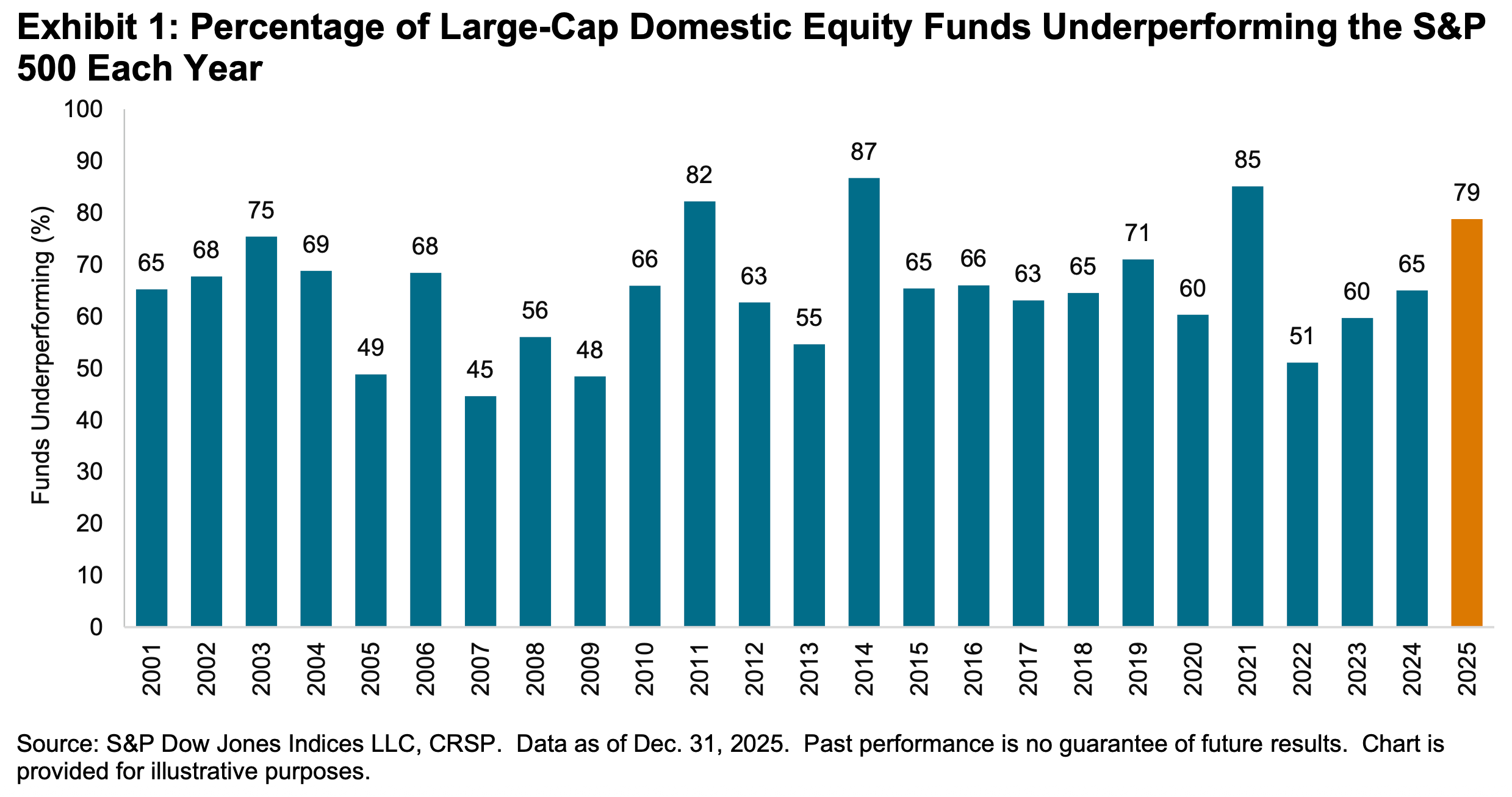
Even if you are a fund manager who generated industry-leading returns in one year, history says it’s an almost insurmountable task to stay on top consistently in subsequent years. According to S&P Dow Jones Indices, just 4.21% of all U.S. equity funds in the top half of performance during the first year were able to remain in the top during the four subsequent years. Only 2.42% of U.S. large-cap funds remained in the top half
SPDJI’s report also considered fund performance relative to their benchmarks over the past three years. Of 738 U.S. large-cap equity funds tracked by SPDJI, 50.68% beat the S&P 500 in 2022. Just 5.08% beat the S&P in the two years ending 2023. And only 2.14% of the funds beat the index over the three years ending in 2024.

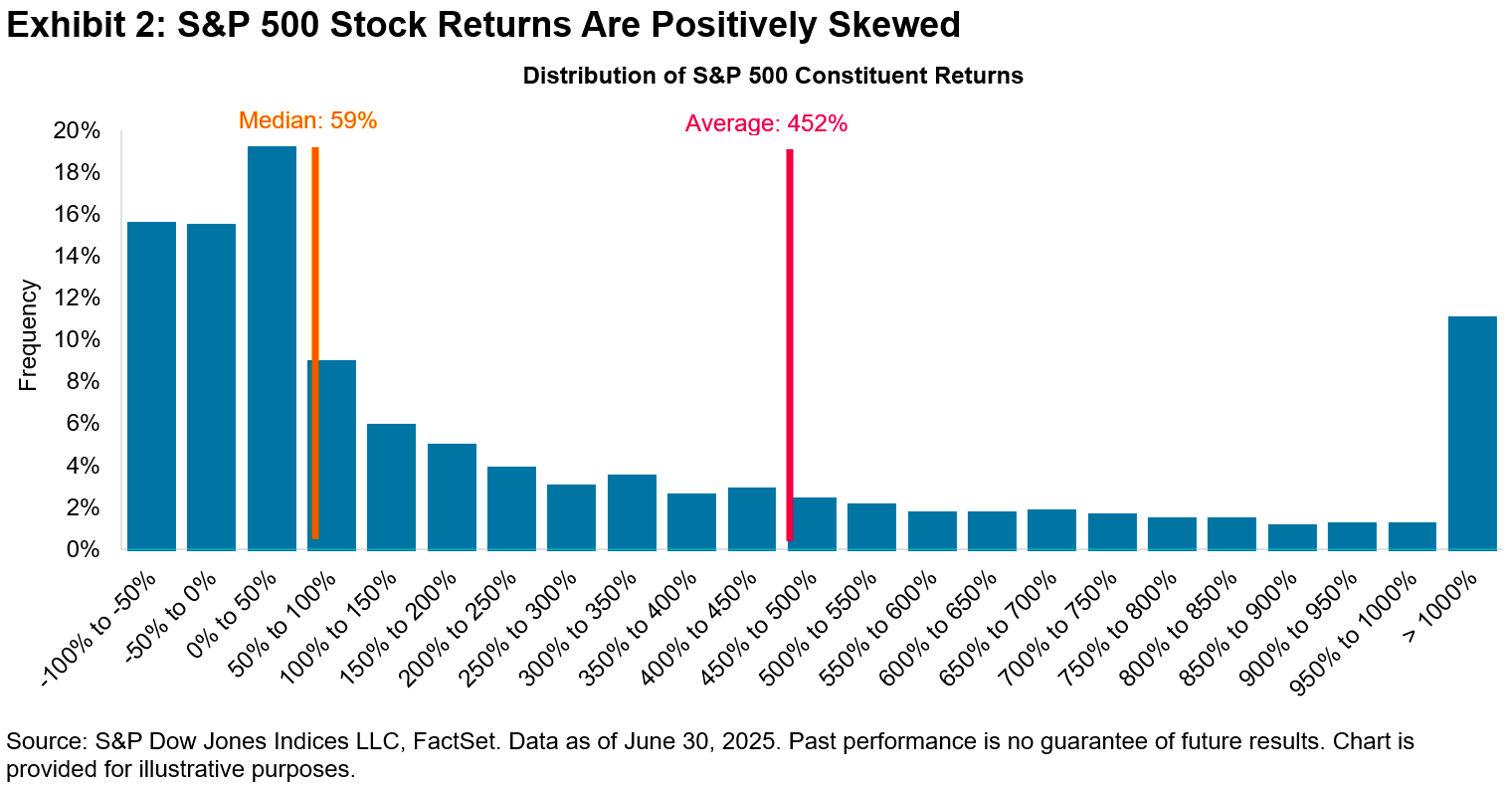
Picking stocks in an attempt to beat market averages is an incredibly challenging and sometimes money-losing effort. Most professional stock pickers aren’t able to do this consistently. One of the reasons for this is that most stocks don’t deliver above-average returns. According to S&P Dow Jones Indices, only 19% of the stocks in the S&P 500 outperformed the average stock’s return from 2001 to 2025. Over this period, the average return on an S&P 500 stock was 452%, while the median stock rose by just 59%.