“In the 20 years since you returned to China, you have transformed your love for the country into actions to serve it,” Xi wrote in a letter to Yao, who heads the Institute for Interdisciplinary Information Sciences and the newly established College of AI at Tsinghua.
With “unwavering dedication”, Yao had made remarkable achievements in both teaching and research innovation, Xi wrote on Tuesday, according to state news agency Xinhua.
01:50
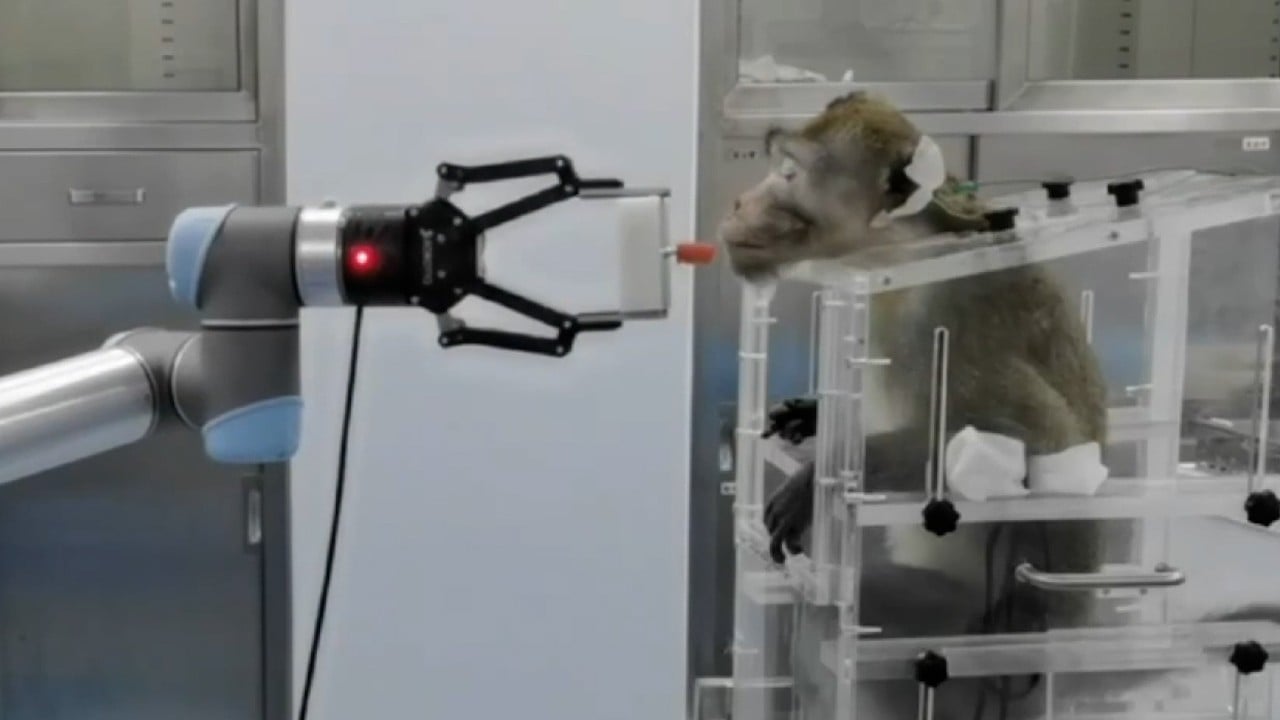
Chinese researchers claim brain-computer interface breakthrough using monkey brain signal
Chinese researchers claim brain-computer interface breakthrough using monkey brain signal
Xi also encouraged the professor, who is the only Chinese winner of the the prestigious AM Turing Award, to remain committed to his “original aspiration” and leverage his strengths to further explore mechanisms to train China’s innovative talents.
Yao, 77, had earlier written to Xi earlier to reflect on his two-decade tenure in Beijing, according to Xinhua. In the letter, Yao expressed determination to contribute to the “great rejuvenation of the Chinese nation”, Xinhua said.
Yao made fundamental contributions to the theory of algorithms and data structure in the 1970s when computer science was still in its nascence.
For instance, he introduced Yao’s min-max principle, which is now a basic technique for reasoning on randomised algorithms and complexity, with applications from property testing to learning theory.
He is also seen as a pioneer in cryptography. His paper with Israeli computer scientist Danny Dolev in 1981 was hailed as the starting point in the field of computer security.
However, computer science was not Yao’s first choice when he went to college. Born in Shanghai in 1946, he moved with his family to Taiwan as a child and attended National Taiwan University as a physics major.
After earning his PhD in physics at Harvard University by 1972, Yao switched courses to computer science, an emerging field where he saw “a lot of things could be done”, he said during an interview at the University of California, Berkeley, in 2018.
Obtaining his second PhD degree, this time in computer science from the University of Illinois in 1975, Yao worked at a number of top universities in the US, including Massachusetts Institute of Technology, Stanford University, UC Berkeley and Princeton University.
In 2000, Yao received the Turing Award – dubbed the Nobel prize of computer science – for his contributions to the theory of computation, including the complexity-based theory of pseudorandom number generation, cryptography and communication complexity, according to the award website.
Four years after that, he chose to leave the US and join Tsinghua University as a full-time professor at the Centre for Advanced Study and the Institute for Theoretical Computer Science.

02:20
Russia’s Vladimir Putin visits China’s ‘little Moscow’ Harbin as part of state visit
Russia’s Vladimir Putin visits China’s ‘little Moscow’ Harbin as part of state visit
Yao is also a member of the US National Academy of Sciences and a fellow of the American Academy of Arts and Sciences, among others.
He is the recipient of several international awards, including the George Pólya Prize in Applied Combinatorics in 1987. In 1996 he was the first recipient of the Donald Knuth Prize which recognises outstanding contribution to the foundations of computer science.