Wall Street’s preeminent valuation yardstick offers a worrisome tale for investors.
From an investment standpoint, Wall Street is a fan of Donald Trump in the White House. During President Trump’s first term in office, the mature stock-driven Dow Jones Industrial Average (^DJI +0.10%), benchmark S&P 500 (^GSPC +0.05%), and innovation-fueled Nasdaq Composite (^IXIC 0.22%) gained 57%, 70%, and 142%, respectively.
In the year and change since he was inaugurated for his second, non-consecutive term, an encore Trump bull market rally has taken shape. From Jan. 20, 2025, through the closing bell on Feb. 10, 2026, the Dow, S&P 500, and Nasdaq Composite have, respectively, rallied 15%, 16%, and 18%. Outsize returns have become something of the norm.
While several catalysts are behind this exceptionally strong bull market, some of which can be attributed to Donald Trump, there are also headwinds that can derail this rally. One insurmountable obstacle that has over 150 years of history in its sails is of particular concern.
President Trump delivering the State of the Union address. Image source: Official White House Photo.
Stocks have catapulted higher under Donald Trump
To get a bit of housekeeping out of the way, Wall Street’s major indexes climbing is nothing new. Since March 1897, there have been 33 presidential terms, 26 of which resulted in a positive return in either the Dow Jones Industrial Average or S&P 500. Most presidents oversee a growing U.S. economy and investment optimism, leading to stock market gains during their tenure — and Trump has been no exception.
However, the early annualized return for President Trump’s second term is among the best of any president dating back well over a century. As investors, it pays to understand what’s behind this outsize return.
Not all of the stock market’s upside catalysts have been influenced by the president. For instance, the rise of artificial intelligence (AI), which began during Joe Biden’s presidency, and the advent of quantum computing are playing key roles in lifting the broader market. Analysts at PwC believe AI can add $15.7 trillion to the global economy by 2030, while Boston Consulting Group estimates quantum computing will create up to $850 billion in global economic value by 2040. These technologies are clearly exciting investors.
Likewise, President Trump had no hand in the Federal Reserve lowering interest rates on six occasions since September 2024. Lowering lending rates can encourage corporate borrowing, in turn leading to an increase in hiring, acquisition activity, and capital devoted to innovation.
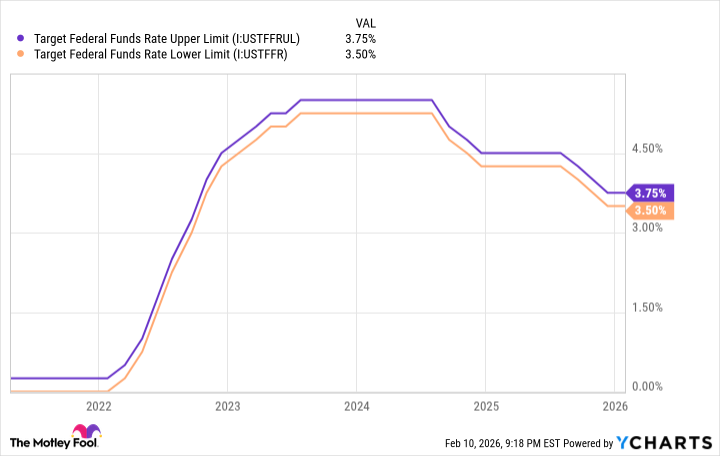
Target Federal Funds Rate Upper Limit data by YCharts.
But the president’s policies have undoubtedly played a role in facilitating upside for equities. For example, the flagship tax and spending law he signed in December 2017, the Tax Cuts and Jobs Act, permanently reduced the peak marginal corporate income tax rate from 35% to 21%. This marked the lowest peak tax rate for businesses since 1939.
Although the purpose of a lower corporate income tax rate is to encourage hiring and innovation, the excess income businesses have retained has led to a historic number of share repurchases. According to S&P Dow Jones Indices, a division of the more familiar S&P Global, S&P 500 companies were projected to top a record $1 trillion in cumulative buybacks in 2025. Share buybacks can increase earnings per share for public companies with steady or growing net income, thereby making them more attractive to value-focused investors.
While Trump’s tariff and trade policy has had its contentious moments for the U.S. economy and Wall Street since its unveiling in April 2025, it’s also brought significant investments into the U.S. from select businesses.
Though it would appear the Trump bull market is unstoppable, one historically accurate valuation tool offers a different story.

Image source: Getty Images.
155 years of history suggest the Trump bull market is in big-time trouble
Make no mistake about it: every bull market has headwinds to contend with. For instance, a historic level of division within the Federal Open Market Committee threatens to turn America’s foremost financial institution, the Federal Reserve, into a stock market liability.
But there’s, arguably, an even more telling historical headwind that can pull the rug right out from beneath the Trump bull market — and it has to do with stock valuations.
Without question, value is subjective. Since there’s no blueprint to valuing an individual stock or the broader market, what you find to be expensive might be viewed as a bargain by another investor. The subjective nature of evaluating equities is one of the factors that makes short-term directional moves in the Dow, S&P 500, and Nasdaq Composite so unpredictable.
However, one time-tested valuation tool has done an exceptional job of cutting through this subjectivity: the S&P 500’s Shiller Price-to-Earnings (P/E) Ratio. You’ll sometimes see the Shiller P/E referred to as the Cyclically Adjusted P/E Ratio, or CAPE Ratio.
Instead of factoring in trailing 12-month earnings, as the traditional P/E ratio does, the Shiller P/E is based on average inflation-adjusted earnings over the prior 10 years. Accounting for a decade’s worth of earnings history, rather than just 12 months, ensures that recessions and other shock events (e.g., the COVID-19 pandemic) can’t meaningfully skew the reading.
Although economists introduced the Shiller P/E in the late 1980s, it’s been back-tested to January 1871. Over the last 155 years, this valuation yardstick has averaged a modest multiple of 17.34.
S&P 500 Shiller PE Ratio hits 2nd highest level in history 🚨 The highest was the Dot Com Bubble 🤯 pic.twitter.com/Lx634H7xKa
— Barchart (@Barchart) December 28, 2025
Yet over the last three decades, it’s spent most of its time above this long-term average. The internet breaking down information barriers that had existed for more than a century between Wall Street and Main Street, coupled with lower interest rates, encouraged retail investors to seek out growth stocks and accept more risk, including higher earnings multiples.
But as of the closing bell on Feb. 10, the S&P 500’s CAPE Ratio clocked in at 40.36. This is the second-priciest stock market in history, trailing only the dot-com bubble, which peaked at a Shiller P/E of 44.19 in December 1999.
Since January 1871, the Shiller P/E has exceeded 30 on just six occasions, including the present. Following the previous five occurrences, the Dow Jones Industrial Average, S&P 500, and/or Nasdaq Composite shed 20% to 89% of their value. While the 89% peak-to-trough decline the Dow experienced during the Great Depression is unlikely to repeat, history has made abundantly clear that extended valuations lead to eventual (keyword!) significant drawdowns in Wall Street’s major stock indexes.
While the CAPE Ratio isn’t a timing tool, it has a flawless track record of foreshadowing the end of bull markets on Wall Street. If history were to repeat, the Trump bull market could soon come to an unceremonious end.