For the last three years, growth investors have been chasing just about anything that merely touches semiconductors, data centers, or cloud computing. The reason, obviously, is due to the proliferation of generative artificial intelligence (AI) across all facets of the technology value chain.
But in 2025, a new pocket of the AI realm made its center-stage debut — and investors are overwhelmingly enthusiastic. Some of the top-performing AI stocks last year were quantum computing developers. In particular, pure plays such as Rigetti Computing and IonQ have burst onto the scene as speculative leaders of the quantum AI arena.
Nevertheless, another player outperformed its cohorts: Enter D-Wave Quantum (QBTS +0.38%), whose shares skyrocketed 211% in 2025, handily trouncing the S&P 500, Nasdaq Composite, and all of the “Magnificent Seven” stocks.
As D-Wave stock fires on all cylinders, smart investors are surely wondering if the company can keep rallying. Let’s take a look at what drove D-Wave’s meteoric rise last year and look at the company’s underlying valuation trends to assess where the stock could be headed in 2026.

Today’s Change
(0.38%) $0.11
Current Price
$28.83
Key Data Points
Market Cap
$10B
Day’s Range
$28.27 – $30.13
52wk Range
$4.45 – $46.75
Volume
41M
Avg Vol
40M
Gross Margin
82.82%
What does D-Wave Quantum do?
D-Wave designs quantum computers that use annealing technology — a method that leverages superconducting qubits. In simple terms, quantum annealing systems allow qubits to naturally converge into their lowest-energy state.
This approach is useful in optimization-based tasks that require analyzing multiple outcomes to the same application. Today, D-Wave’s systems are currently tested in settings such as supply chain management, scheduling, manufacturing and logistics, and portfolio optimization.

Image source: Getty Images.
Can D-Wave Quantum shares keep going parabolic?
Last year the S&P 500 gained roughly 16%, marking the third consecutive year the index generated a double-digit gain. According to an analysis published by Fisher Investments, the sectors that outperformed the broader stock market last year include communications services, financials, materials, industrials, utilities, and of course, technology.
One of the things that makes investing in D-Wave interesting is that quantum computing’s applications are believed to be so broad, the company theoretically has an ability to benefit from rising investment in each of the major industries above. Hence, speculative investors are pouring capital into D-Wave before its next potential breakout.
While these prospects make following D-Wave’s momentum tempting, is it really a smart idea?
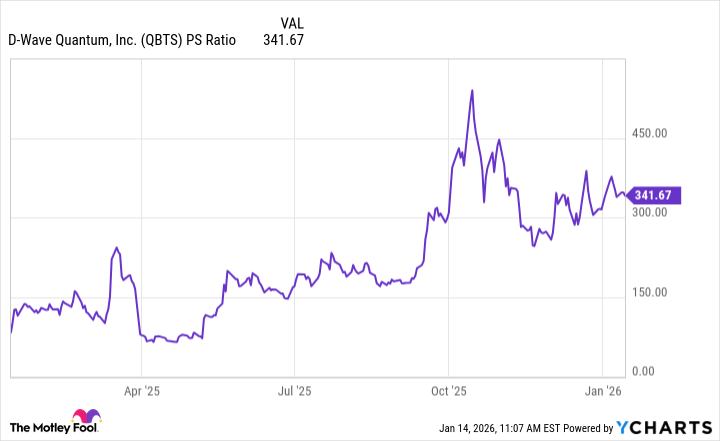
With a share price of $28, D-Wave stock might look dirt cheap. But smart investors understand there is more to a company’s valuation profile than its underlying stock price.
QBTS PS Ratio data by YCharts
Over the last year, the run-up in D-Wave stock has fueled pronounced levels of valuation expansion. As of this writing (Jan. 14), D-Wave boasts a price-to-sales (P/S) ratio of 342. Let’s take a look at how that stacks up to other megatrends previously seen in the stock market.
History doesn’t repeat, but it often rhymes
The AI revolution has drawn a lot of comparisons to the dot-com bubble from the late 1990s and early 2000s. During the early days of the internet, investors were paying absurd premiums for companies that had very little — and in some cases virtually zero — sales or profits.
In other words, investors bought more into a narrative around how the internet would change the world rather than understanding which companies were truly positioned to benefit from an online ecosystem.
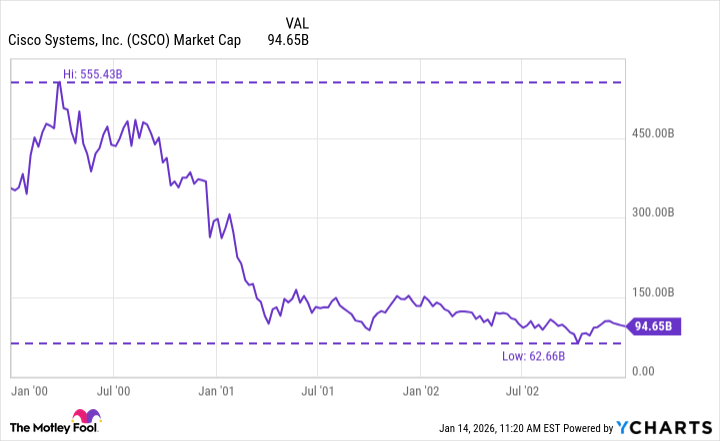
One of the most notable casualties of the dot-com era was Cisco Systems. Cisco was the ultimate pick-and-shovel player of the internet revolution. Each time a new website was created or a data center was constructed, Cisco’s routers and networking gear were in demand.
As we now know, many companies that were hoping to capitalize on the rise of the internet were forced to rein in their capital expenditures (capex) as their business ideas failed to gain traction. This reduction in infrastructure was a direct headwind for companies like Cisco — which saw its market cap fall by as much as 89% in the aftermath of the dot-com bubble.
CSCO Market Cap data by YCharts
Given D-Wave has nowhere near the influence that Cisco once had, I’m predicting the company could follow an even harsher reversal. By the end of this year, I think investors will have woken up to the fact that quantum computing remains primarily an exploratory technology for now — lacking critical commercial scale or enterprise adoption.
By December 2026, I think D-Wave Quantum will have turned into a falling knife and could be trading at penny stock levels.