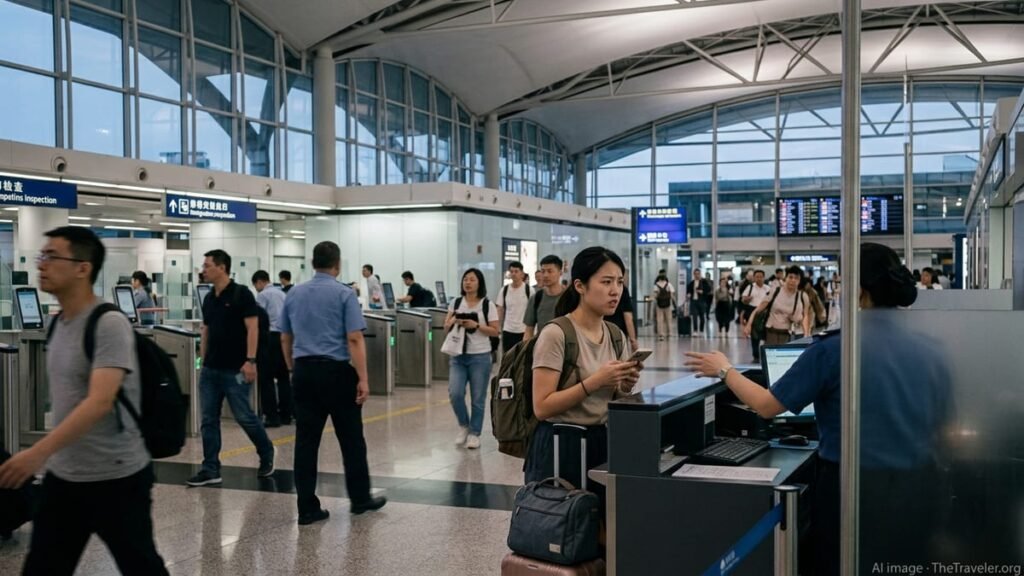
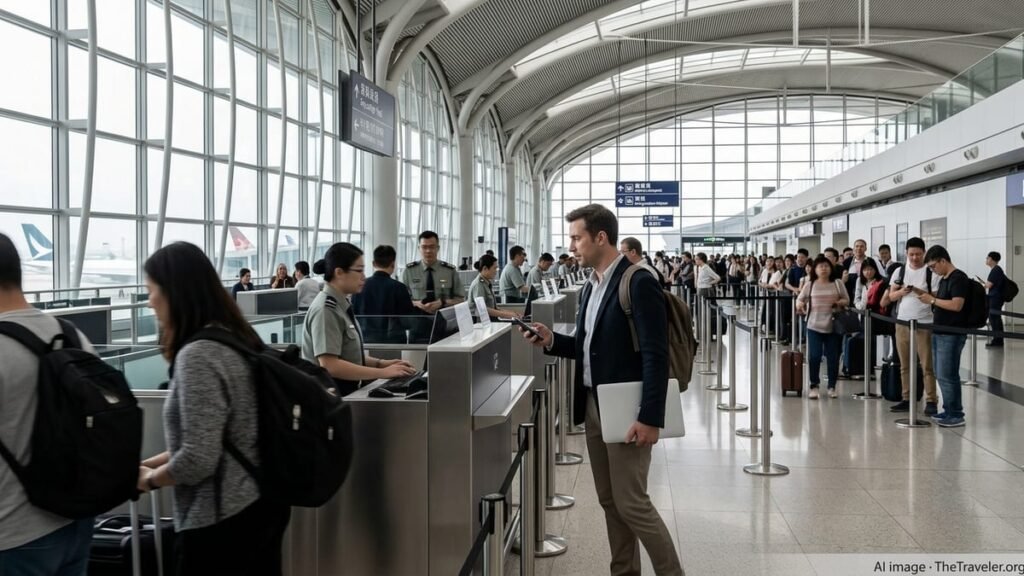
U.S. travelers heading to Hong Kong are being urged to rethink how they carry and protect their digital data, as new rules in the territory make it a criminal offense to refuse to unlock phones or provide passwords when requested by police or national security officers.
Get the latest news straight to your inbox!

Image by simpleflying.com
New Security Rules Expand Powers Over Travelers’ Devices
Recent reports on changes to Hong Kong’s national security framework indicate that law enforcement officers can now compel individuals to unlock mobile phones, laptops, and other digital devices, and to provide passwords or decryption assistance. Refusal can reportedly be prosecuted as a criminal offense, with potential fines and jail terms discussed in local coverage and international technology reporting.
The new powers are described as applying broadly to anyone within Hong Kong’s jurisdiction, including residents, short term visitors, business travelers, and passengers merely transiting through the city’s busy international airport. Coverage of the legal update notes that authorities may demand access during investigations tied to national security concerns, with “assistance with decryption” framed as a legal obligation rather than a voluntary cooperation request.
Technology and civil liberties commentators point out that the rules go beyond traditional customs searches of physical baggage. Devices are gateways to extensive personal information, private communications and cloud accounts, and the legal change is being interpreted as a significant expansion of the data that can be scrutinized during encounters with police and national security officers on Hong Kong soil.
Analysis published in specialist technology outlets suggests that the wording of the rules gives authorities considerable discretion over when to demand access and how to interpret non cooperation. Travelers who decline to share passwords, decline to unlock phones, or provide what is later characterized as incomplete assistance may face criminal allegations tied to obstruction or national security.
U.S. Travel Advisory Highlights Heightened Legal Risks
The U.S. Department of State already maintains a Level 2 travel advisory for Hong Kong, urging travelers to exercise increased caution due to the territory’s national security legislation and what the advisory describes as a substantial narrowing of civil liberties. The latest public guidance and media summaries add a digital dimension to these concerns, underscoring that electronic devices can now be central to national security related enforcement.
According to publicly available U.S. government information, travelers are advised to be aware that local laws may differ sharply from protections they are accustomed to at home. In the Hong Kong context, commentary on the advisory notes that speech and online activity viewed as politically sensitive, as well as materials stored on phones or laptops, may be interpreted through the lens of national security. The new rules on passwords and decryption deepen that exposure.
Reports summarizing U.S. guidance to citizens emphasize that individuals must comply with the laws and legal procedures of the places they visit, even when those rules conflict with expectations shaped by U.S. constitutional standards. Travelers who refuse to unlock a phone in Hong Kong, for instance, cannot rely on U.S. legal principles on self incrimination to shield them from local criminal liability.
While the core State Department advisory level for Hong Kong has not shifted in direct response to the device access change, commentary across major media and travel risk consultancies suggests that the digital privacy dimension is likely to become a standing consideration in risk assessments for corporate and leisure travel alike.
Corporate Travelers Turn to Burner Phones and Data Minimization
Business travel to Hong Kong has long been significant, particularly in finance, logistics, and professional services. Even before the most recent national security updates, some multinational firms had begun advising staff to limit the data they carry into sensitive jurisdictions, and in some cases to use so called burner phones or stripped down laptops for trips. Earlier media coverage chronicled internal policies at global consultancies that discouraged executives from bringing regular work devices to Hong Kong.
With refusal to unlock a device now treated as a potential offense, corporate travel risk teams are revisiting those strategies. Security analyses recommend that travelers assume their devices could be inspected and that they might have little legal room to decline. Instead of counting on refusal, many companies are focusing on reducing the amount and sensitivity of data that could be exposed if a device is searched.
Digital security experts cited in public reporting advise measures such as traveling with dedicated devices that hold only what is necessary for the trip, avoiding storage of sensitive client documents or confidential negotiations locally, and limiting access to corporate networks where possible. Some guidance also points to using strong disk encryption and robust account security, recognizing that while travelers may be required to unlock devices, minimizing what is actually present on those devices can still reduce risk.
Consultancies and law firms with a presence in both Hong Kong and other major financial centers are also reexamining internal policies that govern cross border data flows. Analysts suggest that additional controls on what can be carried physically into Hong Kong may become part of standard compliance procedures, particularly for staff handling regulated or trade sensitive information.
What Individual Tourists Should Know Before Visiting Hong Kong
For leisure travelers, the prospect of facing criminal consequences over a locked smartphone may feel remote, but travel security commentators argue that preparation is now essential. Publicly available advice encourages tourists to assume that any device they bring could be inspected and to plan accordingly by limiting what is stored locally.
Privacy focused guidance suggests simple steps such as removing apps that contain particularly sensitive personal data, signing out of accounts that are not required while traveling, and backing up photos or documents before departure so that they do not need to reside on the device during the trip. Travelers are also encouraged to be mindful of content that might be interpreted as politically sensitive in the context of Hong Kong’s national security framework, whether in messages, images, or saved documents.
Some commentators recommend considering a separate travel phone for trips to destinations with broad device search powers, including Hong Kong. Such devices can be configured with only basic communication tools and minimal personal information. While this does not eliminate the possibility of a search, it can significantly reduce the volume of data exposed if a password is demanded under the new rules.
Observers also note that travelers should be prepared for delays if their devices are pulled aside for closer inspection. Flight connections and same day transit schedules through Hong Kong International Airport may be affected if a secondary screening or device review takes longer than expected, a factor that airlines, tour operators, and passengers are beginning to factor into their planning.
Global Trend of Expanding Border and Security Searches
The evolution of Hong Kong’s national security regime is part of a wider global trend in which border officials and security agencies seek greater access to travelers’ digital devices. Public reporting on policies in the United Kingdom, Australia, mainland China, and the United States describes varying circumstances under which border or security officers may request that devices be unlocked or handed over for inspection.
Comparative legal analyses indicate that in some jurisdictions, refusal can lead primarily to practical consequences, such as seizure of devices or denial of entry for non citizens, whereas in Hong Kong it is now characterized as a criminal offense in its own right. This distinction is seen by legal commentators as a key factor that raises the stakes for travelers transiting the territory.
Travel risk specialists point out that the accumulating patchwork of national approaches makes international itineraries more complex to manage. A traveler flying from North America to Southeast Asia via multiple hubs may encounter different legal expectations about device access in each jurisdiction, and advice that is valid at one border may be misleading at another. This has strengthened calls in the travel security industry for clearer, country specific briefings on digital privacy before departure.
For now, publicly available guidance stresses that anyone planning a trip that includes Hong Kong should inform themselves about the territory’s national security environment, consider how much personal and professional data they need to carry, and weigh whether alternative routings or travel configurations might better align with their risk tolerance.