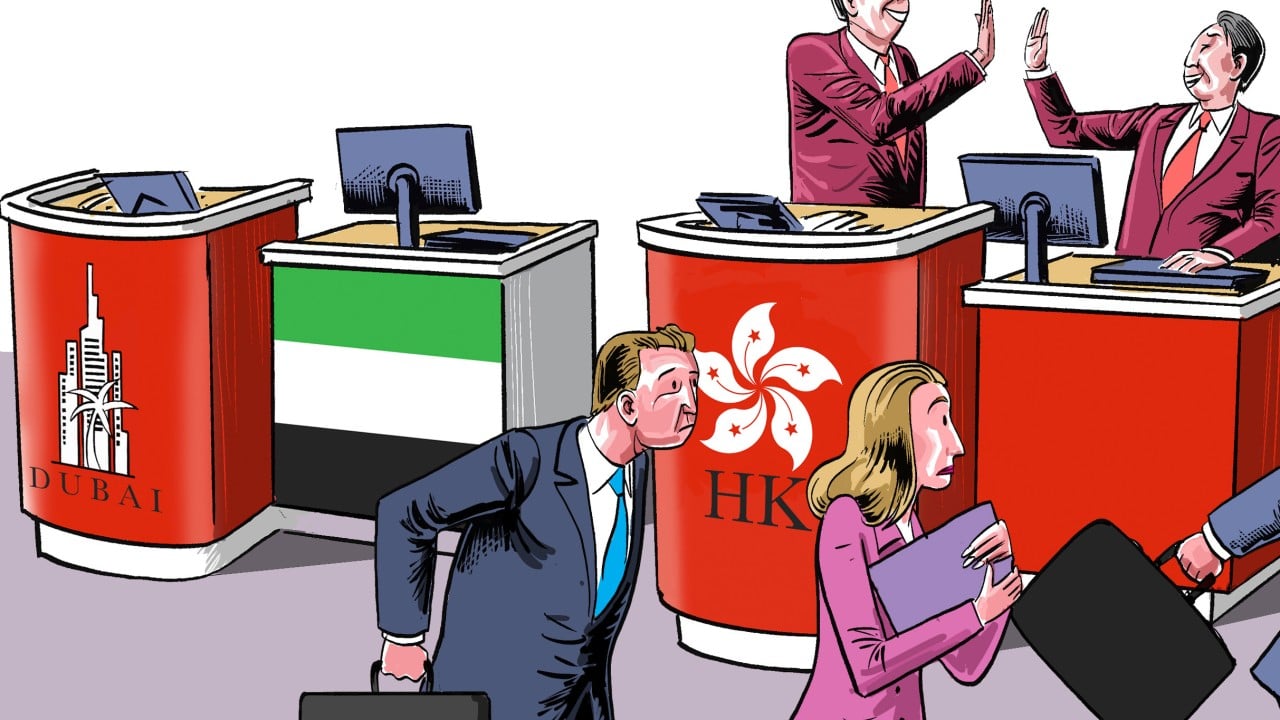
When InvestHK’s director general Alpha Lau Hai-suen recently said that companies using Dubai as a hub had mostly shifted to Hong Kong after the outbreak of the Iran war, the instinct to leverage the city’s position as a safe haven for investment was understandable.
Hong Kong should absolutely try to capture capital and talent unsettled by instability in the Gulf. However, it should resist the temptation to confuse a geopolitical opening with a strategic victory. Opportunity does not become a durable financial gain because an official says the right thing at the right time; it becomes durable only when a jurisdiction is operationally ready to absorb it.
The scale of the opportunity is real. Estimates by Boston Consulting Group put foreign assets registered in the United Arab Emirates at about US$700 billion in 2024, while roughly a quarter of over 2,270 firms established there belonged to Asian owners. That is a meaningful pool of capital and corporate activity, but money does not relocate because of headlines. It moves when family office principals, private bankers and wealth managers decide, one account and one structure at a time, that another jurisdiction is easier, safer and more useful.
Some early signals are encouraging. Asian investors who once chose the Middle East for tax reasons are reconsidering whether the trade-off still makes sense. Major banks have also highlighted Hong Kong as a possible beneficiary if instability in the Middle East persists, with Citigroup arguing that capital and talent outflows from the region could support demand for Hong Kong homes and offices.
All of that matters, but bullish notes and anecdotal flows are not the same as durable reallocation. Three uncomfortable truths should temper the optimism.
First, the compliance challenge is real. Hong Kong’s pitch partly rests on being more accessible than Singapore. That might help at the margin, but accessibility is not the same as readiness. Many of the structures now seeking alternatives to Dubai are likely to be complex in ownership, tax treatment and source-of-wealth documentation. Hong Kong has tightened its anti-money-laundering regime in recent years, and rightly so.
Visited 1 times, 1 visit(s) today