Opinion | 3 low-hanging fruit for US-China cooperation on AI
Given the escalation of technological competition across the Pacific, it is tempting to see AI as an area where excessive caution and hype over security and politico-ideological control render it impossible for the two administrations to see eye to eye.
Yet this view ignores the vast areas in which Beijing and Washington can still work together through government-to-government and people-to-people engagement.
Even while comprehensive agreements on the regulation of dual-use AI remain elusive – given domestic political intransigence, high strategic stakes and the US’ ratcheting up of pressure to contain China’s technological rise – both administrations can pragmatically cultivate a modus vivendi.
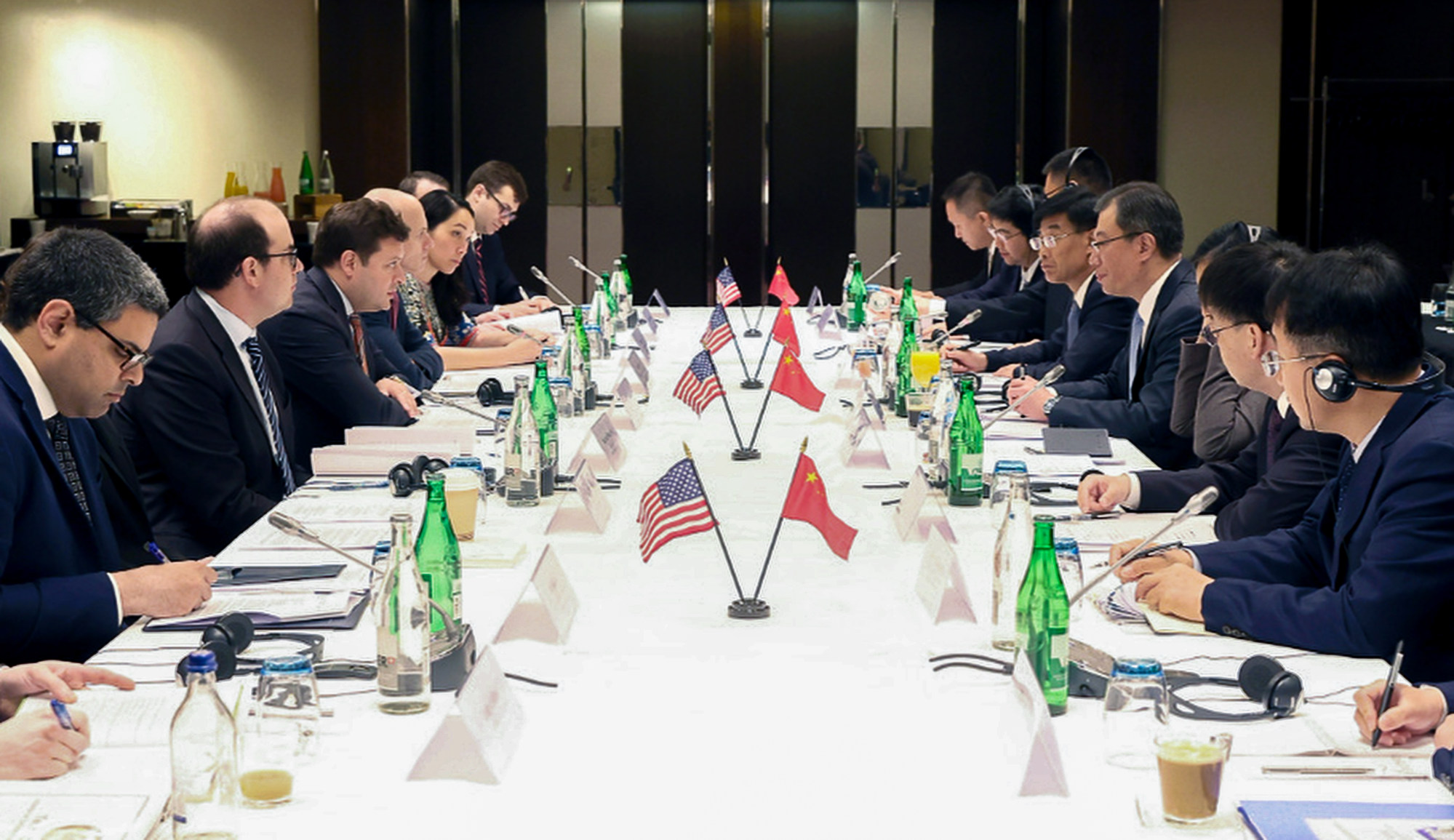
China and the US exchanged views “deeply, professionally and constructively” in their first intergovernmental talks on AI risks and governance in Geneva on May 14, according to a Chinese foreign ministry readout. Photo: Weibo
In San Francisco last November, Chinese President Xi Jinping and US President Joe Biden affirmed the importance of coordinating over the challenges AI poses to humanity. The next step should be to address three low-hanging fruit when it comes to cooperation.
The first area concerns the potential detrimental effect of AI-induced automation on societies. The displacement of routine service labour and acceleration of substitution through AI-powered robotics could result in mass unemployment and widen socioeconomic inequality.
Experts argue that addressing AI-induced malaise – ranging from misinformation via deepfakes and algorithmic targeting to disruption of relationships and attitudes of trust and compassion – requires joint efforts from some of the world’s largest tech regulators, in China, the United States and the European Union.
While China’s extensive regulations on AI use in content generation and social media could prove to be unduly stifling for private developers, and granted that the US has a vastly different political economy, Washington may still benefit from taking a leaf out of China’s book on delineating harmful and impermissible corporate uses of user data. Aligning on transnational privacy and data regulation is of critical importance.
Secondly, it would take explicit instructions from the top to establish guard rails on the deployment of lethal AI-powered technologies in military settings. As the late US secretary of state Henry Kissinger noted, the gargantuan costs of an unbridled AI-powered war are far too daunting for responsible statesmen to ignore.
02:11
Autonomous ‘wingman’ drone technology being developed for tomorrow’s ‘Top Gun’ fighter pilots
Autonomous ‘wingman’ drone technology being developed for tomorrow’s ‘Top Gun’ fighter pilots
More substantively, both sides must commit to withholding decision-making powers from AI in the use of large-scale weaponry and in digital warfare against financial and physical infrastructure, as well as agree on heightened transparency and full disclosure of AI militarisation capacities.
Many of these steps had been adopted previously in nuclear non-proliferation and coordination between the Soviet Union and the US during the Cold War. We live in times when the focal bilateral relationship is much less fractious.
Indeed, China’s defence ministry has indicated its openness to jointly regulating military AI, and the recent US-China talks on the sidelines of the Shangri-La Dialogue in Singapore are a reassuring sign of thawing military-to-military relations.
Recently, the reported use of algorithms to identify human targets in the Gaza war has sparked considerable controversy. The use of AI in the Ukraine war has also raised concern.
In defining the ethical boundaries of war, legal and ethical experts should put their heads together to foster mutually binding regulatory standards, taking into full account the complexity of human experience and contextually specific expectations.
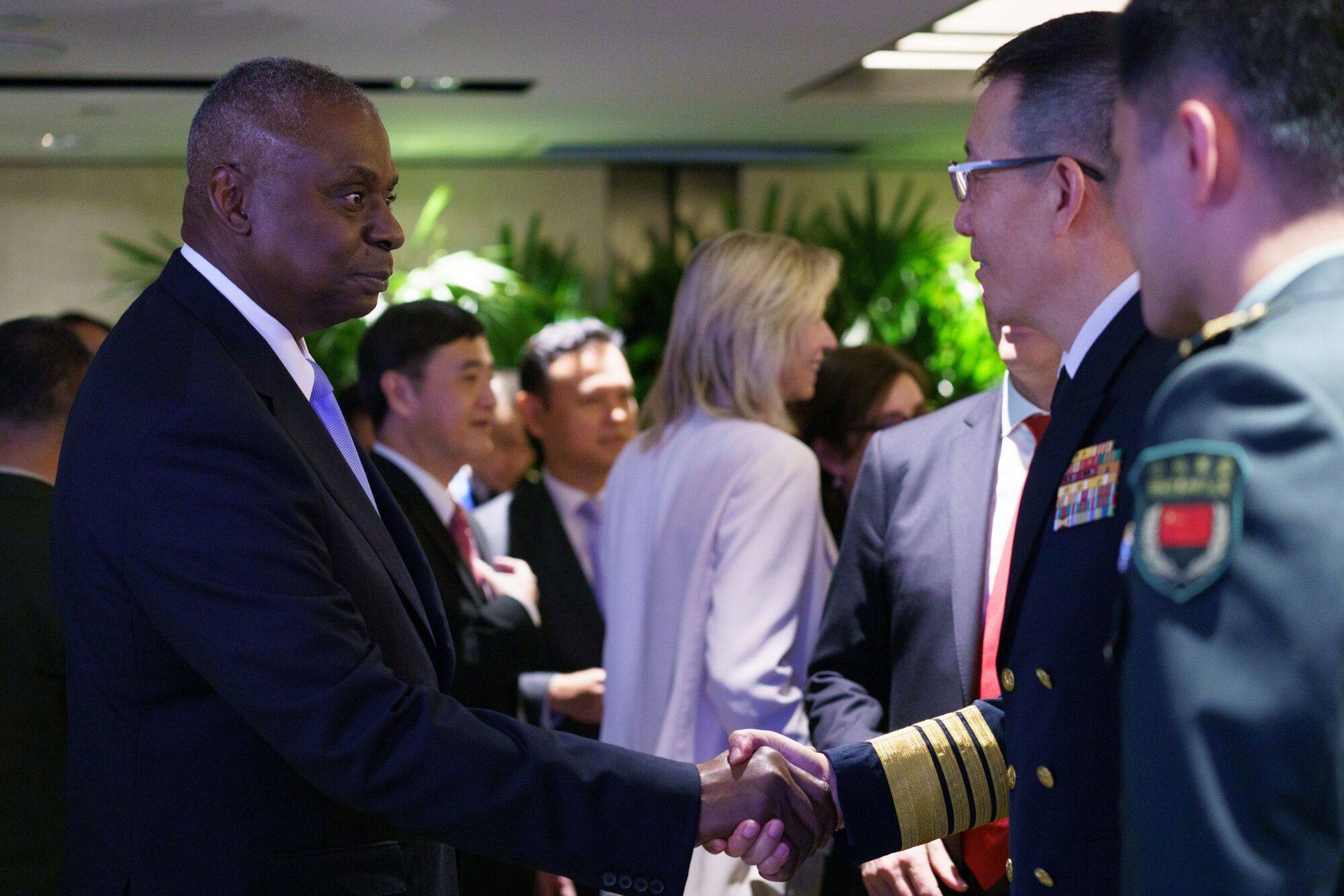
US Secretary of Defence Lloyd Austin shakes hands with China’s Defence Minister Dong Jun during a ministerial round-table discussion on the sidelines of the IISS Shangri-La Dialogue in Singapore on June 1. Photo: Bloomberg
Thirdly, the issue of non-alignment between humanity and AI knows no nationality or politics. As leading Chinese AI ethicist Yi Zeng noted in 2019, value alignment with humanity is a universal challenge for AI.
One classic example is philosopher Nick Bostrom’s 2003 thought experiment – suppose an AI agent has been tasked with producing as many paper clips as possible. In seeking to maximise the space, energy and resources for manufacturing, the powerful agent acts to stifle the growth of humanity, which it views as contrary to its production objective.
This may seem fanciful, yet is by no means unrealistic. With sufficiently powerful AI agents, seemingly clear objectives could produce unintended, perverse consequences – an issue both Chinese and American developers must confront as they race to produce the most competitive AI models.
03:08
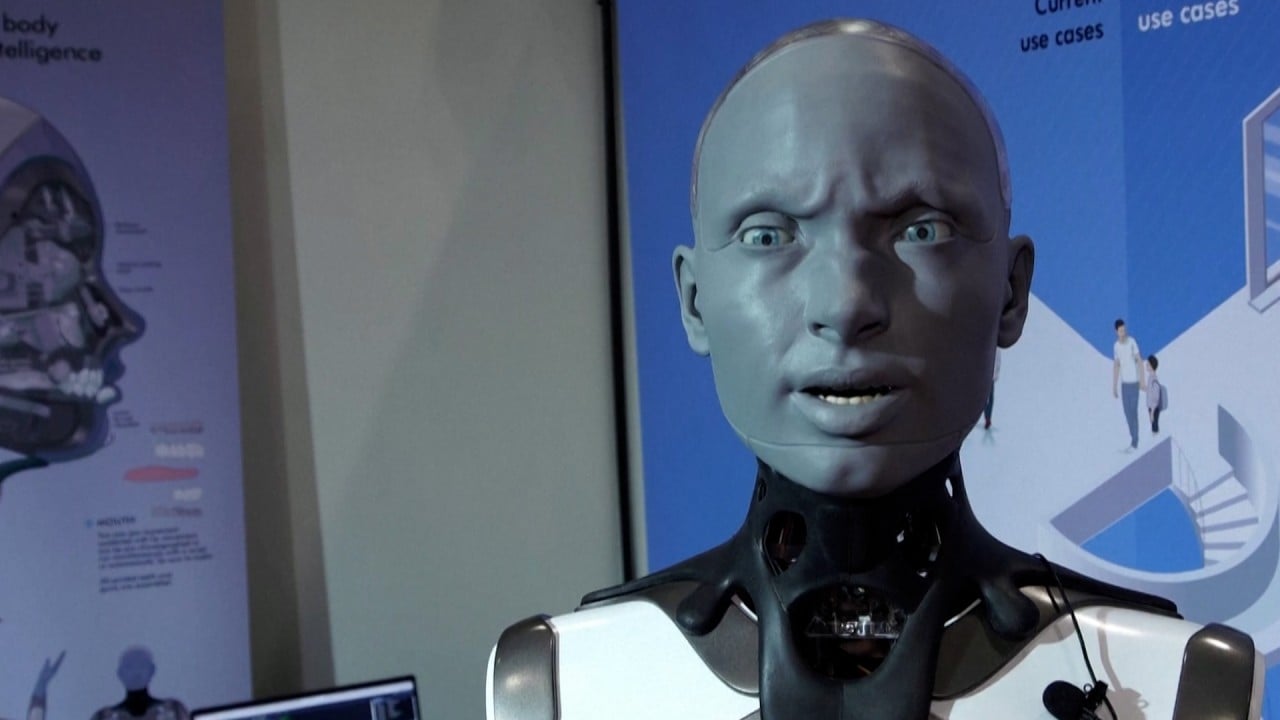
What if robots took over the world? One ‘imagines’ nightmare scenario
What if robots took over the world? One ‘imagines’ nightmare scenario
Additionally, specific training environments and positive reinforcement will spur certain emergent goals in AI, which – when transplanted to a non-test environment – could produce undesirable outcomes.
Both countries’ leaders share an overarching interest in ensuring their AI agents do not impinge on humanity’s interests, whether through intentional manipulation by unaccountable private actors, or faulty developmental processes by authorised researchers.
Thought leadership and research on this issue need not be zero-sum – both China and the US stand to gain from alignment in ethical tech governance.
Here Hong Kong can serve as a conduit for Track 1.5 and 2 dialogues on AI, which could feature a larger proportion of private-sector players than such dialogues in Beijing – especially from the US and the rest of the West.
All hands must be on deck to avoid the calamities that could result from increasingly intertwined developments in nascent technologies and geopolitics.
Brian Wong is an assistant professor in philosophy at the University of Hong Kong, and a Rhodes Scholar and adviser on strategy for the Oxford Global Society
BEIJING, CHINA – MAY 14: Nvidia CEO Jensen Huang (C) gestures as he prepares to depart following a welcome ceremony at the Great Hall of the People on May 14, 2026 in Beijing, China. President Trump is meeting with President Xi Jinping in Beijing to address the Iran conflict, trade imbalances, and the Taiwan situation
There’s still plenty to play for across Europe as we head into the final matches of the club season. Here are all the title races, Champions League fights, and relegation battles left to be decided in the top leagues this month. This story will be updated until the end of the campaign. 👉 Jump to:EPL
Manchester United have opened talks with Michael Carrick over continuing as head coach beyond the end of the season. It is understood that, even though there is still much to complete in legal and contractual issues, an agreement could be reached before United’s game against Nottingham Forest on Sunday. The club’s hierarchy, director of football
Today I finally ran an experiment I’ve wanted to try for a long time. If you’re a professional barista—or you run a busy café—this may save you some time. Most coffee shops use 1–1.5 gallon batch brewers (Bunn, Curtis, Fetco, etc.). When I opened Short Sleeves Coffee, I intentionally avoided brewing full 1-gallon batches. I
Key Points The broader stock market is heavily dependent on a handful of stocks. Today’s leading companies have faster growth rates and higher margins than former market leaders. S&P 500 index funds don’t offer as much diversification as they used to. 10 stocks we like better than Nvidia › Will AI create the world’s first
Chef-approved frozen breakfasts with more protein and better ingredients. Eating a healthy breakfast every morning is a great way to start the day, but most people don’t have time to cook. Whether you’re rushing out the door in the morning for work, taking the kids to school or both, there’s usually not much time in
By Carolyn Jones, CalMatters This story was originally published by CalMatters. Sign up for their newsletters. Until last month, California was poised to join nearly a dozen other states that ban cell phones in K-12 schools. But under pressure from school boards and administrators, lawmakers scaled back a bill that would have required such a
London, United Kingdom, May 15, 2026 (GLOBE NEWSWIRE) — BulkQuant has officially launched its AI trading bot platform designed for crypto, forex, and stock market traders seeking a simpler way to automate trading strategies across multiple financial markets. The platform combines AI-powered quantitative analysis, automated trade execution, portfolio monitoring, and adaptive risk management into a
The International Monetary Fund (IMF) has lauded the resilience of Hong Kong’s economy, noting a sustained recovery despite economic activity having yet to return to pre-Covid levels, while warning of downside risks stemming from escalating geopolitical tensions. It also urged Hong Kong to pursue medium-term financial reforms, including the introduction of a goods and services
For the past year, the Smithsonian Institution has found itself in the awkward position of telling the nation’s story while being supported in part by a government that wants to narrow how that story is told. In December, the White House threatened to revoke funding to the institution if it did not hand over a
A follow-up to Daredevil: Born Again Season 2 on Disney+ has become a massive streaming success within days of its launch. The Punisher: One Last Kill has quickly climbed to the top of multiple charts, beating out other titles on the platform. The MCU television special follows the gun-toting vigilante, who finds himself targeted by
The market has been on a roll lately, with the S&P 500 (SNPINDEX: ^GSPC) setting new highs throughout May. If you think you missed your opportunity when the market bottomed in late March, don’t fret. The market hitting new all-time highs is not particularly rare and should not change your investment strategy. And if you
The Hong Kong government’s first land sale in the current financial year has drawn six bids, according to the Development Bureau, including those from the city’s largest developers, suggesting a more confident outlook for the residential property market. At the close of tender for Tung Chung Town Lot No 54 at Area 106A on Friday
Ryan O’Hanlon Close Ryan O’Hanlon ESPN.com writer Ryan O’Hanlon is a staff writer for ESPN.com. He’s also the author of “Net Gains: Inside the Beautiful Game’s Analytics Revolution.” and Bill Connelly Close Bill Connelly ESPN Staff Writer Bill Connelly is a writer for ESPN. He covers college football, soccer and tennis. He has been at
Gabriel Gudmundsson could return for Leeds after a two-match absence with a thigh injury. Pascal Struijk is a doubt after hobbling off during Monday’s 1‑1 draw at Spurs. Full Leeds’ team news will be provided by the manager, Daniel Farke, in his press conference later on Friday. Kaoru Mitoma is set to miss the final
IE 11 is not supported. For an optimal experience visit our site on another browser. Trump Wraps China Summit With Xi Jinping: What Are the Results? 05:41 Xi gives Trump rare tour of secret garden at heart of Chinese government 01:04 Now Playing Trump departs China after two-day summit 01:01 UP NEXT Special Report: Trump
A Hong Kong property developer has been sued for HK$130 million (US$16.6 million) over allegedly breaching guarantor obligations in two bond subscription agreements, becoming the latest lawsuit to implicate the embattled company and following its founder’s sudden death earlier this week. Lofter Group, known for its urban renewal projects across the city’s core districts, and
This report is from this week’s The Tech Download newsletter. Like what you see? You can subscribe here. One look at the roster of U.S. execs that cozied up to U.S. President Donald Trump on the 20+ hours flight from Alaska to China on Wednesday and you get a sense of the American delegation’s key focus
Cerebras, an AI chipmaker, saw its shares nearly double on Nasdaq, closing up 70% with a $95B market cap. Cerebras’s powerful chips are key in the US-China AI tech race. Chris Buskirk, co-founder and chief investment officer of 1789 Capital, a key Cerebras investor, says the company’s IPO is geopolitically significant. On Thursday, shares of
The Google Fitbit Air is very much the talk of the fitness tracking town right now, not only because it’s the first new Fitbit device that we’ve had in years, but it’s also one of the first big brands to go head-to-head with the established Whoop Strap (if you don’t count the Polar Loop and