
(中央社訊息服務20260311 16:48:03)Students from National Yang Ming Chiao Tung University (NYCU) have captured first place at the Kibo Robot Programming Challenge (Kibo-RPC) global final, hosted by the Japan Aerospace Exploration Agency (JAXA), marking the third time Taiwan has won the international competition.
The final round took place on Feb. 28 at the Tsukuba Space Center in Japan, where the Taiwanese representative team “iTron,” composed of NYCU Department of Mechanical Engineering students Lin Ying-Pei, Wu Dian-Mou, Zheng Li-Qi, and Chen Chang-Jun, outperformed teams from 13 countries and organizations to claim the championship.
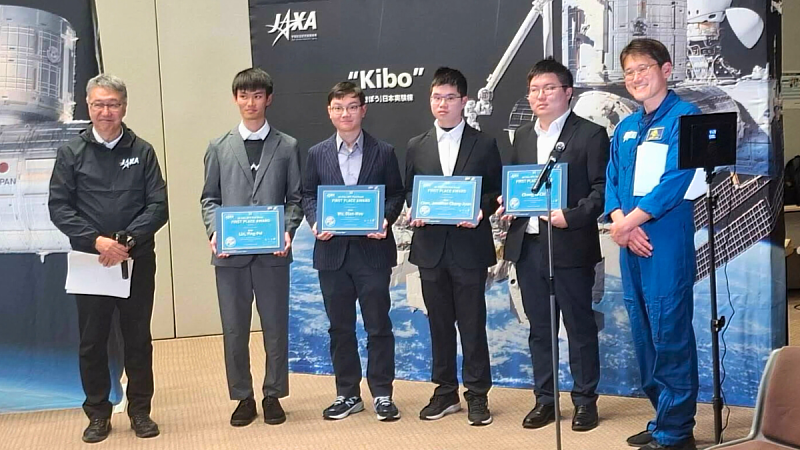
Organized by JAXA and open to members of the Asia-Pacific Regional Space Agency Forum (APRSAF), the Kibo-RPC is an international educational competition that engages students in real-world space robotics challenges. Participants develop programs for Astrobee, a free-flying robotic system aboard the International Space Station (ISS), helping astronauts complete tasks while sharpening their skills in science, technology, engineering, and mathematics (STEM).
The sixth Kibo-RPC competition began accepting registrations in early 2025 and attracted 738 teams worldwide.
Taiwan’s preliminary round was organized by the Taiwan Space Agency (TASA) and hosted by the Department of Mechanical Engineering at National Cheng Kung University, drawing 307 students across 77 teams. After winning the national round, the NYCU team advanced to the global final in Japan, competing against champion teams from Australia, Bangladesh, Indonesia, Japan, Malaysia, Nepal, the Philippines, Singapore, Thailand, the United States, Vietnam, and the United Nations Office for Outer Space Affairs.
According to TASA, this year’s competition featured significantly increased technical difficulty.
In the mission designed by JAXA, competitors were required to write Java programs enabling Astrobee to autonomously navigate confined spaces inside the ISS, identify objects, verify quantities, record locations, and report findings to astronauts. The robot also had to locate specific objects according to the astronaut’s instructions.
To complete the task, teams applied supervised machine learning techniques, transforming data and training models capable of achieving over 95% recognition accuracy, while balancing system stability, scalability, and operational efficiency.
In addition to the traditional Final Round rankings based on live mission execution, this year’s competition introduced a Simulation Competition Award, in which teams’ programs were tested ten times in a simulator with cumulative scoring.
The NYCU team iTron also secured first place in this category, becoming the competition’s double champion. Team captain Lin Ying-Pei said the key to success was to continuously refine the system’s visual recognition models and movement strategies while maintaining a balance between stability and scoring performance.
“During development, we encountered several technical challenges, including difficulties in object recognition under low-resolution and partially occluded conditions, as well as limitations in computing resources and long training times caused by large datasets,” Lin said. “One of our major breakthroughs was finding ways to significantly shorten the training cycle under constrained computing conditions.”
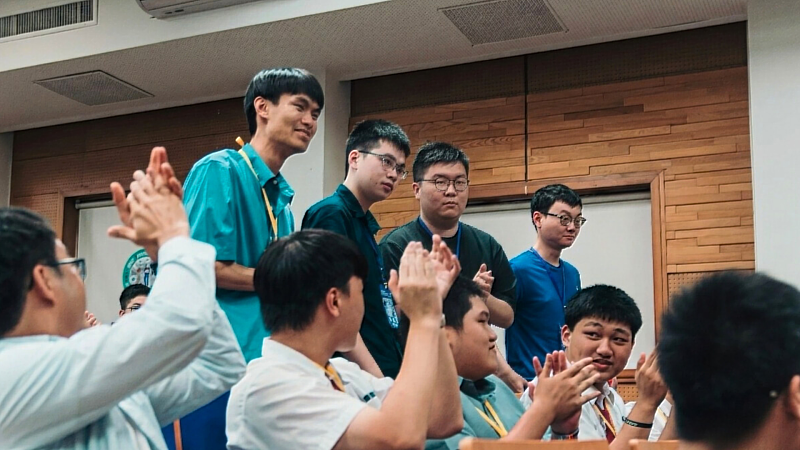
TASA noted that the iTron team demonstrated not only strong technical fundamentals but also creativity in problem-solving. In addition to optimizing their programming code, the students incorporated statistical approaches to refine algorithms and parameter settings, helping them achieve top performance.
Professor Chang I-Ling of National Cheng Kung University, which hosted Taiwan’s preliminary round, said the team’s achievement reflects years of investment in space education and hands-on programming training in Taiwan.
“The outstanding performance of Taiwan’s students highlights the innovative strength of our young generation and allows the world to see Taiwan’s growing capabilities in space technology and engineering,” Chang said.
