Greg Abel, the new CEO of Berkshire Hathaway, will release his first annual shareholder letter this Saturday after taking over from legendary investor Warren Buffett. The 63-year-old Abel faces the challenge of following Buffett’s famous communication style while addressing the company’s $381.7 billion cash pile and declining stock performance.
Greg Abel, the newly appointed chief executive of Berkshire Hathaway, confronts significant obstacles as he steps into the role previously held by legendary investor Warren Buffett.
This Saturday, investors will get their first glimpse of how Abel handles one of Berkshire’s most distinctive traditions: the much-awaited annual shareholder letter.
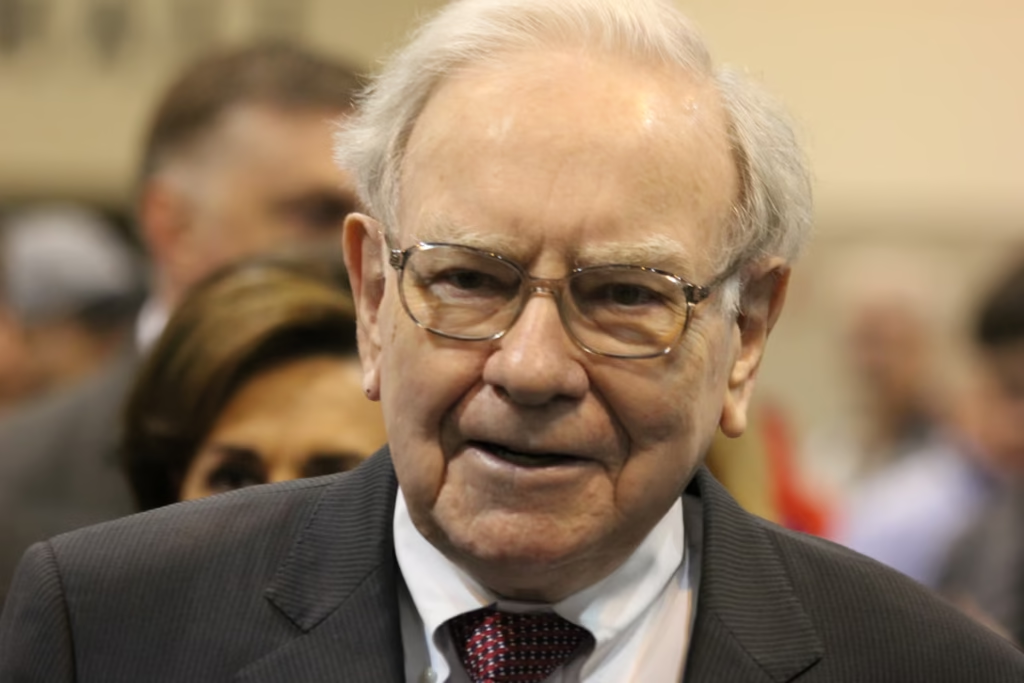
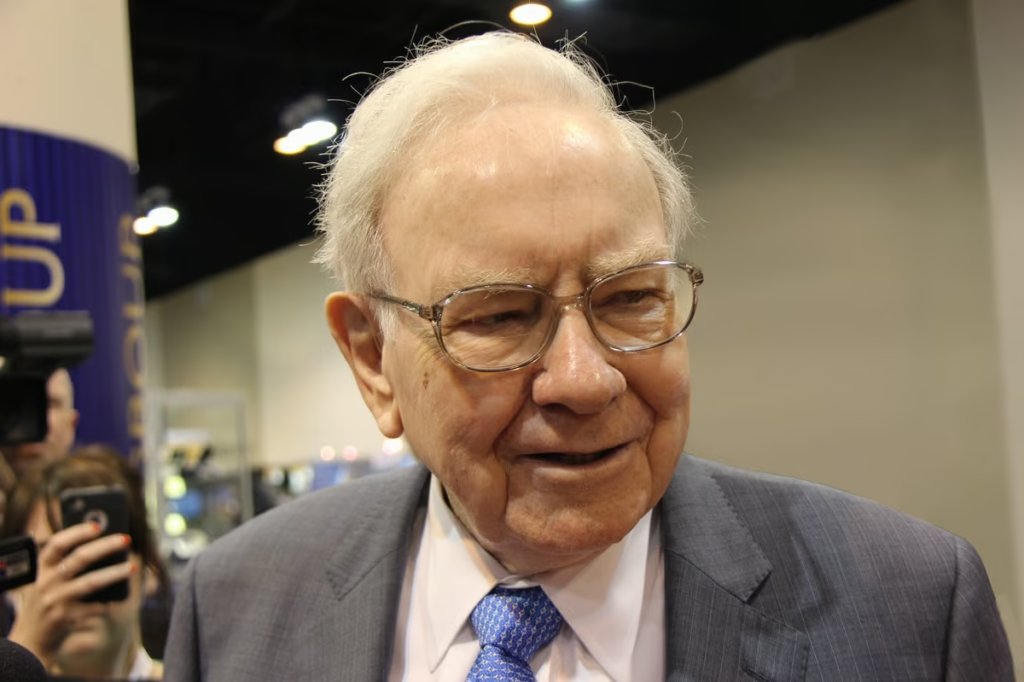
The 95-year-old Buffett retired at the end of last year, ending a remarkable 60-year tenure during which he turned a struggling textile manufacturer into a massive $1 trillion empire encompassing multiple insurance companies, the BNSF railway system, and numerous energy, manufacturing, and retail operations.
Though Buffett remains as chairman, he announced in November that he would be “going quiet” while Abel assumes leadership responsibilities.
Following in Buffett’s footsteps presents a formidable challenge, and the 63-year-old Abel will bring his own distinct approach to the role.
During previous appearances answering questions with Buffett at the company’s annual gatherings in Omaha, Nebraska, and in a 2022 correspondence about environmental issues that Buffett requested he draft, Abel has concentrated more on the operational details of Berkshire’s various enterprises when communicating with shareholders.
His upcoming letter may follow this pattern, potentially with less of the poetic flair that characterized Buffett’s highly anticipated yearly messages. This represents an opportunity to demonstrate Berkshire’s future direction and possibly address its substantial $381.7 billion cash reserves.
“Warren Buffett was the Mark Twain of shareholder letter writers,” commented Evan Pondel, founder of investor relations company Triunfo Partners and instructor at the University of Southern California’s Annenberg School for Communication and Journalism. “Abel hasn’t been an easy person to get to know at Berkshire. The annual letter is his opportunity to establish his voice, tone and strategy.”
Abel became part of Berkshire in 2000, spending his final eight years as vice chairman with oversight of numerous non-insurance operations.
Industry observers widely recognize his thorough knowledge of Berkshire’s operations and dedication to the company’s values.
“Management credibility has been a big part of Berkshire’s strategy,” explained Greg Miller, a professor at the University of Michigan’s Ross School of Business who specializes in financial communications. “Buffett’s name brought credibility to what the company does and the choices it makes. Abel needs to step in and continue that.”
Despite expectations that Berkshire’s operating profit for 2025 could match the previous year’s record of $47.44 billion, the company’s stock performance has disappointed investors.
Berkshire’s share price has fallen 8% since May 3rd of last year, when Buffett revealed his retirement plans, while the S&P 500 index has climbed 22% during the same period.
Financial experts have consistently viewed the cash accumulation as a burden on performance. The company has sold more stocks than it purchased for twelve consecutive quarters and hasn’t repurchased any shares for five straight quarters. Currently, Berkshire’s stock trades at roughly 1.5 times its book value.
Berkshire Hathaway did not provide immediate responses to requests for commentary.
No other corporate leader’s communications received the same level of scrutiny as Buffett’s, surpassing even JPMorgan Chase’s Jamie Dimon and BlackRock’s Larry Fink in terms of attention. Every letter Buffett has written since 1978 remains available on the company’s website.
Buffett frequently employed a down-to-earth writing style. During the 2008 financial crisis, he memorably described the market conditions that exposed poor financial practices in the housing sector: “You only learn who has been swimming naked when the tide goes out.”
Even if Abel focuses primarily on Berkshire’s operations, he may also share broader perspectives on market conditions and economic trends.
“Buffett’s letters were not just about what Berkshire did, but how Buffett saw the world. People will want to know how Greg Abel sees the world,” Miller noted. “He has to walk a fine line between continuity and establishing himself.”
Abel’s correspondence could also clarify several outstanding issues facing the company.
These matters include the future tenure of 74-year-old Vice Chairman Ajit Jain, whom Buffett described as a “unique” talent, and his continued leadership of Berkshire’s insurance divisions after decades in that position.
The company has yet to designate a chief investment officer to succeed Buffett, who managed the majority of its roughly $300 billion stock portfolio. Ted Weschler, who has assisted with portfolio management, could assume this responsibility, as could Abel himself, or potentially both executives.
Potential strategies for deploying excess cash include restarting share repurchase programs or distributing Berkshire’s first dividend payment since 1967.
“Greg will be opportunistic – that’s a hallmark of the Berkshire way,” observed Steven Check, a long-term Berkshire shareholder at Check Capital Management in Costa Mesa, California.
Pondel suggested Abel should utilize the letter to show his commitment to Buffett’s principles, outline his approach to creating long-term shareholder value, and present an investment strategy he can implement over the coming decade.
This means assuming a role beyond simply serving as Berkshire’s new operational leader.
“Following Buffett is like taking the football from Tom Brady,” said Macrae Sykes, portfolio manager at Gabelli Funds in Rye, New York, referencing the former NFL quarterback. “As long as Abel can communicate well, and give clear and transparent business feedback, he will do well in building shareholder confidence.”